
Doodle Sizes:Weight and Height by Breed and Class.
One consistent framework for how large each doodle line typically grows, drawn to scale, with the bands every Stokeshire breeding decision answers to.
The canonical ladder, drawn to scale.
Five classes anchor every doodle line we breed. Heights are measured at the withers, the top of the shoulder. Weights are typical adult ranges across our lines. Ultra describes ancestry, not size, so it is not a class; see what Ultra means.
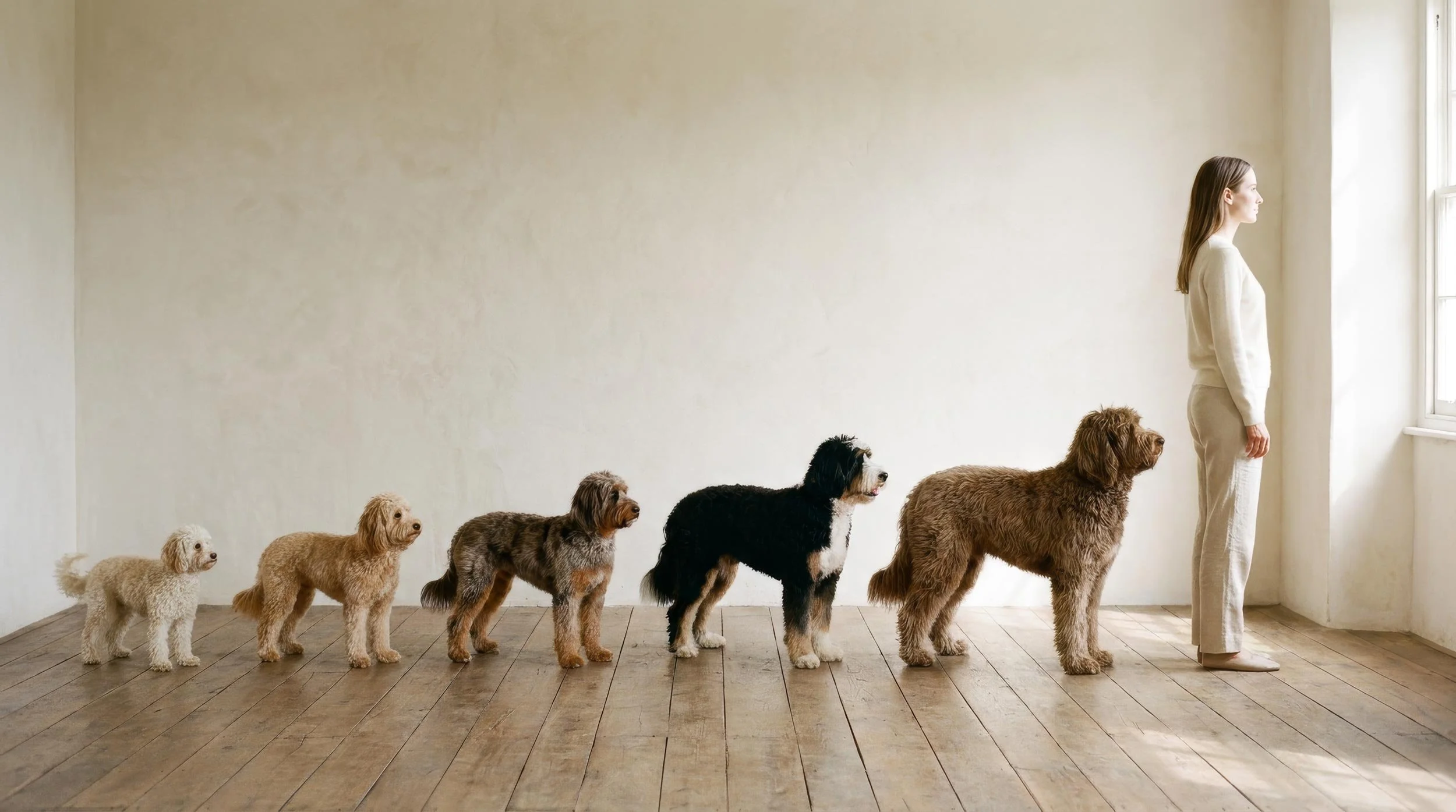
| Class | Typical adult weight | Height at withers | Common reference |
|---|---|---|---|
| Toy | up to 15 lb | under 13 in | coffee-table height |
| Petite | 16 to 25 lb | 12 to 15 in | side-table height |
| Mini | 26 to 35 lb | 14 to 17 in | couch-armrest height |
| Medium | 36 to 50 lb | 17 to 21 in | kitchen-counter underside |
| Standard | 51 lb and up (typically 70 to 90) | over 21 in | thigh-high on a 5′8″ adult |
Adult size is typical, not guaranteed. Adult weight is an estimate rather than a guarantee and may vary based on parentage, sex, generation, and individual development. In a first-generation cross both parents contribute equally, but because Poodles range from Toy to Standard, the Poodle parent’s size usually sets the class; as the share of non-Poodle ancestry rises, the size of that side counts for more. Individual puppies may finish 15 to 20 percent above or below the band.
Who sets doodle size standards.
If you have wondered why the same size word means different things at different breeders, this is why.
The Goldendoodle Association of North America (GANA) publishes a widely recognized doodle size standard, and it covers Goldendoodles only. For the Bernedoodle, Aussiedoodle, Australian Mountain Doodle, and Golden Mountain Doodle, no breed authority sets size classes, and terminology varies widely between breeders.
Stokeshire follows GANA for Goldendoodles and publishes this standard for the breeds GANA does not cover. Every Stokeshire litter announcement and placement description maps to the ladder above. For breed-specific detail, see Bernedoodle Sizes.
We are also compiling adult weights from Stokeshire dogs that have reached two years of age. We will publish them here, with sample sizes and method, once the sample is large enough to be meaningful.
Which classes each breed produces.
Each Stokeshire line covers a different part of the ladder. The Poodle parent, the generation, and the cross determine which classes a pairing can produce. Class availability in any year depends on the pairings we have planned.
Bernedoodle Sizes
A cross of Bernese Mountain Dog and Poodle, and the broadest size range of any breed we raise. Most Stokeshire Bernedoodle pairings target the Mini or Standard class. Ultra Bernedoodles have majority Bernese ancestry, and their size follows their parents rather than the label: our Mini Ultra pairings start with smaller Bernese and are planned to finish under 50 lb, while Ultras from full-size lines often finish Standard.
Petite is the size class; Munchkin is the program and line. Stokeshire’s Petite-range Bernedoodles come through our Munchkin Bernedoodle program, which adds Cavalier King Charles Spaniel heritage.
Goldendoodle Sizes
A cross of Golden Retriever and Poodle. For Goldendoodles, Stokeshire follows the GANA size standard, which sets each class by height at the withers. GANA’s Petite class is under 14 inches and typically 25 pounds or less, so it spans both the Toy and Petite bands above.
Follows the GANA size standardAussiedoodle Sizes
A cross of Miniature American Shepherd (or Australian Shepherd) and Poodle. Stokeshire focuses Aussiedoodle production on the Toy and Mini classes. The Petite class is available on an application-only basis from select pairings.
Australian Mountain Doodle Sizes
A multigenerational cross blending Bernese Mountain Dog, Australian Shepherd, and Poodle. Stokeshire breeds Australian Mountain Doodles from Toy through Standard.
Golden Mountain Doodle Sizes
A cross of Bernese Mountain Dog, Golden Retriever, and Poodle. The Stokeshire Golden Mountain Doodle line does not currently include Toy or Petite classes. Some Standard pairings are expected to produce adults above 70 or 90 pounds. That is an expected range, not a fourth class.
Ultra is an ancestry term, not a size.
Ultra is a breeder’s marketing term for a doodle whose ancestry is more than 50 percent non-Poodle. It describes the breeds behind a dog, not how large that dog will grow, which is why it is not a class on the ladder above.
Every puppy inherits half of its DNA from each parent, so its expected ancestry is the average of its parents’ ancestry. A doodle is Ultra when that expected share is more than 50 percent Bernese Mountain Dog, Golden Retriever, Australian Shepherd, or another non-Poodle breed, alone or combined.
The usual goal of an Ultra pairing is to reduce the Poodle’s influence while keeping the traits families prefer in the other breed: its frame, head, and overall look. The term is not a size class or a scientific classification, and breeders do not all define it the same way.
Expected ancestry by generation
| Generation | Pairing | Expected non-Poodle share |
|---|---|---|
| F1 | Non-Poodle breed × Poodle | 50% |
| F1B | F1 × Poodle | 25% |
| Reverse F1B | F1 × non-Poodle breed | 75% Ultra |
| Multigen, bred back | Multigenerational doodle × non-Poodle breed | about 55 to 75% Ultra |
These are expected values calculated from the pedigree. Beyond the F1, the doodle parent passes on a random half of its mixed DNA, so the share a puppy actually inherits, its realized ancestry, varies around the expected figure, and littermates can show different percentages on a breed-ancestry DNA test.
Reverse F1B, the classic Ultra
A Reverse F1B is a backcross: a first-generation (F1) doodle bred back to its non-Poodle parent breed. In a Bernedoodle, that is an F1 Bernedoodle bred to a Bernese Mountain Dog, for an expected 75 percent Bernese and 25 percent Poodle. The standard F1B runs the other way, back to the Poodle, for an expected 75 percent Poodle. Each further generation bred back to the same breed halves the remaining Poodle share again, from 25 to 12.5 percent.
Ultra is broader than Reverse F1B. It covers any pairing, multigenerational ones included, whose expected ancestry is more than half non-Poodle. Generation detail for Bernedoodles is in our Bernedoodle Generations guide.
What ancestry predicts, and what it does not
For most of the body traits studied across breeds, three or fewer genetic regions explain the majority of the variation. An Ultra carries mostly majority-breed DNA, so it usually looks more like that breed, but because a few genes have large effects, littermates can still differ.
Boyko et al., PLoS Biology, 2010When the other breed is the larger parent, as the Bernese is, more of its ancestry usually means a larger dog. Six genes with large effects, including IGF1 and GHR, explain roughly half of the variation in body size between breeds, but they mostly separate small breeds from large ones. Within a large breed such as the Bernese, the parents’ own size is the more reliable guide, which is why our Mini Ultra Bernedoodle pairings start with smaller Bernese: it keeps the Bernese share high while planning for an adult under 50 pounds.
Rimbault et al., Genome Research, 2013Variants in three genes, RSPO2 for furnishings (the beard and eyebrows), FGF5 for length, and KRT71 for curl, explain the coat type of 95 percent of the dogs sampled across 108 breeds, and a variant in MC5R is linked to reduced shedding. Furnishings are dominant and, in these crosses, come from the Poodle side, so a Reverse F1B from an F1 parent is expected to be about half unfurnished. If a multigenerational doodle parent carries two copies, every puppy inherits furnishings. We know both parents’ coat genes before a pairing is planned. See unfurnished doodles.
Cadieu et al., Science, 2009; Hayward et al., Nature Communications, 2016Ancestry shifts behavioral tendencies across a population, but it predicts little about one dog. In a study that genotyped 2,155 dogs and surveyed the owners of 18,385 dogs, breed explained about 9 percent of the variation in individual behavior. An Ultra may lean toward its majority breed, which is why every Stokeshire puppy completes an individual aptitude evaluation before Match Day.
Morrill et al., Science, 2022Where Ultras finish
Ultras from full-size lines, such as a full-size Bernese and a Standard Poodle, often finish in the Standard class, sometimes above 90 pounds. Ultras from smaller parents finish smaller. Our Mini Ultra Bernedoodles start with smaller Bernese and are planned to finish under 50 pounds. Adult weight is an estimate rather than a guarantee and may vary based on parentage, sex, generation, and individual development. Stokeshire does not breed for maximum size. For Ultra Bernedoodles in detail, see Bernedoodle Sizes.
- Boyko AR, et al. A simple genetic architecture underlies morphological variation in dogs. PLoS Biology, 2010.
- Cadieu E, et al. Coat variation in the domestic dog is governed by variants in three genes. Science, 2009.
- Hayward JJ, et al. Complex disease and phenotype mapping in the domestic dog. Nature Communications, 2016.
- Morrill K, et al. Ancestry-inclusive dog genomics challenges popular breed stereotypes. Science, 2022.
- Rimbault M, et al. Derived variants at six genes explain nearly half of size reduction in dog breeds. Genome Research, 2013.
- Embark Veterinary. Recombination explained: how littermates can look different. 2020.
Which size fits your home.
The right tier is rarely the one a family arrives wanting. It is the one their household actually accommodates. Match the household, not the photo.
Suits apartments, frequent travel, and homes with mobility considerations. Often fits an under-seat airline carrier. The easiest size to lift and to live with in a small footprint.
Anchor: coffee-table heightA typical Petite doodle matures under the 25-pound ceiling many condos and co-ops enforce. Adult size is not guaranteed, so we do not recommend choosing a Petite puppy to meet a strict weight rule without talking with your veterinarian and your building first.
Anchor: side-table heightThe most requested Stokeshire tier. Active families, urban professionals, suburban homes. Substantial enough for hiking and long walks, compact enough for travel and most living spaces.
Anchor: couch-armrest heightA larger-dog presence in a footprint most homes still accommodate. Families with children, larger homes, and outdoor lifestyles. Comfortable on a trail and on the couch.
Anchor: kitchen-counter undersideA substantial dog that needs room to move, a vehicle that fits a Standard crate, and a family comfortable with size. A confident family presence that needs daily activity and structure.
Anchor: thigh-high on a 5′8″ adultAn Ultra’s space, travel, and exercise needs follow the size class it finishes in, not its ancestry. Choose the class that fits your home first, then decide how much Bernese, Golden, or Australian Shepherd influence you want.
What Ultra meansAirline cabin eligibility.
Cabin eligibility depends on how big a dog is on the day it flies, not on its adult class. Most U.S. airlines no longer set a weight limit for cabin pets, but the dog must fit in a carrier that goes under the seat in front of you, so the carrier is the practical limit.
At 8 weeks, most puppies are still small enough for an under-seat carrier, Standards included: even a Standard puppy usually weighs about 10 to 20 pounds at that age. Stokeshire puppies fly home in the cabin with a Stokeshire handler, never as cargo, and are handed to you at your airport. A puppy too large for the cabin travels by ground delivery or a custom hand-delivery route, quoted individually. We quote your route before you commit. Delivery options.
Once grown, cabin travel is realistic only for Toy doodles and the smallest Petites. Larger adults travel by ground or with a pet transport service. Airline rules, including minimum age and carrier size, vary and change, so confirm before booking.
| Class | Typical adult weight | Cabin eligibility as an adult |
|---|---|---|
| Toy | up to 15 lb | In-cabin eligible on most airlines |
| Petite | 16 to 25 lb | Possible at the lower end if the dog fits an under-seat carrier; airline-specific |
| Mini | 26 to 35 lb | Too large for most under-seat carriers |
| Medium | 36 to 50 lb | Ground travel or a pet transport service |
| Standard | 51 lb and up | Ground travel or a pet transport service |
Sizing questions families ask first.
How big does a Mini doodle get?
Under the Stokeshire Doodle Size Standard, a Mini doodle typically matures between 26 and 35 pounds and stands 14 to 17 inches at the withers, the top of the shoulder. Under this standard the Mini band is the same for every breed we raise: Bernedoodle, Goldendoodle, Aussiedoodle, Australian Mountain Doodle, and Golden Mountain Doodle. Adult weight is an estimate rather than a guarantee and may vary based on parentage, sex, generation, and individual development; individual puppies may finish 15 to 20 percent above or below the band. For breed-specific growth timelines, see Bernedoodle Sizes.
What is the difference between a Toy and a Petite doodle?
A Toy doodle typically matures up to 15 pounds and under 13 inches at the withers. A Petite doodle typically matures between 16 and 25 pounds and 12 to 15 inches. The heights overlap, but a Petite carries noticeably more body weight and a sturdier frame, which can make it less fragile around young children. Toy is the lap-and-carry tier; Petite is the lap-and-couch tier. In Bernedoodles, Stokeshire’s Petite-range dogs come through our Munchkin Bernedoodle program. As with every class, adult size is typical, not guaranteed.
What determines a doodle’s adult size?
Both parents, and the size genes each one passes on. In a first-generation cross both parents contribute equally, but because Poodles range from Toy to Standard, the Poodle parent’s size usually sets the class: a Toy or Miniature Poodle parent tends to produce a smaller class, and a Standard Poodle parent a larger one. As the share of non-Poodle ancestry rises, as it does in an Ultra, the size of that side counts for more. Six genes with large effects, including IGF1, explain roughly half of the variation in body size between breeds, mostly separating small breeds from large ones, and because each puppy inherits a random half of each parent’s variants, littermates can finish at different sizes. Sex matters too: females tend toward the lower end of a band, males toward the upper. Adult weight is an estimate rather than a guarantee. During growth, feed to body condition rather than the bag chart and keep your puppy lean.
Can a doodle live in an apartment?
Yes, with the right class and a daily routine. Toy and Petite doodles generally suit apartments and condos. A Mini can work in a larger apartment with a committed exercise plan. Medium and Standard dogs need substantially more living space and a daily activity routine to settle well indoors. If a building enforces a weight limit, the Petite class is typically the largest that conforms to a 25-pound ceiling. Because adult size is typical and not guaranteed, we recommend talking with your veterinarian and your building before choosing a puppy for a strict weight rule.
Can doodles fly in-cabin on an airplane?
As puppies, usually; as adults, only the small classes. Most U.S. airlines no longer set a weight limit for cabin pets, but the dog must fit in a carrier under the seat in front of you. At 8 weeks, most puppies still fit, Standards included, which is how Stokeshire puppies fly home in the cabin with a Stokeshire handler, never as cargo; a puppy too large for the cabin travels by ground delivery or a custom hand-delivery route. As adults, Toy doodles generally fit and some Petites at the lower end may, depending on the airline. Mini, Medium, and Standard adults typically travel by ground or with a pet transport service. Airline rules, including minimum age and carrier size, vary and change, so confirm directly before you book.
Is a smaller doodle healthier?
Not necessarily. Larger dogs tend to live shorter lives on average, but health outcomes depend more on the parent dogs’ health screening, the breeder’s protocols, and ongoing care than on size class. Very small dogs carry their own concerns, including dental crowding, fragile bones, and difficulty regulating body temperature, which is why Stokeshire does not endorse extreme miniaturization. Selecting for the smallest possible size can compromise structural soundness. Talk with your veterinarian about size selection, especially if anyone in your household has health considerations that affect the choice.
What is the lifespan of a Stokeshire doodle?
The typical lifespan for most Stokeshire doodles is 12 to 15 years with good care. Smaller classes tend toward the longer end of that range and larger classes toward the shorter end, and the largest dogs, such as Bernedoodles that finish above 90 pounds, tend to run shorter still. No lifespan is guaranteed. Parent health screening lowers some inherited risks, and the choices families make over a lifetime matter just as much: keeping the dog lean, routine veterinary care, dental care, and daily activity suited to the dog’s age and size.
Is Ultra a doodle size?
No. Ultra is a breeder’s marketing term for ancestry, not a size class. It describes a doodle whose expected ancestry is more than 50 percent non-Poodle. The classic example is a Reverse F1B, an F1 doodle bred back to its non-Poodle parent breed for an expected 75 percent of that breed. When that breed is larger than the Poodle, as the Bernese is, more of its ancestry usually means a larger dog, but adult size depends on the size of the parents: Ultras from full-size lines often finish in the Standard class, sometimes above 90 pounds, while our Mini Ultra Bernedoodles start with smaller Bernese and are planned to finish under 50 pounds. See what Ultra means, or Bernedoodle Sizes for Ultra Bernedoodles.
Found a class that fits?
Three paths into a Stokeshire placement. Each one maps to the standard on this page.
Heights are measured at the withers. Weight bands reflect typical adult ranges across Stokeshire breeding lines, and individual puppies may finish 15 to 20 percent above or below. Adult size is an estimate, not a guarantee. The signed Purchase Agreement governs. Full terms on the Legal page.