Observe
Temperament, energy, recovery, motivation and the family goals already known from matching guide the trainer's priorities.

A private, 28-day developmental residency for Stokeshire puppies, guided by an adult professional training team and documented through the Stokeshire Method™ and Companion™.
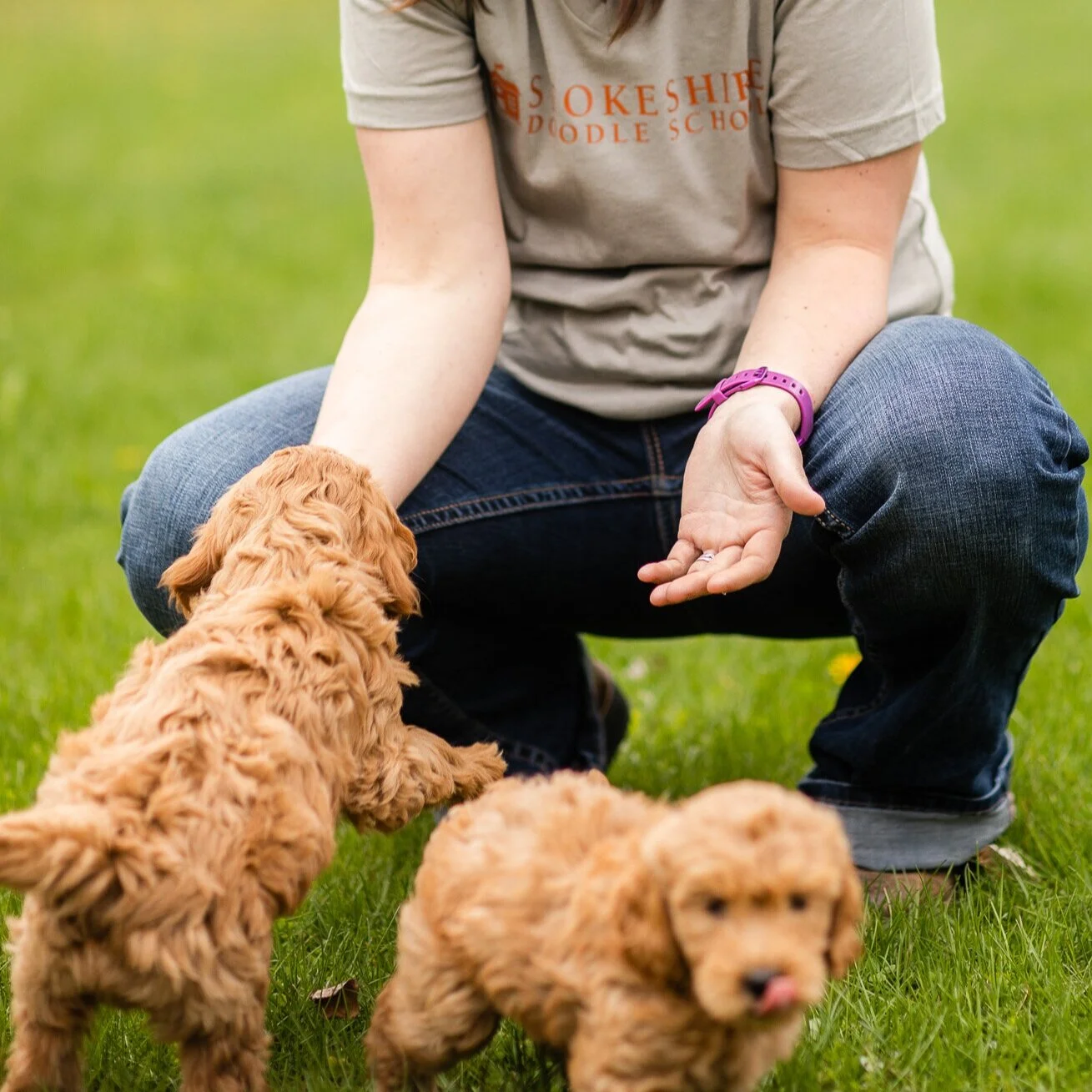
Not kennel boarding. Not a volume cohort. A four-week developmental residency inside the daily life of an adult Stokeshire trainer.
Stokeshire Doodle School™ has run continuously since December 2020: a breeder-run puppy school, in a trainer's home, from eight weeks.
Private in-home board & train. Not kennel boarding with puppies pulled out for scheduled group sessions. Meals, naps, crate time, visitors, grooming, play, outings and evenings become the curriculum.
Doodle School is residential. Your puppy lives with an approved Stokeshire trainer in Wisconsin rather than being housed in a kennel and pulled out only for scheduled group sessions.
Each trainer home hosts a small cohort of Doodle School puppies. Capacity is deliberately limited so each puppy is observed, handled and trained as an individual.
Doodle School placements are led by the adult training team. Children are part of the natural household environment in which Stokeshire puppies are raised; they are not substitutes for the puppy's assigned professional trainer.
Twelve-week-old puppies are still puppies. We establish rhythms, associations, confidence and early skills that your family continues after homecoming.
Doodle School does not skip the puppy stage. It gives those first weeks structure. The goal is to send home a puppy whose earliest routines have already been practiced in a real household with a trainer.
Doodle School is not a list of commands sold as a finished dog. It is a documented developmental system: evaluate the puppy, shape daily life, observe the response, record the work, and transfer the same framework to the family.
Temperament, energy, recovery, motivation and the family goals already known from matching guide the trainer's priorities.
Short training blocks are integrated with meals, rest, crate work, handling, play, socialization and household routines.
Training records, milestone assessments, photos, video and trainer observations live in Stokeshire Companion.
Graduation is a handoff, not a finish line. Your family receives the routines and priorities needed to continue the work at home.
The first week earns trust. The second makes the day predictable. The third makes skills more visible. The fourth prepares the puppy and family to continue together. The pace changes with the individual puppy.
The trainer establishes safety, attachment and a repeatable daily rhythm. Crate introduction, potty timing, sleep, handling and calm engagement begin here.
Predictability becomes the teaching tool. Socialization expands through carefully selected surfaces, sounds, people, vehicles and environments while early leash and cue work begins.
Short sessions introduce and reinforce age-appropriate foundations such as Sit, Come, Down, Kennel and Wait. Grooming and vet-style handling continue as routine rather than an event.
The trainer reinforces routines in varied contexts, finalizes progress documentation and prepares the family for the first 48–72 hours, the first week and the weeks that follow.
The training team combines canine behavior education, puppy-development leadership, animal-science education and clinical communication. We describe each person's actual background rather than implying that every professional holds the same credential.
Katie leads puppy development and training across Stokeshire. Since 2020 she has overseen litters from whelping through go-home, including early neurological stimulation, socialization, Doodle School™, Bootcamp™ and family handoff.
Her role creates continuity: the puppy's earliest developmental history does not disappear when formal training begins.
Karlee trained at Highland Canine School for Dog Trainers in its Obedience and Behavior Modification Program and is a Certified Professional Pet Dog Trainer based in Medford.
She works with Stokeshire families after Doodle School and beyond, helping owners understand the dog in front of them and continue building reliable, relationship-centered behavior.

Korby leads Bootcamp™ intake, daily training, family updates and handoff. A speech-language pathologist by profession, trained at the University of South Dakota, she brings a clinician's habit of clear goals and documented progress to puppy work.
That mindset fits the larger Stokeshire standard: observe what is happening, define what comes next and communicate it clearly to the family.
Lisa brings more than a decade of animal-science education to the team. She has served as an agriculture educator and FFA advisor at Medford Area Senior High School since 2014 and holds a B.S. in Agricultural Education from the University of Wisconsin–River Falls.
Her training philosophy mirrors good teaching: read the individual, find what motivates them, create structure, reinforce success and build confidence without forcing the learner past their threshold.

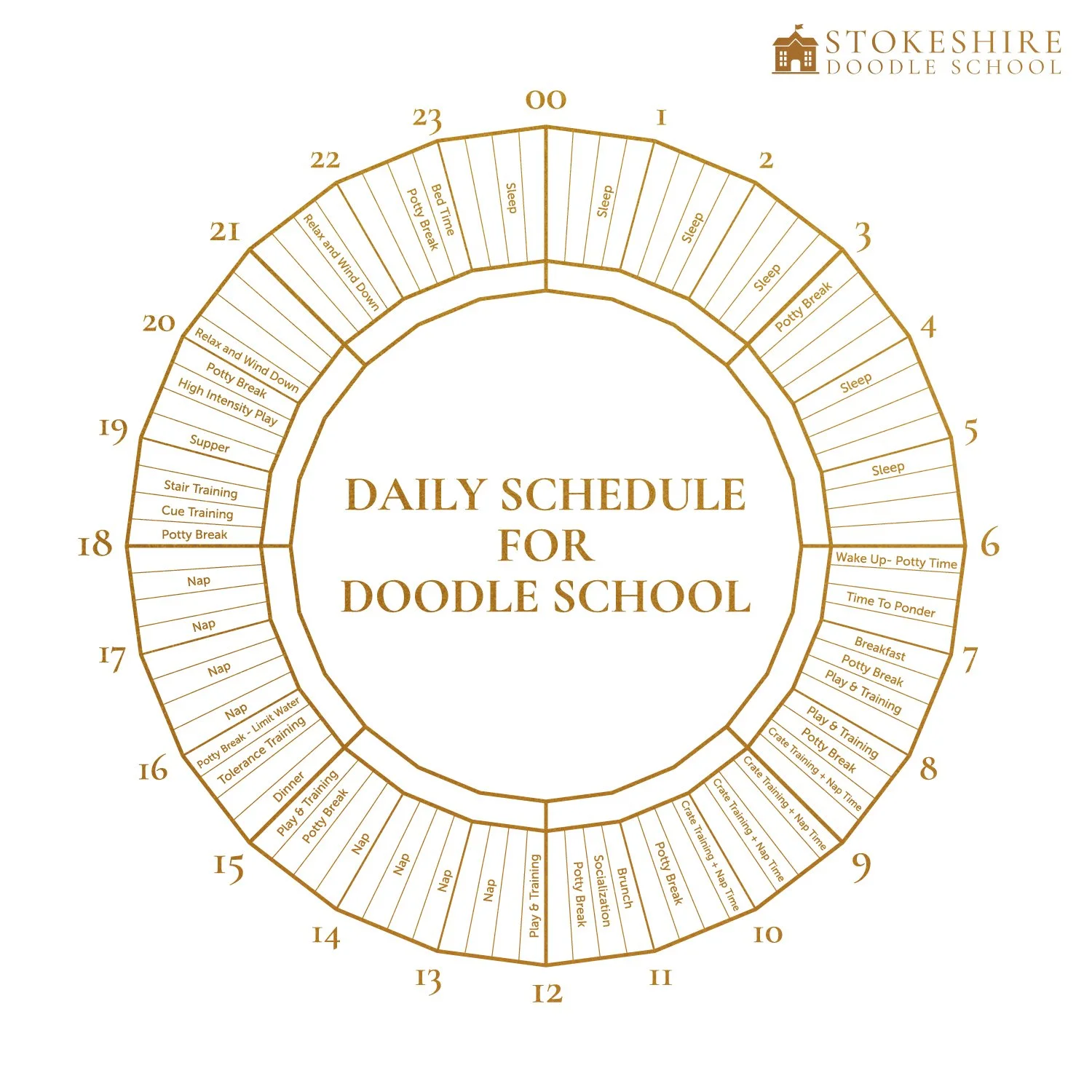
The residential model matters because the puppy's entire day can become coherent. A cue practiced for three minutes is useful. A calm household rhythm practiced all day is transformative.
The day begins with the same predictable destination and routine.
Food, attention and simple interaction become part of relationship-building and regulation.
Age-appropriate cues and foundations are practiced in minutes, not marathon sessions.
Rest is protected as part of development, not treated as time away from training.
Toys, simple problems and supervised play build curiosity without constant overstimulation.
Novelty is selected and calibrated to the puppy's current threshold.
Calm evening routines rehearse the kind of household pattern the family can continue at home.
Luxury care should not require blind trust. Companion gives enrolled families a structured window into the work: daily training activity, milestone assessments, photos and video, and go-home preparation.
Instead of reducing four weeks to a handful of update texts, Companion becomes the developmental record that connects trainer observation to the family's next step.
See which training blocks and developmental activities were recorded.
Track progress against a consistent written framework rather than adjectives alone.
Visual updates are associated with the puppy's actual training period.
Schedules, setup and continuation priorities become part of the transition.
Stokeshire's therapy-informed framework emphasizes confidence without flooding, recovery after novelty, human connection, handling tolerance, settling and appropriate arousal. For a small number of appropriately matched prospects, those priorities can be extended into a Therapy Track.
The goal is not to make every puppy a therapy dog. The goal is to use developmentally thoughtful practices that also matter in excellent family companions.
When aptitude, family goals and trainer capacity align, the program can emphasize foundations relevant to future therapy-oriented work.
Therapy Track is developmental preparation, not therapy-dog certification, and it does not assure future qualification. Formal therapy work requires later training, maturity and the standards of the certifying organization.
The most important transition is not trainer to puppy. It is trainer to family. Graduation gives you the language, routine and priorities that allow the work to survive the move home.
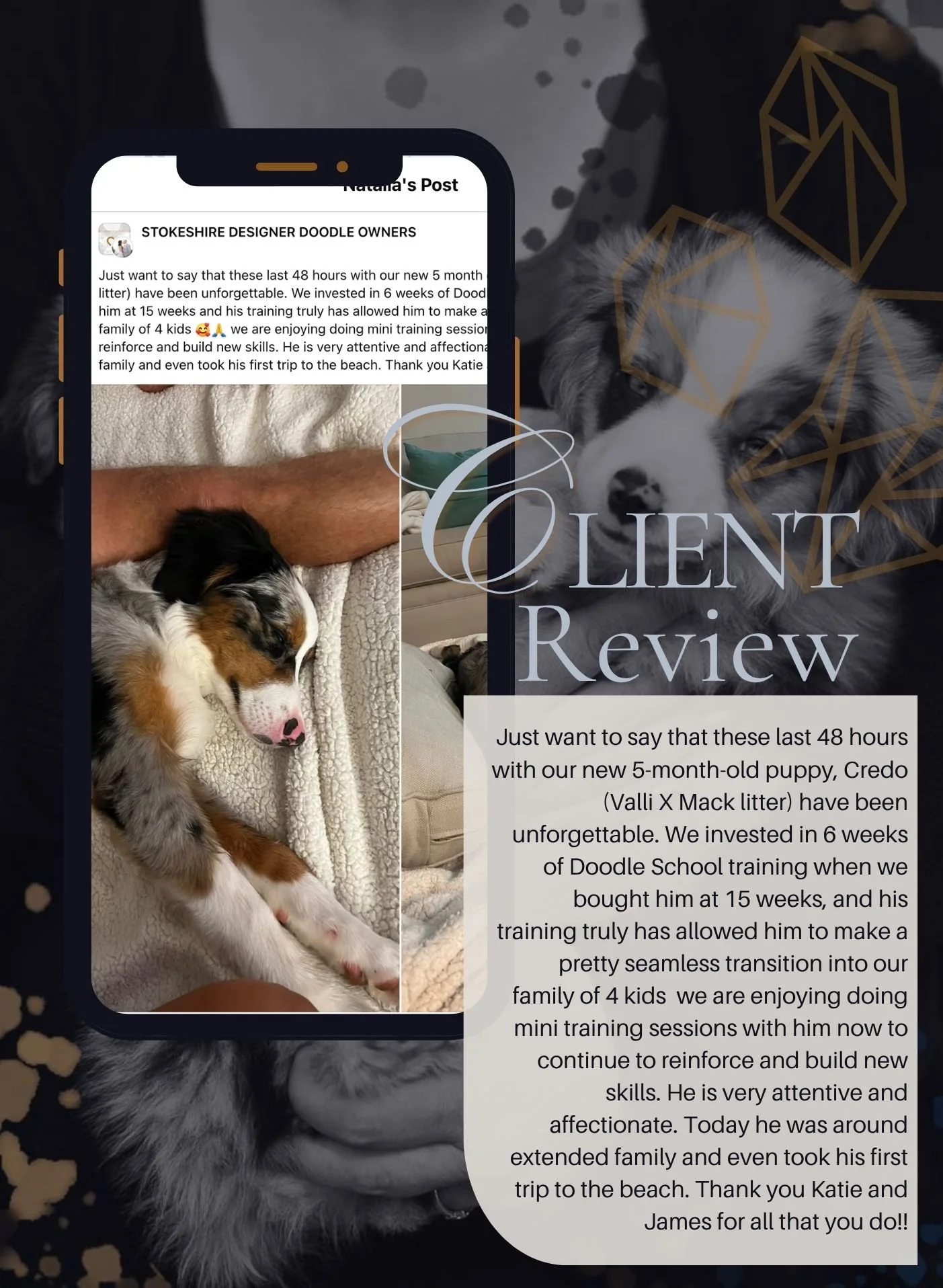
A beautiful training video matters less than what happens after the puppy crosses your threshold. The reviews we prioritize here describe the parts families actually live with: transition, crate comfort, confidence, education and continued training.
“Wonderful experience from start to finish. We did have our mini Bernedoodle go through Bootcamp and 4 weeks of Doodle School with Karlee, which was very helpful. She did a fantastic job.”Elizabeth Z.Zara's Family · Doodle School™
“His early training made a huge difference. He sleeps through the night, goes to his crate without a bribe, and has adjusted so well to our home.”Michelle BaileyWinston's Mom · Mini Bernedoodle
“Fantastic experience from start to finish. Stokeshire went above and beyond to support us in raising a future therapy dog.”Elaina P.Mobile Therapy Centers of Illinois
Doodle School tuition is added to the puppy's placement price and confirmed at Match Day after matching. Trainer capacity is reserved in advance and availability is intentionally limited.
The 28-day program includes professional in-home care, structured training, socialization and developmental exposures, grooming and handling work, Companion access, progress documentation and the graduation handoff.