One gene. Two mutations.
Both must be tested.
Degenerative myelopathy is caused by a mutation that makes the SOD1 protein misfold and accumulate inside nerve cells — not, as is widely repeated, by a loss of the enzyme. Two mutations of that gene matter, and one copy of each counts as two.
Degenerative myelopathy (DM) is a progressive, incurable spinal cord disease in adult dogs, closely comparable to ALS in people. It is caused by a mutation in the SOD1 gene that makes the SOD1 protein misfold and accumulate inside nerve cells.
SOD1A (c.118G>A) is found across more than 120 breeds. SOD1B (c.52A>T) has been identified only in Bernese Mountain Dogs and their descendants. A dog needs two mutated copies to be at risk — and one copy of each variant counts as two.
The gap most breeders miss: the most widely used breeder DNA platform tests SOD1A only. A “DM clear” result from a SOD1A-only panel does not clear a Bernese-influenced dog for SOD1B.
Family view keeps the focus on what these results mean for your dog. Switch to breeder view for pairing arithmetic, laboratory reference, and the population-genetics rationale.
Protein misfolding,
not enzyme deficiency.
The SOD1 gene instructs the body to build superoxide dismutase 1, a copper-zinc enzyme that helps neutralize reactive oxygen species. Because that is the enzyme's job, a reasonable-sounding explanation circulated for years and now appears on hundreds of breeder and testing-laboratory pages: the mutation breaks the enzyme, free radicals accumulate, nerves die.
That explanation is incorrect, and it appeared on earlier versions of this page. We corrected it.
Biochemical characterization of both canine mutants found that the mutated proteins still form enzymatically active dimers — evidence against loss of function — and instead show a markedly increased tendency to aggregate inside cells (Crisp et al., 2013). Later work confirmed that neither mutation meaningfully reduces enzyme activity or overall protein stability, but both promote the formation of fibrous aggregates (Kimura et al., 2020).
The accurate mechanism. The mutation causes SOD1 protein to misfold and clump into toxic deposits within motor neurons and supporting cells of the spinal cord. The damage comes from what the malformed protein does, not from what the enzyme fails to do. This is the same mechanism at work in SOD1-associated ALS in humans, which is why canine DM is the only naturally occurring non-human model of that disease.
Two variants.
One gene.
A point worth stating plainly, because much of the internet gets it wrong: SOD1B is not a separate gene. SOD1A and SOD1B are two different mutations within the same SOD1 gene. Laboratories use the A and B shorthand, and some use “exon 2” and “exon 1” instead. There is one gene, and every dog carries two copies of it.
The original and far more widespread mutation, identified through genome-wide association analysis at the University of Missouri (Awano et al., 2009).
A survey of 33,747 dogs found this variant in 124 of 222 breeds surveyed, plus mixed-breed dogs (Zeng et al., 2014). It is old, it is common, and it moved across the breed map as modern breeds were established.
Poodles, Golden Retrievers, Australian Shepherds, Miniature American Shepherds, and Bernese Mountain Dogs all carry it — every founding breed behind our program.
First reported in a Bernese Mountain Dog whose motor neurons showed the same protein aggregates seen in SOD1A-affected dogs (Wininger et al., 2011).
In that same 33,747-dog survey, the SOD1B allele appeared only in Bernese Mountain Dogs — not even in the closely related Greater Swiss Mountain Dog. It arose recently, almost certainly in a single Berner, and spread through that dog's descendants.
It is also the less common of the two within the breed. One testing laboratory reports detecting SOD1B in roughly 3% of Bernese Mountain Dogs tested, against roughly 38% for SOD1A.
Why one copy of each
counts as two.
DM is recessive. One mutated copy makes a dog a carrier; two make it at risk. The intuitive assumption is that a dog carrying one SOD1A copy and one SOD1B copy is simply a carrier twice over — genetically inconvenient, but not at risk.
That assumption is wrong.
The two mutations have never been observed on the same chromosome. Haplotype analysis of 408 Bernese Mountain Dogs found no chromosome carrying both mutated alleles (Pfahler et al., 2014). So a dog carrying one of each almost certainly has one mutation on each copy of the gene — meaning it has no unaffected copy of SOD1 at all. It is functionally equivalent to a dog homozygous for either mutation. Geneticists call this a compound heterozygote.
In that same study of 408 Berners, 22 dogs (5.4%) were compound heterozygous, and one of them showed clinical signs of DM. The authors concluded that compound heterozygosity may carry risk comparable to being homozygous for SOD1A.
An honest limitation. The clinical evidence here rests on a small number of documented cases rather than a large case series. The genetic logic is sound and breed clubs treat compound heterozygotes as at risk — a position we share and apply — but the underlying clinical dataset is thinner than the confident phrasing found on most websites suggests.
One further practical note from the laboratories: when a dog tests as a carrier for both mutations, the lab cannot determine from that dog's sample alone whether the two mutations sit on separate copies or the same copy. Resolving it requires testing parents or littermates. Because no same-copy configuration has ever been documented, the responsible default is to treat any double carrier as at risk.
Two parents whose reports both read “carrier” can produce puppies at risk for DM. That is the entire argument for testing both variants.
Set both parents.
See the litter.
This is the same arithmetic we run before every pairing, opened up so you can test any combination. Each dog carries two copies of the SOD1 gene, and each copy is normal, SOD1A, or SOD1B. Each parent passes one copy at random.
The combination worth trying first is a SOD1A carrier bred to a SOD1B carrier. Neither parent is at risk. Both reports read “carrier.”
Note the last option. “Clear for SOD1A, SOD1B not tested” is the result a SOD1A-only panel produces. It is the most common real-world state for a Bernese-influenced dog, and it is why the calculator cannot always answer.
Mendelian expectation, not a guarantee. These are the probabilities for each individual puppy, not a promise about how a specific litter will divide. A four-puppy litter will rarely land exactly on the percentages.
What this means
for doodles.
A claim circulates widely in the doodle market: crossbreeding produces hybrid vigor, and hybrid vigor eliminates genetic disease. It does not, and DM is the cleanest illustration of why.
Crossing two breeds that both carry a recessive mutation does not remove the mutation. It only changes the odds that two mutated copies meet. The alleles travel with the dogs. Large-scale screening of roughly 83,000 mixed-breed and 18,000 purebred dogs found mixed-breed dogs less likely to be affected by the recessive disorders evaluated — but carrying the mutations at comparable rates (Donner et al., 2018). Carriers pass mutations forward. Multigenerational breeding concentrates what the founders carried; it does not dilute it away.
BernedoodleA + B
Bernese × Poodle. Both parent breeds carry SOD1A; the Bernese side may also carry SOD1B. This is the cross where the compound heterozygote scenario is most likely to appear.
Golden Mountain DoodleA + B
Golden Retriever × Bernese × Poodle. Three founding breeds, all carrying SOD1A, with SOD1B entering from the Bernese line.
Australian Mountain DoodleA + B
Australian Shepherd or Miniature American Shepherd × Bernese × Poodle. Aussie lines carry SOD1A at meaningful frequency, combined with both Bernese variants.
Australian Mountain DogA + B
Unfurnished Bernese-influenced lines. Same SOD1A and SOD1B exposure as the doodle crosses that share their ancestry.
AussiedoodleA only
Australian Shepherd × Poodle. SOD1A risk from both sides of the cross. No SOD1B exposure, since neither breed has Bernese ancestry.
GoldendoodleA only
Golden Retriever × Poodle. SOD1A risk from both sides. No SOD1B exposure. A SOD1A-only panel is genetically complete for this cross.
Which laboratories
cover which variant.
This is where assumptions cost the most.
| Laboratory | SOD1A | SOD1B |
|---|---|---|
| Embark | Yes | No |
| Paw Print Genetics | Yes | Yes |
| GenSol Diagnostics | Yes | Yes |
| Animal Genetics | Yes | Yes |
| Genomia | Yes | Yes |
| Antagene | Yes | Yes |
| UC Davis VGL | Yes | No |
| Wisdom Panel | Yes | No |
Panels change. Confirm current coverage with the laboratory before relying on a result. Verified July 2026.
Embark is the most widely used platform in the breeding community, and its own published breed guidance states directly that while it tests the SOD1A variant, it does not test the SOD1B (Bernese Mountain Dog type) variant, and that its degenerative myelopathy results apply only to SOD1A.
Read that again in practical terms. A Bernese Mountain Dog, Bernedoodle, Golden Mountain Doodle, or Australian Mountain Doodle showing “DM — Clear” on an Embark report has been cleared for SOD1A. Its SOD1B status is unknown. If you are evaluating a breeder's health testing and see only a SOD1A-capable panel behind a Bernese-influenced litter, the genetic picture is incomplete — and it is a fair, reasonable question to ask.
Reading your results
Laboratories use inconsistent terminology for identical genotypes, which causes avoidable alarm.
| Genotype | Also reported as | Meaning |
|---|---|---|
| Two normal copies | Clear, Normal, N/N | Cannot develop DM from this variant and cannot pass it on. |
| One mutated copy | Carrier, N/DM, heterozygous | Very unlikely to develop DM. Passes the mutation to about half of offspring. |
| Two mutated copies | At Risk, Affected, DM/DM | Elevated lifetime risk of developing DM. Passes the mutation to all offspring. |
A carrier is a healthy dog. Carriers make excellent family companions and, bred correctly, excellent breeding dogs.
What “at risk” honestly means
Laboratories report the two-copy genotype as at risk rather than affected, and the distinction is deliberate.
DM shows age-related incomplete penetrance. Not every dog with two mutated copies develops clinical disease — some die of unrelated causes first, and the disease may progress too slowly to surface within a normal lifespan. Penetrance appears to climb steeply with age.
There is also a small, real exception in the other direction. In the 33,747-dog survey, eight dogs with histologically confirmed DM carried only one copy of SOD1A with no other identified SOD1 coding variant (Zeng et al., 2014). The authors still concluded that two-copy dogs face far higher risk than carriers, but “carrier” does not mean zero risk forever.
A genetic test measures risk. It is not a diagnosis and not a prophecy. Discuss any result with your veterinarian in the context of your individual dog.
When the second test is unnecessary
If a dog already tests at risk for SOD1A — two copies — it is already at risk, and adding a SOD1B test does not change that dog's own status.
The second test matters for dogs that test clear or carrier for SOD1A, because those are the dogs whose true genetic picture is still open. A SOD1A-clear Bernese could still be a SOD1B carrier or, rarely, SOD1B at risk.
Single-variant pairing arithmetic
Outcomes within one variant. The calculator above handles the cross-variant cases, which are the ones most often missed.
| Pairing | Clear | Carrier | At Risk |
|---|---|---|---|
| Clear × Clear | 100% | 0% | 0% |
| Carrier × Clear | 50% | 50% | 0% |
| Clear × At Risk | 0% | 100% | 0% |
| Carrier × Carrier | 25% | 50% | 25% |
| Carrier × At Risk | 0% | 50% | 50% |
| At Risk × At Risk | 0% | 0% | 100% |
Why we do not simply remove every carrier
Eliminating all carriers from a breeding population shrinks the gene pool and, in breeds where the SOD1A allele is common, risks concentrating other problems while chasing one.
Breed clubs, the Orthopedic Foundation for Animals, and population geneticists consistently recommend the same approach: breed carriers to clear dogs, never carrier to carrier, and treat DM as one factor within a complete health picture rather than a single-gene verdict.
The Bernese Mountain Dog Club of America includes DM among its core recommended health screenings. The prevailing breed guidance is that at least one parent must be clear for both SOD1A and SOD1B. When that condition is met, no puppy in the litter can be at risk for DM.
What we test,
and what we will not say.
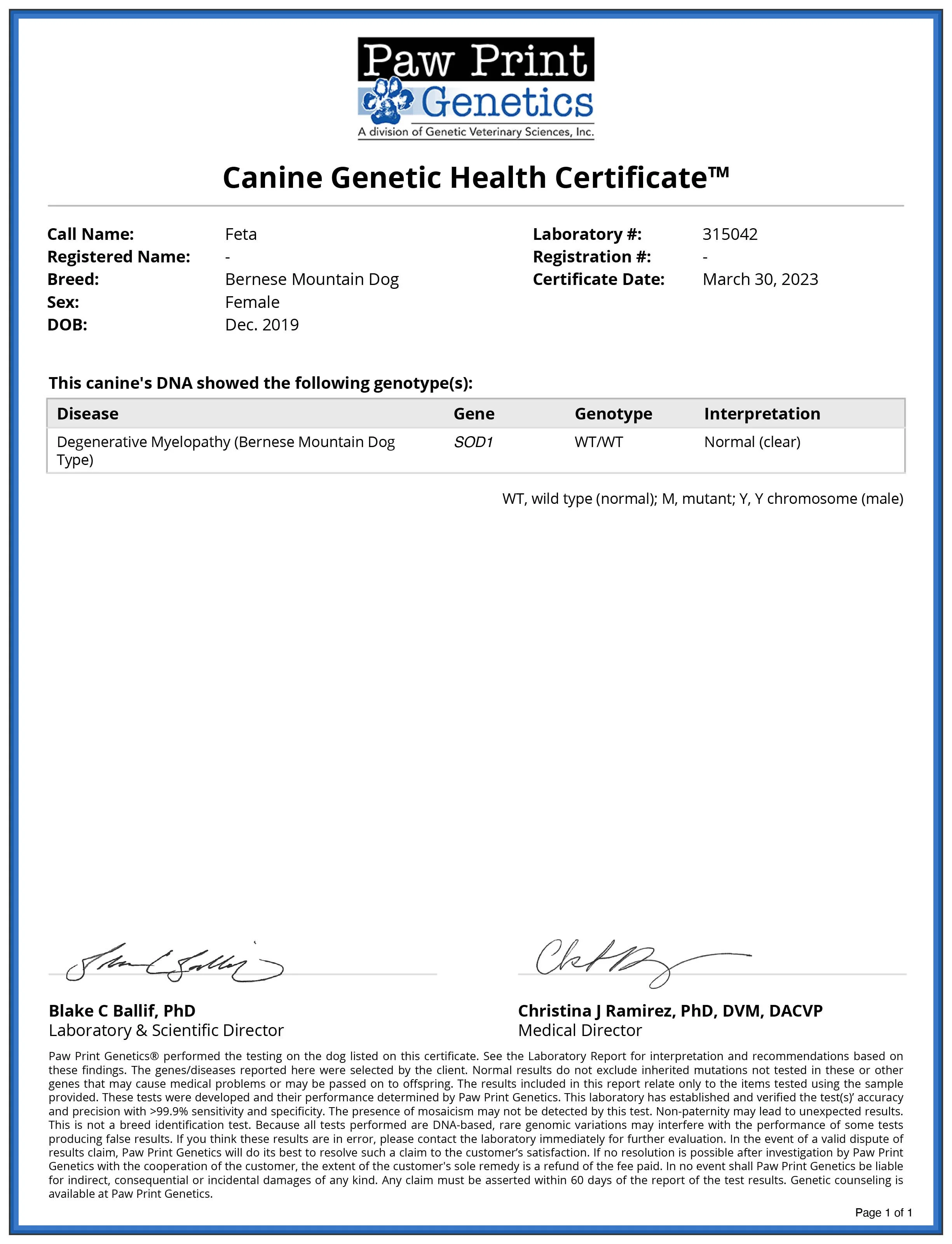
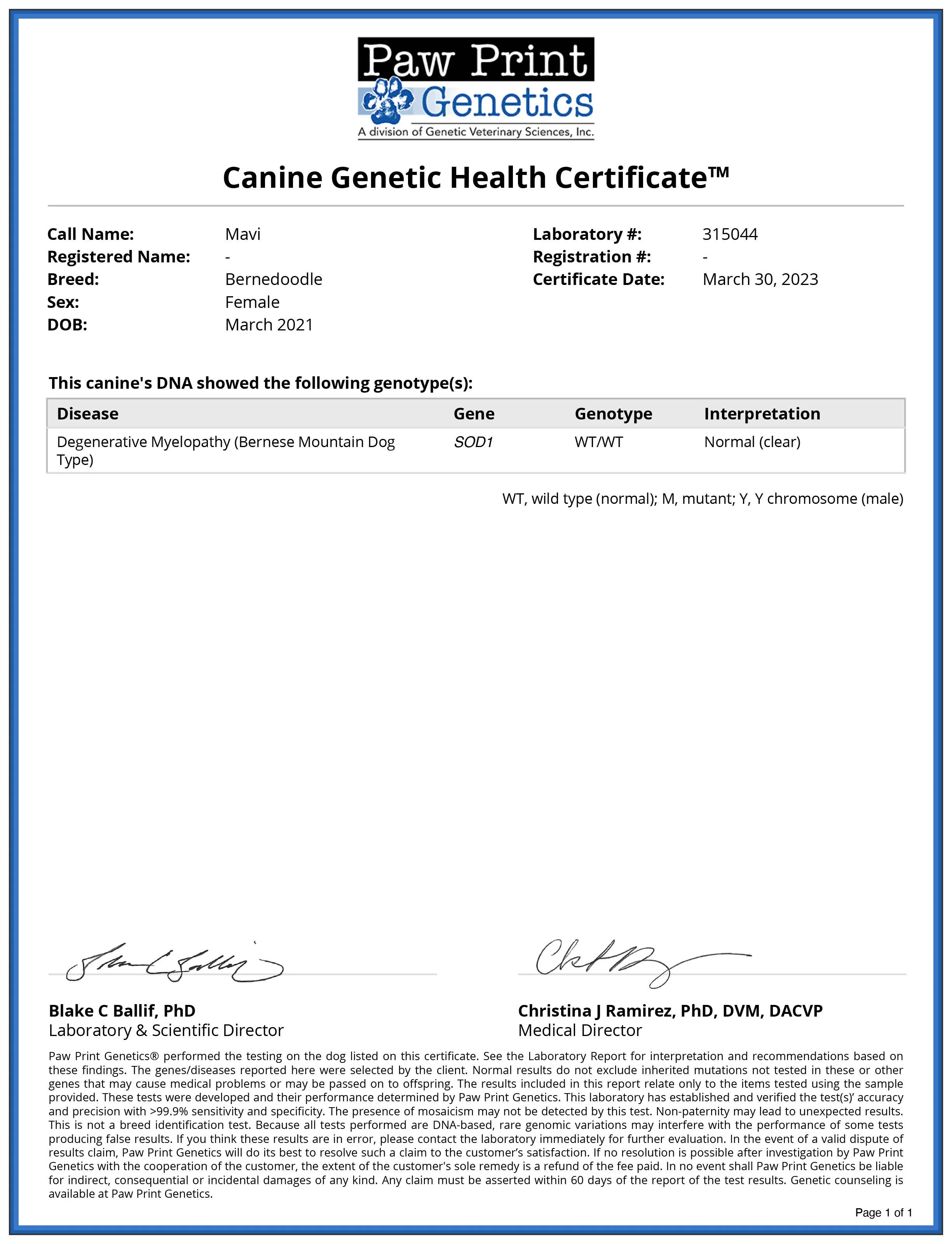
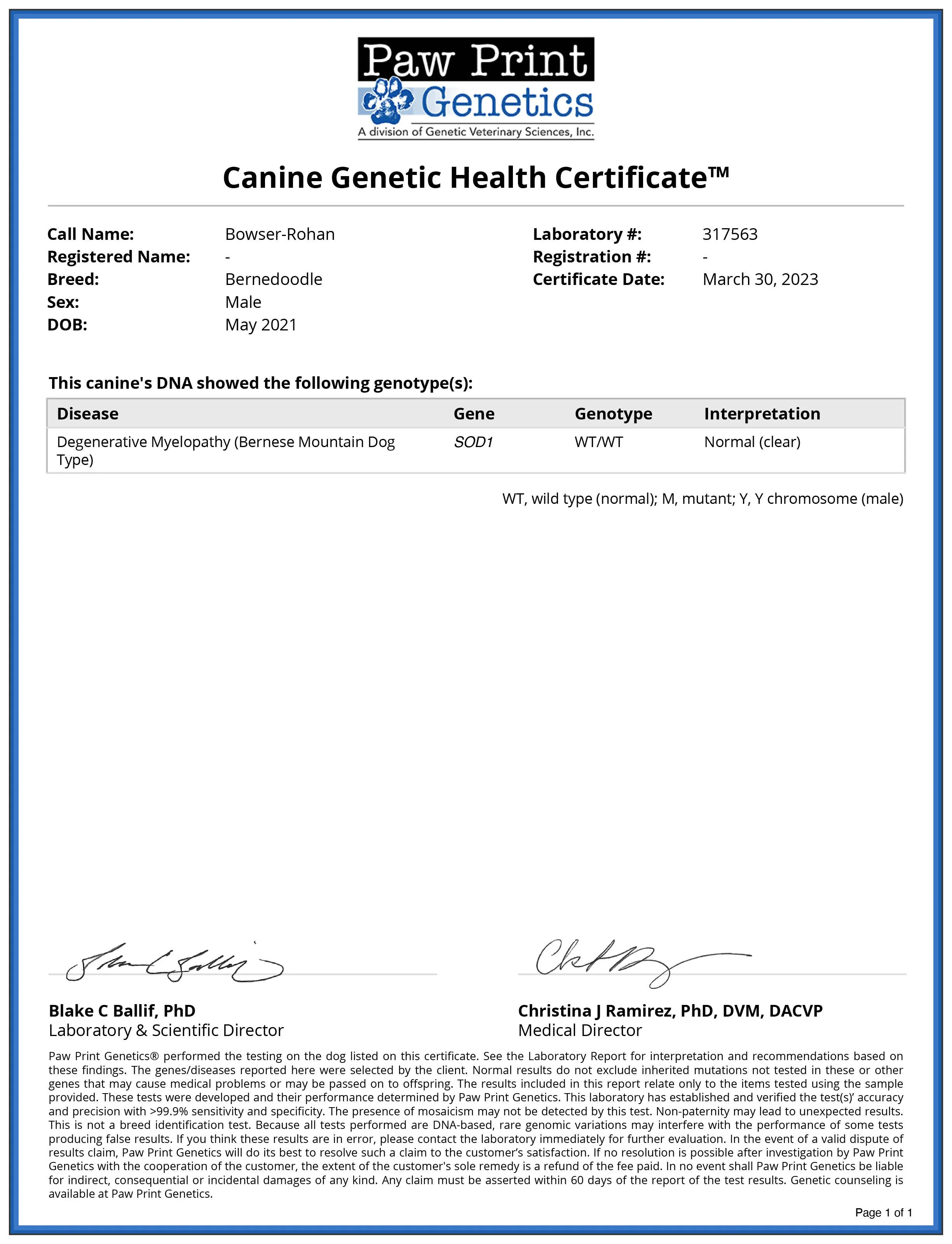
Every Stokeshire breeding dog is DNA tested, and our published panel includes both degenerative myelopathy variants — SOD1A and SOD1B, Bernese Mountain Dog type. Review the full panel on our health and DNA testing page.
We pair so that at least one parent is clear for both variants. Individual results are published on each dog's profile under our dogs, so families can verify rather than take our word for it.
That standard allows one specific statement: no Stokeshire litter is planned in a way that can produce a puppy at risk for degenerative myelopathy. It does not allow several other statements, which we do not make.
Carriers exist in our program, as they do in every honest program. A carrier is a healthy dog, and removing every carrier would damage the genetic diversity we work to protect.
Genetic testing identifies known variants. It cannot account for variants not yet discovered, and it cannot exclude conditions unrelated to SOD1.
What we will say is what the testing actually supports — the same standard we hold across our method and our health guarantee.
Course, diagnosis,
and care.
Onset is typically eight years of age or older, with a mean near nine years in large breeds (Coates & Wininger, 2010). The first changes are usually subtle — a scuffed toenail, a foot that knuckles under, a slight sway when turning on a smooth floor — and are frequently attributed to arthritis in an aging dog.
DM is not painful. That matters more than it sounds. A dog with DM often stays bright, hungry, and eager to go, which makes the decisions ahead of the family harder rather than easier.
The four stages
Stage one. Asymmetric hind-limb weakness and loss of coordination. A dragging or knuckling rear paw, worn toenails, difficulty on smooth flooring, a wobble when turning. Reflexes remain normal or exaggerated.
Stage two. Progression to non-ambulatory weakness and then hind-limb paraplegia, with visible muscle loss and, often, loss of urinary or fecal control.
Stage three. Flaccid hind-limb paralysis with weakness beginning in the front limbs.
Stage four. Weakness in all four limbs, with difficulty swallowing, a weakened bark, and eventually compromised breathing.
Most large-breed dogs progress to non-ambulatory weakness or paraplegia within six to twelve months of diagnosis. Small breeds generally survive longer. Most families choose euthanasia during stage two.
A claim we withdrew
Earlier versions of this page stated that Bernese Mountain Dogs develop a more slowly progressive form of DM. That statement appears on many testing-laboratory and breeder pages.
We can no longer support it. We could locate no comparative dataset — no study measuring progression or survival in Bernese Mountain Dogs against other breeds — and the biochemical work comparing the two mutations found them behaving comparably (Kimura et al., 2020).
It may prove true. Presented as established fact, it is not, and we would rather correct our own page than repeat a convenient claim.
How DM is diagnosed
There is no definitive test in a living dog. Confirmation requires post-mortem examination of spinal cord tissue showing the characteristic degeneration and protein aggregates.
In practice, DM is diagnosed by exclusion. A veterinarian rules out the conditions that mimic it — intervertebral disc disease, lumbosacral stenosis, hip dysplasia, arthritis, spinal tumors, discospondylitis — using MRI, spinal fluid analysis, and neurological examination. The genetic test contributes risk context; it does not confirm the diagnosis.
Useful clinical distinction: most of the conditions on that list are painful and often show compression on imaging. DM is neither. Slowly progressive, non-painful, asymmetric hind-limb weakness in an older dog warrants a workup rather than an assumption.
Research is progressing on spinal-fluid biomarkers that could allow earlier antemortem confidence. A neurofilament marker has shown promising sensitivity and specificity in cerebrospinal fluid, though not in blood (Toedebusch et al., 2017). None of this is standard practice yet.
What helps, and what does not
There is no cure, and no drug has been shown to slow the disease.
Physical therapy has the strongest supporting evidence. In a study of dogs with suspected DM, mean survival was 255 days with intensive physiotherapy, 130 days with moderate physiotherapy, and 55 days with none (Kathmann et al., 2006). That study was small and not randomized, so the effect size should be held loosely — but structured rehabilitation remains the best-supported way to extend comfortable, mobile time.
Supportive care that genuinely helps: mobility carts and support harnesses; non-slip flooring and runners; padded bedding with scheduled repositioning to prevent pressure sores; protection for knuckling paws; attentive urinary management and prompt treatment of urinary tract infections. None of this slows the disease. All of it protects quality of life.
Treatments without supporting evidence. Families should know before spending money and hope: aminocaproic acid, N-acetylcysteine, vitamin E and cobalamin protocols, and corticosteroids have not been shown to alter the course of DM. Commercial supplement combinations marketed as DM treatments have no demonstrated efficacy. If a product promises to halt or reverse degenerative myelopathy, that promise is not supported.
Quality of life, and deciding
Because DM is not painful, families lose the clearest signal they usually rely on.
Decisions tend to turn on mobility, dignity, hygiene burden, recurrent infections, and — in dogs that live into the later stages — the onset of swallowing or breathing difficulty, which is a strong indication to act before a respiratory crisis.
Structured quality-of-life scales help, and your veterinarian can walk through one with you. Deciding early is not giving up.
Where research is headed
The connection between canine DM and human ALS is not a curiosity. It is the most credible reason for optimism.
In April 2023, the FDA granted accelerated approval to tofersen, marketed as Qalsody, for SOD1-associated ALS in humans — a therapy that reduces production of the toxic SOD1 protein rather than treating symptoms. It is the first ALS treatment to target a genetic cause.
No equivalent therapy exists for dogs. Tofersen is a human medication, and its own pivotal trial did not meet its primary endpoint, though extension data have been more encouraging. But it establishes something that matters: reducing mutant SOD1 protein is an achievable therapeutic strategy. Canine DM, as the only naturally occurring non-human model of the disease, sits close to that work.
We will update this page as that research develops.
What genetic testing
does not do.
A DNA result identifies which variants a dog carries. Definitive diagnosis of DM requires post-mortem histopathology, and clinical suspicion in a living dog is reached by excluding other conditions. Genotype and diagnosis are different things.
DM shows age-related incomplete penetrance. Not every at-risk dog develops clinical disease, and a small number of confirmed cases have occurred in dogs carrying only one copy. The test measures risk, not destiny.
SOD1B was not discovered until 2011. Testing clear for both known variants means clear for both known variants. It cannot exclude a mutation science has not yet identified.
When a dog carries one copy of each variant, the laboratory cannot tell from that sample alone whether they sit on separate copies of the gene or the same one. Resolving it requires testing parents or littermates.
This page is educational and is not veterinary medical advice. Consult a licensed veterinarian regarding your individual dog, particularly if you are seeing changes in an older dog's gait or hind-limb coordination.
Questions families
and breeders ask.
References.
Awano, T., Johnson, G. S., Wade, C. M., Katz, M. L., Johnson, G. C., Taylor, J. F., Perloski, M., Biagi, T., Baranowska, I., Long, S., March, P. A., Olby, N. J., Shelton, G. D., Khan, S., O'Brien, D. P., Lindblad-Toh, K., & Coates, J. R. (2009). Genome-wide association analysis reveals a SOD1 mutation in canine degenerative myelopathy that resembles amyotrophic lateral sclerosis. Proceedings of the National Academy of Sciences, 106(8), 2794–2799. https://doi.org/10.1073/pnas.0812297106
Coates, J. R., & Wininger, F. A. (2010). Canine degenerative myelopathy. Veterinary Clinics of North America: Small Animal Practice, 40(5), 929–950. https://doi.org/10.1016/j.cvsm.2010.05.001
Crisp, M. J., Beckett, J., Coates, J. R., & Miller, T. M. (2013). Canine degenerative myelopathy: Biochemical characterization of superoxide dismutase 1 in the first naturally occurring non-human amyotrophic lateral sclerosis model. Experimental Neurology, 248, 1–9. https://doi.org/10.1016/j.expneurol.2013.05.009
Donner, J., Anderson, H., Davison, S., Hughes, A. M., Bouirmane, J., Lindqvist, J., Lytle, K. M., Ganesan, B., Ottka, C., Ruotanen, P., Kaukonen, M., Forman, O. P., Fretwell, N., Cole, C. A., & Lohi, H. (2018). Frequency and distribution of 152 genetic disease variants in over 100,000 mixed breed and purebred dogs. PLOS Genetics, 14(4), e1007361. https://doi.org/10.1371/journal.pgen.1007361
Ivansson, E. L., Megáquist, K., Friedenberg, S. G., Parker, H. G., Ostrander, E. A., Meadows, J. R. S., Lindblad-Toh, K., & Coates, J. R. (2016). Variants within the SP110 nuclear body protein modify risk of canine degenerative myelopathy. Proceedings of the National Academy of Sciences, 113(22), E3091–E3100. https://doi.org/10.1073/pnas.1600084113
Kathmann, I., Cizinauskas, S., Doherr, M. G., Steffen, F., & Jaggy, A. (2006). Daily controlled physiotherapy increases survival time in dogs with suspected degenerative myelopathy. Journal of Veterinary Internal Medicine, 20(4), 927–932. https://doi.org/10.1111/j.1939-1676.2006.tb01807.x
Kimura, S., Iridoy, M. O., Nakamae, S., Ozawa, T., Kurosawa, Y., & Kamishina, H. (2020). Canine SOD1 harboring E40K or T18S mutations promotes protein aggregation without reducing the global structural stability. PeerJ, 8, e9512. https://doi.org/10.7717/peerj.9512
Pfahler, S., Bachmann, N., Fechler, C., Lempp, C., Baumgärtner, W., & Distl, O. (2014). Degenerative myelopathy in a SOD1 compound heterozygous Bernese mountain dog. Animal Genetics, 45(2), 309–310. https://doi.org/10.1111/age.12118
Toedebusch, C. M., Bachrach, M. D., Garcia, V. B., Johnson, G. C., Katz, M. L., Shaw, G., Coates, J. R., & Garcia, M. L. (2017). Cerebrospinal fluid levels of phosphorylated neurofilament heavy as a diagnostic marker of canine degenerative myelopathy. Journal of Veterinary Internal Medicine, 31(2), 513–520. https://doi.org/10.1111/jvim.14659
Wininger, F. A., Zeng, R., Johnson, G. S., Katz, M. L., Johnson, G. C., Bush, W. W., Jarboe, J. M., & Coates, J. R. (2011). Degenerative myelopathy in a Bernese Mountain Dog with a novel SOD1 missense mutation. Journal of Veterinary Internal Medicine, 25(5), 1166–1170. https://doi.org/10.1111/j.1939-1676.2011.0760.x
Zeng, R., Coates, J. R., Johnson, G. C., Hansen, L., Awano, T., Kolicheski, A., Ivansson, E., Perloski, M., Lindblad-Toh, K., O'Brien, D. P., Guo, J., Katz, M. L., & Johnson, G. S. (2014). Breed distribution of SOD1 alleles previously associated with canine degenerative myelopathy. Journal of Veterinary Internal Medicine, 28(2), 515–521. https://doi.org/10.1111/jvim.12317
Orthopedic Foundation for Animals. (n.d.). Degenerative myelopathy. https://ofa.org/degenerative-myelopathy/
Bernese Mountain Dog Club of America. (n.d.). Recommended health testing. https://bmdca.org/
A family-run breeding and development program in Medford, Wisconsin, established 2020, structured around temperament stability, genetic diversity, and COI analysis. Licensed by the Wisconsin Department of Agriculture, Trade and Consumer Protection, license 514401-DS. James on LinkedIn
Every result
is published.
Every Stokeshire breeding dog is tested for both degenerative myelopathy variants, and every pairing is planned so that no puppy can be at risk. The individual results sit on each dog's profile, where you can check them yourself.