
Megaesophagus and Myasthenia Gravis in Bernedoodles: What Families and Breeders Should Know
When choosing a Bernedoodle puppy, health is just as important as personality or coat type. At Stokeshire Designer Doodles, we are committed to raising healthy Bernedoodle puppies through science-based breeding practices, transparency, and care.
Two uncommon but serious conditions that families sometimes hear about are megaesophagus and myasthenia gravis (MG). While rare, these disorders highlight why it matters so much to work with an ethical Bernedoodle breeder who prioritizes health testing and long-term outcomes.
What Is Megaesophagus?
Megaesophagus occurs when the esophagus becomes enlarged and loses its ability to move food into the stomach. Puppies or adult dogs with this condition may:
Regurgitate undigested food or water
Struggle to gain weight
Develop aspiration pneumonia (from inhaling food or liquid into the lungs)
What Is Myasthenia Gravis?
Myasthenia gravis (MG) is an autoimmune disorder where the body blocks communication between nerves and muscles, leading to weakness and fatigue. In many cases, MG causes secondary megaesophagus, making eating and swallowing difficult.
While both conditions are uncommon, they underscore the importance of genetic diversity, careful breeding decisions, and early puppy monitoring.
How Ethical Bernedoodle Breeders Minimize Risks
1. Comprehensive Health and Genetic Testing
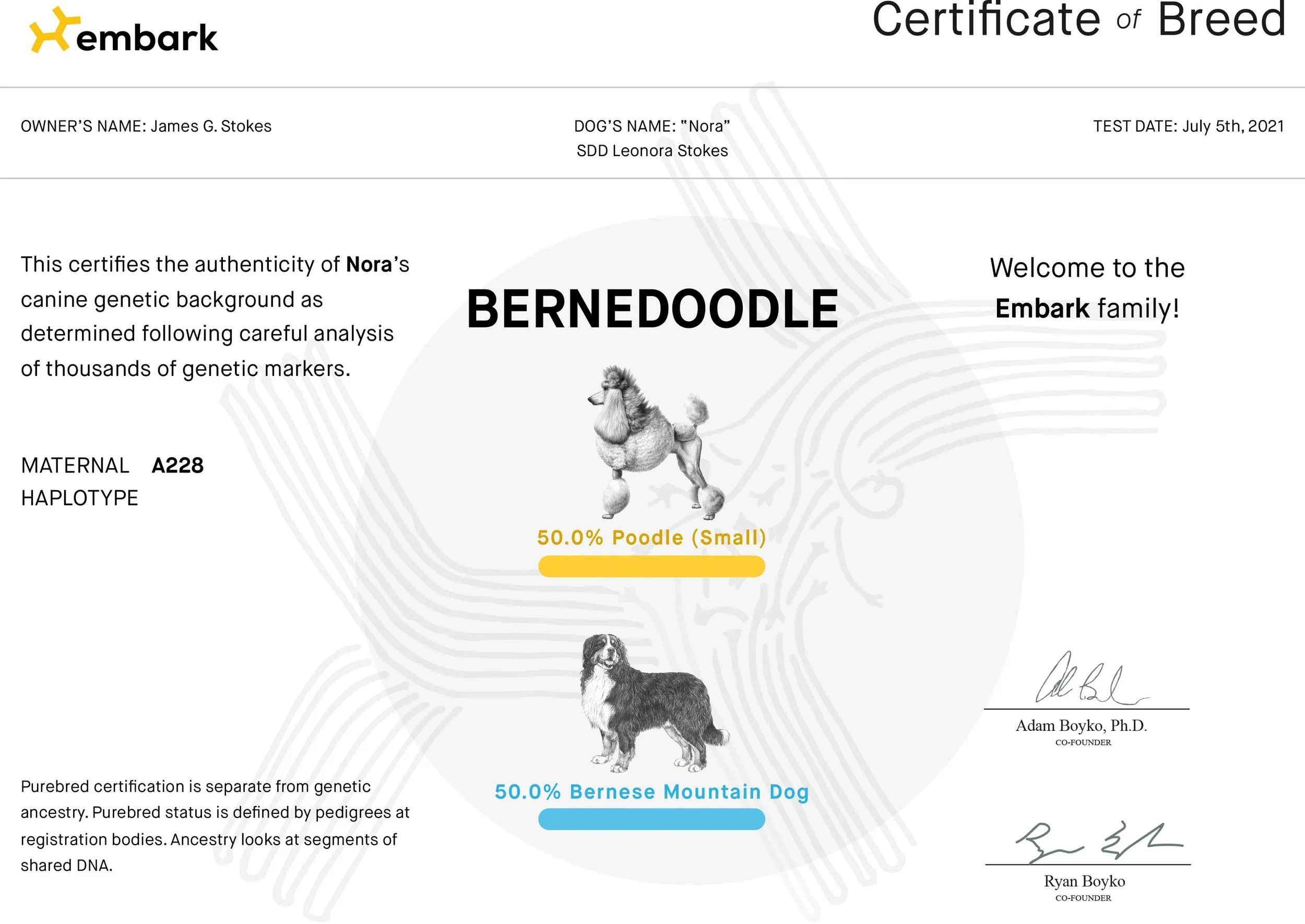
Ethical breeders use advanced genetic panels (like Embark or Paw Print) and OFA certifications to identify carriers of neuromuscular or autoimmune conditions. This prevents risky pairings and protects the next generation.
2. Managing Inbreeding Coefficients (COI)
The Bernese Mountain Dog, one of the parent breeds of the Bernedoodle, is known for a shorter lifespan and higher rates of autoimmune issues. At Stokeshire, we keep the COI under 10% in our litters to reduce the risk of inherited disorders.
3. Close Monitoring of Puppies
From birth to go-home day, puppies are observed for early signs of regurgitation, weakness, or swallowing difficulties. Any concerns are immediately addressed with veterinary partners.
4. Retiring Risky Breeding Lines
If a sire or dam produces offspring with megaesophagus or MG, responsible breeders remove them from the program to strengthen the health of future generations.
5. Education and Health Guarantees for Families
Stokeshire families receive not only a 3-year health guarantee, but also education on how to recognize health concerns early. We believe in standing beside our families for the lifetime of their puppy.
What Families Should Ask Their Bernedoodle Breeder
Before adopting, ask your breeder:
Have both parents been genetically tested for neuromuscular and autoimmune conditions?
What is the COI (inbreeding coefficient) of this pairing?
How do you handle health issues if they arise in your program?
Do you provide a written health guarantee and ongoing support?
Breeders who can’t answer these questions may not be taking the steps needed to minimize risk.
Australian Mountain Doodles: A Healthier Alternative
At Stokeshire, we are passionate about creating healthier, more resilient hybrids. One way we achieve this is through the Australian Mountain Doodle (AMD) — a cross of the Bernese Mountain Dog, Australian Shepherd, and Poodle.
Why many families choose Australian Mountain Doodles:
Lower risk of autoimmune issues thanks to greater genetic diversity
Balanced temperament combining the loyalty of the Bernese with the intelligence of Aussies and Poodles
Coat variety — furnished, allergy-friendly coats or straighter coats with light shedding
Longer lifespan potential compared to higher-COI Bernedoodles
For families who love the Bernedoodle’s look and temperament but want to reduce health risks, the AMD offers a healthier, longer-living option.
Why This Matters
Choosing the right breeder — and sometimes even the right doodle variety — is about more than looks. It’s about building a healthier future for your puppy and your family.
At Stokeshire Designer Doodles, we believe in transparency, science, and compassion. Whether you’re interested in a Bernedoodle or an Australian Mountain Doodle, working with an ethical breeder ensures your puppy is raised with care, tested for health, and placed for success.
FAQs: Bernedoodle Health, Megaesophagus, and Myasthenia Gravis
-
Yes. At Stokeshire, every breeding dog completes advanced genetic testing through Embark or Paw Print Genetics. This includes screening for over 200+ inherited conditions, with a special focus on neuromuscular and autoimmune markers. We only pair dogs that are clear or compatible to ensure puppies are not at risk for these conditions.
-
We carefully track and publish the estimated Coefficient of Inbreeding (COI) for each litter. Our goal is always under 10%, and most of our pairings are much lower, thanks to diverse pedigrees and thoughtful crosses. This lowers the chance of recessive health issues like congenital myasthenia gravis appearing in our lines.
-
Transparency is one of our core values. If a health issue appears in one of our puppies or breeding dogs, we immediately:
Work with our veterinary partners to confirm diagnosis.
Support the family with treatment resources and financial coverage as outlined in our guarantee.
Retire or adjust breeding pairings to prevent recurrence.
We also log every health outcome into our program records so that each decision we make builds a healthier future for our dogs and families.
-
Absolutely. All Stokeshire puppies come with a 3-year written health guarantee covering genetic and hereditary conditions, along with lifetime breeder support. Families can reach out to us at any time with questions about nutrition, training, or health—we consider every puppy placed an extension of our family.
Are Bernedoodles prone to megaesophagus?
Not typically, but it can occur when genetic or autoimmune predispositions are present. Ethical breeders reduce this risk through genetic testing and selective breeding.
Can myasthenia gravis be inherited in Bernedoodles?
Congenital MG is rare, but possible if both parents carry defective genes. Acquired MG is immune-mediated. Breeding programs with low COI and health testing greatly minimize this risk.
What is the difference between vomiting and regurgitation?
Vomiting is an active process (with retching and effort), while regurgitation is passive (food or liquid comes back up without warning). Regurgitation is a hallmark sign of megaesophagus.
What questions should I ask my Bernedoodle breeder about health?
Ask about genetic testing, COI levels, health guarantees, and how they track health outcomes in their program.
Why are Australian Mountain Doodles considered healthier?
AMDs benefit from hybrid vigor, drawing on three breeds instead of two. This lowers the risk of autoimmune conditions, extends lifespan potential, and preserves the Bernese’s beloved temperament.
Does Stokeshire provide a health guarantee?
Yes — all Stokeshire puppies come with a 3-year health guarantee and lifetime breeder support.