
Golden Retrievers vs Australian Shepherds: Best Family Dog Comparison

Male Red Golden Retreiver
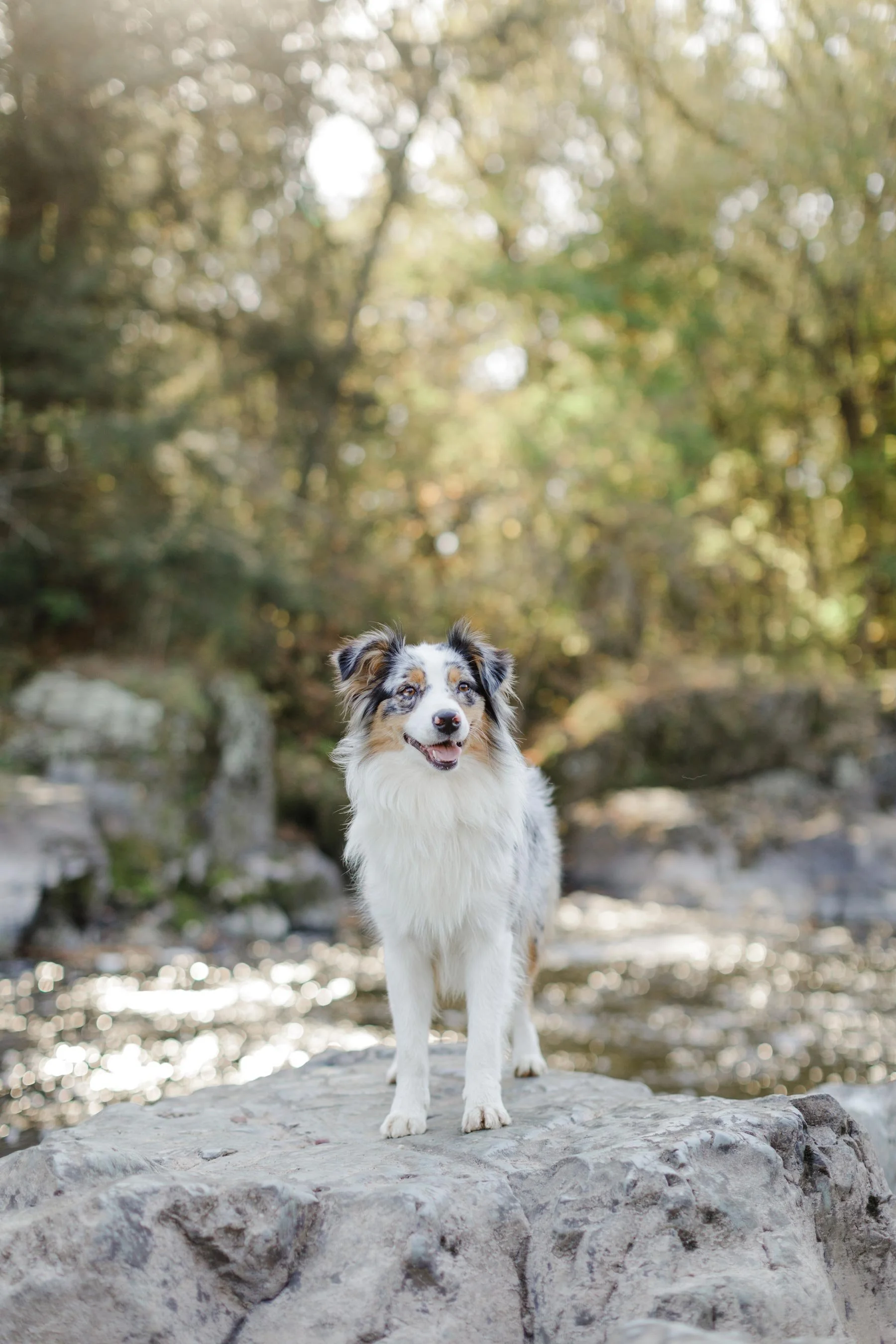
Female Blue Merle Aussie
Golden Retrievers and Australian Shepherds are two of America's most beloved dog breeds. Both make incredible family companions, but they bring very different histories and personalities to the table. Understanding their unique traits is key to finding the right fit for your household. At Stokeshire, these two foundational breeds play a pivotal role in our intentional hybrid breeding programs, and we want to share our expertise with you.
This guide offers a deep dive into the worlds of the Golden Retriever and the Australian Shepherd, including its smaller cousin, the Miniature American Shepherd. We will explore their origins, compare their temperaments, and discuss their modern roles in family and therapy settings. By the end, you will have a clear picture of each breed and understand how we thoughtfully combine their best qualities to create exceptional puppies for today's families.
Breed Origins: A Tale of Two Continents
A dog's history shapes its modern-day instincts. The Golden Retriever and Australian Shepherd were developed thousands of miles apart for very different jobs, which explains why they behave so distinctly today.
Golden Retriever: Scotland's Noble Gundog
The Golden Retriever story begins in the Scottish Highlands during the 19th century. Lord Tweedmouth, an aristocrat, sought to create the perfect gundog for retrieving waterfowl from his estate's rugged terrain. He crossed a Flat-Coated Retriever with the now-extinct Tweed Water Spaniel, later adding infusions of Irish Setter and Bloodhound. The result was a superb retriever with a keen nose, a gentle mouth, and a deep love for water.
Recognized by the UK Kennel Club in 1913, the breed's fame spread globally. Goldens arrived in the United States by the 1930s and quickly became popular for their biddable nature and friendly disposition. Their history as a gentleman's hunting partner forged the eager-to-please, sociable dog we know and love.
Australian Shepherd: The American Cowboy's Companion
Despite the name, the Australian Shepherd is a uniquely American breed. Its ancestors were various herding dogs that arrived in the American West with Basque shepherds, some of whom came via Australia. These dogs were perfected in the 19th century by ranchers who needed an agile, intelligent, and tireless partner to manage livestock.
For decades, the "Aussie" was known only in ranching circles. Its popularity surged in the mid-20th century thanks to rodeo performer Jay Sisler, who dazzled audiences with his talented Aussies. The breed gained official AKC recognition in 1991 and has since become a favorite for active families. Their heritage as a ranch hand explains their high intelligence, boundless energy, and protective loyalty.
The Miniature American Shepherd shares this history but was selectively bred down in size starting in the 1960s. These smaller versions were perfect for traveling equestrians and were recognized by the AKC as a distinct breed in 2015.
Personality and Instincts: What to Expect at Home
A breed's original job is the best predictor of its personality. A Golden's retrieving past and an Aussie's herding heritage create two very different, yet equally wonderful, family companions.
The Golden Retriever: Friendly, Patient, and Eager to Please
Goldens are the gold standard for a family-friendly temperament. They are famously gentle, affectionate, and patient, especially with children. Bred to work closely with people, they view strangers as friends they haven't met yet and thrive on being part of every family activity.
This breed is playful and retains a puppy-like joy for life well into adulthood. You'll often find your Golden greeting you with a favorite toy in its mouth, a nod to its retriever instincts. Their trainability is legendary; Goldens are highly intelligent and live to make their owners happy, making them a top choice for service and therapy work.
The Australian Shepherd: Intelligent, Loyal, and Energetic
Australian Shepherds are known for their sharp minds and intense devotion to their families. An Aussie often becomes a "velcro dog," following its people from room to room to keep its "flock" together. This loyalty comes with a protective streak; they are excellent watchdogs who may be reserved with strangers.
The defining Aussie trait is a combination of high energy and high intelligence. These dogs need a job, whether it's herding, agility training, or daily vigorous play. A bored Aussie can become destructive, so they thrive in active homes that can provide both mental and physical stimulation. Their herding instinct may lead them to gently "herd" children or other pets, a behavior that can be managed with training and proper outlets.
Overview Golden Retrievers vs Australian Shepherds (incl. MAS)
- Origins: Golden—Scotland gundog; Aussie—U.S. ranch herder; MAS—downsized Aussie (AKC 2015).
- Lines: Golden field vs bench; Aussie working vs show; MAS mirrors Aussie spectrum.
- Core feel: Golden = gentle, ultra-social; Aussie/MAS = loyal, alert, brilliant.
Temperament & Training
- Golden: Eager-to-please, patient with kids/guests; novice-friendly.
- Aussie/MAS: Velcro loyalty, reserved with strangers; thrives on jobs & structure.
- Energy: Golden = mod→high; Aussie/MAS = high (needs mental + physical work).
Grooming & Shedding
- Both are double-coated shedders with seasonal blowouts.
- Weekly brushing (daily in shed); de-shedding + comb-outs; don’t shave double coats.
- Goldens: watch ears/skin; Aussies/MAS: manage pants/mane tangles.
Health & Longevity
- Golden: Screen hips/elbows/eyes/heart; cancer vigilance; ~10–12 yrs average.
- Aussie/MAS: Hips/eyes, MDR1 drug sensitivity, epilepsy watch; ~12–15 yrs.
- Weight & fitness extend quality years in both breeds.
Modern Roles
- Golden: Service/therapy star, hunting/obedience, family companion.
- Aussie/MAS: Herding, agility/sports, SAR/K9 tasks, active family homes.
- Fit check: Golden = social ease; Aussie/MAS = engagement & boundaries.
Show vs Working (Why it matters)
- Golden: Field = drive/speed/athletic; Bench = calmer/build/coat—some dual-purpose blends.
- Aussie: Working = stock grit & intensity; Show = polish + more off-switch.
- MAS: Show & sport lines both exist; energy remains high for size.
Stokeshire Method (for the modern home)
- Deposits: First-come, first-pay—then concierge guidance.
- Litter match → Puppy match: Goals, allergies, energy, coat, temperament testing.
- Intentional crosses: GMD & AMD (and minis) blend Golden heart + Aussie brain + Bernese warmth + Poodle low-shed.
- Outcome: Therapy-grade temperaments, family-ready, low-to-moderate shedding, trainable companions.
Support doesn’t end on pick day—coaching on grooming, training, and transitions included.
Side-by-Side Comparison: Key Traits for Families
How Golden Retrievers compare with Australian Shepherds (and Minis).
| Trait | Golden Retriever | Australian Shepherd (and Mini) |
|---|---|---|
| Energy Level | Moderate — daily exercise but has a reliable “off switch” indoors. | High to very high — requires strong daily physical + mental stimulation. |
| Trainability | Excellent — eager to please and ideal for first-time owners. | Excellent — highly intelligent but may be independent or intense. |
| Sociability | Very friendly with strangers, kids, and pets; low guarding instinct. | Deeply loyal to family; may be reserved with strangers; good watchdog. |
| Grooming | Heavy shedder — weekly brushing + seasonal coat blowouts. | Heavy shedder — weekly brushing; extra de-shedding in coat blow seasons. |
| Size | Medium–Large Males 65–75 lbs Females 55–65 lbs |
Medium Males 50–65 lbs Females 40–55 lbs Mini Aussies 20–40 lbs |
| Lifespan | 10–12 years | 12–15 years |
Health and Grooming: The Commitment Involved
Both breeds require a commitment to regular grooming and an awareness of potential health issues.
Grooming and Coat Care
Both Goldens and Aussies have double coats that shed significantly, especially in the spring and fall. If you bring one of these dogs home, be prepared for fur.
Golden Retrievers need regular brushing (at least weekly) to prevent tangles in their feathery fur, especially behind the ears and on the tail. Their floppy ears should be checked and cleaned often to prevent infections, particularly after swimming.
Australian Shepherds also require weekly brushing to manage their undercoat. Their coat texture often repels dirt well, but they can still get mats in their "mane" and "britches" if neglected.
Neither breed should be shaved, as their double coat provides insulation from both heat and cold. A good vacuum cleaner and a consistent brushing routine will be your best friends.
Health and Longevity
Responsible breeders perform health screenings to reduce the risk of genetic conditions.
Golden Retrievers are unfortunately prone to certain cancers, with studies showing high rates in North American lines. They are also susceptible to hip and elbow dysplasia, heart conditions, and skin allergies. Their average lifespan is 10-12 years.
Australian Shepherds are generally a hardy breed with a lifespan of 12-15 years. They can be prone to hip dysplasia, certain eye disorders, and epilepsy. A notable concern is the MDR1 gene mutation, which causes sensitivity to common drugs. A simple DNA test can identify this, allowing owners to use safe alternatives.
Golden Retrievers vs Australian Shepherds: Health Comparison
A side-by-side look at common health considerations and lifespan.
| Health Factor | Golden Retriever | Australian Shepherd (incl. Mini) |
|---|---|---|
| Overall Health | Generally healthy but higher inherited disease risk. | Robust working breed with fewer major concerns. |
| Top Concern | Cancer (leading cause of death, high breed prevalence). | MDR1 gene mutation causing drug sensitivity. |
| Common Conditions | Hip/elbow dysplasia, heart disease, allergies, ear infections. | Hip dysplasia, epilepsy (some lines), PRA, hereditary cataracts. |
| Genetic Screening | OFA hips/elbows, heart, eye exams, DNA panel. | OFA hips/elbows, eye exams, MDR1, PRA, HC. |
| Cancer Risk | High – hemangiosarcoma & lymphoma common. | Moderate – lower than Goldens overall. |
| Lifespan | 10–12 years (varies by line & genetics). | 12–15 years (Mini Aussies sometimes longer). |
| Allergies & Skin | Higher rates of allergies and hot spots. | Lower overall allergy sensitivity. |
| Ears | Floppy ears – prone to infections. | Semi-erect ears – fewer infections. |
Stokeshire's Hybrids: Blending the Best of Both Breeds
At Stokeshire, we deeply admire the purebred Golden Retriever and Australian Shepherd. We also recognize that for many modern families, an intentional hybrid can offer the perfect blend of traits. Our breeding program focuses on creating puppies optimized for family life, therapy work, and low-shedding companionship.
We combine the Golden Retriever's gentle heart and the Australian Shepherd's brilliant mind with the low-shedding coat of the Poodle and the calm, sturdy nature of the Bernese Mountain Dog. This allows us to produce exceptional companions like:
Golden Mountain Doodles (GMDs): A mix of Golden Retriever, Bernese Mountain Dog, and Poodle. These dogs are typically calm, gentle, and incredibly friendly—ideal for families and therapy roles. They blend the Golden's sociability with the Berner's mellow nature.
Aussie Mountain Doodles (AMDs): A cross of Australian Shepherd, Bernese Mountain Dog, and Poodle. AMDs are highly intelligent and loyal, with a more moderate energy level than a pure Aussie. They are perfect for active families who want a clever, engaged, and low-shedding partner.
By thoughtfully selecting parent dogs with excellent health and temperaments, we aim to produce puppies that embody the best qualities of their foundation breeds. Whether you are drawn to the sunny disposition of a Golden, the sharp intellect of an Aussie, or the balanced nature of one of our doodles, we are here to help you find the perfect companion for your family.