Are Mixed-Breed Dogs Healthier Than Purebreds?
A Simple Guide for Families Who Want the Healthiest, Happiest Puppy Possible


Health and Genetics
Every few months an article circulates claiming that mixed-breed dogs are healthier than purebreds, and that the science settles it. I breed crossbred dogs for a living, so that headline flatters me. It is also not what the research says.
I want to be honest about this, because the version of the argument that helps my business is not the version that is true. The true one is more useful anyway.
The claim usually traces back to a University of California, Davis study. It gets summarized as proof that mutts have fewer genetic problems. What the study actually found is narrower, more conditional, and considerably more interesting than the headline. And the study most often cited about cancer is not that study at all. It is a completely separate line of research asking a completely different question.
Here is what I have taken from reading the literature, and how it changed the way Katie and I make pairing decisions.
What the UC Davis inherited-disorder study actually found
The study is Bellumori and colleagues, published in the Journal of the American Veterinary Medical Association in 2013. The researchers reviewed records from roughly 90,000 dogs seen at the UC Davis veterinary teaching hospital between 1995 and 2010, identifying more than 27,000 with one or more of 24 inherited disorders.
The finding that gets quoted is real: for 10 of those 24 disorders, purebred dogs were significantly more likely to be affected. That list includes aortic stenosis, dilated cardiomyopathy, elbow dysplasia, epilepsy, hypothyroidism, intervertebral disk disease, early-onset cataracts, atopy, bloat, and portosystemic shunt.
The finding that almost never gets quoted is the other one. For 13 of the 24 disorders, there was no statistically significant difference between purebred and mixed-breed dogs at all. That list includes hip dysplasia and several cancers. And for one condition, ruptured cranial cruciate ligament, mixed-breed dogs were affected more often.
The explanation researchers offer is elegant. Some canine disease mutations are ancient. They predate the breed system entirely and are distributed across the whole global dog population, so no amount of crossbreeding dilutes them. Other mutations are recent, concentrated inside particular lineages by closed registries and selection for appearance. Crossbreeding tends to help with the second category. It does very little about the first.
A 2015 follow-up from the same group sharpened this further. Of the 10 disorders that showed higher purebred prevalence overall, seven were not spread evenly across purebreds. They were concentrated in specific breed groups and lineages. So "purebred" is not the risk factor. Being descended from a particular narrow gene pool is.
The number that actually matters is not breed. It is inbreeding.
This is where the evidence gets much stronger, and much less comfortable for the show world.
In 2021, Bannasch and colleagues published an analysis of 49,378 dogs across 227 breeds in Canine Medicine and Genetics. They measured genetic inbreeding directly from DNA rather than estimating it from pedigree paperwork.
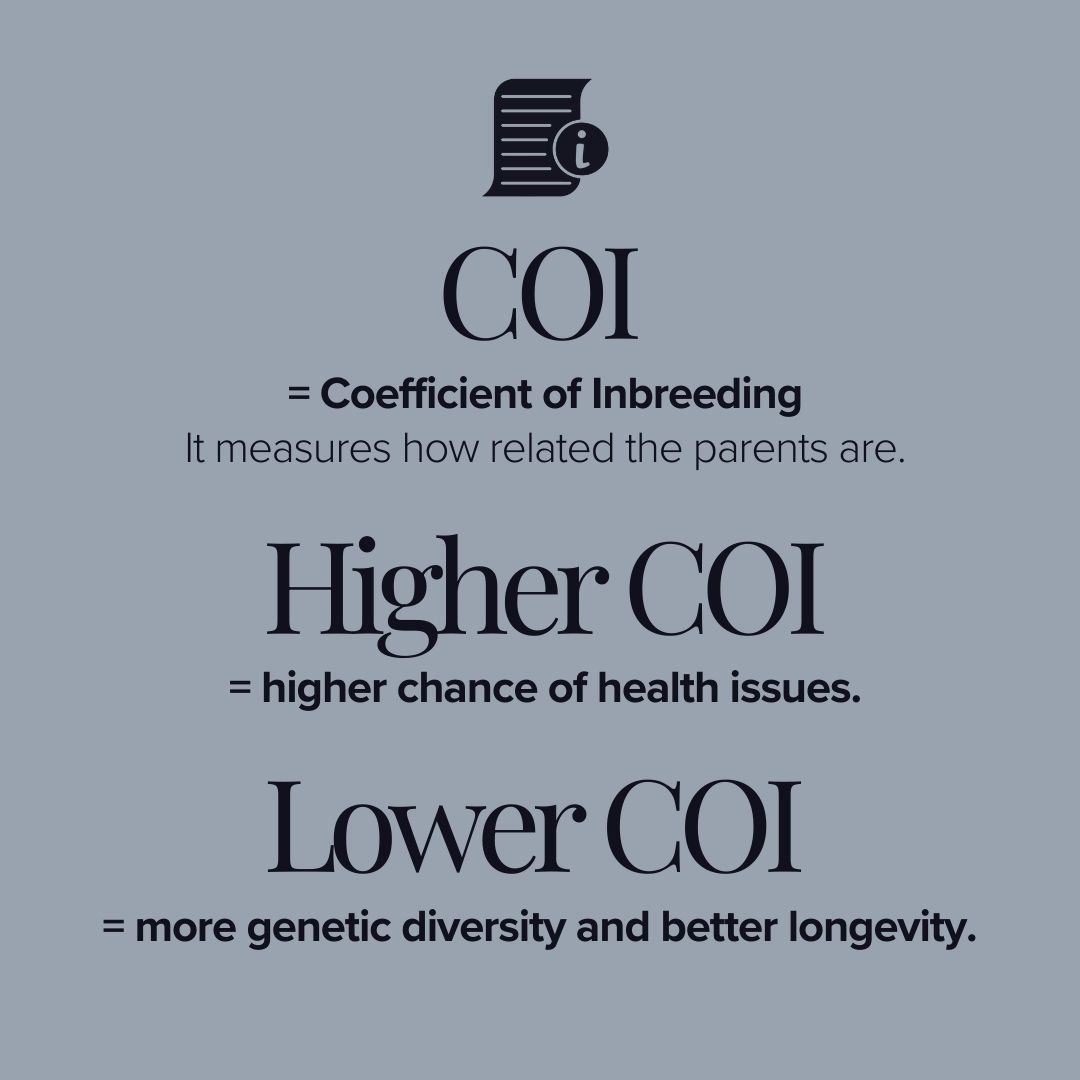
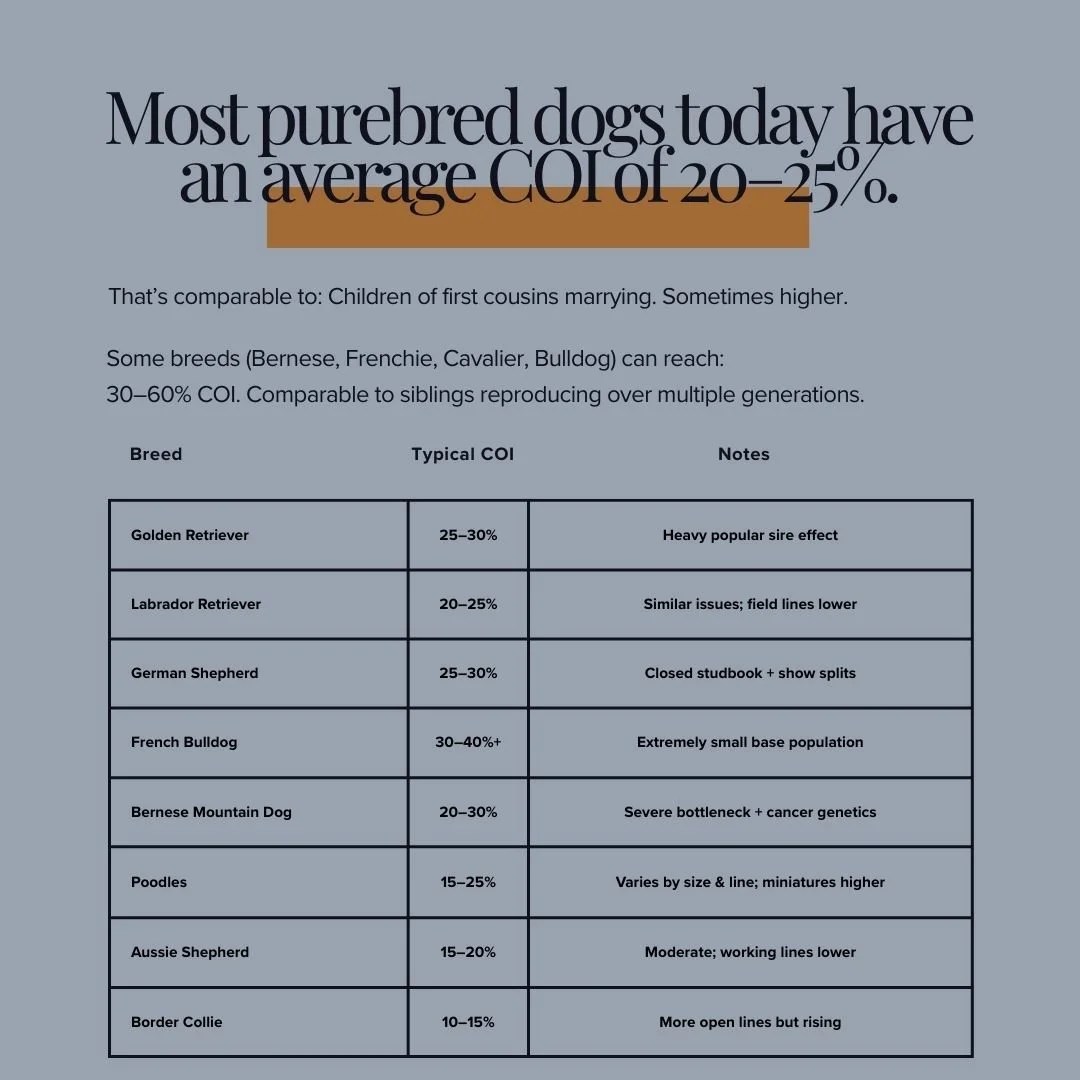
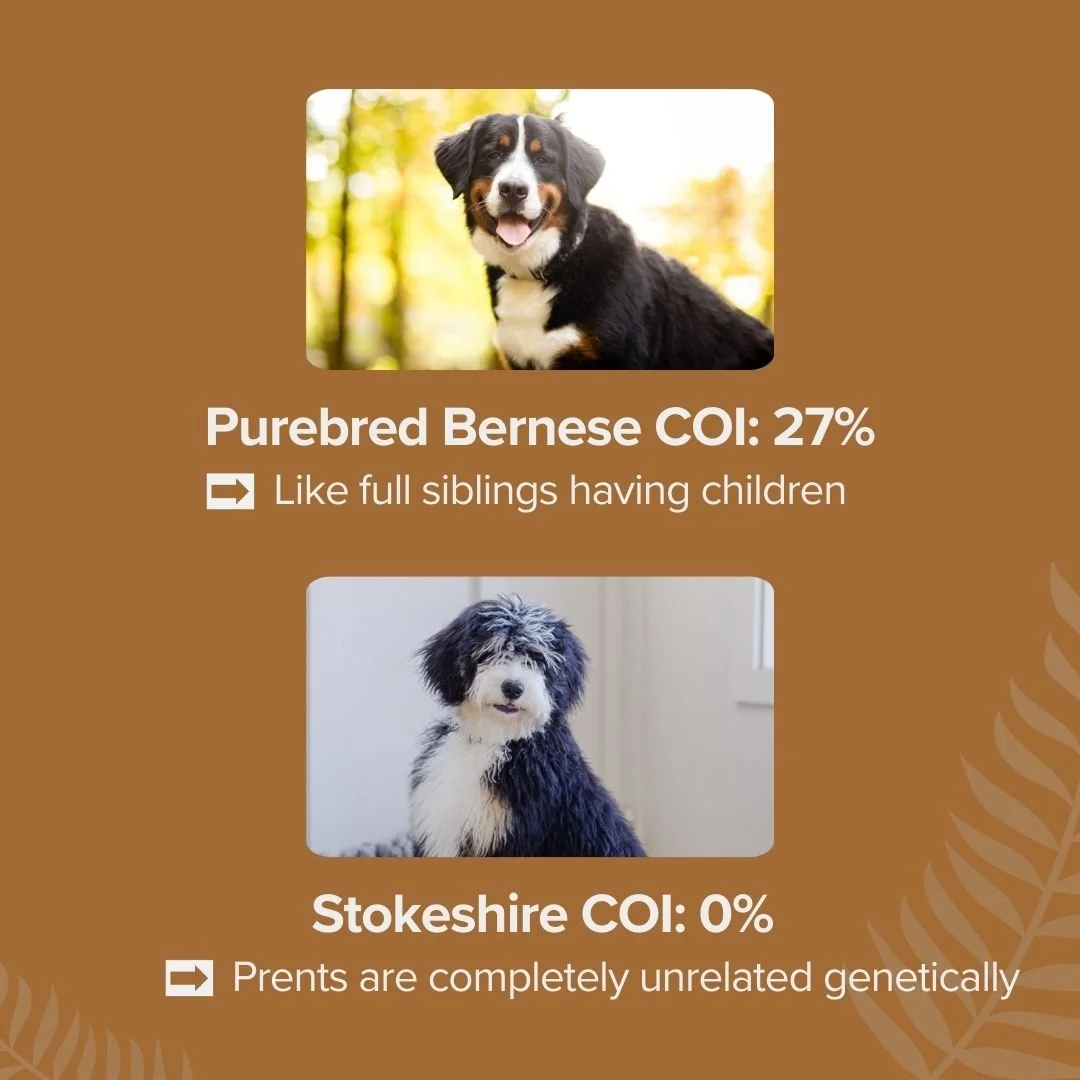
Average genetic coefficient of inbreeding across 227 dog breeds. That is roughly the level produced by mating full siblings. Only 12 of the 227 breeds measured below 10 percent. Mixed-breed dogs in the same dataset averaged about 3.7 percent.
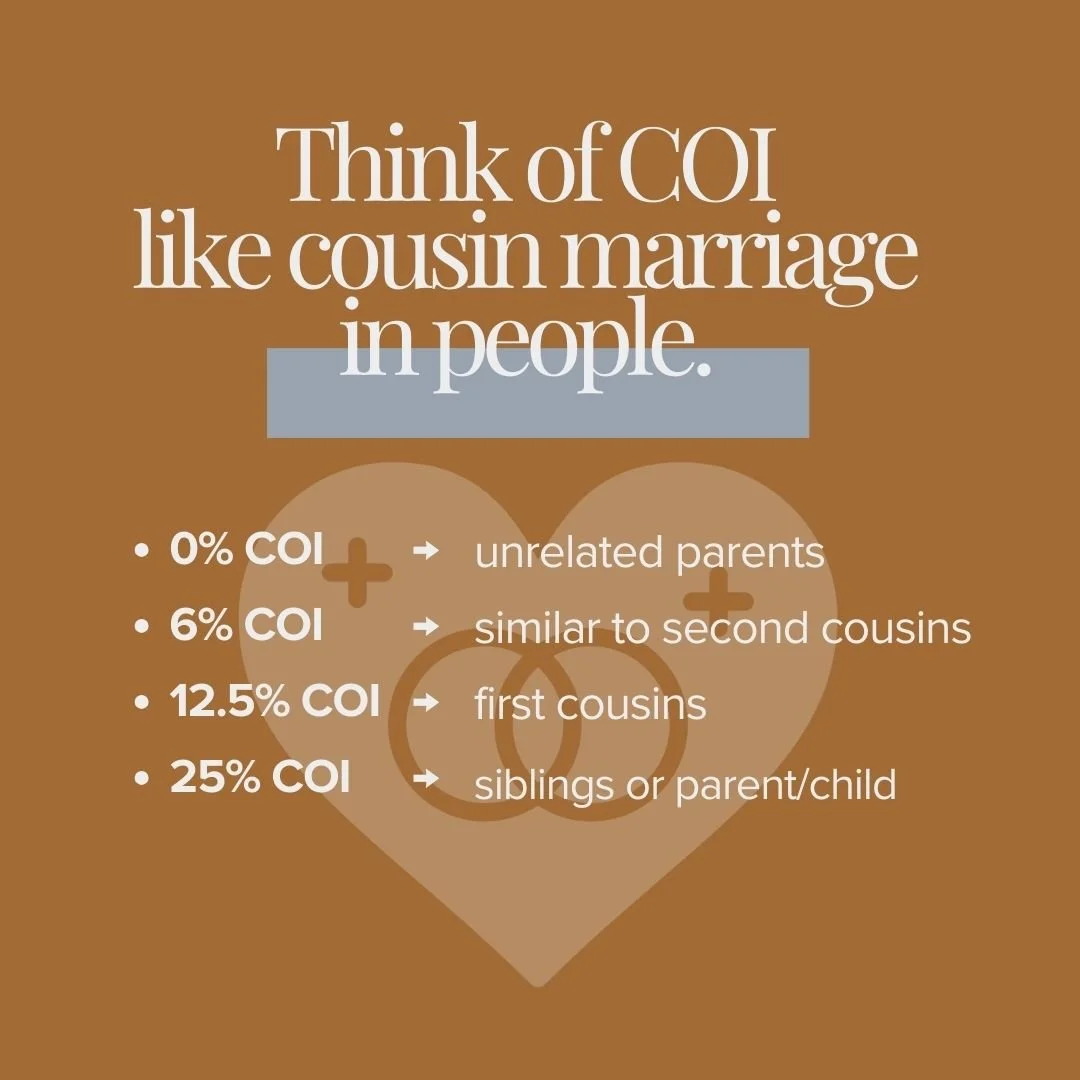
Sit with that. The average registered purebred dog is, genetically speaking, about as inbred as the product of a brother-to-sister mating. Not because any individual breeder did something reckless, but because a hundred years of a closed studbook does that arithmetic on its own.
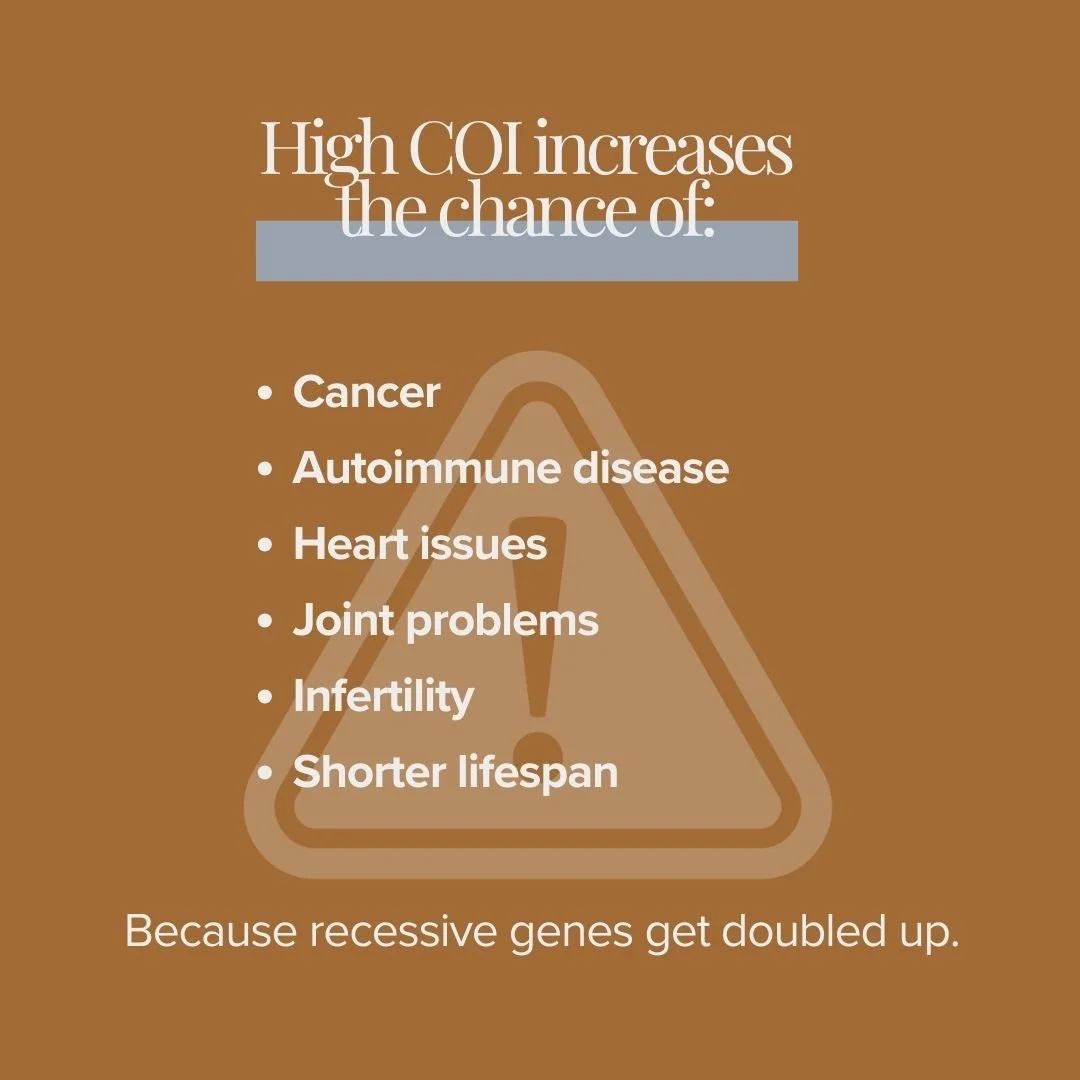
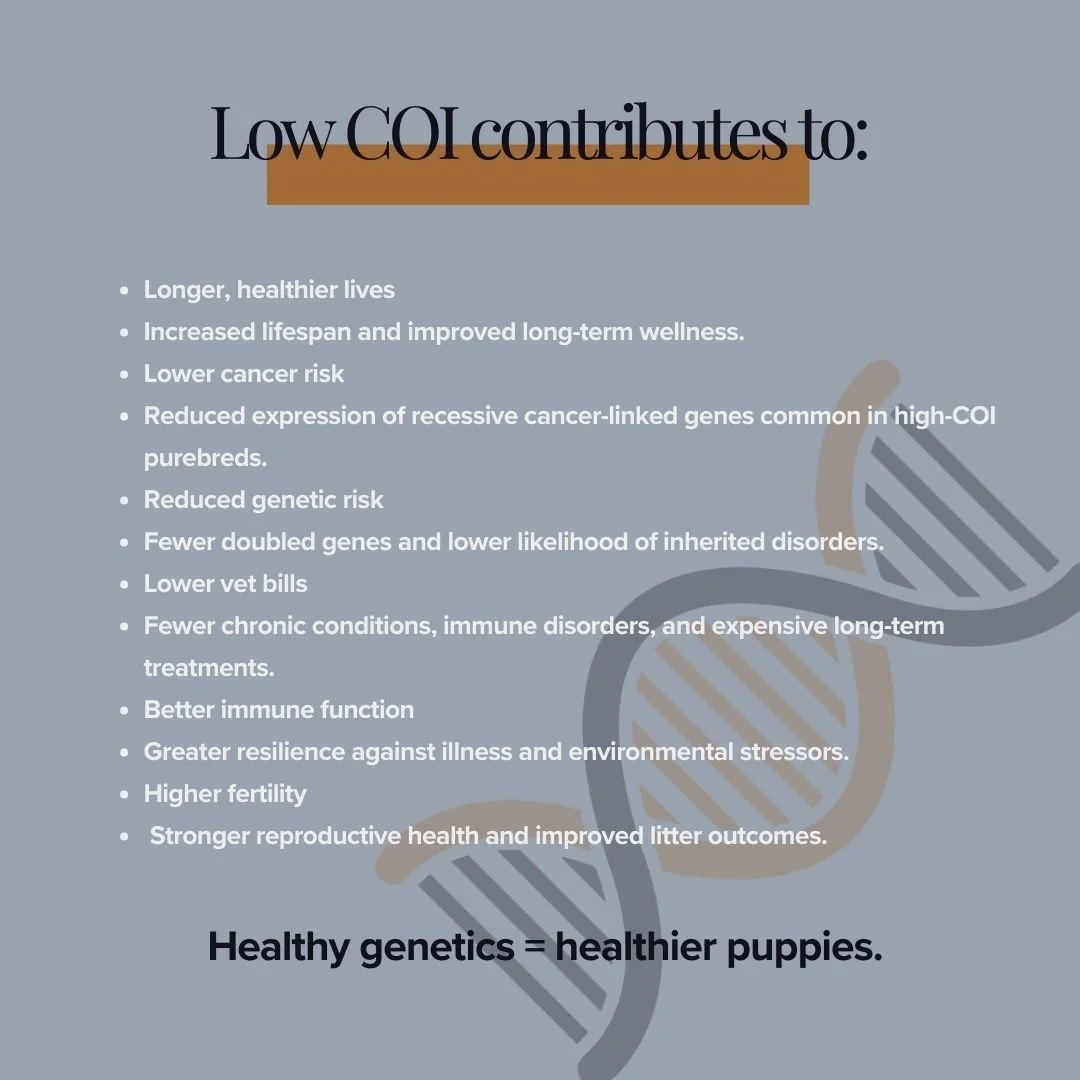
The same study modeled the health consequence. Inbreeding and adult body weight both showed independent, statistically significant effects on morbidity. Breeds with inbreeding above 25 percent averaged roughly 29 percent more non-routine veterinary care events than mixed-breed dogs. A separate 2024 analysis found purebred dogs showed higher frequencies of micronuclei and nuclear aberrations than mixed breeds, which is a cellular-level marker of genomic instability.
Two things are true at once, and holding both is the entire point. Inbreeding tends to raise disease burden in a measurable way. And crossbreeding, by itself, does nothing about the ancient mutations that account for a large share of what actually walks into a veterinary clinic.
Which means genetic diversity is necessary and insufficient. It lowers one category of risk. Health testing addresses the other. A breeder who does the first and skips the second is selling you half a strategy and calling it hybrid vigor.
Fair question: what are your numbers?
I just spent several hundred words arguing that coefficient of inbreeding is the variable that matters. It is reasonable to ask what ours are.
I would rather not answer with an average. Averages are marketing. The dogs we keep are the dogs we selected, and low inbreeding is part of why we selected them, so any average of our own program is flattering itself. Here is what we do instead.
We publish the number on every litter
Each litter page carries the parentage breakdown and the full genetic panel results for both parents, posted before any puppy is placed. You do not have to take a range on faith. Open any litter and read the figure for the actual pairing you are considering.
We hold a ceiling, not an average
No Stokeshire pairing exceeds 15 percent. That is a commitment about what we produce, not a description of what we own, and it is the number to hold us to.
We own dogs far above that ceiling, on purpose
This is where it gets interesting, and where most programs would go quiet.
| Reference point | COI |
|---|---|
| Full siblings, or parent bred to offspringThe textbook definition of close inbreeding | ~25% |
| Average across 227 registered breedsBannasch et al. 2021, measured from DNA across 49,378 dogs | 24.9% |
| Feta, our Bernese Mountain DogAcquired from another breeder. We did not produce this number | 27% |
| Colby-Jack, our Bernese Mountain DogAcquired from another breeder | 28% |
| Emma, our Bernese Mountain DogAcquired from another breeder | 32% |
| Mixed-breed dogs, population averageSame 2021 dataset | 3.7% |
| Finn, out of Feta and our Poodle PhoenixOne generation. Same dogs, same lines | 0% |
| Our ceiling on any planned pairingPublished per litter, before placement | 15% |
We did not breed those Bernese numbers. We bought them, because buying is the only way to get a Bernese. Every one of those dogs came out of another breeder's program, and every one arrived at or above the 24.9 percent average measured across 227 registered breeds. Emma sits meaningfully above a full-sibling mating. She is a lovely dog and nobody did anything wrong to produce her. That is simply what a century of a closed studbook hands you when you go looking for a Bernese.
Cross Feta to Phoenix and you get Finn, who measures 0 percent.
Twelve of our twenty-six crossbred dogs measure exactly 0 percent. Not most, and I am not going to round it up. Twelve of twenty-six, and you can check every one of them.
It is also worth saying that our two highest-inbreeding crossbred dogs were both acquired from other programs rather than bred here. That is not a swipe at anyone. It is the same point the Bernese make, one rung down.
One caution on our own numbers, because it matters. A low coefficient of inbreeding addresses one category of risk: the recent, lineage-concentrated recessive disorders. It does nothing about the ancient mutations behind hip dysplasia and several cancers. These figures are evidence that we are doing one thing well. They are not evidence that we have solved canine health, and I do not want them read that way.
How coefficient of inbreeding actually works
A plain-language breakdown of what COI measures, why pedigree estimates tend to understate the real figure, how common breeds compare, and the questions worth asking any breeder before you reserve.
Read the COI breakdownTwo UC Davis studies, two different questions
This is the confusion I most want to clear up, because I see these two research lines blended together constantly, including by people quoting them at me.
| Bellumori / Oberbauer | Hart and Hart | |
|---|---|---|
| Question asked | Which inherited disorders are more common in purebreds versus mixed breeds, and why | Does the age a dog is spayed or neutered change its risk of joint disorders and certain cancers |
| Biological level | Germline. What the dog inherits before birth | Endocrine. What happens after a surgery removes gonadal hormones |
| What you can change | Pairing decisions, testing, coefficient of inbreeding | Timing of the procedure, in consultation with a veterinarian |
| Who controls it | The breeder, before the puppy exists | The owner and veterinarian, years later |
Conflating these is not a small error. It leads owners to believe a "healthy mix" is protected from a risk that has nothing to do with pedigree, and it lets breeders take credit for outcomes that are decided in an exam room long after the puppy leaves.
The lever almost nobody tells buyers about
Benjamin and Lynette Hart at UC Davis have spent more than a decade on the second question. Their work, published across PLOS ONE and Frontiers in Veterinary Science between 2013 and 2024, now covers 40 breeds plus a mixed-breed cohort sorted by body weight.
The pattern is not subtle, and it is not uniform.
In Golden Retrievers, neutering before six months was associated with joint disorder rates of roughly 20 to 27 percent, against about 5 percent in intact dogs. In Labrador Retrievers, the same early timing roughly doubled joint disorder rates to about 10 to 12 percent. Same procedure, same age, markedly different outcome, because the breeds differ.
The Golden Retriever female is the case that unsettles me most. Researchers reported that spaying at any age through eight years was associated with roughly a three to four-fold increase in the risk of at least one tracked cancer, rising from about 3 percent in intact females to 8 to 14 percent in spayed females. That anomaly has not replicated in Labradors, and it has not replicated in standard mixed breeds.
And here is the part that matters for anyone who thinks a mixed-breed dog opts them out of this: it does not. In the mixed-breed cohort, dogs with a mature weight of 20 kilograms or more that were neutered before one year showed up to a three-fold increase in joint disorder risk compared with intact dogs. Under 20 kilograms, no timing association was detected. The lever is body weight, not pedigree.
Notably, in that same mixed-breed cohort, no increase in cancer risk was detected at any neuter age. The oncological piece of this appears to be highly breed-specific. The orthopedic piece appears to be about size and hormone timing during skeletal growth.
None of this is a recommendation to leave a dog intact. It is a recommendation to stop treating six months as a default and start treating timing as a decision, made with your veterinarian, based on your specific dog's expected adult weight and lineage.
Where "adopt, don't shop" is right, and where it stops
I want to be careful here, because I have no interest in arguing against adoption. Shelter dogs are good dogs. Rescue work is good work. My family has loved dogs that came from both paths.
What I will argue with is the biology in the slogan.
The adoption argument frequently rests on hybrid vigor: that a mixed-breed dog is protected by its diversity. The evidence says that protection is real for one category of disease and absent for another. A shelter mix is fully susceptible to hip dysplasia, patellar luxation, and several cancers at rates that do not differ meaningfully from purebreds. You are not buying immunity. You are buying an unknown, and unknown is not the same thing as safe.
The honest framing is that adoption and responsible breeding solve different problems. Adoption gives a home to a dog who needs one, which is worth doing on its own terms and needs no scientific justification. Structured breeding gives a family predictability: known parents, known testing, known temperament work, known coefficient of inbreeding. Neither of those is a substitute for the other, and pretending one is makes the argument weaker, not stronger.
There is also a third position that the slogan erases entirely. Purebred preservation breeders are not the villain in the inbreeding data. They are the people most constrained by it. A closed studbook means a conscientious breeder can be doing everything right and still be locked inside a gene pool that has been narrowing since before they were born. That is a structural problem, not a character problem, and outcrossing is one of the few tools that addresses it at the root.
What this changed about how we breed
Reading this research did not make me more confident. It made me more specific.
We treat coefficient of inbreeding as a number, not a vibe
Pedigree-based inbreeding estimates tend to understate the real figure, because a five to twelve generation chart cannot see the historical bottleneck behind it. We work from genotype-based measurement instead, we know the number before the pairing rather than after, and we publish it on the litter page.
We do not let diversity substitute for testing
Because roughly half the disorders in the UC Davis data show no mixed-breed advantage, outcrossing alone cannot be the health plan. Parent dogs go through orthopedic evaluation and breed-appropriate genetic panels. Diversity handles the recent, lineage-concentrated mutations. Screening handles the ancient, widely distributed ones. You need both instruments.
We talk about neuter timing before a family takes a puppy home
This is the one I think most programs skip, and it is free. If a family is bringing home a dog that will mature past 20 kilograms, the timing conversation with their veterinarian matters, and the research generally supports delaying past 11 to 12 months to reduce joint risk. I would rather have that conversation at week eight than hear about a cruciate tear at year three.
We say what we cannot promise
Parents cleared of single-gene recessive mutations can still produce puppies affected by complex polygenic disorders. Multifactorial traits do not obey clean arithmetic. Anyone guaranteeing you a disease-free dog is guaranteeing something the science does not support, and you should treat that as information about the breeder.
The limits of my own argument
Fairness requires me to name the weaknesses in the evidence I just used, including where it favors me.
The UC Davis prevalence studies drew from a tertiary referral hospital. That population may overrepresent purebred dogs, whose owners are often more willing to pursue advanced specialty care, which could distort the comparison in either direction. The inbreeding study leaned on commercial DNA databases and Swedish insurance records, which may carry geographic and socioeconomic bias in who seeks veterinary care and when. It also modeled breed averages rather than matching individual genomes to individual medical histories, which invites ecological fallacy. The neutering studies are retrospective and observational, so they establish association rather than causation, and they cannot see why an owner chose a given timing.
Our own figures deserve the same scrutiny. The dogs I can show you are the dogs we kept, and we kept them partly because their numbers were good. That is exactly why I will not quote you an average of our program, and why the ceiling and the per-litter figure are the only numbers I think you should hold us to.
None of that voids the findings. The inbreeding signal in particular is large, consistent, and biologically coherent. But a breeder who cites studies only when they flatter him is doing marketing, not reasoning. If the evidence turns against something I do, I would rather find out from the literature than from a family three years in.
James Stokes
Stokeshire Designer Doodles, Medford, Wisconsin
Frequently asked questions
Are mixed-breed dogs healthier than purebred dogs?
Sometimes, and it depends on the specific condition. A UC Davis analysis of roughly 90,000 veterinary records found that for 10 of 24 inherited disorders, purebred dogs were significantly more likely to be affected. For 13 of the 24 disorders, including hip dysplasia and several cancers, there was no statistically significant difference between purebred and mixed-breed dogs. For ruptured cranial cruciate ligament, mixed-breed dogs were affected more often. The pattern generally tracks genetic diversity and the age of the underlying mutation rather than the mixed versus purebred label itself. Mixed-breed dogs do not have a universal health advantage.
Why do purebred dogs tend to carry more inherited disorders?
Closed studbooks and generations of breeding within a limited gene pool tend to raise the coefficient of inbreeding, and higher inbreeding is associated with a greater probability of inherited disease. A 2021 study of 49,378 dogs across 227 breeds found an average genetic coefficient of inbreeding of about 24.9 percent, which is roughly equivalent to a full-sibling mating, compared with about 3.7 percent in mixed-breed dogs. Only 12 of the 227 breeds measured below 10 percent. Higher inbreeding concentrates deleterious recessive mutations within a lineage, which is generally a structural consequence of closed registries rather than a failure by any individual breeder.
Does crossbreeding guarantee a healthier dog?
No. Genetic diversity may lower the risk of certain recent, lineage-concentrated recessive disorders, but it does not remove risk and it is not a substitute for health testing. Many canine disease mutations are ancient and distributed widely across the global dog population, which is generally why conditions such as hip dysplasia and several cancers appear at similar rates in mixed-breed and purebred dogs. A crossbred puppy from untested parents can still inherit disease. Outcomes depend on the specific pairing, the screening performed on both parents, and lifelong care. No breeding program can guarantee a disease-free dog.
What is the UC Davis cancer study, and is it the same as the mixed-breed study?
They are two separate lines of research and should not be conflated. The inherited-disorder work by Bellumori and Oberbauer examined which diseases dogs inherit at birth and why some are concentrated in specific lineages. The cancer and joint work led by Benjamin and Lynette Hart examined something different: whether the age at which a dog is spayed or neutered affects its later risk of certain cancers and joint disorders. The first studies germline genetics that are fixed before a puppy is born. The second studies endocrine effects of a surgery performed months or years afterward. A dog's pedigree does not determine its surgical vulnerability.
Does spaying or neutering affect cancer risk in dogs?
It may, and the effect appears to be highly breed-specific rather than universal. In female Golden Retrievers, researchers reported that spaying at any age period through eight years was associated with roughly a three to four-fold increase in the risk of at least one tracked cancer, rising from about 3 percent in intact females to approximately 8 to 14 percent. That pattern has not been replicated in Labrador Retrievers or in standard mixed-breed dogs, where no significant increase in cancer risk was detected across neuter-timing groups. Owners should generally decide timing in consultation with their veterinarian based on their individual dog's breed and expected adult size.
At what age is it generally safest to spay or neuter a large mixed-breed dog?
For dogs expected to mature at 20 kilograms, or roughly 44 pounds, or more, research generally supports delaying sterilization until at least 11 to 12 months of age to reduce the risk of joint disorders. In the UC Davis mixed-breed cohort, dogs at or above 20 kilograms that were neutered before one year showed up to a three-fold increase in joint disorder risk compared with intact dogs. For dogs under 20 kilograms, no significant timing association with joint disorders was detected, which generally allows caregivers more flexibility. These findings are observational and should be applied through a conversation with your veterinarian rather than as a fixed rule.
Is hip dysplasia only a purebred problem?
No. Peer-reviewed research indicates that the prevalence of hip dysplasia does not differ significantly between purebred and mixed-breed dogs. It is believed to involve ancient mutations distributed widely throughout the global dog population, which is generally why crossbreeding does not dilute it the way it can dilute more recent, lineage-concentrated disorders. Hip dysplasia is polygenic and multifactorial, meaning its expression may also be influenced by body weight, growth rate, activity, and hormone timing during skeletal development. Orthopedic screening of parent dogs and lean body condition throughout life both matter more here than pedigree status.
Does a pedigree chart show my puppy's real inbreeding level?
Generally not accurately. Pedigree-based calculations of inbreeding tend to underestimate the true genetic coefficient, because a typical five to twelve generation chart cannot capture the deeper cumulative homozygosity created by historical breed bottlenecks that occurred before the chart begins. A pedigree showing no repeated ancestors within those generations can still describe a dog sitting on a very narrow genetic foundation, since the founding population itself may have been small. Modern genotype-based DNA measurement generally provides a more precise picture of a dog's actual inbreeding level, because it reads the genome directly rather than inferring it from paperwork. This distinction matters when comparing programs, and it is a reasonable question to ask any breeder: whether the inbreeding figure they quote is calculated from pedigree or measured from DNA.
What is a good coefficient of inbreeding for a puppy?
There is no single universal threshold, but the benchmarks are well established. A 2021 analysis measuring DNA from 49,378 dogs found an average coefficient of inbreeding of about 24.9 percent across 227 registered breeds, which is roughly equivalent to a full-sibling mating, while mixed-breed dogs in the same dataset averaged about 3.7 percent. Figures in the low single digits generally indicate parents that are largely unrelated. Our own standard is that no Stokeshire pairing exceeds 15 percent, and we publish the figure for each pairing on its litter page before any puppy is placed. Arguably more important than any single number is whether the breeder measured it from DNA rather than estimating it from a pedigree, and whether they will show you the figure for your specific pairing rather than an average of their program.
Why should I distrust a breeder who quotes an average COI?
Because an average describes the dogs a program chose to keep, and programs keep dogs partly for good numbers. That makes any program-wide average a selected sample rather than a representative one, and it will generally look better than the reality. The figure that cannot be gamed is the one attached to the specific pairing that produces your puppy, published before you reserve. This is why we hold a ceiling and publish per litter rather than quoting an average of our own dogs. When any breeder offers you an average, the useful follow-up is simple: what is the number on this pairing, and can I see it.
If both parents pass genetic testing, can the puppy still develop an inherited disorder?
Yes. Parents cleared of single-gene recessive mutations can still produce offspring affected by complex polygenic disorders. Many canine health traits are multifactorial, meaning they are influenced by multiple genes acting together with environmental factors such as nutrition, growth rate, body condition, and hormone timing during skeletal development. Hip dysplasia is a common example, since it is not governed by a single testable gene and its expression may be shaped by weight and activity across a dog's life. A genetic panel also only screens for the mutations it includes, and testing panels do not cover every disorder that exists. Clearance on a panel reduces specific known risks, which is meaningful and worth doing. It cannot guarantee a disease-free outcome, and any program presenting it that way is overstating what the testing does.
Can a breed maintain a consistent type without high inbreeding?
Yes. Genetic evidence indicates that consistent type and function can be maintained without extreme homozygosity. The Danish-Swedish farmdog is a frequently cited example, having been bred primarily for function rather than strict aesthetic conformation, resulting in a low genetic inbreeding coefficient and a favorable clinical profile in European insurance data. In the 2021 inbreeding analysis, 12 of 227 breeds measured below 10 percent, which indicates that low inbreeding is achievable within a recognized breed rather than theoretical. This generally suggests that the high inbreeding seen across most modern breeds is a consequence of closed registries and sustained selection for appearance rather than an unavoidable cost of predictability. Predictability comes from selection. Homozygosity is what happens when the gene pool is also sealed.
Are doodles just mutts?
The meaningful difference is documentation, not vocabulary. A doodle is an intentional cross, typically involving a Poodle, with recorded parentage and health testing performed on both parents before the pairing. A random-bred dog of unknown origin may share the benefit of broader genetic diversity, but it carries no record of what was screened or what was selected for. Both may sit closer to the mixed-breed inbreeding baseline than to the purebred average, which is a real advantage for one category of inherited disease. Only one arrives with known parental orthopedic evaluations, known genetic panels, and known temperament history. Genetic diversity is one variable, and it addresses lineage-concentrated recessive disorders. Predictability is a separate variable, and it comes from testing and selection. A responsible program should be able to show you both.
Do purebred dogs still have value?
Yes. Purebreds offer predictability in size, coat, and working aptitude that a random cross generally cannot match, and preservation breeders play an important role in maintaining lineages and working ability developed over generations. The concern raised by the research is not the existence of purebred dogs, and it is not the diligence of the people breeding them. It is that closed studbooks structurally limit a conscientious breeder's ability to reduce inbreeding, because the one tool that would address it at the root, introducing unrelated genetics, is generally not permitted within the registry. A breeder can health test rigorously and still be working inside a gene pool that has been narrowing for a century. That is a systems problem rather than an indictment of the people operating within it.
How does Stokeshire apply this research?
We treat genetic diversity and health testing as two separate instruments addressing two different categories of risk, and we use both. We measure coefficient of inbreeding from genotype rather than estimating it from pedigree, we hold a ceiling of 15 percent on any pairing we plan, and we publish the figure with both parents' full genetic panels on the litter page before any puppy is placed. Parent dogs receive orthopedic evaluation and breed-appropriate genetic panels. We also discuss neuter timing with families before a puppy goes home, because for dogs maturing past 20 kilograms that decision may carry real orthopedic weight. We describe this as intentional development, and we are transparent that no program can guarantee a specific health outcome.
Health-tested pairings, published before the puppy exists
See how the Stokeshire Method applies genetic diversity, screening, and temperament matching to every litter we plan.
Explore the MethodSources
- Bellumori TP, Famula TR, Bannasch DL, Belanger JM, Oberbauer AM. Prevalence of inherited disorders among mixed-breed and purebred dogs: 27,254 cases (1995-2010). Journal of the American Veterinary Medical Association. 2013;242(11):1549-1555.
- Oberbauer AM, Belanger JM, Bellumori T, Bannasch DL, Famula TR. Ten inherited disorders in purebred dogs by functional breed groupings. Canine Genetics and Epidemiology. 2015;2:9.
- Bannasch D, Famula T, Donner J, et al. The effect of inbreeding, body size and morphology on health in dog breeds. Canine Medicine and Genetics. 2021;8:12.
- Torres de la Riva G, Hart BL, Farver TB, et al. Neutering dogs: effects on joint disorders and cancers in Golden Retrievers. PLOS ONE. 2013;8(2):e55937.
- Hart BL, Hart LA, Thigpen AP, Willits NH. Long-term health effects of neutering dogs: comparison of Labrador Retrievers with Golden Retrievers. PLOS ONE. 2014;9(7):e102241.
- Hart BL, Hart LA, Thigpen AP, Willits NH. Assisting decision-making on age of neutering for mixed breed dogs of five weight categories. Frontiers in Veterinary Science. 2020;7:472.
- Hart LA, Hart BL, Thigpen AP, et al. Assisting decision-making on age of neutering for German Short/Wirehaired Pointer, Mastiff, Newfoundland, Rhodesian Ridgeback, Siberian Husky. Frontiers in Veterinary Science. 2024;11:1322276.
- Santovito A, et al. Purebred dogs show higher levels of genomic damage compared to mixed breed dogs. 2024. PMC10884103.
This article is educational and is not veterinary advice. Decisions about spay and neuter timing, screening, and individual health management should be made in consultation with a licensed veterinarian who has examined your dog.