
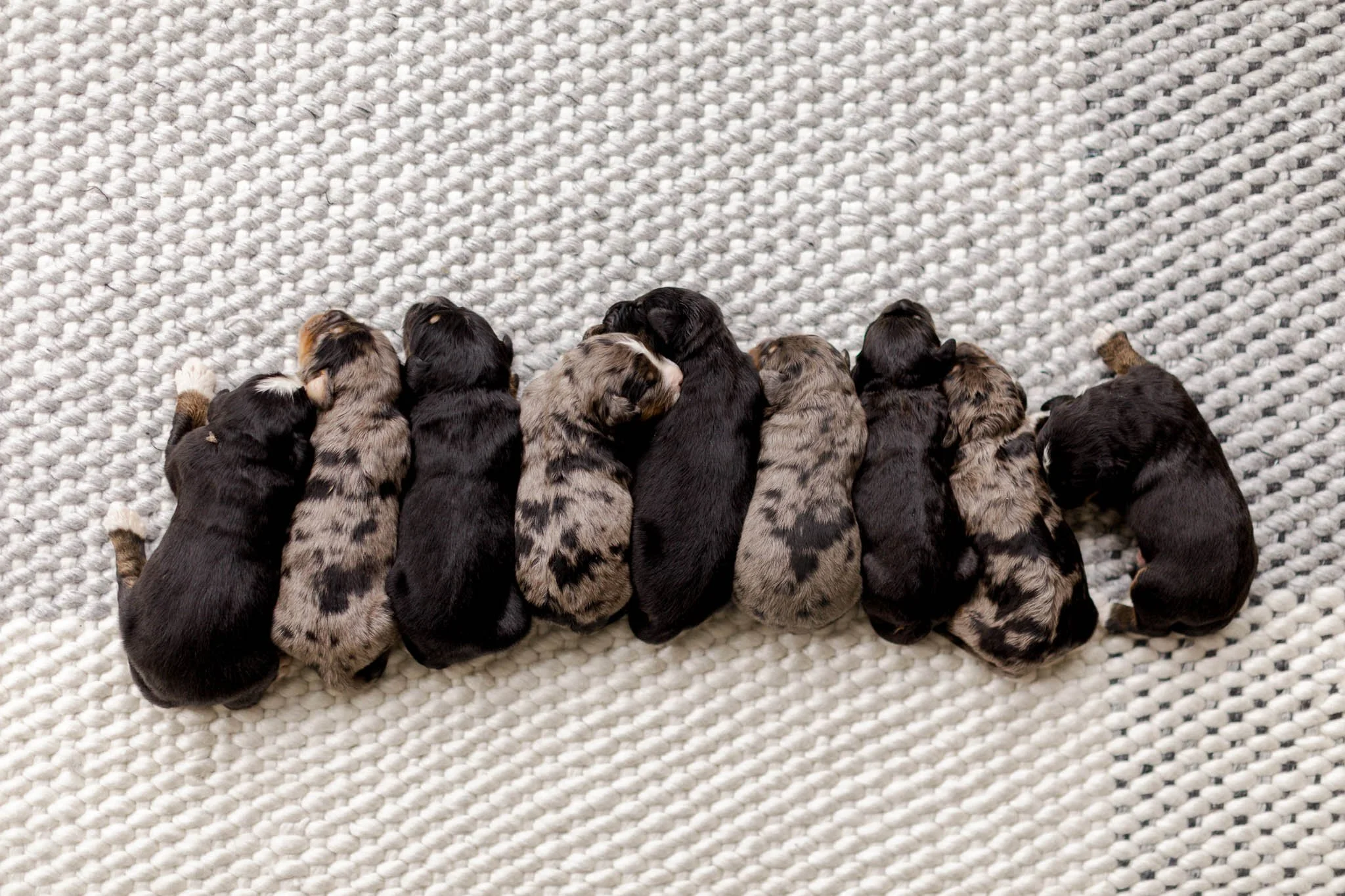
Australian Mountain Doodle Coat Types:
A Genetics-First Guide
Whether a doodle sheds, how curly it looks, and whether its coat is appropriate for allergy-sensitive households are all determined by specific, testable gene variants — not by generation labels or breeder claims. This guide explains the four genes that control doodle coat type, what each one means for your family, and what questions to ask any breeder before committing to a puppy.
This page is part of Stokeshire's complete Australian Mountain Doodle breed guide.
Which Genes Determine Doodle Coat Type?
Four gene loci control the coat characteristics families care most about in Australian Mountain Doodles: texture, curl, shedding rate, and coat length. Each puppy inherits a unique combination from both parents — which is why coat outcomes vary within litters even when parents are carefully selected. Responsible breeders test every breeding dog for all four loci before making any pairing.
Controls facial hair — the beard, eyebrows, and moustache that define the classic "doodle look." Dogs with one or two copies (Ff or FF) are furnished. Dogs with zero copies (ff) are unfurnished: shorter facial hair, more similar in appearance to the Bernese Mountain Dog or Australian Shepherd parent. Unfurnished dogs are not considered low-shedding and are not appropriate for allergy-sensitive households. Stokeshire tests all breeding dogs for RSPO2 status before any pairing.
Determines how tightly the coat curls. Dogs with two copies of the curl variant produce tight, Poodle-like curls. Dogs with one copy have wavy coats — the most common and widely preferred expression. Dogs with zero copies have straight or loose coats. Curl level directly affects grooming demands: curlier coats trap shed hair internally rather than releasing it, which reduces environmental shedding but increases mat risk without consistent brushing.
Influences the rate at which the hair growth cycle turns over and how much hair is released from the follicle. Poodles typically carry the low-shedding MC5R variant — a primary genetic reason doodle-type dogs distribute less hair into the environment than double-coated breeds. Shedding is multigenic, however: MC5R is one important locus, but furnishings status and coat type together determine the real-world shedding experience. No single gene guarantees a non-shedding outcome.
Controls overall coat length. Most furnished doodles carry the long-coat FGF5 variant inherited through Poodle lineage, contributing to the flowing, luxurious coats associated with the breed. Dogs expressing the short-coat FGF5 variant will have noticeably shorter coats regardless of curl degree or furnishings status — which is why some dogs within a litter may look significantly different from others even when parents are identical.
The Four Coat Types in Australian Mountain Doodles
The four gene loci above combine to produce four distinct coat expressions commonly seen in Australian Mountain Doodles. Each has a different grooming profile, shedding level, and allergy suitability.
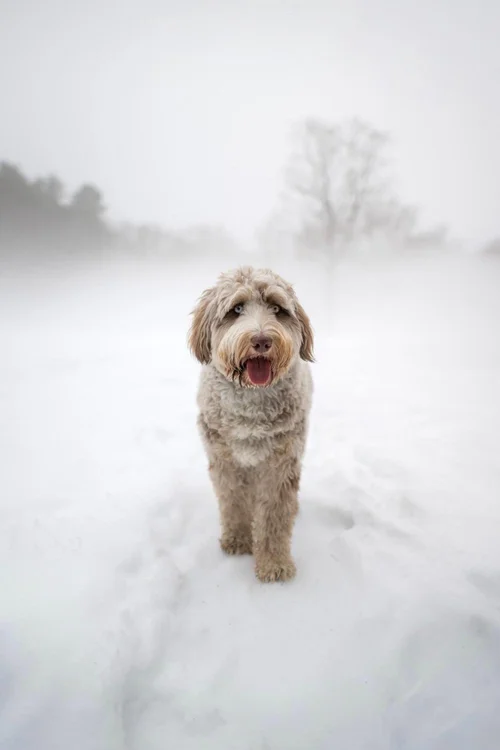
Curly & Furnished
The lowest-shedding coat expression. Tight curls trap released hair within the coat rather than distributing it into the environment. Highest grooming demand — must be brushed every 2–3 days to prevent matting. Best for allergy-sensitive families willing to commit to maintenance. Professional grooming every 6–8 weeks required.
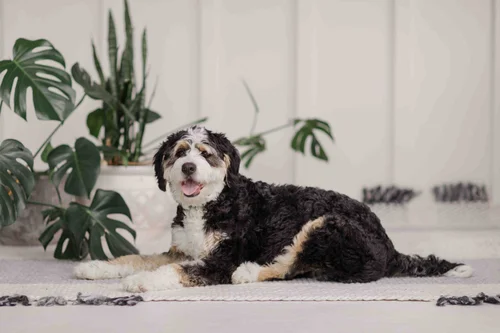
Wavy & Furnished
The most common and widely sought coat expression. Soft, flowing waves with minimal environmental shedding. More manageable than curly coats but still requires brushing 3–4 times per week. Appropriate for most allergy-sensitive households. Professional grooming every 8 weeks recommended. The classic "doodle look."
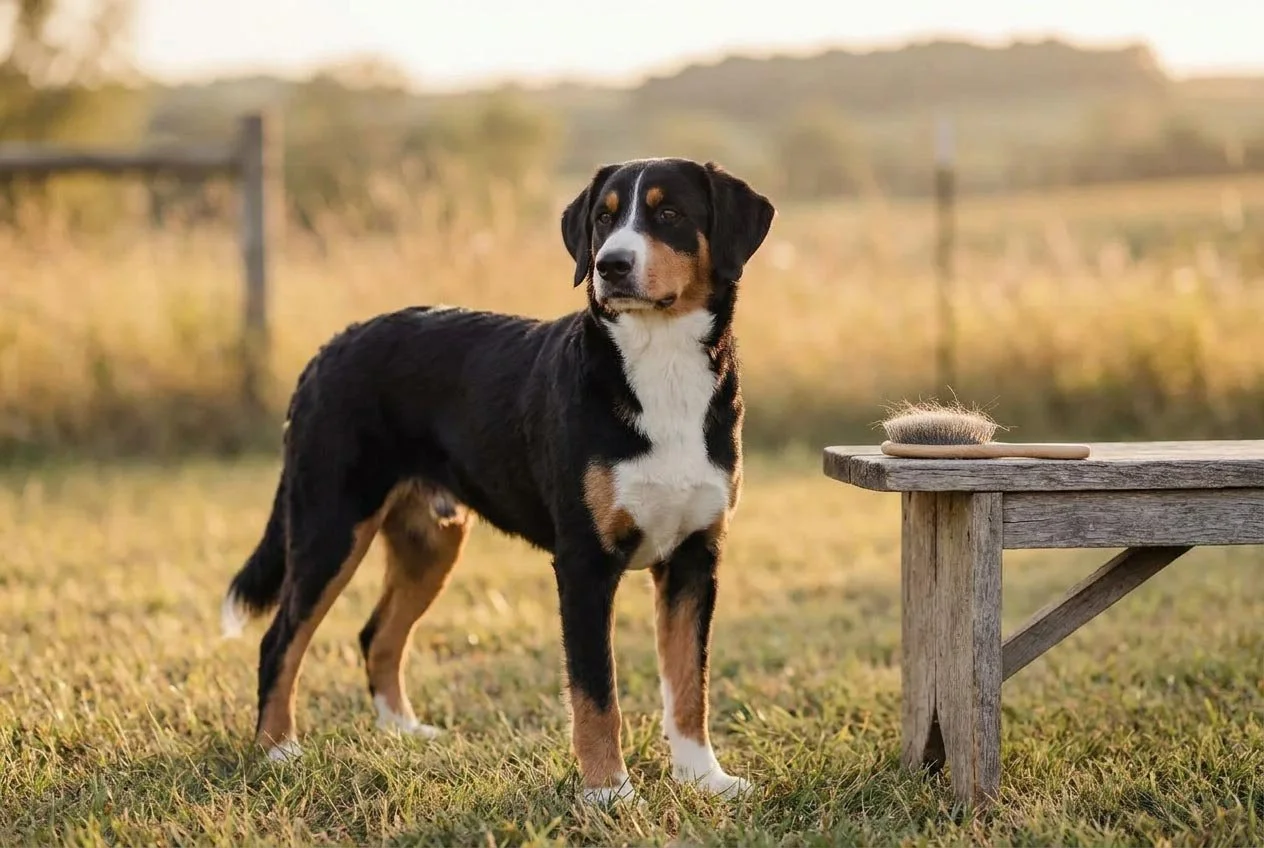
Unfurnished
No RSPO2 variant — short, natural facial hair with no beard or eyebrows. Sheds similarly to the Bernese Mountain Dog or Australian Shepherd parent. Not appropriate for allergy-sensitive households. Lower grooming demand overall. Stokeshire breeds intentional unfurnished lines and is transparent about their shedding profile. Never marketed as hypoallergenic.
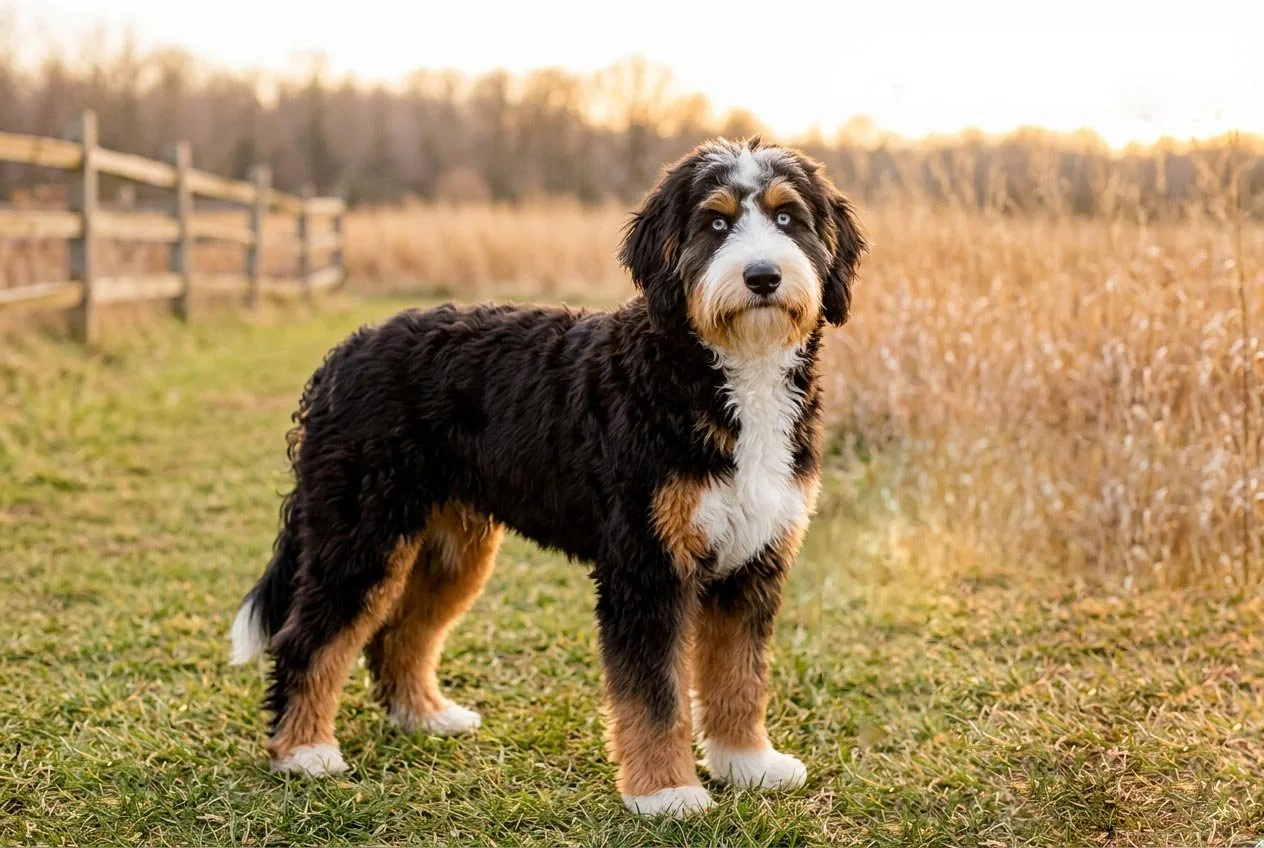
Fleece / Soft Wave
Furnished but with low or zero curl — a softer, looser wave sometimes called "fleece." Less shedding than unfurnished but more than curly. Easiest coat to maintain of the furnished types. Still requires regular brushing to prevent matting along high-friction areas (collar zone, armpits, behind ears). Professional grooming every 8–10 weeks.
How Much Do Australian Mountain Doodles Shed?
Shedding level in Australian Mountain Doodles is determined by the interaction of multiple coat genes — primarily RSPO2, KRT71, and MC5R. The chart below shows approximate relative shedding levels by coat type. All figures are relative to each other, not absolute measures.
A coat can be low-shedding and still high-maintenance. Curly and wavy furnished coats release far less hair into the environment — but that hair stays within the coat. Without consistent brushing, it mats. The lower the shedding, the higher the brushing commitment required.
The "Hypoallergenic" Caveat
No dog is completely hypoallergenic. Human allergic responses to dogs are triggered by proteins found in dander, saliva, and urine — not hair itself. Low-shedding coats distribute less hair and attached dander into the environment, which many allergy-sensitive families find significantly more manageable. But individual tolerance varies by person, by dog, and by household conditions.
The American Academy of Allergy, Asthma & Immunology and other clinical organizations consistently state that no breed reliably produces fewer allergens across all individuals. If allergy sensitivity is a primary concern, Stokeshire recommends spending time with an adult dog from the program before committing to a puppy.
Coat Outcome by Gene Combination
The table below shows how combinations of RSPO2 and KRT71 variants produce different coat outcomes. This is the framework Embark and other genetic testing platforms use when reporting coat predictions.
| RSPO2 | KRT71 | Expected Coat | Shedding Level | Allergy Suitability |
|---|---|---|---|---|
| FF (2 copies) | CC (2 copies) | Tightly curly, fully furnished — classic Poodle-like doodle | Minimal | Highest |
| FF or Ff | Cc (1 copy) | Wavy to loose curl, furnished — the most common doodle coat | Low | High |
| FF or Ff | cc (0 copies) | Straight to soft wave, furnished — fleece coat | Low–Moderate | Moderate |
| ff (0 copies) | Any | Unfurnished — natural face, coat varies by KRT71 | Moderate–High | Not recommended for allergy homes |
Merle, Tri-Color, and Pattern Genetics in AMDs
The Australian Shepherd parent introduces the merle gene (PMEL/SILV locus) to the Australian Mountain Doodle cross. Merle is a dilution pattern that creates marbled or mottled coat coloration and is associated with striking blue or heterochromatic eyes. It is one of the most visually distinctive traits in AMD litters.
Merle Safety: What Every Buyer Must Know
Merle is a dominant gene — one copy produces the merle pattern. Two copies (double merle, MM) produce dogs that are predominantly white and carry significant risk of auditory and ophthalmologic developmental defects, including deafness and blindness. Double-merle outcomes are documented in veterinary literature and are the result of breeding two merle-carrying dogs together.
Common color and pattern expressions in Stokeshire AMD litters include: tricolor (the Bernese influence), blue merle tri, red merle tri, phantom, phantom merle, parti, tuxedo, bi-color, and mismark. No two Australian Mountain Doodles are visually identical — the combination of three parent breed color genetics produces one of the widest color ranges of any companion breed.
Coat & Genetics FAQ
What gene makes doodles not shed?
Shedding in doodle-type dogs is primarily influenced by three genes: RSPO2 (furnishings), KRT71 (curl), and MC5R (shedding rate). Dogs carrying the furnishings gene (RSPO2) have coats that retain shed hair rather than releasing it into the environment. The low-shedding MC5R variant, commonly carried by Poodles, reduces the rate of hair cycling. No single gene eliminates shedding entirely — low-shedding outcomes require favorable combinations across multiple loci, which is why genetic testing of both parents is the only reliable way to predict a puppy's coat behavior.
What is the difference between furnished and unfurnished doodles?
Furnishings refers to the longer facial hair — beard, eyebrows, and moustache — produced by the RSPO2 gene variant. Furnished dogs carry at least one copy of this variant and have the classic doodle facial appearance. Unfurnished dogs carry no RSPO2 copies and have shorter, natural facial hair resembling their Bernese Mountain Dog or Australian Shepherd parent. The practical difference that matters most for families: unfurnished Australian Mountain Doodles shed considerably more than furnished ones and are not considered appropriate for allergy-sensitive households.
Can two furnished parents produce an unfurnished puppy?
Yes — if both parents carry one copy of the furnishings gene (Ff), approximately 25% of offspring will inherit zero copies (ff) and be unfurnished. This is why knowing the specific genotype of each parent (FF vs. Ff) matters more than knowing their appearance. A parent dog that looks fully furnished may still produce unfurnished puppies if they carry only one copy of RSPO2. At Stokeshire, breeding dogs are genotyped — not just visually assessed — so families know exactly what coat outcomes are possible in each litter.
Do low-shedding coats require more grooming?
Yes — this is the trade-off most breeder pages fail to explain. Curly and wavy furnished coats distribute far less hair into the environment because loose, shed hair is retained within the coat structure rather than falling away. But that retained hair accumulates and tangles over time, leading to matting if the coat is not brushed consistently. Curly furnished AMDs require brushing every 2–3 days. Wavy furnished coats require brushing 3–4 times per week. Professional grooming every 6–8 weeks is necessary for both coat types. The lower the shedding, the higher the grooming commitment required.
Reviewed by the Stokeshire Breeding Team · Updated March 2026
Learn More About Australian Mountain Doodles
Coat genetics are one piece of the picture. Stokeshire's complete Australian Mountain Doodle guide covers temperament, sizes, parent breeds, health testing, training, and therapy dog potential.
View the Full Breed Guide View Planned Litters