
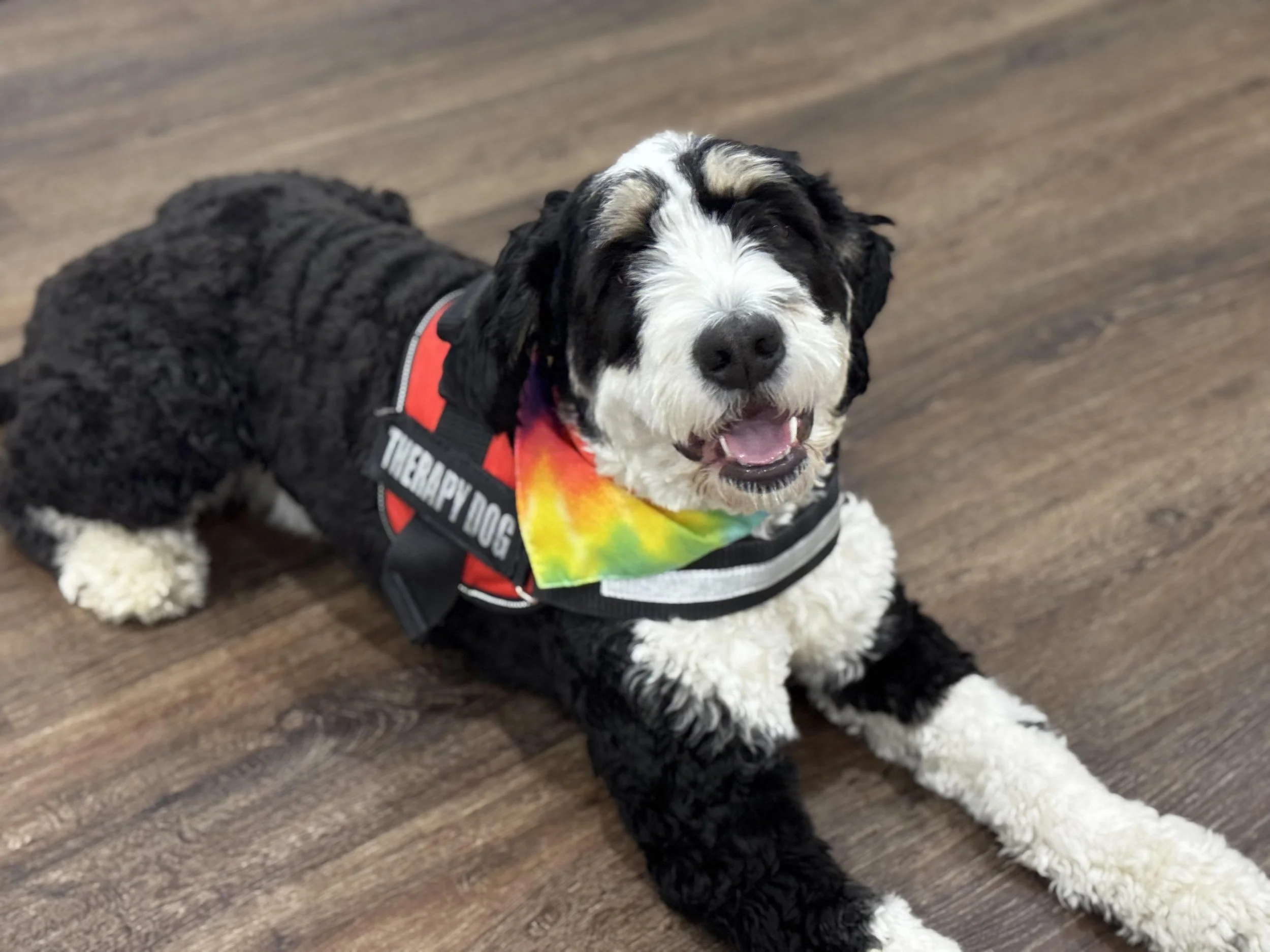
Australian Mountain Doodle
Therapy Dog Potential
Many Australian Mountain Doodles carry the temperament foundation that therapy dog evaluation organizations describe as their ideal candidate: emotional attunement, calm non-reactive behavior, high trainability, and a strong desire to maintain connection with people. This guide explains the traits that support therapy work, the distinction between therapy and service dogs, and the path to formal certification.
This page is part of Stokeshire's complete Australian Mountain Doodle breed guide.
The Temperament Traits That Support Therapy Work in AMDs
Therapy dog suitability is not a breed designation — it is an assessment of the individual dog's temperament, training, and handler skill. That said, certain breed combinations produce dogs that enter temperament evaluations with strong foundational traits. The Australian Mountain Doodle's triple-cross background contributes several of the characteristics that therapy certification organizations specifically look for.
Traits Inherited from the Cross
- Calm, stable baseline — Bernese Mountain Dog lineage contributes a naturally settled temperament, patient with strangers and novel environments
- Emotional attunement — Poodle and Bernese lineage both select for dogs that read and respond to human emotional states, a core requirement in healthcare settings
- High trainability — Aussie Shepherd and Poodle lineage produce dogs that learn and retain commands quickly, making formal obedience preparation efficient
- Non-reactive in crowds — when well-socialized, AMDs tend to be calm in busy, varied environments such as hospitals, schools, and care facilities
- Handler-bonded — strong human connection supports the controlled, handler-directed behavior therapy visits require
- Low-shedding furnished coats — practical advantage in healthcare settings with infection control protocols and allergy policies
- Adaptable to varied handling — comfort with being touched, petted, and handled by unfamiliar individuals is evaluable and trainable
What Therapy Work Requires — Beyond Breed
Breed and temperament potential are the starting point, not the qualification. Pet Partners, the Alliance of Therapy Dogs, and similar certification bodies evaluate the team — dog and handler together — not the breed alone. Their evaluation frameworks typically assess:
- Response to enthusiastic and unpredictable petting
- Behavior around startling stimuli (dropped objects, sudden movements, medical equipment)
- Tolerance of gentle restraint or hugging
- Obedience reliability in novel environments
- Handler control and awareness
- Absence of food aggression or resource guarding
Even well-bred, well-socialized AMDs from health-tested programs may not pass therapy evaluation — individual temperament varies within any breed or cross, and suitability must be assessed at the team level by the certifying organization.
Therapy Dog Certification Organizations in the United States
Pet Partners
petpartners.org — One of the largest and most widely recognized therapy animal organizations. Offers a standardized evaluation system, comprehensive handler training, and placement in healthcare, educational, and community settings. Annual registration and re-evaluation required.
Alliance of Therapy Dogs
therapydogs.com — Evaluates teams through observed visits with an experienced evaluator. One of the longest-established therapy dog organizations in the US. Particularly active in hospital and school visitation programs.
Therapy Dogs International
tdi-dog.org — National organization with evaluators across the US. Testing is based on the AKC Canine Good Citizen standards plus additional therapy-specific evaluations. Widely accepted by healthcare facilities.
Therapy Dog vs. Service Dog: An Important Legal Difference
Therapy dogs and service dogs are not the same category and do not carry the same legal rights. This distinction matters significantly for families who are hoping a dog will serve in a formal accessibility capacity.
Certified Therapy Dog
- Visits facilities to provide comfort and engagement to multiple people
- Accompanied by a handler at all times
- No public access rights beyond what the facility grants
- Does not qualify for ADA service animal accommodations
- Cannot accompany handler in housing, transportation, or public spaces under ADA
- Certification is through private organizations (Pet Partners, ATD, TDI, etc.)
ADA Service Dog
- Trained to perform specific tasks directly related to a person's disability
- Protected access rights under the Americans with Disabilities Act
- Emotional comfort alone does not qualify under the ADA definition
- Requires extensive training — IAADP minimum standards describe hundreds of training hours
- Even well-bred litters produce only a subset of dogs with service-level temperament suitability
- No single organization certifies all service dogs — programs and standards vary
Stokeshire can identify puppies showing strong foundational traits for therapy work during the placement process — calm, handler-bonded, high tolerance for handling. We cannot guarantee therapy certification outcomes or service dog suitability. Those outcomes are determined by training, the individual dog, and the certifying organization's evaluation.
How Stokeshire Prepares Puppies for Therapy Potential
The foundation for therapy dog suitability is built in the first weeks of life — long before any formal training begins. At Stokeshire Designer Doodles, the puppy development program includes several components specifically relevant to therapy work candidacy.
- Early Neurological Stimulation (ENS) — begins at Day 3. Five specific mild handling exercises performed daily through Day 16. Research on ENS documents improvements in stress tolerance, cardiovascular efficiency, and cognitive performance in developing dogs — traits that directly support therapy work.
- Sound desensitization — varied sound exposure from the first weeks of life reduces startle reactivity and noise sensitivity, a common disqualifier in therapy evaluations.
- Varied surface exposure — puppies are introduced to multiple surfaces, textures, and environments. Novel surface confidence supports the calm public-access behavior therapy work requires.
- Multi-person handling — puppies are handled by multiple people of different ages, sizes, and interaction styles. The comfort with being touched by strangers that therapy visits require is built through this early conditioning.
- Health testing of all parents — temperament and health are not independent. Dogs bred from health-tested, temperament-evaluated parents are more likely to produce the stable nervous system profiles that support therapy work.
Therapy Dog FAQ
Are Australian Mountain Doodles good therapy dogs?
Many Australian Mountain Doodles carry the temperament foundation suited for therapy work — calm, emotionally attuned, trainable, and comfortable with varied handling. The Bernese Mountain Dog's emotional steadiness, the Poodle's responsiveness, and the Australian Shepherd's intelligence produce a dog that therapy dog evaluation organizations frequently identify as a strong candidate. Suitability must still be assessed at the individual level through temperament evaluation and formal certification testing — not all AMDs will qualify, and temperament varies within any cross or breed.
What is the difference between a therapy dog and a service dog?
A therapy dog visits facilities to provide comfort to multiple people and has no public access rights under the ADA. A service dog is trained to perform specific tasks directly related to a single person's disability and has protected public access rights under the Americans with Disabilities Act. Emotional comfort alone does not qualify a dog as a service animal under the ADA. The training requirements for service dogs are extensive — the International Association of Assistance Dog Partners describes minimum training standards involving hundreds of hours and comprehensive public-access preparation. These are legally and practically distinct categories.
How do I get my Australian Mountain Doodle certified as a therapy dog?
The path to therapy dog certification typically involves: (1) completing the AKC Canine Good Citizen (CGC) test as a prerequisite for most programs; (2) enrolling in a therapy dog-specific obedience preparation course; (3) registering with a certification organization (Pet Partners, Alliance of Therapy Dogs, or Therapy Dogs International); and (4) passing a formal team evaluation with a certified evaluator. Annual re-registration and, in some organizations, periodic re-evaluation are required to maintain certification. The process typically takes 12–18 months of preparation from puppy placement to first certified visit.
Reviewed by the Stokeshire Breeding Team · Updated March 2026
Back to the Full Australian Mountain Doodle Guide
Temperament, health testing, coat genetics, sizes, and the complete Stokeshire program — all in the full breed guide.
Full Breed Guide View Planned Litters