
Bernedoodle Colors: Tri-Color, Merle, Phantom, Sable & the Fading Gene
What colors do Bernedoodles come in? The Bernedoodle's color diversity is one of its most striking features — ranging from the classic Bernese tri-color to rare merle patterns, phantoms, sables, and parti markings. But Bernedoodle color is more than aesthetics. It involves genetics that affect health (merle safety), change over time (the fading gene), and vary by generation and parent genetics. This guide covers every color pattern, the genetics behind them, why coats change color, and the breeding ethics of merle production.
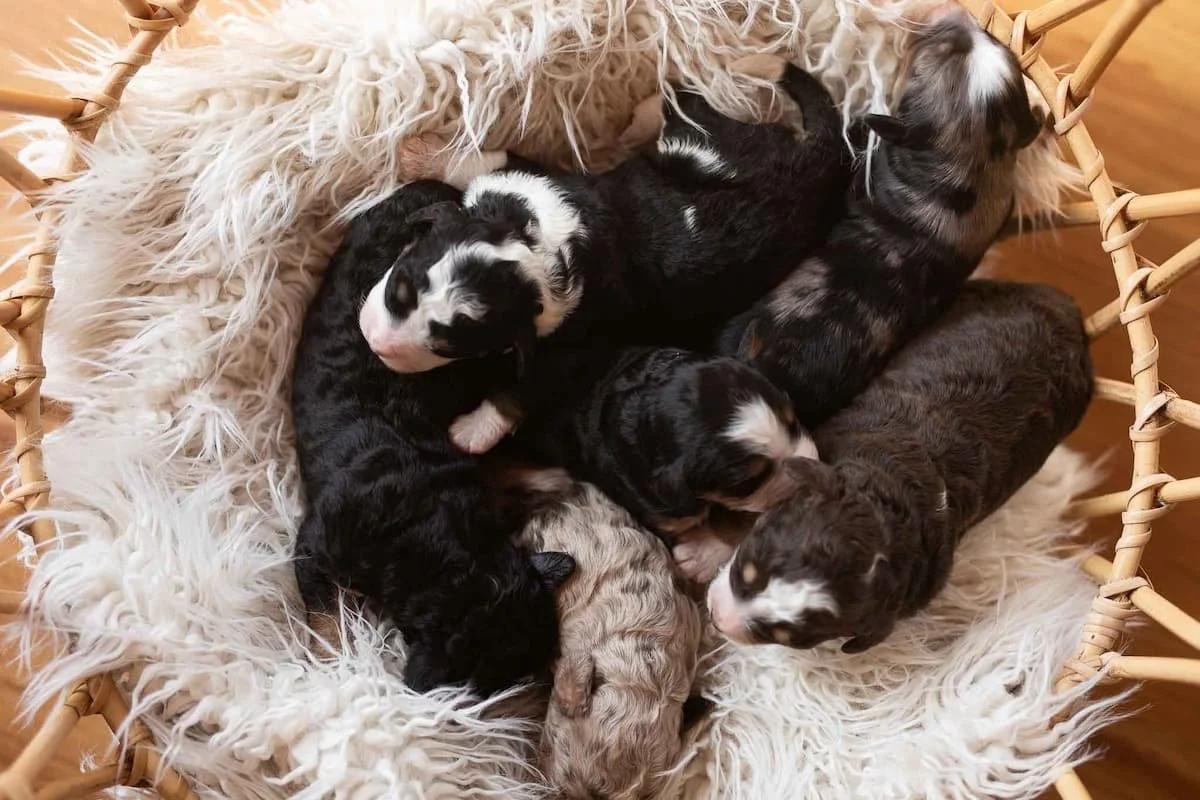
Bernedoodle Color Patterns Explained
Bernedoodle color comes from both parent breeds. The Bernese Mountain Dog contributes the iconic tri-color pattern — black, white, and rust. The Poodle introduces a broader palette of possibilities: phantom markings, sable tipping, parti patterning, solid colors, and — when the Poodle carries the merle gene — the striking marbled patterns that have become among the most sought-after in the breed.
Traditional Tri-Color
Black base with rust (tan) markings above the eyes, on the cheeks, legs, and chest, plus white markings on the face, chest, and feet. This is the pattern that pays direct homage to the Bernese Mountain Dog heritage and remains the most recognized and sought-after Bernedoodle color. The symmetry and placement of markings vary by individual — no two tri-color Bernedoodles look exactly alike.
Merle
A mottled or marbled pattern caused by the merle gene (M-locus) affecting pigment distribution. The base color is diluted in irregular patches, creating a speckled or dappled effect. Merle is not naturally found in purebred Bernese — it enters the Bernedoodle through Poodle parents that carry the merle allele. Variations include blue merle (grey/black marbling), chocolate merle (brown/cream marbling), and red merle (red/apricot marbling). Often paired with blue or heterochromatic (two-colored) eyes.
Phantom
A specific two-tone pattern with a solid dark base color (black, chocolate, or red) and distinct lighter markings in defined locations: above the eyes, on the cheeks, on the chest, on the legs, and under the tail. Phantom patterning resembles the markings of a Doberman or Rottweiler. The contrast between base and points can be dramatic — deep black with rich tan is the most classic phantom combination in Bernedoodles.
Sable
Sable Bernedoodles have hair that is one color at the base but tipped with black or dark brown. The puppy coat often appears dark and richly colored. As the dog matures and is groomed, the dark tips are trimmed away through successive haircuts, gradually revealing the lighter base color — a process sometimes called "clearing." An 8-week sable puppy may look dramatically different from the same dog at two years old. Base colors range from deep red to apricot to cream.
Parti
A Bernedoodle whose coat is at least 50% white with large, irregular patches of another color — typically black, chocolate, or red. Parti patterning creates a bold, high-contrast appearance. The distribution of colored and white areas is random and varies widely between individuals. "Tuxedo" is a specific parti variant where the white is concentrated on the chest, giving the appearance of a formal shirt front.
Solid Colors
Bernedoodles can appear in solid black, chocolate brown, cream, apricot, red, or silver. Solid-colored Bernedoodles are less common than patterned individuals because the Bernese parent contributes a strong genetic push toward multi-color patterning. Solid black is the most frequent solid color. Solid cream or apricot Bernedoodles may result from the recessive red (e/e) genotype inherited from the Poodle side.
Tri-Merle
The most visually striking Bernedoodle color: a merle base overlaid with the traditional Bernese tri-color markings — rust points, white chest, and merle marbling across the body. This combines the Bernese heritage pattern with the Poodle's merle gene, creating what is sometimes described as a "cookies and cream" appearance. Tri-merle Bernedoodles are among the rarest and most highly valued color patterns. Production requires a merle Poodle parent paired with a non-merle Bernese or Bernedoodle.


The Genetics Behind Bernedoodle Color
Bernedoodle color is not random. It is determined by multiple genetic loci — each controlling a different aspect of pigment production, distribution, and expression. Understanding these loci explains why certain colors are common, why some are rare, and why two Bernedoodles from the same litter can look dramatically different.
| Locus | Gene | What It Controls | Bernedoodle Relevance |
|---|---|---|---|
| A-Locus | ASIP (Agouti) | Pattern distribution — where dark and light pigments appear on the body | Controls tri-color (at) vs. sable (ay) vs. solid (a) patterning. The Bernese contributes the tan-point (at) allele responsible for the classic tri-color look. |
| B-Locus | TYRP1 (Brown) | Whether eumelanin (dark pigment) is black or brown | Two copies of the recessive allele (bb) produce chocolate/brown instead of black. Chocolate tri-color and chocolate merle Bernedoodles carry bb. |
| E-Locus | MC1R (Extension) | Whether eumelanin can be expressed at all | The recessive red genotype (e/e) prevents all dark pigment, producing cream, apricot, or red Bernedoodles regardless of other loci. Also masks merle — a dog can be genetically merle but appear solid cream. |
| K-Locus | CBD103 (Dominant Black) | Whether the A-locus pattern is expressed or overridden | KB (dominant black) overrides the A-locus pattern, producing solid black. ky allows A-locus patterns to show through. Bernese typically carry ky/ky, allowing tri-color expression. |
| M-Locus | PMEL/SILV (Merle) | Random dilution of eumelanin — the marbled/mottled pattern | One copy (M/m) = merle pattern. Two copies (M/M) = double merle with serious health risks. Not naturally found in Bernese — enters through Poodle lineage. |
| S-Locus | MITF (White Spotting) | Distribution and extent of white markings | Controls the white on chest, face, feet, and blaze. Bernese are genetically coded for specific white placement; Poodle influence can modify the extent. |
This is why genetic testing matters for color — and for health. A dog that appears solid cream may be genetically merle (hidden by the e/e recessive red), which poses a danger if bred to another merle. Visual coat assessment alone is never sufficient to determine breeding safety when merle genetics are involved.
The Fading Gene: Why Bernedoodle Coats Change Color
One of the most common surprises for new Bernedoodle owners is discovering that their puppy's coat color changes — sometimes dramatically — as the dog matures. This is caused by the progressive graying gene, commonly called the "fading gene," inherited from the Poodle parent.
How Fading Works
The progressive graying gene causes the melanocytes (pigment-producing cells) in the hair follicle to gradually reduce their output over time. The result is a slow, continuous lightening of the coat color across the first one to three years of the dog's life. The fading process is not a health concern — it is a normal genetic expression that affects aesthetics only.
What Fading Looks Like
Deep jet black coats may soften to silver, blue, or charcoal grey. Rich chocolate browns may lighten to café au lait, silver-beige, or warm taupe. Vibrant reds may fade to apricot, golden, or cream. The degree of fading varies significantly by individual — some dogs fade only slightly, producing a mature "silvered" effect, while others lighten dramatically. Dogs with two copies of the fading gene typically fade more than those with one copy.
Sable "Clearing" vs. True Fading
Sable Bernedoodles undergo a different color change process that is sometimes confused with fading. In sable dogs, the hair is dark-tipped over a lighter base. As the dog is groomed and the dark tips are trimmed away, the lighter base color becomes more visible — this is called "clearing." True fading, by contrast, is a pigment-cell process that occurs regardless of grooming. A sable Bernedoodle may experience both clearing and fading simultaneously, which can produce substantial color change from puppyhood to adulthood.
The puppy you bring home at 8 weeks may look noticeably different at 2 years old. Black may become silver. Chocolate may become café au lait. Red may become apricot. This is genetically normal and does not indicate a health problem. Breeders should prepare families for the possibility of color change, and families should choose based on temperament, health, and breeder quality — not on puppy coat color, which may not persist. At Stokeshire, we discuss the fading gene with every family during the matching process so there are no surprises.
Merle Genetics & Double-Merle Safety
The merle pattern is among the most visually striking coat variations in Bernedoodles — and one that carries the greatest ethical responsibility for breeders. Understanding merle genetics is essential for any family considering a merle Bernedoodle or any breeder producing them.
How Merle Works
The merle gene (M-locus, PMEL/SILV) is a dominant modifier that randomly dilutes eumelanin — the black or brown pigment — in the coat. This creates the marbled, speckled, or dappled appearance. Dogs with one copy of the merle allele (M/m — heterozygous merle) display the merle pattern and carry no increased risk of sensory impairment from the gene itself.
Merle is not naturally found in the purebred Bernese Mountain Dog. In Bernedoodles, it enters exclusively through the Poodle parent. Any Bernedoodle displaying a merle coat pattern definitively carries Poodle (or other non-Bernese) genetics — this is a useful genetic marker for confirming lineage.
The Double-Merle Danger
When two merle-carrying dogs are bred together, approximately 25% of the resulting litter will be homozygous merle (M/M) — "double merle." These puppies inherit two copies of the dominant M allele, causing an extreme reduction in melanocytes during embryonic development. Melanocytes are not only responsible for coat color — they are essential for the proper development of the inner ear and the eye.
| Genotype | Appearance | Sensory Risk |
|---|---|---|
| m/m (Non-Merle) | Solid base color | No increased risk from merle gene |
| M/m (Single Merle) | Marbled/mottled pattern; often blue or odd eyes | Minimal — standard health profile |
| M/M (Double Merle) | Predominantly white; extreme pigment loss | High risk of bilateral deafness (up to 56% in published studies) and visual impairments including microphthalmia, cataracts, and colobomas |
| Mc/m (Cryptic Merle) | Appears solid — merle gene is hidden | No direct health risk, but dangerous for breeding if paired with another merle |
Cryptic Merle: The Hidden Risk
Cryptic merles are dogs that carry a short version of the merle insertion — enough to pass the gene to offspring but not enough to produce a visible merle pattern. These dogs appear solid-colored and may be mistakenly identified as non-merle. If a cryptic merle is bred to a visible merle, approximately 25% of the litter will be double merle. This is why DNA testing for the M-locus is the only reliable way to identify merle status. Visual coat assessment is not sufficient.
The recessive red genotype (e/e) presents an additional masking risk. A dog that is genetically merle but also e/e will appear solid cream, red, or apricot — the merle pattern is invisible because there is no eumelanin to dilute. These dogs can still produce merle or double-merle offspring.
Stokeshire's Merle Breeding Protocol
Stokeshire confirms merle status via Embark DNA testing on every breeding dog before any pairing is made. We breed merle dogs only to confirmed non-merle partners. We test for cryptic merle and recessive red masking. The production of double-merle puppies is entirely preventable with proper genetic testing, and we consider any breeder who does not test for the M-locus before merle pairings to be operating below the ethical standard of care.
How Generation Affects Color Availability
The colors available in a Bernedoodle litter depend on the genetics of both parents — and which generation the litter represents. Certain colors are only possible when specific alleles are present in the Poodle parent.
| Generation | Common Colors | Merle Possible? | Notes |
|---|---|---|---|
| F1 | Black tri, phantom, sable, parti | Only if Poodle parent carries M allele | Classic Bernese tri-color is the most common F1 outcome. Merle requires a merle Poodle parent. |
| F1B | All colors including merle | Yes — if Poodle parent carries M | Wider color diversity due to backcross to Poodle. Sable and phantom more common. Fading gene more likely. |
| Reverse F1B | Black tri dominant, limited variety | Unlikely unless F1 parent was merle | Bernese backcross strongly pushes toward tri-color patterning. |
| F2 | All colors — highest variability | If either F1 parent carries M | Widest range of outcomes. Recessive colors (chocolate, solid red) may appear unexpectedly. |
| Multigen | Stabilized by breeder selection | Yes — if in the line | Breeders select for specific color goals across generations. Most predictable color outcomes. |
Color, Health & What Actually Matters
The market demand for specific Bernedoodle colors — particularly rare merle and tri-merle patterns — has created pricing tiers where coat color significantly influences puppy cost. While we understand the aesthetic appeal of striking coat patterns, Stokeshire's position is clear: color should never be the primary criterion for selecting a puppy or a breeder.
The most important factors in selecting a Bernedoodle remain: parent health testing (Embark genetic panels, hip evaluation, eye certification), temperament assessment, socialization protocol, and the breeder's transparency about genetic outcomes. A genetically sound, well-socialized black Bernedoodle from health-tested parents is a better long-term companion than a merle Bernedoodle from untested parents with unknown health profiles.
Families who have a color preference should communicate that clearly — breeders can often match families with upcoming litters that are likely to produce specific patterns based on parent genetics. But the family that falls in love with temperament and health first, and color second, is the family most likely to have a positive 15-year experience with their dog.
The most beautiful Bernedoodle is the healthy one that fits your family. Every other consideration — including color — is secondary.
Bernedoodle Color FAQs
What is the most popular Bernedoodle color?
Why did my Bernedoodle's coat color change?
What is a merle Bernedoodle?
Is it safe to breed two merle Bernedoodles together?
What is a cryptic merle Bernedoodle?
What is a phantom Bernedoodle?
What is a sable Bernedoodle and does the color change?
Do rare Bernedoodle colors cost more?
Can you predict what color a Bernedoodle puppy will be?