
Your Puppy’s First
Vet Visit.
What to expect, what to bring, and the conversations that matter most during your puppy’s first veterinary appointment.
Before You Go
Book the appointment within 72 hours of completing your puppy checkout — while your puppy is still in our care. The exam itself must be completed within the first 7 calendar days of go-home, per the binding language in your Purchase Agreement and the authoritative terms on our Legal page.
This window does two things. First, it establishes your puppy’s baseline with your veterinarian and ensures a smooth handoff from our medical team to yours. Second, it activates your 3-Year Health & Wellness Partnership Guarantee the moment you take custody. Miss the window and the guarantee will not activate.
Stokeshire puppies come home with a Certificate of Veterinary Inspection (CVI), vaccination records, and deworming history. Bring everything we sent home with you.
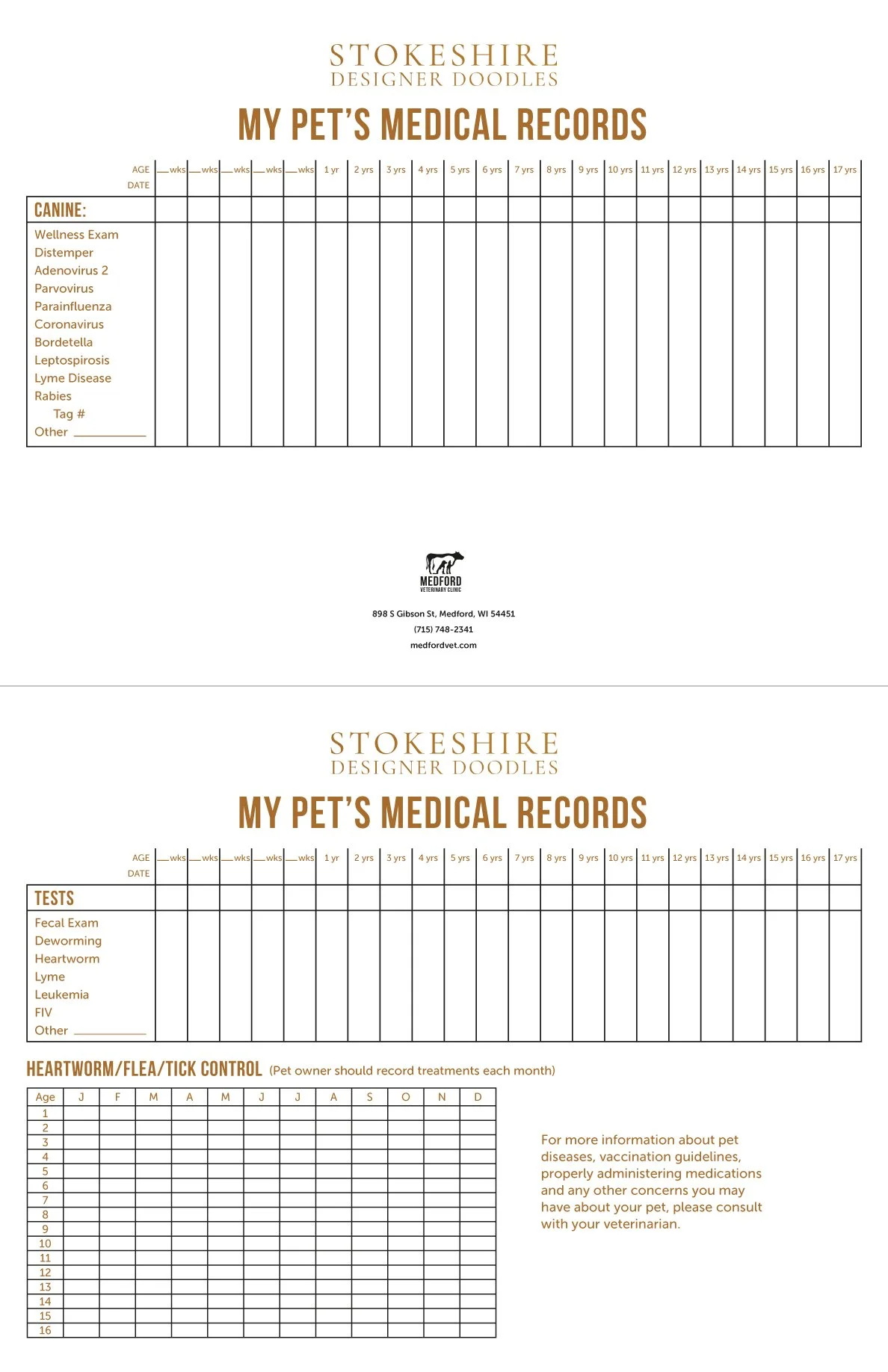
The Stokeshire health record you received with your puppy. Bring this to your first vet visit.
First Vet Visit Checklist
Your puppy received deworming during their time with us. We often send home an additional 8–10 week dose in your puppy bag. Mention the brand to your vet and ask to be placed on their recommended schedule going forward. Also discuss flea and tick prevention appropriate for your area.
What Happens During the Visit
At your puppy’s 6-week appointment with us, our veterinarian has already performed a comprehensive wellness exam. Your vet will now repeat this process to establish their own baseline and continue your puppy’s care.
If you go home with medications or treatments, make sure you understand when and how they are to be given. Follow directions precisely, and set up a schedule for follow-up visits and vaccinations before you leave. Email your exam documentation to hello@wisconsindesignerdoodles.com so we can file it with your puppy’s records.
Vaccination Schedule
Core vaccination is a three-dose series. Your puppy begins that series at Stokeshire and your veterinarian completes it. Exactly which doses your puppy has received depends on their age at go-home — the vial sticker and lot number on your Stokeshire health record is the authoritative record. Bring it to your first appointment.
Puppies remain vulnerable to parvovirus until the full series is complete. Until your veterinarian confirms the series is finished, limit contact with unknown dogs and avoid dog parks, pet store floors, rest stops, and other unvetted public ground.
DHPP covers distemper, hepatitis (adenovirus), parainfluenza, and parvovirus. DHLPP adds leptospirosis — the “L.” Leptospirosis is generally not started until around 9 weeks of age, so the first dose is typically DHPP and leptospirosis is added at the later doses. If your health record reads DHPP rather than DHLPP, this is the reason. Your veterinarian will continue the series with the combination appropriate to your puppy’s age and region.
Core Series — Three Doses
Adverse reactions are uncommon. Mild symptoms can include soreness at the injection site, low-grade fever, mild lethargy, or brief loss of appetite, and these typically resolve within 24–48 hours. If you observe facial swelling, vomiting, difficulty breathing, or collapse, contact your veterinarian immediately. We recommend scheduling vaccinations when you are able to monitor your puppy afterward.
This schedule reflects the Stokeshire protocol and standard veterinary practice for medium and large-breed puppies. Regional disease pressure, individual health history, and your veterinarian’s clinical judgment may warrant adjustment. Your veterinarian’s recommendation governs. If you would like a second perspective on any recommendation, we are always available to talk it through.

Medford Veterinary Clinic
Every Stokeshire puppy begins care under our partner veterinarian at Medford Veterinary Clinic, where the first wellness exam, initial vaccinations, and Certificate of Veterinary Inspection are completed before go-home. The records you receive originate here — and your own veterinarian continues the care from that foundation.
Visit Medford VetNutrition & Controlled Growth
One topic that sometimes comes up during the first vet visit is puppy food vs. all-life-stages nutrition. Many veterinary clinics are trained to recommend high-calorie “puppy growth formulas” designed to maximize growth speed during the early months of development.
While these formulas can be appropriate in some situations, breeders who raise medium and large-breed dogs often focus on something slightly different: steady, controlled growth rather than rapid growth.
When puppies grow too quickly — especially during the first year — their bones can lengthen faster than joints, tendons, and ligaments can comfortably support. In some dogs this can contribute to temporary developmental issues.
Our goal is simple: healthy puppies who develop strong bodies, stable temperaments, and long, active lives. We prefer diets that support balanced development rather than maximum growth rate.
Nutritional Profile of the Food We Recommend
The diet your puppy has been started on is formulated to support balanced development, digestive health, and steady growth.
Every veterinarian may have slightly different nutritional preferences, and we always encourage families to maintain a good working relationship with their vet. What matters most is that your puppy is growing steadily, maintaining healthy body condition, and developing normally. If your veterinarian recommends dietary changes and you would like a second perspective, we are always happy to talk through it with you.
Topics to Discuss at Your First Visit
Throughout your first vet visit, the veterinary team will discuss many aspects of puppy care. Come prepared to ask about:
Exercise & Play
Age-appropriate activity levels, safe play intensity, and how to protect developing joints during the first year.
Coat Care & Grooming
Ask specifically about ear and coat health as it relates to Poodle and Doodle breeds — moisture in the ear canal and mat prevention are breed-specific considerations.
Dental Care
Ask about gingivitis, which can progress to periodontal disease. Establishing dental hygiene early prevents serious issues later.
Spay & Neuter Timing
Discuss the benefits and risks relative to your puppy’s breed, size, and development stage. Timing matters.
Parasite Prevention
Flea, tick, heartworm, and internal parasite control. Ask about products appropriate for your geographic region.
Socialization & Behavior
Safe socialization windows, puppy classes, and early behavioral guidance — especially if your puppy completed Doodle School™.
After Your Visit
Expect that your puppy may be a little subdued for a day or two after their first vet visit — especially if vaccinations were administered. This is normal.
Once the wellness exam is complete, email a copy of the exam summary to hello@wisconsindesignerdoodles.com. We file it with your puppy’s records and use it to confirm activation of your Health Guarantee. This step is required.
Treat your puppy generously throughout the vet visit with praise and high-value treats. Vet techs are excellent at this — let them help. The goal is to build a positive association with the veterinary experience that lasts their entire life. Dogs who enjoy (or at least tolerate) vet visits are safer, easier to examine, and receive better care.
Questions About Your Puppy’s Health?
We are always available to discuss your puppy’s veterinary care, nutrition, or any concerns that come up during the transition home.