Guardian Portal.
Resources, protocols, and program information for approved and active Stokeshire Guardian families.
Salmon & Potato
Simparica not allowed
Any vet visit or health change
Of confirmed pregnancy
You are part of
how this works.
Guardian families are not a vendor relationship. You are the reason every Stokeshire breeding dog grows up in a home — with routine, love, and the kind of daily life that shapes a well-adjusted dog and a stable litter.
This portal is your reference for the practical side of that partnership: what to watch for, what to feed, how to communicate, and what happens at each stage of the program. Use it as a living resource. Reach out to Stokeshire whenever something is unclear.
The information here supersedes any older documentation you may have received. If you see a discrepancy between this page and earlier materials, this page reflects current standards.
hello@wisconsindesignerdoodles.com
715-570-5718
W4954 County Rd O, Medford WI 54451
What Guardians provide.
All progesterone testing, cytology, ultrasounds, radiographs, breeding and whelping veterinary care, and litter-related expenses not covered by insurance.
Full Embark genetic panel, COI analysis, and all necessary health evaluations for breeding candidacy — completed at Stokeshire's expense before the breeding program begins.
Spay or neuter at program conclusion, performed at Medford Veterinary Clinic at 100% Stokeshire's expense. Dog retires permanently into your family.
Understanding her cycle.
Dams typically cycle every 6–10 months. Log day-by-day changes in spotting, swelling, and behavior and send a quick update to Stokeshire — these details allow us to time breeding responsibly.
Notify Stokeshire immediately when you observe the first signs of heat. Also notify us when your dog has her first cycle (typically 9–12 months of age) so we can anticipate her next one.
| Stage | Duration | What you’ll observe |
|---|---|---|
| Proestrus | 7–10 days | Vulva swelling, bloody discharge. Not receptive to males. |
| Estrus | 5–14 days | Fertile window. Receptive to mating. Color lightens to straw. |
| Diestrus | 60–90 days | Return to baseline or supports pregnancy if bred. |
| Anestrus | ~4 months | Hormonal rest between cycles. |
Breeding Drop-off
When she comes
to Stokeshire.
As soon as you are aware your dog has entered heat, contact Stokeshire. We will coordinate a drop-off by day 5–7 of the heat cycle. She will remain with us for approximately one week during the breeding window, then return home.
During this time, keep her environment calm. Avoid introducing new foods, supplements, or medications. Limit strenuous activity — light exercise and leashed walks only.
The transition from your home to Stokeshire is typically smooth. She was born here and recognizes the environment, smells, and people. Most dogs are settled and comfortable within an hour or two of arrival.
Pregnancy
Week by week
what to expect.
Postpartum Recovery
After she comes
home.
— Mild itching associated with shedding
— Increased thirst and appetite while milk dries
— Light discharge up to two weeks post-whelp
— Fatigue, extra naps, occasional clinginess
These are temporary and resolve with stable diet, hydration, and calm routine.
— Ear odor or discharge (possible yeast)
— Swollen, hot, or painful mammary glands
— Refusal to eat or drink; lethargy or distress
— Loose stool lasting more than 48 hours or vomiting
— Pale or white gums with weakness or fast breathing
Mastitis: Watch for swollen, hot, firm, or painful mammary glands, reluctance to lie on one side, fever, or lethargy. Apply warm compresses (5–10 minutes, 3–4×/day) and contact Stokeshire immediately. Do not delay — mastitis can escalate quickly.
Skin and coat flares after weaning are common and typically related to hormonal shifts and nutritional draw-down during nursing. Return strictly to the approved Diamond Naturals diet, add salmon oil 2–3×/week and a probiotic 3–4×/week. Most flares resolve within 6–8 weeks once triggers are removed. Do not shave close — maintain at least a 1” guard length.
Pale or white gums: Brief paleness can accompany hormonal shifts, but gums that remain pale — especially with weakness, rapid breathing, or lethargy — require prompt contact with Stokeshire and your veterinarian.
Seeing her puppies.
Dam guardians are welcome to visit Stokeshire once puppies reach at least 4 weeks of age. Visits are limited to approximately one hour given our nursery schedule. Gloves and masks are required for any puppy contact. We will do our best to accommodate a meaningful visit — please coordinate timing with Stokeshire in advance.
Raising an
intact male.
Stud dogs are typically ready for breeding between 10–18 months of age, once they reach reproductive and structural maturity. Most Stokeshire studs are not used frequently — the breeding schedule is determined entirely by program demand and Stokeshire’s litter calendar.
Living with an intact male requires some additional management. He will be aware of cycling females in the neighborhood and may exhibit more interest in escaping or marking, particularly during active breeding season. A fenced yard and consistent leash habits are essential.
His temperament, structure, and coat condition are a direct reflection of his home environment. Guardian studs are ambassadors for the program and should be well-groomed, well-socialized, and well-mannered.
Studs stay at Stokeshire for approximately 3–5 days per breeding cycle. Stokeshire will provide advance notice of the window. In some cases, pickup transport can be arranged through Stokeshire’s transporter network. Most stud guardians find the schedule easy to accommodate.
Stud guardians on the 50% Placement Track receive $100 per confirmed sired litter, issued after puppies have gone home. Free Placement stud guardians receive no per-litter payment — the dog’s market value ($4,500–$5,500) was gifted as compensation at placement.
Behavioral management
Managing an
intact male well.
Retirement
When the program
concludes.
When Stokeshire determines that a stud has completed his breeding career — based on age, health, or program needs — he will be neutered at Stokeshire’s expense at Medford Veterinary Clinic and permanently retired into your family. Timing will be communicated in advance.
If at any point a stud does not meet breeding standards, he will be neutered and retired early at no cost to the Guardian family. The program’s commitment to the dog does not change based on breeding outcome.
The required diet for all Stokeshire Guardian dogs is Diamond Naturals Skin & Coat — Salmon & Potato. Feed twice daily with fresh water available at all times. This formula is a single-protein fish diet that supports coat recovery, hormone stability, and digestive consistency across our program.
The following require written approval from Stokeshire before use: switching brand, formula, or protein source; chicken or multi-protein kibbles; pea/lentil-heavy grain-free diets; raw or home-cooked diets; any "performance" or bargain feed.
Unauthorized diet changes may impact breeding eligibility and may result in the Guardian family being responsible for any related veterinary costs. Salmon oil (2–3×/week) and probiotic support during recovery are encouraged — advise Stokeshire before adding anything new.
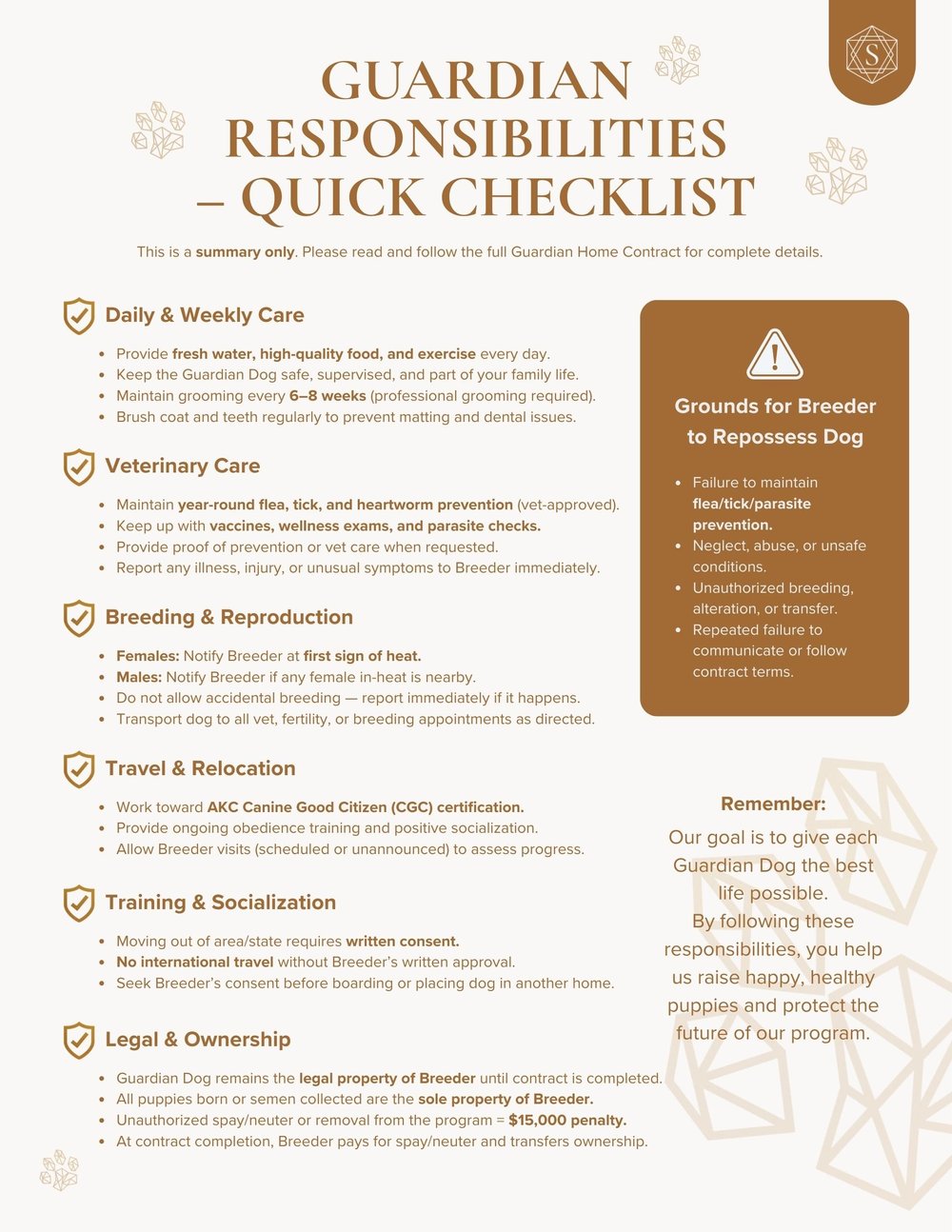
Approved flea/tick preventative: Bravecto. Simparica and Simparica Trio are not allowed under any circumstances.
Heartworm prevention requires Stokeshire approval before use. Contact us and we will advise on timing relative to breeding cycles.
The following require breeder approval before starting: steroids (e.g., Prednisone), Apoquel, Cytopoint, hormonal therapies, any new or long-term prescription. If your vet recommends one of these, have them contact Stokeshire directly — we collaborate to keep your dog safe while addressing health needs.
No medications or supplements may be given during pregnancy without explicit approval. This includes flea prevention, supplements, and all prescription items. Guardian families are responsible for all medication costs that fall outside of breeding-related care.
Stokeshire covers: All progesterone testing, cytology, ultrasounds and radiographs, genetic health testing (Embark panel), breeding-related veterinary care, whelping and nursery care, litter-related expenses not covered by insurance, and spay/neuter at retirement.
Guardian covers: Annual wellness exams, core vaccinations, flea/tick and heartworm prevention (approved products), routine wormings, grooming, food, equipment (dishes, leashes, beds, toys), and any illness or injury unrelated to pregnancy or breeding. Surgical pet insurance is required and is the Guardian’s responsibility to maintain.
Stokeshire must be notified of and involved in all treatment decisions, even when the Guardian bears the expense. Do not begin treatment for any serious condition without first contacting us.
Guardian families are fully responsible for transporting the dog to and from Stokeshire for breeding, whelping, health testing, and any other program-related visit. Stokeshire does not pick up or drop off dogs.
Drop-off and pickup windows are coordinated with advance notice. If you are unable to transport within 1–2 days of the scheduled window, it is your responsibility to arrange an alternative. Stokeshire’s transporter network may be available at a cost of $100 per trip — contact us to check availability. This is not guaranteed and should not be relied upon as a primary plan.
Dam guardians must return dogs by Day 52 of pregnancy without exception. Plan your schedule around this date once pregnancy is confirmed.
Dams cycle every 6–10 months. Current veterinary literature supports breeding back-to-back without skipping heat cycles when the dog is healthy, as this is physiologically less demanding than cycles without pregnancy. Stokeshire follows this standard.
A dam will not be bred before 12 months of age or after 6 years. Most females average 4–6 litters over the course of the program. If a female experiences complications or would be unhealthily served by another breeding, Stokeshire will conclude her program early and arrange retirement.
Stokeshire aims not to let more than one year pass between breedings without a medical reason. You will be given advance notice of all scheduled breeding windows.
Guardian dogs are ambassadors for the Stokeshire program and will be photographed regularly. They must be well-maintained, clean, and presentable. Stokeshire does not require a specific grooming style — work with a groomer you trust.
Discounts with Stokeshire’s in-house groomer are available to Guardian families, as is use of the Stokeshire grooming facility. Contact us to schedule.
Stokeshire retains the right to bathe and groom your dog during program visits to ensure cleanliness for whelping and nursery care. During skin recovery periods, maintain at least a 1” guard length and avoid close shaving, which can slow coat regrowth and expose skin to irritants.
Stokeshire offers complimentary boarding to Guardian families when space and scheduling allow. This is a genuine program benefit, not a guaranteed service. Contact Stokeshire well in advance to check availability and arrange dates.
Boarding at Stokeshire also serves the program: your dog benefits from time with familiar people, and Stokeshire can do any needed health checks or observations during your dog’s stay.
If your household relocates during the program, contact Stokeshire immediately. An updated Guardian Home Contract must be executed to maintain compliance under Wisconsin DATCP License #514401-DS.
Dam guardians must remain within 120 miles of Medford, Wisconsin. A move outside this radius may affect program eligibility. Stud guardians may reside anywhere in the United States and are not subject to a geographic restriction.
Stokeshire conducts thorough Embark genetic screening and health evaluation before any dog enters the breeding program. In the rare event that a placed dog does not meet breeding standards, Stokeshire will spay or neuter the dog at Stokeshire’s expense and the dog is awarded permanently to the Guardian family.
Breeding quality and pet quality are different standards. A dog that does not qualify for breeding may still be an outstanding companion and family dog. Stokeshire does not reclaim dogs on this basis.
The formal agreement governing the Guardian Home Program under Wisconsin DATCP License #514401-DS. Covers breeding rights, responsibilities, compensation, relocation, and retirement terms.
The initial application for families interested in the Guardian Home Program. If you are already an active Guardian, you do not need to reapply — contact Stokeshire directly for program questions.
Adult dogs available for adoption or Guardian placement. Retired program dogs are spayed/neutered and available to approved adopter families. If your dog is retiring, Stokeshire will communicate the timeline directly with you.
Stokeshire Designer Doodles operates under Wisconsin DATCP Dog License #514401-DS, Tier 100–249 dogs per year. License renews annually October 1 – September 30 and is publicly verifiable through the Wisconsin DATCP.