
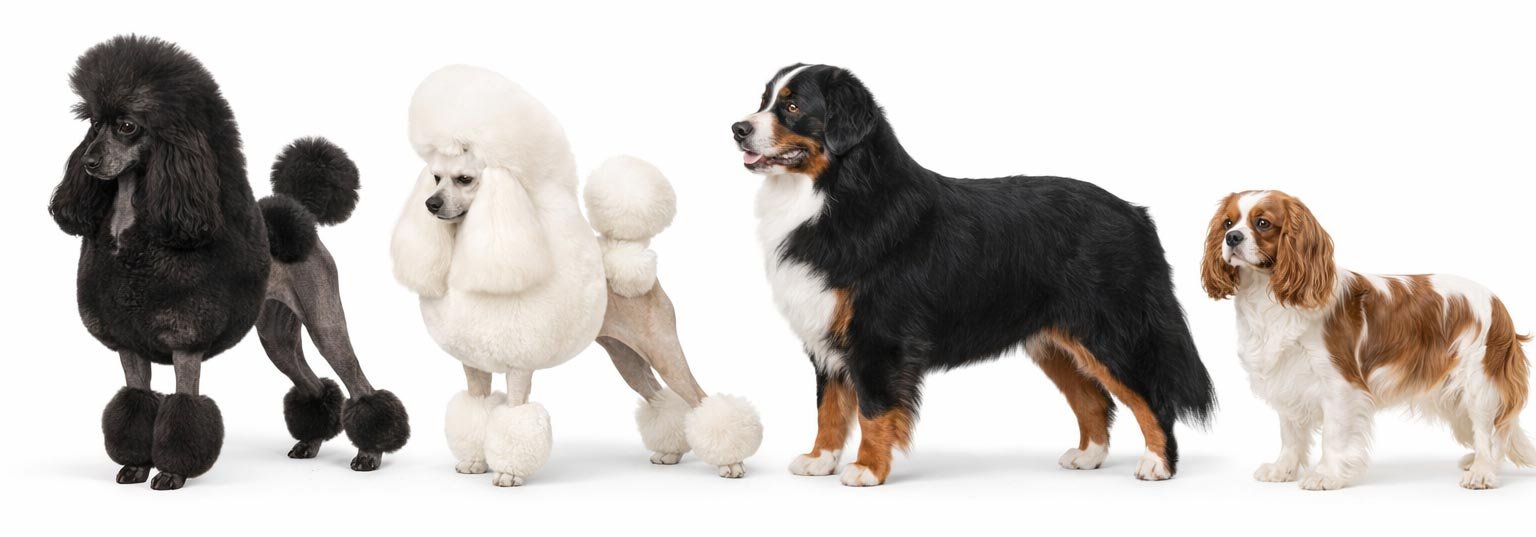
A lineup of Poodles, a Bernese Mountain Dog, and a Cavalier King Charles Spaniel used in Munchkin Bernedoodle breeding.
Petite.
Proper.
Proven.
A thoughtfully downsized Bernedoodle — developed across generations for joint integrity, stable temperament, and long-term health. Not a trend. Not a shortcut. A small dog, built right.
Munchkin Bernedoodles
are intentionally petite,
not genetically dwarfed.
At Stokeshire, the term "Munchkin" refers to a thoughtfully downsized Bernedoodle achieved through multi-generation breeding. It does not involve skeletal dwarfism, compressed timelines, or extreme miniaturization.
Programs that attempt to reduce size too quickly — stacking small lines or overusing a single breed contribution — may produce smaller puppies faster but often increase orthopedic, cardiac, or neurological risk over time.
This guide outlines what a Munchkin Bernedoodle should be, how ethical breeding prioritizes health and longevity over novelty, and how Stokeshire approaches the work differently.
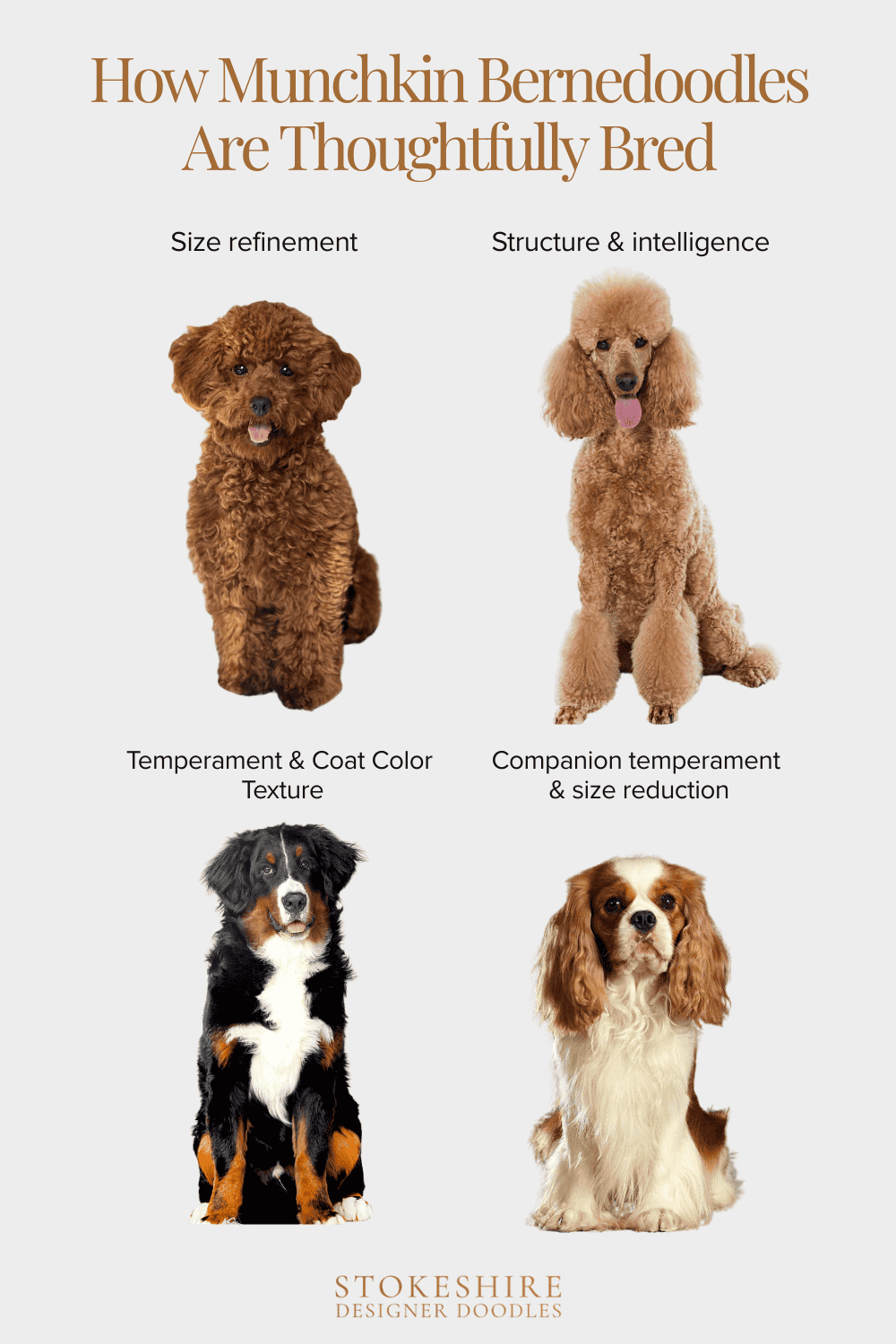
True petite Bernedoodles are developed across multiple generations. Stokeshire begins with a Bernese Mountain Dog × Miniature Poodle foundation, then introduces Toy Poodle lines slowly to maintain joint health and proportional balance.
Cavalier King Charles Spaniel lines bring affiliative temperament — but also known cardiac and neurological risk. We introduce them at low percentages, only after structural stability is established, and only with cardiac-cleared breeding dogs.
Hips, elbows, eyes (PRA, cataracts), cardiac evaluation, and full genetic panels — performed across the program, not selectively. We avoid redundant pairings that increase recessive expression. The result is documented, not assumed.
A true petite Bernedoodle: thoughtfully developed, structurally balanced, emotionally stable, and bred for 12–15 years of companionship.
The market has rewarded smaller dogs for years. The temptation, for any breeder, is to chase that demand by stacking the same small lines until the size goal is hit. The problem is that genetics don't compress that easily. Push too hard, too fast, and you concentrate the very risks that responsible breeding exists to manage — orthopedic instability, cardiac disease, neurological conditions.
At Stokeshire, the Munchkin program exists because there is a real, lasting demand for a smaller Bernedoodle that is still healthy, structurally sound, and emotionally regulated. We build that dog through patience — multi-generation planning, selective Cavalier introduction, comprehensive screening across the whole program.
If you are considering a petite Bernedoodle, the first thing to understand is that the breeder you choose matters more than the breed name. We're confident in how we approach this work. The pages below explain exactly what we do, and why.
How a true petite
Bernedoodle is built.
We begin with a foundational Bernese Mountain Dog × Miniature Poodle cross to establish strong structure and genetic diversity. Size is reduced gradually through the introduction of Toy Poodle lines, maintaining joint health and proportional balance.
Cavalier King Charles Spaniel genetics are introduced selectively and at low percentages, only after structural stability is established. This supports companion temperament without concentrating known cardiac or neurological risk.
Across generations, we prioritize genetic diversity and perform comprehensive structural, cardiac, and genetic screening — while avoiding redundant pairings that increase recessive expression.
The result is a true petite Bernedoodle: thoughtfully developed, emotionally stable, and bred for long-term health.
Where the Munchkin
Bernedoodle comes from.
Munchkin Bernedoodles are a designer hybrid developed by crossing a Bernedoodle (Bernese Mountain Dog × Poodle) with a Cavalier King Charles Spaniel. Toy or Miniature Poodles are often incorporated into the lineage.
Genetic
Composition
While not recognized by major kennel clubs, the term "Munchkin" describes an intentionally downsized, proportionate companion. The goal of this cross is to combine the Cavalier's affiliative temperament, the Poodle's cognitive responsiveness and coat qualities, and the Bernese's stability and structure within a smaller size range.
Development of this mix requires multi-generation planning to maintain consistency in size, temperament, and health outcomes.
What a properly built
Munchkin looks like.
10–30 pounds, 14–16 inches at the shoulder.
Soft, wavy to curly. Often described as low-shedding, though no dog is fully hypoallergenic.
Tricolor (black, white, rust); also bicolor, sable, merle, and tuxedo variations.
Compact, proportionate, structurally balanced. Limbs remain correctly proportioned without dwarfism traits.
Bred for stable,
human-focused engagement.
Strong attachment patterns. Close bonding with their household.
High responsiveness. Excellent fit for structured training.
Balanced activity profile. Settles well into daily life.
Generally integrate well with children and other pets.
Built for 12–15 years
of companionship.
Well-bred Munchkin Bernedoodles commonly reach 12–15 years. Longevity is influenced by genetics, structure, and breeding practices. Owners and breeders should be aware of these inherited risks across the three contributing breeds:
Hip or elbow dysplasia (Bernese), patellar luxation (Cavalier and Poodle).
Progressive Retinal Atrophy (PRA), cataracts, dry eye.
Mitral valve disease, particularly in Cavalier lines.
Syringomyelia risk — managed through Cavalier line selection.
Sensitivities and dermatologic conditions.
Present, but lower risk than full Bernese lineage.
Always seek breeders who prioritize comprehensive health screening — including hips, eyes, cardiac evaluation, and genetic panels — across the entire breeding program.
Begin the
conversation.
Our next Munchkin Bernedoodle litter is planned for 2027. Spaces on Selection Day are reserved for families whose alignment we've already confirmed. The first step is a placement request.
Begin Your Placement RequestAre Munchkin Bernedoodles dwarf dogs?
No. Ethically bred Munchkin Bernedoodles are not produced using skeletal dwarfism genes. Their smaller size is achieved through gradual, multi-generation breeding that preserves joint structure and limb proportion.
How is a Munchkin Bernedoodle different from a Mini or Micro Bernedoodle?
The difference is generational depth and breed contribution. A Mini Bernedoodle typically reaches its smaller size through one generation of Mini Poodle breeding. A Micro is pushed further with continued Toy Poodle integration. A Munchkin adds Cavalier King Charles Spaniel genetics for affiliative temperament, with the size goal achieved gradually across multiple generations rather than aggressively in one.
Is breeding Munchkin Bernedoodles ethical?
Yes — when approached with responsible breeding practices focused on joint health, cardiac screening, genetic diversity, and gradual size reduction. It becomes problematic when breeders compress the timeline to hit a size goal faster than the genetics allow.
Do Cavalier genes increase health risks?
Cavalier King Charles Spaniels can carry known cardiac (mitral valve disease) and neurological (syringomyelia) risks. Responsible programs limit Cavalier percentage, screen breeding dogs with cardiac evaluation, and avoid pairings that concentrate these risks. Stokeshire introduces Cavalier genetics only after structural stability is established — never as the foundation of the cross.
Are Munchkin Bernedoodles hypoallergenic?
No dog is completely hypoallergenic. However, many Munchkin Bernedoodles inherit low-shedding coats from the Poodle side, making them a good fit for some allergy-sensitive households. We always recommend spending time with a Bernedoodle before committing if allergy sensitivity is a primary concern.
Do they have shorter lifespans because they're small?
No. When bred responsibly, petite Bernedoodles often enjoy lifespans similar to or longer than standard Bernedoodles — commonly 12–15 years or more. Lifespan is determined far more by breeding practices and inherited risk management than by size alone.
What size will an adult Munchkin Bernedoodle be?
Adult Munchkin Bernedoodles typically weigh 10–30 pounds and stand around 14–16 inches at the shoulder. Within a single litter there is some natural variation. We provide projected adult size estimates for each puppy based on lineage and growth trajectory.
Are they good with children?
Yes. Munchkin Bernedoodles are typically gentle, social, and bond closely with the entire family. As with any small dog, supervision with very young children is recommended — not because of the dog's temperament, but to protect the dog from accidental rough handling. Older children typically integrate beautifully.
Are they good apartment dogs?
Yes, with appropriate daily exercise. Munchkin Bernedoodles are adaptable to apartments or smaller homes provided they receive 30–60 minutes of daily activity and consistent human engagement. They do best when their household is regularly present rather than absent for long stretches.
Do they shed?
Munchkin Bernedoodles are generally low-shedding due to their Poodle ancestry, but the exact amount varies by coat type. Curlier coats shed less than wavy coats. All coat types require regular brushing and professional grooming every 6–8 weeks.
Do they bark a lot?
Typically no. Munchkin Bernedoodles tend to be social and low-reactivity, with minimal guarding tendencies. Excessive barking is usually a training or environment issue, not a breed trait. Our dogs are raised with structured early exposure to reduce reactivity.
Are they good for first-time dog owners?
Yes — for the right home. Their affectionate nature, moderate energy, and trainability make them a strong choice for families, seniors, and first-time owners who can provide companionship and routine care. We support every placement with training resources, our Doodle School program, and lifetime breeder support.
What health testing do Stokeshire breeding dogs undergo?
Comprehensive: hip and elbow evaluation (OFA), eye certification (OFA/CAER), full cardiac evaluation by a veterinary cardiologist (especially Cavalier-line dogs), and Embark genetic panels covering 250+ inherited conditions. Results are documented and verifiable.
Can they be trained as therapy or service dogs?
Munchkin Bernedoodles often have the temperament foundation for therapy work — affectionate, low-reactivity, intelligent. Service work depends on the individual dog and the demands of the role. Our Doodle School program supports families pursuing structured training pathways.
How long does it take to get a Stokeshire Munchkin Bernedoodle?
Our next Munchkin Bernedoodle litter is planned for 2027. Families who submit a placement request are reviewed in order of submission and alignment. Match Day spaces are limited and reserved for families whose fit we have already confirmed.
What does a placement request commit me to?
Nothing. Submitting a placement request is the first step in a conversation — not a deposit, not a contract. A $500 deposit is only required after a specific puppy match is confirmed by our team and you've reviewed the details with James directly.
What owning a
Munchkin looks like.
Grooming & Care
- BrushingSeveral times per week. Daily for curlier coats.
- Professional GroomingEvery 6–8 weeks.
- BathingAs needed, with gentle products.
- Routine CareEar, nail, and dental maintenance.
Exercise & Diet
- Activity30–60 minutes of daily exercise.
- DietHigh-quality small-breed food, with portion control.
- SensitivitySome need adjustments for allergies or sensitive stomachs.
- TemperamentEasygoing; integrates well into daily life.
Ideal Home
- Apartments or HousesSuitable with daily activity.
- FamiliesBenefit from structure and routine.
- IndividualsWell-suited for engaged companionship.
- SchedulesPerform best with regular human presence.
If you'd prefer to speak with someone before submitting a placement request, schedule a virtual call. We're happy to walk you through the process and answer any questions.
Schedule a CallIf you haven't yet reviewed how placement works at Stokeshire — from application to Selection Day to go-home — the Process page is the best place to start.
How Placement WorksIf you'd like to see what breeds and litter timelines are currently planned before submitting your request, our litter page is updated as pairings are confirmed.
Upcoming Litters