
Are merle poodles purebred?
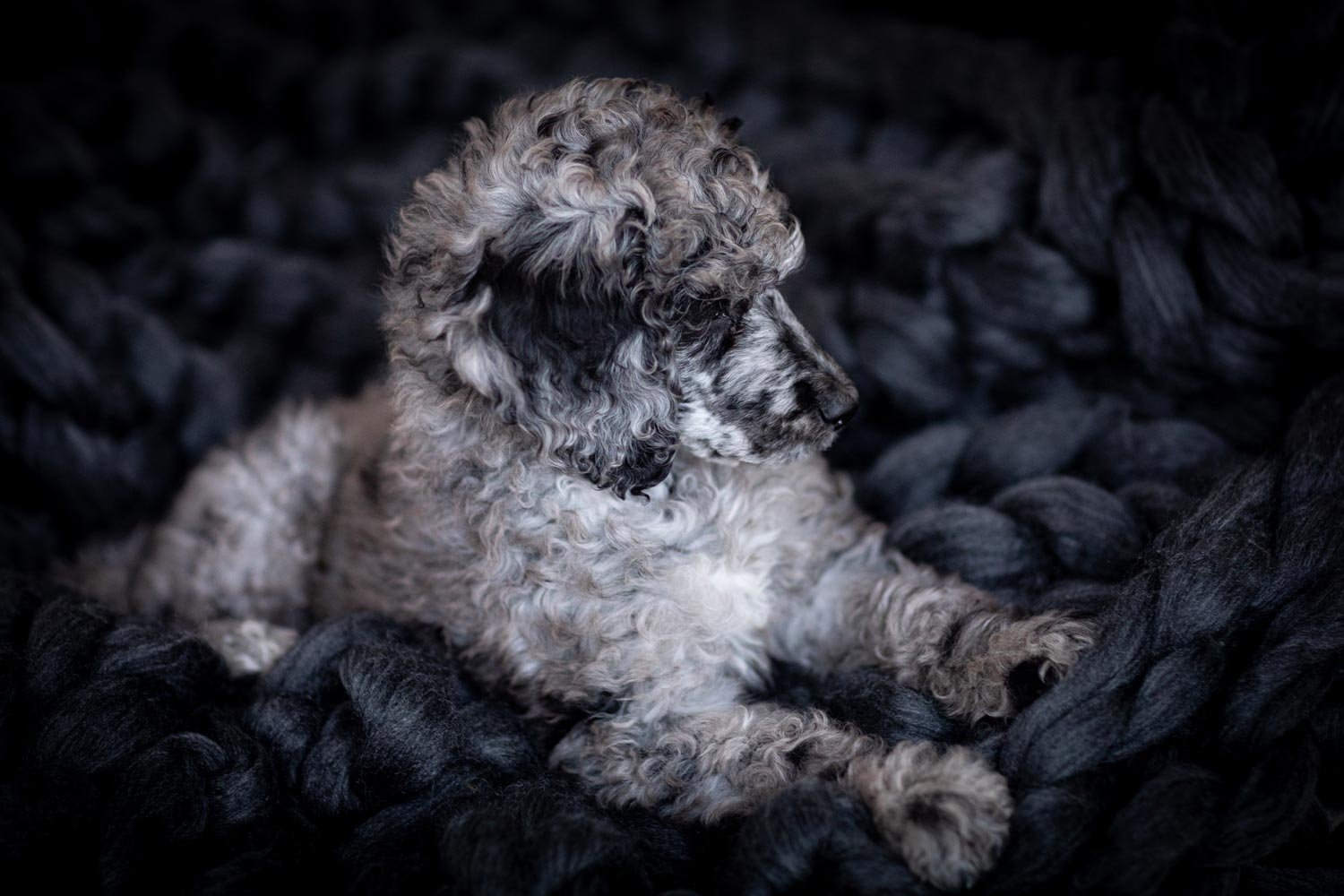
Black Merle Standard Poodle - The Merle Gene In Poodles
Overview
A merle poodle has a cacophony of colors on its coat. Merle tends to express itself in patches, dots, spots, and dashes. Merle is a genetic pattern that can be in a dog's coat. Merle comes in different colors and patterns and can affect all coat colors. The merle gene creates mottled patches of color in a solid or piebald coat, blue or odd-colored eyes, and can affect skin pigment as well. Heterozygosity for a Short INterspersed Element (SINE) insertion in canine PMEL causes a striking pigmentation pattern, known as merle, that is unique to domesticated dogs. The Merle Gene is an incomplete dominant gene, which means that it only requires one copy to reproduce it.
Yes, Merle Poodles are purebred. Poodles are a breed of dog that are known for their intelligence, athleticism, and hypoallergenic coat. There are three sizes of Poodles: Standard, Miniature, and Toy. Merle is a coat color pattern that is found in some purebred dogs, including Poodles. The Merle coat color pattern is characterized by a mottled or marbled appearance, with patches of solid color mixed with areas of diluted or faded color. The Merle pattern can occur in a variety of colors, including blue, red, chocolate, and black. It is important to note that the Merle coat pattern is not recognized by all Poodle breed standards, so it is not considered a standard coat color in some Poodle breed clubs. However, it is still considered a purebred Poodle.

It has been recognized that the Merle coat pattern in dogs is not only a visually interesting feature, but it also exerts an important biological role, in terms of hearing and vision impairments. In 2006, the Merle (M) locus was mapped to the SILV gene (aka PMEL) with a SINE element in it, and the inserted retroelement was proven causative to the Merle phenotype. Mapping of the M locus was a genetic breakthrough and many breeders started implementing SILV SINE testing in their breeding programs. Unfortunately, the situation turned out complicated as genotypes of Merle-tested individuals did not always correspond to expected phenotypes, sometimes with undesired health consequences in the offspring. Two variants of SILV SINE, allelic to the wild type sequence, have been described so far–Mc and M. Here we report a significantly larger portfolio of existing Merle alleles (Mc, Mc+, Ma, Ma+, M, Mh) in Merle dogs, which are associated with unique coat color features and stratified health impairment risk. The refinement of allelic identification was made possible by systematic, detailed observation of Merle phenotypes in a cohort of 181 dogs from known Merle breeds, by many breeders worldwide, and the use of advanced molecular technology enabling the discrimination of individual Merle alleles with significantly higher precision than previously available. We also show that mosaicism of Merle alleles is an unexpectedly frequent phenomenon, which was identified in 30 out of 181 (16.6%) dogs in our study group. Importantly, not only major alleles but also minor Merle alleles can be inherited by the offspring. Thus, mosaic findings cannot be neglected and must be reported to the breeder in their whole extent. Most importantly, sperm cells seem to be a significant source of germline Merle allelic variants, which can be passed to the offspring on a Mendelian basis and explain unusual genotype/phenotype findings in the offspring. In light of negative health consequences that may be attributed to certain Merle breeding strategies, we strongly advocate the implementation of the refined Merle allele testing for all dogs of Merle breeds to help the breeders in the selection of suitable mating partners and production of healthy offspring.
The Merle pattern can be seen in various breeds, such as the Australian Shepherd Dog, Australian Koolie, Border Collie, Dachshund, French Bulldog, Louisiana Catahoula, Labradoodle, Miniature American Shepherd, Miniature Australian Shepherd, Pyrenean Shepherd, Rough Collie, Shetland Sheepdog, Welsh Sheepdog, Cardigan Welsh Corgi, Chihuahua, Great Dane etc. Merle is thought to be inherited in an autosomal, incomplete dominant way. Dogs heterozygous for the M allele show a typical coat pattern, however, dogs homozygous for the M allele may also exhibit auditory and ophthalmologic impairments and abnormalities together with very pale or completely white coat phenotypes (Strain et al. 2009). Such negative health effects associated with the M locus encouraged the researchers to identify the gene responsible.
Source: https://www.ncbi.nlm.nih.gov/pmc/articles/PMC6147463/
Specific sizes of the M Allele have been associated with the potential to produce “classic” merle patterning or other M-associated coat color variations. Merle is most appropriately viewed as a spectrum of coat colors/patterns, and the size of the variant M allele is associated with a coat color/pattern somewhere within that spectrum. Although some coat color/pattern variations have been associated with specific sizes of the M allele in certain breeds, referred to here as a ‘bin’, the size of the M allele does not guarantee a specific outcome.
In general, dogs with M allele sizes between 200 – 246 base pairs (bp) have been associated with non-merle or minimal-merle coat colors/patterns and are often referred to as “cryptic” merle; M allele sizes between 247 – 264 bp have been associated with “atypical” or “diluted” coat colors/patterns; M allele sizes between 265 – 269 bp have been associated with the “classic” merle coat colors/patterns; and M allele sizes between 270 – 280 bp have been associated with “tweed”, “harlequin” or “patchwork” merle coat colors/patterns
Cryptic merles don’t show any of the obvious merle traits. They look like a traditional merle; however, what makes them merle is their genetics. Cream, Red, Apricot, or Parti can hide the Merle pattern.
Concerning AKC classification, merle is often noted as Black & Silver or Brown and Tan.
Because merle genetics can be visually subtle, breeders and dog owners often rely on shared knowledge to better understand what they’re seeing beyond the coat itself. These nuances spark ongoing discussions about inheritance, testing, and responsible breeding practices. Many people now turn to an interactive social platform through online video chat to exchange real-time insights, compare experiences, and ask questions directly. Seeing and discussing examples live helps clarify complex traits that written descriptions alone can’t always explain. In this way, conversation and visual interaction play a growing role in making genetic information more accessible and practical.
Merle poodles, however, can put you out a whopping $5,000. This is pretty standard for the type of poodle (standard, toy, or miniature) and age range (puppy or adult). Merle dogs of any breed are likely to be more expensive than solid-colored dogs, even though a lot of responsible breeders try to change that. Depending on how rare the merle pattern is in the breed and how much the standard price for a puppy is, your merle dog might cost up to $3,000
Are merle poodles purebred?
Short answer: Yes — merle poodles can be purebred.
Long answer: it depends on genetics, documentation, and breeding ethics, not just appearance.
Are Merle Poodles Purebred?
Yes. A merle poodle can be 100% purebred if the merle gene is present within the poodle gene pool and verified by genetic testing and pedigree records. The merle pattern itself is not a separate breed—it’s a coat pattern caused by a mutation at the PMEL (SILV) gene, specifically a SINE insertion.
Key facts that matter:
Merle is a coat pattern, not a breed
It is caused by an incomplete dominant gene
Only one copy (Mm) is needed to express merle
Two copies (MM) significantly increase the risk of hearing and vision defects
Why Merle Poodles Are Controversial
1. Breed Standards vs. Genetics
The merle pattern is not recognized by the American Kennel Club (AKC) poodle standard.
However:
AKC recognition ≠ of genetic purity
AKC focuses on conformation standards, not molecular genetics
A dog can be genetically purebred and still be “non-standard.”
So while merle poodles may be registered as poodles, they are often listed under alternative color descriptions (e.g., Black & Silver, Brown & Tan).
2. Historical Crossbreeding vs. Modern Reality
Some merle poodles originated decades ago from outcrossing (commonly herding breeds like Australian Shepherds).
However:
After many generations of purebred-to-purebred poodle breeding, the dogs are still genetically poodles
This is no different than how many accepted coat colors entered other breeds historically
The question is not “Did merle ever come from outside the breed?”
The real question is: Is this dog genetically a poodle today?
The Science (Why This Matters)
Modern research has shown:
There are multiple merle alleles (Mc, Ma, M, Mh, etc.)
Merle exists on a spectrum, from cryptic to classic to harlequin
Mosaicism (multiple merle variants in one dog) is common
Even “hidden” or cryptic merles can pass merle to offspring
This is why responsible breeders must use advanced merle allele testing, not just visual inspection.
👉 Breeding merle × merle without testing is irresponsible, regardless of breed.
So… Are Merle Poodles Legit?
Yes — when bred responsibly.
A merle poodle is purebred if:
It has documented poodle lineage
It passes breed-specific genetic testing
It is bred merle × non-merle only
Health risks are clearly disclosed and managed
A merle poodle is not ethical if:
Merle status is hidden or misunderstood
Testing is skipped
Color is prioritized over health
Final Verdict
Merle poodles can be purebred.
They are genetically real, scientifically documented, and ethically acceptable only when bred with precision and transparency.
The controversy isn’t about purity —
it’s about responsibility.
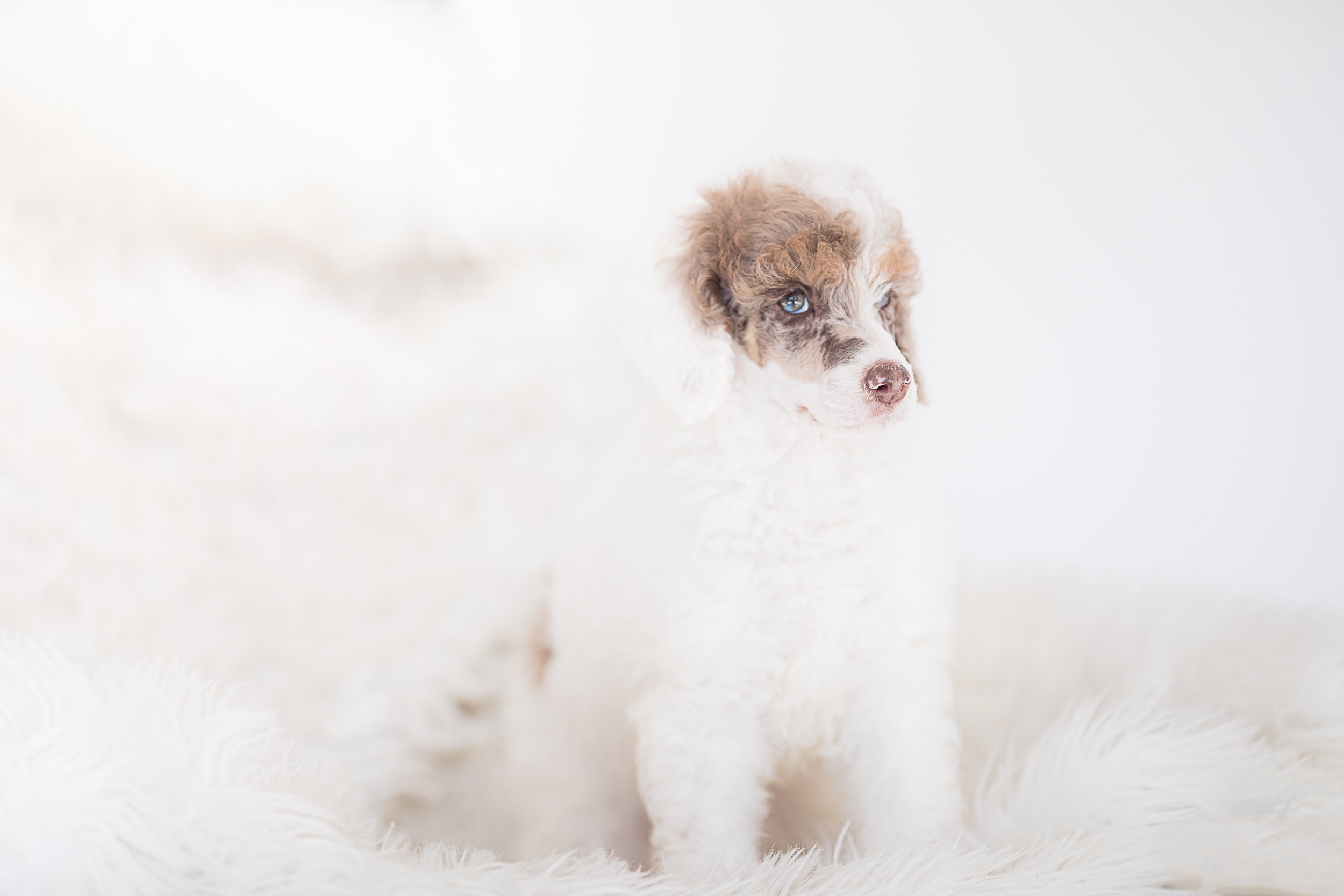
Red Merle Parti Poodle with Blue Eyes