
Aussiedoodle:
Complete Breed Guide
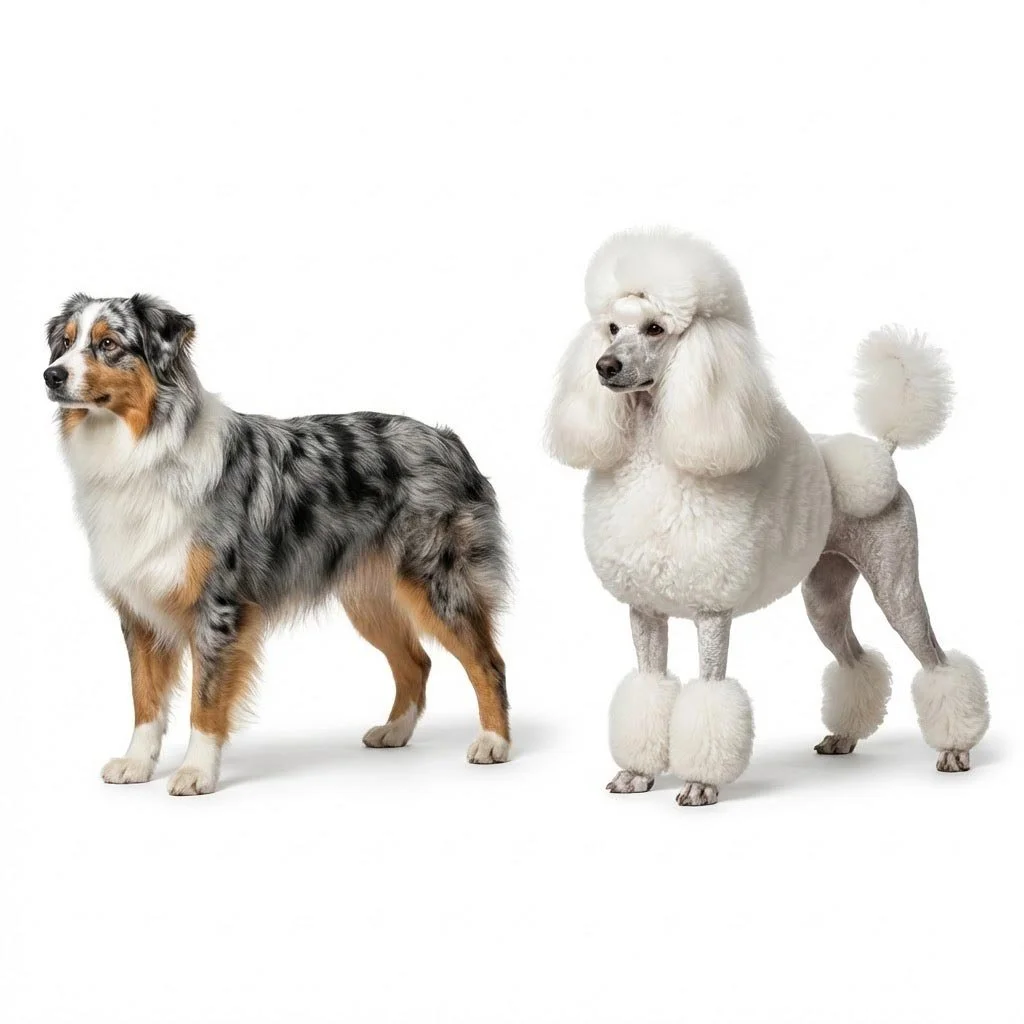
The Aussiedoodle is a two-breed hybrid cross between an Australian Shepherd and a Poodle — designed to combine the Australian Shepherd's exceptional working intelligence and athleticism with the Poodle's trainability and low-shedding coat genetics. At Stokeshire, we breed Toy and Mini Aussiedoodles from a carefully selected foundation of health-tested, temperament-evaluated dogs.
Also known as: Aussie Poo · Aussie Poodle · Australian Shepherd Poodle Mix
View Planned Litters Learn About the Breed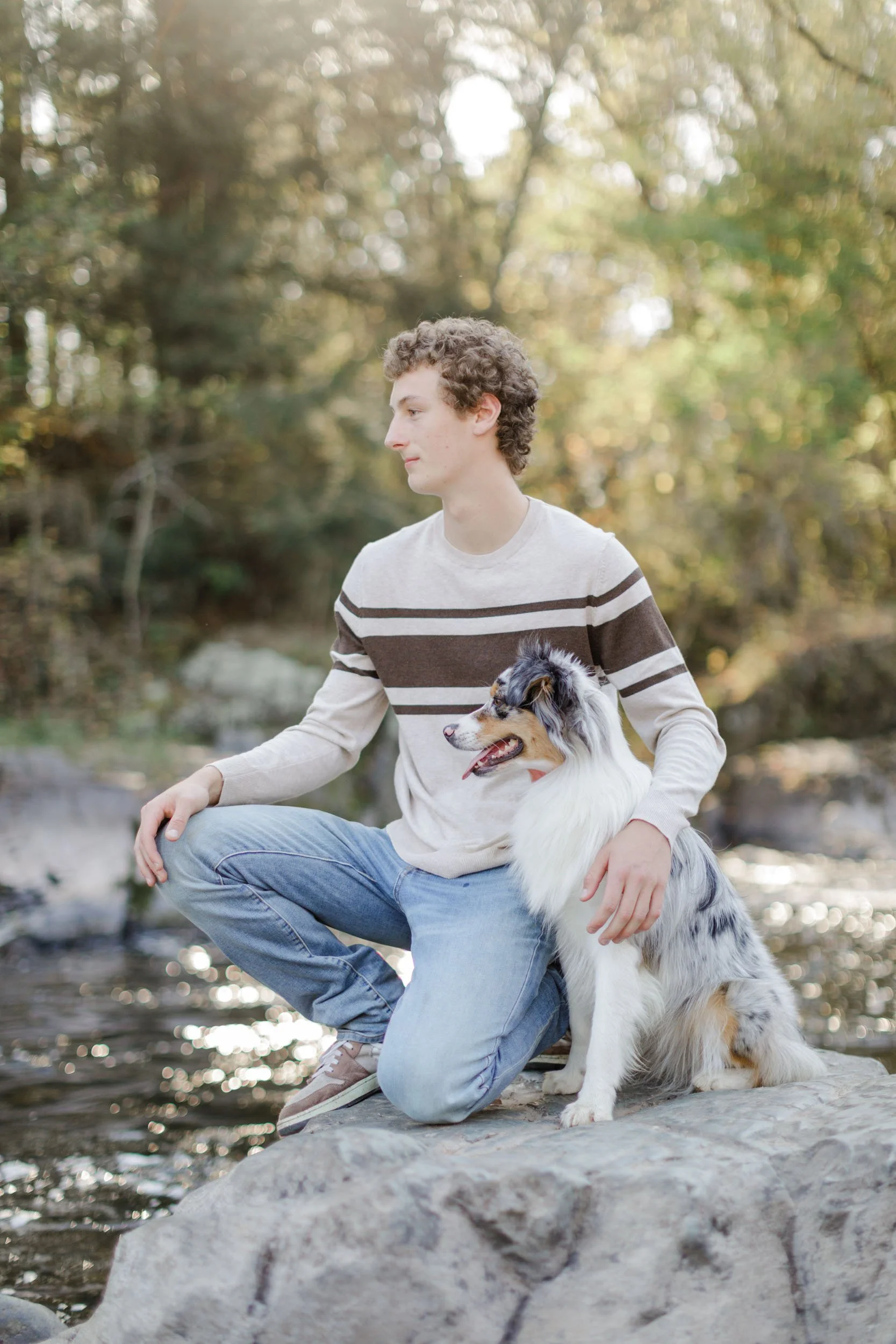
Aussiedoodle — Quick Facts
| Breed Type | Designer hybrid — two-breed cross. Not AKC or FCI recognized. |
| Parent Breeds | Australian Shepherd × Poodle |
| Also Called | Aussie Poo, Aussie Poodle, Australian Shepherd Poodle Mix |
| Stokeshire Focus | Toy and Mini Aussiedoodles — bred from health-tested parent dogs |
| Size Range | Toy (10–20 lbs), Mini (20–35 lbs) — Stokeshire focus sizes |
| Coat Types | Wavy, curly, furnished or unfurnished — determined by RSPO2, KRT71, and FGF5 genetics |
| Shedding Level | Low to moderate — furnished, curly-coated dogs shed least |
| Temperament | Highly intelligent, energetic, people-bonded, trainable, strong herding drive |
| Exercise Need | 45–90 minutes daily structured activity plus daily mental stimulation |
| Trainability | Very high — among the most responsive companion breeds to positive reinforcement |
| Lifespan | 12–15 years (Toy and Mini sizes toward the longer end) |
| Best For | Active families, sport and agility households, experienced dog owners, families willing to commit to consistent daily training |
| Pricing | See Stokeshire puppy pricing — Toy Aussiedoodles are priced higher than Mini. |
What Is an Aussiedoodle?
An Aussiedoodle is a two-breed hybrid cross between an Australian Shepherd and a Poodle. The cross draws on two of the highest-ranked breeds in working and obedience intelligence assessments — the Australian Shepherd, developed as a herding and ranch dog requiring sustained mental and physical output, and the Poodle, historically a retriever and performance breed with exceptional trainability and low-shedding coat genetics.
Unlike some companion-oriented Poodle crosses, the Aussiedoodle retains a significant portion of the Australian Shepherd's working drive. This is the cross's primary strength and its primary management challenge. Families who match this dog well — active, consistent, engaged — find Aussiedoodles deeply rewarding. Families underestimating the drive component often find them more demanding than expected.
The cross does not have a standardized registry or breed standard. No major kennel club recognizes it as a breed. Generation labels (F1, F1B, multigen) describe breeding structure and influence coat and size predictability, but do not guarantee specific outcomes in any individual puppy.
The Aussiedoodle inherits a bright, busy mind and an athletic body. It asks for structure, engagement, and consistency — and delivers exceptional partnership in return.
The Two Parent Breeds
Understanding both parent breeds is the most accurate way to predict what an Aussiedoodle will need from its home. Each contributes distinct traits, health considerations, and temperament tendencies.
Australian Shepherd
Developed as a working ranch and stock dog in the American West, the Australian Shepherd was bred for sustained physical output, sharp problem-solving, and a deep responsiveness to human handlers. It is one of the most trainable breeds available — and one of the most demanding. Australian Shepherds carry a significant population rate of the MDR1/ABCB1 drug sensitivity variant. They are also predisposed to several heritable eye conditions including PRA, hereditary cataracts (HSF4), and Collie Eye Anomaly. The herding behavioral tendency — circling, chasing, nipping at movement — is a normal expression of working genetics that requires early training and management in a companion setting.
Poodle
Available in Standard, Miniature, and Toy sizes — at Stokeshire, Mini and Toy Poodle lines drive the Toy and Mini Aussiedoodle sizes. The Poodle contributes the RSPO2 furnishings gene and the MC5R shedding variant associated with low environmental shedding, as well as the emotional attunement and training responsiveness that make Poodle crosses so well-suited to companion and performance work. Standard Poodle health concerns include hip dysplasia, progressive retinal atrophy, von Willebrand's disease, sebaceous adenitis, idiopathic epilepsy, and gastric dilation-volvulus (GDV) risk in deep-chested individuals. Miniature and Toy Poodle health profiles differ — orthopedic risks shift toward patellar luxation at smaller sizes.
F1, F1B & Multigen Aussiedoodles
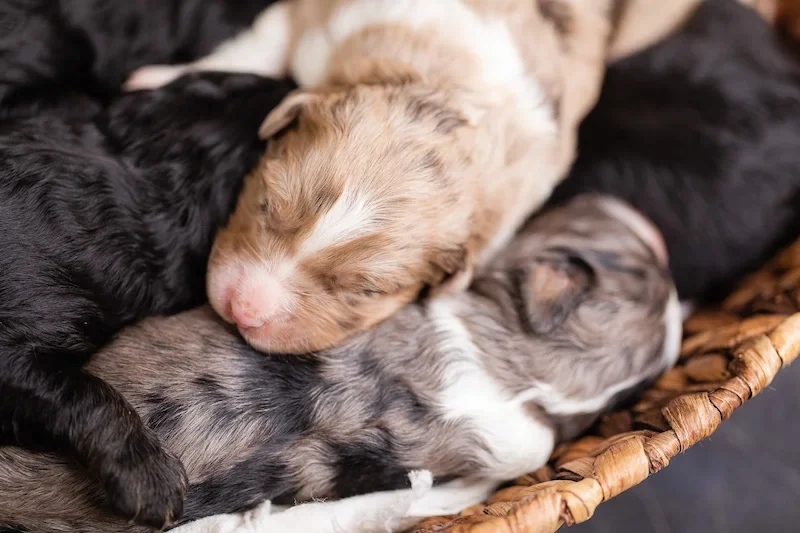
Generation describes the breeding structure behind a puppy. In Aussiedoodles, generation influences coat predictability and, in F1B lines, increases Poodle percentage — which typically improves furnishings consistency and reduces shedding. It does not guarantee a specific size or temperament outcome.
| Generation | Genetic Structure | Coat Expectation | Best Suited For |
|---|---|---|---|
| F1 | 50% Australian Shepherd / 50% Poodle | Wavy to straight; moderate shedding; furnishings vary by RSPO2 status | Families comfortable with coat variability; maximum hybrid vigor |
| F1B | ~75% Poodle / ~25% Australian Shepherd (F1 × Poodle) | Curlier, lower-shedding; more consistent furnishings; more allergy-friendly | Allergy-sensitive homes; families prioritizing low shedding |
| F2 | ~50% Poodle / ~50% Australian Shepherd (F1 × F1) | High variability — coat and size outcomes less predictable | Families comfortable with variability in outcomes |
| Multigen | Multiple generations — proportions vary by program design | Most consistent coat; curly or wavy; lowest shedding | Families prioritizing coat predictability and allergy management |
Aussiedoodle Temperament
Aussiedoodles are among the most intelligent and people-oriented companion dogs available — and among the most demanding. The Australian Shepherd's working heritage is not diluted by the Poodle cross; it is amplified by it. Both parent breeds were selected for sustained engagement with humans, responsiveness to training cues, and the intelligence to solve problems independently when needed. In a companion setting, this produces a dog that learns quickly, bonds deeply, and requires consistent daily engagement to stay behaviorally balanced.
Research from behavioral genetics indicates breed ancestry explains roughly 9% of behavioral variation across individual dogs — environment, socialization, and training account for far more. This means temperament language should use "tends to" and "often" rather than guarantees. With that framing: well-bred, well-socialized Aussiedoodles from active programs tend to be alert, affectionate, fast-learning, and highly handler-focused.
* Calm indoors once exercise needs are met — understimuated dogs are rarely calm. † Excellent with early socialization; herding behavior requires active management around young children. ‡ Furnished coats with curl shed least. No dog is 100% hypoallergenic.
The Herding Drive: What It Looks Like in a Home
The Australian Shepherd's herding instinct is a product of generations of selection for controlling the movement of livestock. In a companion setting, the behavior pattern is the same — the target changes. Without early training and consistent management, Aussiedoodles may attempt to herd children (especially running children), cats, other dogs, or cyclists. This presents as circling, nipping at heels, or standing in front of moving targets to redirect them. It is normal working-breed behavior, not aggression — but it requires active training and redirection from early puppyhood.
Who the Aussiedoodle Is Not Ideal For
- First-time dog owners without a clear plan for consistent daily training and socialization — this breed rewards structure and becomes challenging without it
- Households with very young children (under 5) unless the owner is experienced managing herding behavior around small, unpredictable movement
- Families unable to provide 45–90 minutes of structured daily exercise plus mental stimulation — physical exercise alone is not sufficient
- Households where the dog will be left alone for extended periods daily without prior separation conditioning
- Those expecting low-maintenance grooming — furnished coats require brushing multiple times per week and professional grooming every 6–8 weeks
Toy & Mini Aussiedoodle Sizes
Stokeshire breeds Toy and Mini Aussiedoodles. Adult size is primarily driven by the Poodle parent — Toy Poodle crosses produce Toy AMDs; Miniature Poodle crosses produce Mini AMDs. No specific adult size is guaranteed in any hybrid breeding program.
| Size | Adult Weight | Adult Height | Full Growth By | Lifespan Est. |
|---|---|---|---|---|
| Toy | 10–20 lbs | 10–14 in | 9–12 months | 13–15 years |
| Mini | 20–35 lbs | 14–18 in | ~12 months | 12–14 years |
→ Learn more about the Toy Aussiedoodle specifically at Stokeshire
Aussiedoodle Coat Types & Color Patterns
Whether an Aussiedoodle sheds, how curly the coat is, and whether it is appropriate for allergy-sensitive homes are determined by testable gene variants — not by generation label or color. Four loci control the coat characteristics families care about most.
Controls facial furnishings — beard, eyebrows, moustache. Furnished dogs (FF or Ff) have the classic doodle appearance and shed less from the face. Unfurnished dogs (ff) shed comparably to their Australian Shepherd parent and are not appropriate for allergy-sensitive households. Stokeshire does not market unfurnished Aussiedoodles as hypoallergenic.
Determines coat curl tightness. Two copies = curly; one copy = wavy; zero = straight or soft wave. Curlier coats shed least but mat most quickly without consistent brushing. Wavy is the most common expression in Aussiedoodle crosses and the most widely preferred by families.
Influences the hair growth cycle turnover rate. Poodles typically carry the low-shedding variant — one of the primary genetic reasons doodle-type dogs distribute less hair into the environment. Shedding is multigenic; no single gene guarantees a non-shedding outcome.
Controls overall coat length. Most furnished Aussiedoodles carry the long-coat FGF5 variant through Poodle lineage. Dogs with the short-coat variant will have noticeably shorter coats regardless of curl or furnishings status.
Color Patterns
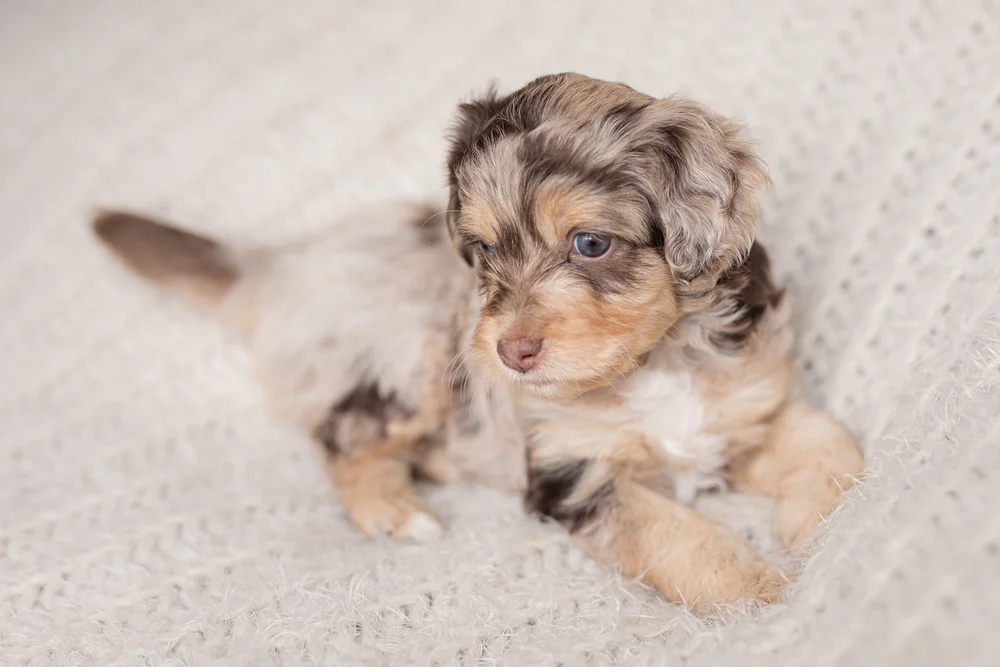
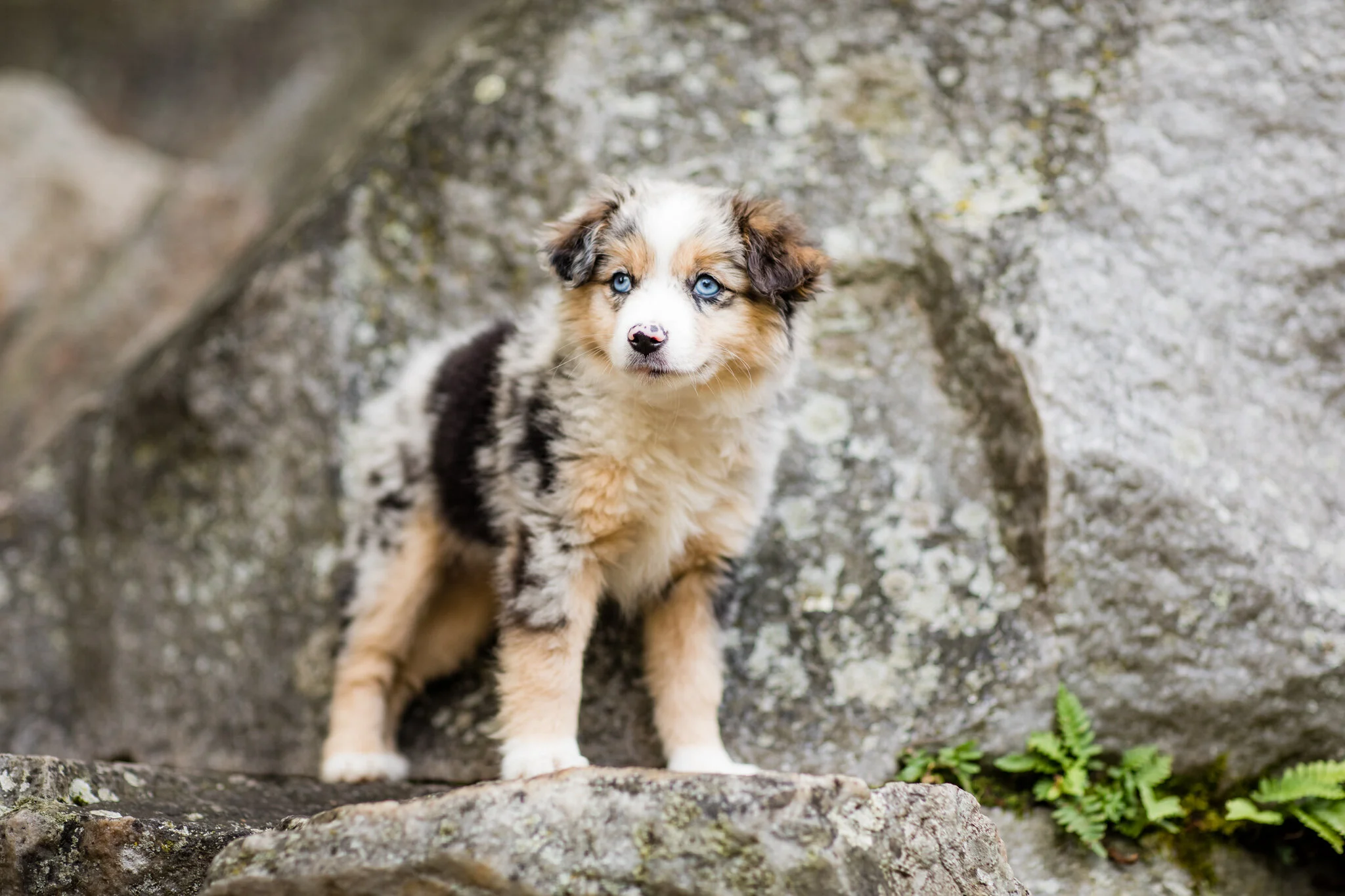
The Australian Shepherd parent introduces merle genetics (PMEL/SILV locus) and a wide range of base color and pattern expressions. Common Aussiedoodle coat patterns include:
Black-based merle — grey, black, and white marbling. Often paired with blue or heterochromatic eyes. One of the most recognized Aussiedoodle patterns.
Brown-based merle. Red, cream, and chocolate marbling with variable eye color.
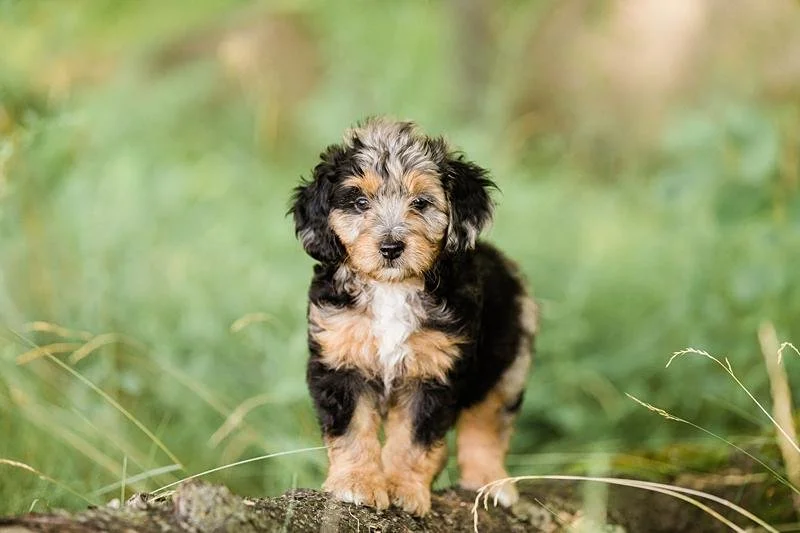
Black or chocolate base with white markings and copper/tan points. Classic Australian Shepherd-influenced pattern.
Solid base with secondary markings above eyes, cheeks, legs, and chest.
Large patches of two or more colors, typically with significant white. Often visually striking.
Black, chocolate, red, or cream. Less common in Aussiedoodle programs; depends on parent dog genetics.
Aussiedoodle Grooming Requirements
Low-shedding furnished coats are not low-maintenance coats. The same coat structure that retains hair within the curl rather than releasing it into your home also accumulates tangles and mats without consistent brushing. The lower the shedding, the higher the brushing requirement.
Brushing
Professional grooming every 6–8 weeks. Highest grooming demand. Mat risk is significant without consistent attention.
Brushing
Professional grooming every 6–8 weeks. Most common Aussiedoodle coat. Mat-prone at friction zones without regular brushing.
Brushing
Professional grooming every 8–10 weeks. More forgiving than curly, but mat-prone zones still require regular attention.
Brushing
Lower mat risk. Professional grooming every 10–12 weeks. Higher environmental shedding. Not appropriate for allergy-sensitive homes.
→ Full grooming guide: mat zone breakdown, tool list, bathing protocol, puppy introduction program
The mat science, brushing technique, and puppy grooming introduction protocol covered in our AMD grooming guide applies equally to Aussiedoodle coats — the coat structure is identical.
Aussiedoodle Health Considerations
Aussiedoodles inherit health considerations from both parent breeds. Large-scale veterinary research — including published VetCompass data from the Royal Veterinary College — has shown that while crossbreeding can reduce the expression of some recessive conditions, it does not eliminate inherited health risk. Responsible programs perform parent-breed-informed health screening on all breeding dogs before any litter is planned.
Australian Shepherd Lineage
- MDR1/ABCB1 drug sensitivity — DNA test (critical; affects ivermectin and related medications)
- Hereditary cataracts (HSF4) — DNA test (Aussie-specific; distinct from PRA)
- Progressive retinal atrophy (PRA) — DNA test
- Collie Eye Anomaly (CEA) — DNA test
- Hip dysplasia — OFA radiographic evaluation
- Idiopathic epilepsy — no genetic test; selection relies on pedigree and clinical history
- Degenerative myelopathy — SOD1 DNA test
Poodle Lineage
- Hip dysplasia — OFA radiographic evaluation (Standard Poodle); patellar luxation evaluation (Toy/Mini Poodle)
- Progressive retinal atrophy (prcd-PRA) — DNA test
- Von Willebrand's disease Type 1 — DNA test
- Degenerative myelopathy — SOD1 DNA test
- Sebaceous adenitis — OFA skin punch biopsy (Standard lines)
- Idiopathic epilepsy — Standard Poodle lines
- Addison's disease — no genetic test; clinical awareness and pedigree selection
Stokeshire's Approach
Every breeding dog at Stokeshire completes a full Embark genetic panel before inclusion in the program — screening for over 230 health conditions including all coat loci, MDR1, eye disease variants, and degenerative myelopathy risk. Hip evaluations are performed by OFA-certified radiologists. Eye evaluations (CAER) are maintained on schedule. No pairing is made without confirmed MDR1 status and confirmed merle status on both parents. Families receive their puppy's Embark results at placement.
The health testing framework and breeder evaluation questions in our AMD health guide apply equally to Aussiedoodle programs — the Australian Shepherd and Poodle lineages are shared.
Are Aussiedoodles Easy to Train?
Aussiedoodles are among the most trainable companion dogs available. The Australian Shepherd and Poodle consistently rank at the top of canine working and obedience intelligence assessments. These dogs learn commands quickly, retain training well, and are highly motivated by structured engagement with their handler.
The American Veterinary Society of Animal Behavior (AVSAB) recommends reward-based training methods for all dogs. For Aussiedoodles specifically, positive reinforcement with consistent cues, short focused sessions (10–15 minutes, two to three times daily), and early socialization beginning in the first weeks of life produces the most reliable adult behavior. Aversive training methods — harsh corrections, physical punishment — produce anxiety and handler avoidance in sensitive breeds and are counterproductive with this cross.
Physical Exercise
Toy Aussiedoodles require approximately 45 minutes of structured daily exercise. Mini Aussiedoodles typically need 60–75 minutes. The Australian Shepherd's working dog heritage means these dogs do not self-regulate activity well — exercise needs to be human-led and structured, not just yard access.
For puppies: the standard guideline is 5 minutes of structured leash exercise per month of age, twice daily, until growth plates are confirmed closed. High-impact exercise (sustained running on hard surfaces, repetitive jumping) should be avoided in puppies and young adolescents regardless of size.
Mental Stimulation
Physical exercise alone is not sufficient for a working-heritage dog. Training sessions, puzzle feeders, scent games, and structured play provide the mental engagement that prevents boredom-driven behaviors — destructive chewing, excessive vocalization, compulsive movement, and self-directed activity that can escalate into anxiety patterns.
Dogs that are physically well-exercised but mentally under-stimulated show higher rates of anxiety and nuisance behavior regardless of how much they've run. Both channels — physical and mental — must be consistently met.
The Socialization Window: 3–14 Weeks
The 3–14 week developmental period is the primary socialization window — when puppies are most receptive to novel experiences and most likely to integrate them without fear. Gaps in this window are difficult to fully compensate for later. At Stokeshire, Early Neurological Stimulation begins at Day 3. Sound desensitization, surface variation, and multi-person handling continue through all eight weeks before placement.
Aussiedoodle vs. Australian Mountain Doodle
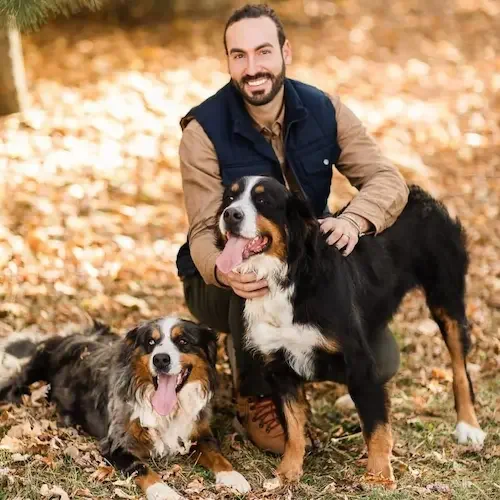
The Australian Mountain Doodle (AMD) is a triple-cross hybrid — Bernese Mountain Dog × Australian Shepherd × Poodle. Both breeds share Australian Shepherd and Poodle genetics. The Bernese Mountain Dog is what differentiates them. Families who are drawn to the Aussiedoodle's intelligence and coat but want a somewhat more settled daily energy level often find the AMD a better match.
| Feature | Aussiedoodle | Australian Mountain Doodle |
|---|---|---|
| Parent Mix | Australian Shepherd + Poodle | Bernese Mountain Dog + Australian Shepherd + Poodle |
| Energy Level | High to Very High | Moderate to High |
| Calm Indoors | Moderate — requires significant exercise first | Good — settles more readily with exercise |
| Herding Drive | Moderate to High | Lower — Bernese tempers herding instinct |
| Trainability | Very High | Very High |
| Affection Level | High | Very High |
| Good With Young Children | Good with management | Excellent |
| First-Time Owner Suitability | Moderate — demanding breed | Good — with training commitment |
| Merle Colors Available | Yes | Yes |
| MDR1 Risk | Yes — Aussie lineage | Yes — Aussie lineage |
| Bernese Cancer Risk | None | Moderate (diluted by two other breeds) |
| Stokeshire Focus Sizes | Toy & Mini | Mini, Medium & Standard |
| Best For | Active experienced owners, sport & agility, high-engagement households | Active families, therapy work candidates, first-time owners with commitment |
The Aussiedoodle is the more intense of the two crosses — more drive, more speed, more demand. The Australian Mountain Doodle carries that same intelligence and coat in a somewhat more grounded frame. Neither is better. They serve different households.
Aussiedoodles at Stokeshire Designer Doodles
Stokeshire's Aussiedoodle program is built on a deliberate, small-volume foundation. Our breeding dogs — Blue, Olive, Savi, Chatter, and Dia — represent a carefully managed gene pool focused on Toy and Mini sizes with health-tested, temperament-evaluated parents. We are not a high-volume Aussiedoodle program. We produce Aussiedoodle litters selectively, with the same health testing and developmental standards applied to every Stokeshire litter regardless of breed.
Aussiedoodles serve an important role in our program beyond companion placement. The Australian Shepherd and Poodle genetics in our Aussiedoodle line are also foundational to our Australian Mountain Doodle program — the two breeds share parent dogs and inform the health and coat diversity of both. A family choosing a Stokeshire Aussiedoodle is choosing a dog from the same tested, developed gene pool that underlies our AMD program.
About the Breeder
About the Stokeshire Program
Explore Planned Aussiedoodle Litters
Stokeshire raises Toy and Mini Aussiedoodles in Medford, Wisconsin, from health-tested, Embark-tested parents. Nationwide transport available.
View Planned Litters How the Process WorksReviewed by the Stokeshire Breeding Team · Updated March 2026
Aussiedoodle FAQs
Are Aussiedoodles good family dogs?
Aussiedoodles can be excellent family dogs for the right household — active, experienced, and committed to consistent training. Their intelligence and people-bonded nature make them engaging and rewarding companions. The primary management consideration for families is the Australian Shepherd herding instinct: without early training and redirection, Aussiedoodles may attempt to herd children, particularly small children who run unpredictably. For families with young children who want a similarly intelligent but more settled temperament, the Australian Mountain Doodle — which carries Bernese Mountain Dog genetics that moderate the herding drive — is often a stronger match.
How big do Toy and Mini Aussiedoodles get?
Adult size depends primarily on the Poodle parent used. Toy Aussiedoodles at Stokeshire typically reach 10–20 lbs and 10–14 inches at the shoulder, with full growth by 9–12 months. Mini Aussiedoodles typically reach 20–35 lbs and 14–18 inches at the shoulder, with full growth by approximately 12 months. No specific adult size is guaranteed in any hybrid breeding program — individual genetics, litter variation, and the size of the Australian Shepherd parent all influence final outcomes.
Are Aussiedoodles hypoallergenic?
No dog is completely hypoallergenic. The AAAAI and clinical allergy research consistently state that no breed reliably produces fewer allergens for all individuals. Furnished Aussiedoodles with curly coats are among the lower-shedding companion breeds available, and many allergy-sensitive families live comfortably with them. The real-world shedding experience is determined by coat genetics — specifically RSPO2, KRT71, and MC5R. Families with moderate allergies are encouraged to spend time with an adult dog from the program before committing to a puppy. Stokeshire does not guarantee allergy compatibility for any dog.
Do Aussiedoodles have herding instincts?
Yes. The Australian Shepherd's herding behaviors — circling, chasing, nipping at movement, attempting to control the position of people or animals — are a direct expression of working genetics and are present to varying degrees in Aussiedoodle offspring. In a companion home, these behaviors manifest most visibly around moving children, running pets, and cyclists. Early socialization and consistent training that redirects herding impulses into appropriate outlets (structured play, sport work, obedience) is the most effective management approach. This trait cannot be fully eliminated through training — it can be managed and channeled.
How much exercise does an Aussiedoodle need?
Toy Aussiedoodles require approximately 45 minutes of structured daily exercise plus mental stimulation. Mini Aussiedoodles typically need 60–75 minutes. The Australian Shepherd lineage drives this requirement — herding breeds do not self-regulate activity well and become behaviorally challenging when under-exercised. Physical exercise alone is not sufficient: training sessions, puzzle feeders, scent games, and structured play provide the mental engagement necessary to keep a working-heritage dog behaviorally balanced. For puppies, the recommended guideline is 5 minutes of structured exercise per month of age, twice daily, until growth plates close.
What is MDR1 and why does it matter for Aussiedoodles?
MDR1 (ABCB1) is a gene mutation carried at a significant rate in Australian Shepherd populations that causes sensitivity to certain medications — including ivermectin (found in common heartworm preventatives), loperamide, certain anesthetics, and some chemotherapy drugs. Dogs with one or two copies of the variant may have severe or fatal reactions to medications that are otherwise safe. Because every Aussiedoodle carries Australian Shepherd genetics, MDR1 testing is not optional — it is essential. Stokeshire tests all breeding dogs for MDR1 status via Embark and provides families with their puppy's results at placement. Families should discuss MDR1 status with their veterinarian before any heartworm preventative is prescribed.
Are Aussiedoodles easy to train?
Yes — Aussiedoodles are among the most trainable companion breeds available. Both the Australian Shepherd and Poodle rank consistently at the top of working and obedience intelligence assessments. These dogs learn commands quickly, retain training well, and are highly motivated by engagement with their handler. Positive reinforcement with consistent cues and short focused sessions produces the fastest and most durable results. The same intelligence that makes them easy to train also makes them quick to pattern unwanted behaviors if reinforcement is inconsistent — structure and consistency matter as much as intelligence in this cross.
What is the difference between an Aussiedoodle and an Australian Mountain Doodle?
The core difference is the addition of Bernese Mountain Dog to the Australian Mountain Doodle cross. Aussiedoodles are a two-breed cross — Australian Shepherd × Poodle. Australian Mountain Doodles are a triple cross adding Bernese Mountain Dog, which contributes a naturally calm, patient, and family-settled temperament that moderates the Aussiedoodle's herding drive. Both crosses share Australian Shepherd and Poodle genetics, so both require MDR1 testing and have similar coat and trainability profiles. Families drawn to Aussiedoodle intelligence and coat but wanting a more settled daily energy level often find the AMD a better match for their household.
How long do Aussiedoodles live?
Aussiedoodle lifespan estimates are based on parent breed data — Australian Shepherds are commonly listed at 12–15 years and Poodles at 10–18 years (size-dependent). Large-scale VetCompass data from the Royal Veterinary College reports crossbred life expectancy at approximately 11.82 years across all sizes in their UK dataset. Toy and Mini Aussiedoodles — the sizes Stokeshire focuses on — can be expected toward the longer end of this range. Lifespan is meaningfully influenced by health testing quality of the parents, body weight management, diet, and veterinary care throughout life.
Find the Right Aussiedoodle for Your Family
The Aussiedoodle is one of the most intelligent and engaging companion breeds available — built for families that can match its energy and commitment with structure, exercise, and daily training. Stokeshire raises Toy and Mini Aussiedoodles in Medford, Wisconsin, from health-tested parents with Early Neurological Stimulation from Day 3.
View Planned Litters How to Reserve a Puppy