
Bernedoodle Generations: F1, F1B, Reverse F1B, F2 & Multigen Explained
What is an F1B Bernedoodle? How is it different from an F1 or Multigen? Bernedoodle generation labels describe the breeding structure behind a puppy — the ratio of Bernese Mountain Dog to Poodle genetics — and directly influence coat type, shedding level, allergy suitability, and phenotypic predictability. This guide explains every generation, the genetics that drive coat outcomes, and what each means for your family.
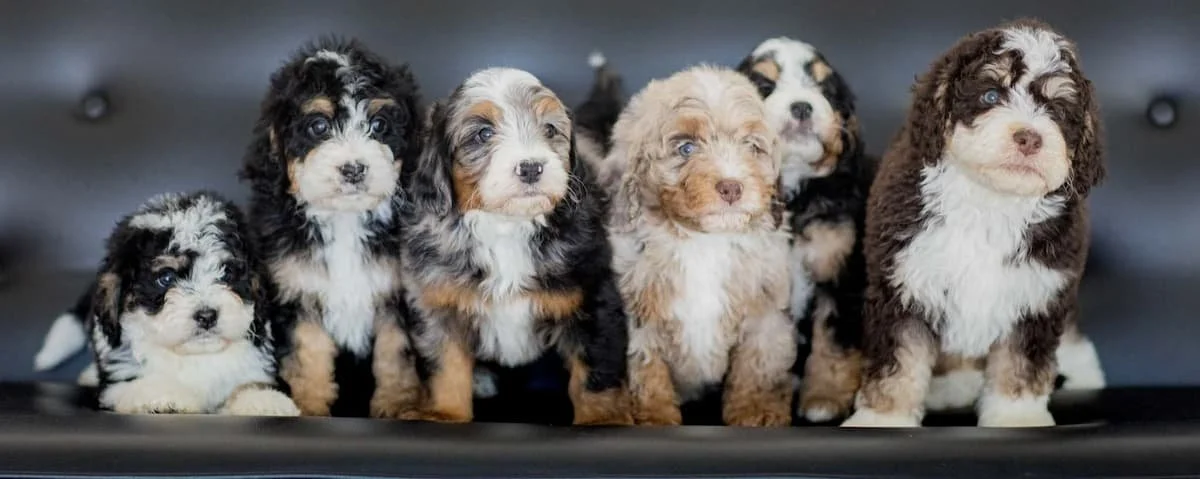
Bernedoodle Generation Comparison
Each generation label describes how much Bernese Mountain Dog vs. Poodle genetics a Bernedoodle carries — and how far removed it is from purebred ancestors. This ratio is the single most important predictor of coat type and shedding behavior.
| Generation | Cross | Genetic Ratio | Coat Expectation | Shedding | Allergy Suitability |
|---|---|---|---|---|---|
| F1 | Bernese × Poodle | 50% / 50% | Wavy to slightly curly; variable | Low to moderate | Mild allergies |
| F1B | F1 × Poodle | ~25% Bernese / 75% Poodle | Curlier; more consistent furnishings | Very low to non-shedding | Moderate to severe |
| Reverse F1B | F1 × Bernese | ~75% Bernese / 25% Poodle | Straight to wavy; Bernese-dominant look | Moderate to high | Not suitable for allergies |
| F2 | F1 × F1 | ~50% / 50% (recombined) | Highly variable; unfurnished possible | Variable — RSPO2-dependent | Unpredictable |
| F2B | F2 × Poodle | ~62.5% Poodle / 37.5% Bernese | Wavy to curly; more stable than F2 | Low | Moderate allergies |
| F3 | F2 × F2 | ~50% / 50% (further recombined) | Variable; stabilizing through selection | Low to moderate | Varies by individual |
| Multigen | Multiple generations | Varies — selectively bred | Most consistent wavy or curly | Very low | Most suitable |
Generation labels describe breeding structure. They do not guarantee specific outcomes in any individual puppy. The only way to predict coat type with confidence is genetic testing — specifically RSPO2, KRT71, and MC5R — on both parents before the pairing is made.
Each Bernedoodle Generation Explained
F1 Bernedoodle
A direct cross between a purebred Bernese Mountain Dog and a purebred Poodle. F1 Bernedoodles typically exhibit the highest degree of hybrid vigor — the genetic advantage of crossing two unrelated breeds — which may contribute to overall health resilience and longevity.
Coat outcomes in F1 litters are the most variable. Puppies may range from wavy to slightly curly, with shedding levels from low to moderate. Furnishings depend on whether the Poodle parent carries one or two copies of the RSPO2 gene — since purebred Poodles typically carry two copies (FF), most F1 puppies will be at least heterozygous (Ff) and furnished, but coat curl and shedding intensity vary.
Best suited for: Families seeking maximum hybrid vigor who are comfortable with coat variability. Mild allergy sufferers — not recommended for severe allergies.
F1B Bernedoodle
Produced by breeding an F1 Bernedoodle back to a purebred Poodle. The "B" stands for backcross. This increases the Poodle genetic contribution to approximately 75%, which significantly stabilizes the curly, lower-shedding coat trait. F1B litters produce the most consistently furnished, allergy-considerate coats of any first-generation cross.
The higher Poodle percentage means the Bernese temperament influence is somewhat diluted — F1B Bernedoodles may be slightly more energetic and less "heavy" in their calm-indoors temperament compared to F1s. However, the Bernese gentleness and people-orientation remain strong in well-bred lines.
Best suited for: Allergy-sensitive households. Families who prioritize coat predictability and low shedding. The most popular generation for families with moderate to severe allergies.
Reverse F1B Bernedoodle
Produced by breeding an F1 Bernedoodle back to a purebred Bernese Mountain Dog — the reverse of the standard F1B. This increases the Bernese contribution to approximately 75%, creating a dog that leans heavily toward the Bernese in appearance, temperament, and coat structure.
Reverse F1B Bernedoodles tend to have straighter coats that shed more — they look and feel more like a Bernese than a doodle. Some may retain wavy texture from the Poodle grandparent, but furnished, curly coats are uncommon in this generation. These dogs are not appropriate for allergy-sensitive households.
At Stokeshire, we produce Reverse F1B crosses by breeding multigenerational Bernedoodle or AMD studs back to our Bernese dams. The result is the "Ultra" Bernedoodle — a larger-framed dog with strong Bernese presence and a more traditional coat, while still carrying enough Poodle influence to benefit from outcross vigor.
Best suited for: Families who love the Bernese look and temperament but want the lifespan and health benefits of a cross. Not suitable for allergy-sensitive homes.
F2 Bernedoodle
Produced by crossing two F1 Bernedoodles. The overall genetic ratio remains approximately 50/50, but the recombination of genes from two hybrid parents produces the widest variability of any generation. Coat texture, curl, shedding level, and even size can vary significantly within a single F2 litter.
The critical concern in F2 litters is the "unfurnished" trait. If both F1 parents carry only one copy of the RSPO2 furnishings gene (Ff), approximately 25% of their offspring may be homozygous recessive (ff) — unfurnished dogs that lack the characteristic doodle facial hair and shed more like a purebred Bernese. This is why RSPO2 testing of both parents before an F2 pairing is essential.
Best suited for: Families comfortable with unpredictable outcomes in coat and size. Not recommended for allergy-sensitive households unless both parents are RSPO2-tested as FF (homozygous furnished).
F2B Bernedoodle
Produced by breeding an F2 Bernedoodle back to a Poodle. This reintroduces Poodle coat genetics after the variability of the F2 generation, resulting in more stable wavy-to-curly coats with lower shedding than F2 litters. The Poodle percentage is intermediate between F1 and F1B levels.
F2B Bernedoodles offer a compromise: more coat predictability than F2 crosses while retaining a slightly higher Bernese influence than F1B crosses. Temperament tends to balance well between both parent breeds.
Best suited for: Families wanting more predictable coats than F2 without the full 75% Poodle concentration of an F1B. Moderate allergy suitability.
Multigen Bernedoodle
Multigenerational Bernedoodles represent the breed's maturation. These dogs are produced by crossing Bernedoodles with other Bernedoodles (or with Poodles) across three or more generations, with breeders selectively choosing parents that produce consistent coat type, size, temperament, and health outcomes.
In well-managed Multigen programs, coat predictability is the highest of any generation. Breeders who RSPO2-test and select for homozygous furnished (FF) status can produce litters where virtually every puppy carries the furnished, lower-shedding coat. Temperament and size also stabilize as breeders select across generations for the traits families value most.
Multigen Bernedoodles still benefit from hybrid vigor if breeders maintain genetic diversity through careful COI monitoring and strategic outcrossing. Programs that breed too narrowly within their own Multigen lines risk recreating the inbreeding problems they originally sought to avoid.
Best suited for: Families who prioritize predictability in coat, size, and temperament. Most suitable for allergy-sensitive households. Therapy and service work candidates.
Why Generation Affects Coat: The Genetics
Generation labels are shorthand for genetic ratios — but the real driver of coat outcomes is the specific genes each parent contributes. Four loci determine whether a Bernedoodle will have a curly, low-shedding coat or a straight, shedding coat. Understanding these genes explains why two F1 Bernedoodles from different programs can produce dramatically different coats.
Controls facial furnishings — beard, eyebrows, moustache. FF (two copies) = fully furnished. Ff (one copy) = furnished but carries unfurnished. ff = unfurnished, sheds like a Bernese. This is the gene that determines whether a doodle looks like a doodle.
Determines coat curl tightness. Two copies = curly. One copy = wavy. Zero = straight. F1B and Multigen litters typically carry more curl copies from the increased Poodle genetics.
Influences hair growth cycle turnover. Poodles carry the low-shedding variant. Higher Poodle percentage (F1B, Multigen) = more likely to inherit this variant. Shedding is multigenic — no single gene is a guarantee.
Controls overall coat length. Most furnished Bernedoodles carry the long-coat variant through Poodle lineage. Short-coat variants produce noticeably shorter hair regardless of curl or furnishings.
RSPO2 Inheritance by Generation
The furnishings gene is the most consequential for families choosing between generations. Here's how RSPO2 inheritance typically plays out:
| Generation | Typical Poodle Parent RSPO2 | Typical Offspring RSPO2 | Unfurnished Risk |
|---|---|---|---|
| F1 | FF (purebred Poodle) | Ff (one copy — furnished but carrier) | None in this litter — but offspring carry one copy |
| F1B | FF (purebred Poodle) | FF or Ff — high furnishing consistency | Very low — Poodle contributes at least one F copy |
| F2 (Ff × Ff) | N/A — both parents are F1 | ~25% FF, ~50% Ff, ~25% ff | ~25% of litter may be unfurnished |
| Multigen | Varies — selected for FF | FF or Ff — stabilized through selection | Minimal in tested programs |
| Reverse F1B | N/A — Bernese parent is ff | Ff at best — many will be ff | High — most lean unfurnished |
This is why F2 litters can produce "surprise" unfurnished puppies — and why responsible breeders test both parents for RSPO2 before any F2 or Multigen pairing. At Stokeshire, every breeding dog is Embark-tested for coat genetics before inclusion in the program. We do not make pairings without confirmed RSPO2, KRT71, MC5R, and FGF5 status on both parents.
→ Full coat genetics guide: RSPO2/KRT71/MC5R explained in depth with genotype outcome tables
Which Bernedoodle Generation Is Right for Your Family?
The right generation depends on three factors: your allergy sensitivity, your coat preference, and how much predictability you need in the outcome.
| Your Priority | Best Generation | Why |
|---|---|---|
| Maximum hybrid vigor | F1 | Widest genetic distance between parents. Most health resilience. Variable coat. |
| Low-shedding coat for allergies | F1B or Multigen | 75%+ Poodle genetics stabilize curly, furnished, low-shedding coat outcomes. |
| Bernese look with cross benefits | Reverse F1B | 75% Bernese appearance and temperament. Shedding coat. Not for allergies. |
| Most predictable outcomes | Multigen | Multiple generations of selection stabilize coat, size, and temperament. |
| Therapy/service work candidate | F1B or Multigen | Consistent temperament + low-shedding coat for clinical environments. |
| Budget-conscious | F1 or F2 | Sometimes lower-priced due to coat variability. Excellent dogs — coat is the trade-off. |
We produce F1, F1B, and Multigen Bernedoodle litters, with our primary focus on F1B and Multigen lines for their coat consistency and allergy suitability. Our F1 litters serve families who prioritize maximum hybrid vigor and are comfortable with coat variability. We produce Reverse F1B crosses selectively for families who want the Ultra Bernedoodle experience — strong Bernese presence with the longevity benefits of the outcross. Every pairing is informed by full Embark genetic panels on both parents, including coat genetics (RSPO2, KRT71, MC5R, FGF5), so we can predict coat outcomes with a higher degree of confidence than generation labels alone would allow.
Common Misconceptions About Bernedoodle Generations
"F1B is always better than F1"
Not necessarily. F1B is better for allergy suitability and coat predictability. F1 is better for maximum hybrid vigor. Neither is universally superior — they serve different families. An F1 Bernedoodle with a wavy coat from health-tested parents may be a stronger health prospect than an F1B from untested parents. Generation is one factor, not the only factor.
"Higher generation number means higher quality"
Generation number describes breeding structure, not quality. An F3 Bernedoodle is not inherently better than an F1 — it is further from purebred ancestors, which means more opportunities for selective stabilization but also more potential for inbreeding if the program is not carefully managed. Quality is determined by health testing, temperament evaluation, and breeding decisions — not by generation label.
"All F1 Bernedoodles are hypoallergenic"
No dog is completely hypoallergenic. F1 Bernedoodles are among the most variable in coat outcomes. Some will produce low-shedding wavy coats; others may shed more substantially. Families with allergies should consider F1B or Multigen lines, or spend time with an adult dog of the same generation before committing. Stokeshire does not guarantee allergy compatibility for any dog regardless of generation.
"Unfurnished Bernedoodles are defective"
Unfurnished Bernedoodles are genetically normal dogs that simply did not inherit the RSPO2 furnishings gene. They are healthy, well-tempered, and make wonderful companions — they simply have a Bernese-like coat that sheds more than a furnished doodle. The term "unfurnished" describes a coat genotype, not a flaw. For families who do not have allergy concerns and prefer a more natural appearance with less grooming demand, unfurnished Bernedoodles may actually be a better fit. Stokeshire breeds intentional unfurnished lines and does not market them as defective or discount them.
→ Learn more about unfurnished doodles: what they are, why they exist, and who they're for
Bernedoodle Generation FAQs
What is an F1 Bernedoodle?
What is an F1B Bernedoodle?
What is a Reverse F1B Bernedoodle?
What is a Multigen Bernedoodle?
Which Bernedoodle generation is best for allergies?
Can F2 Bernedoodle litters produce unfurnished puppies?
Does generation affect Bernedoodle temperament?
What does the RSPO2 furnishings gene mean for my Bernedoodle?