
The Bespoke
Companion
Program
A fully managed placement developed continuously from birth through go-home under the Stokeshire Method™, matched to your household and documented daily in the Stokeshire Companion app. Limited to four to six families per year.
You want a companion,
not a project.
You have the resources, the space, and the lifestyle to support an exceptional dog. You don't need to debug training systems or manage behavioral uncertainty. When you commit to a dog, you expect it to be right.
You have researched breeders for months and have not found one that matches your standards. Volume operations feel impersonal and focused on velocity. Smaller breeders lack developmental transparency. You want proof that temperament matters, that genetics are honest, and that the breeder will still be there if questions arise at month eight.
Most extended training programs share the same flaw, and it is not duration. It is anonymity. A standardized curriculum, handlers you never meet, a dog developed with no knowledge of the household it will join, and months of work you cannot see. The dog arrives finished on paper and unfamiliar in person, and you are asked to take the binder's word for all of it.
The problem was never how long a dog trains. It is how much of that training you never see.
Families receive occasional updates chosen by the program, with no daily record of what the dog practiced, how the week's assessment scored, or what the trainers observed along the way.
Many programs develop the dog to a generic standard, then offer it to whichever family arrives. No specific household is in mind during the months that shape the dog.
Your dog is matched to your family early, developed continuously under one method from the whelping box through go-home, documented every day in the Stokeshire Companion app, and transitioned deliberately with an in-home consultation and twelve months of support.
Development has a sequence.
The program respects it.
A companion dog is built in stages, and each stage rewards different work. The Bespoke Companion is structured around those stages rather than around a fixed calendar.
The Early Window
During roughly the first fourteen weeks of life, puppies are most open to new people, surfaces, sounds, and experiences. Exposure during this period generally shapes how comfortably a dog accepts novelty for years afterward. Every Stokeshire puppy moves through this window inside one continuous program: the Stokeshire Method™ Nursery from birth to eight weeks, then Doodle School™ foundation training from eight to twelve weeks, with no handoffs between systems and no gaps between curricula.
The Adolescent Reality
The harder truth is what comes later. Adolescence, roughly six to eighteen months, is when flight instinct, fear periods, and impulse-control challenges surface, and it is when many family dogs struggle. Standard programs return the dog before adolescence begins and leave the most demanding developmental phase to the owner. A Bespoke engagement can train straight through it.
Learn more about puppy developmental stages and adolescent regression.
Bonding Is Built, Not Scheduled
Dogs form and deepen attachments throughout life. What builds a bond is relationship: consistent handling, shared routines, and trust earned across ordinary days. A Bespoke engagement is structured so that bond has everything it needs. You are matched to your dog before extended development begins. You follow the work daily in the Stokeshire Companion app rather than waiting for a monthly email. And go-home is not a handoff; it is a transition, with a written plan, an in-home consultation, and twelve months of direct support while the relationship takes root in your household.
Explore the science: The Critical Bonding Period
One method. Three stages.
Your timeline.
Every Stokeshire puppy follows the same developmental spine. A Bespoke Companion simply travels further along it before coming home. The curriculum that begins in the whelping box is the curriculum your dog graduates from, and each stage is documented as it happens.
Family profile assessment, breed selection, and temperament matching so your household shapes the plan before development begins.
Birth to eight weeks: Early Neurological Stimulation beginning in the first week, graduated stress inoculation, surface and sound exposure, and daily observation through the Canine Recovery Index™.
Weeks eight to twelve: crate and house-training foundations, leash introduction, handling and grooming exposure, and structured socialization. 135+ hours of development by twelve weeks.
Week twelve onward: continuous training with a Stokeshire trainer under the same method. Duration is set by your engagement, not by a fixed calendar.
A written plan built to your household's targets: settling, house manners, leash work, recall, car behavior, grooming, and veterinary handling.
Every training day logged in the Stokeshire Companion app: activity logs, weekly milestone rubric scoring, photos, and video from the day's sessions.
Impulse control, environmental steadiness, and behavior carried through fear periods and adolescence, the window most programs hand back to the owner.
A training consultant visits your home to establish consistency, walk the handoff protocols, and address location-specific challenges.
The complete record: assessment results, milestone history, training progression, and veterinary documentation, delivered at go-home.
Direct access to Stokeshire for health questions, behavioral concerns, training referrals, and ongoing guidance after go-home.
Parent health testing and transparency: hips, elbows, eyes, cardiac, and genetic panels. Temperament assessment and matching to your family profile. Early Neurological Stimulation and graduated socialization. Doodle School™ foundation curriculum. Extended development with a Stokeshire trainer for the duration of your engagement. A written milestone plan built to your household's targets. Daily documentation in the Stokeshire Companion app. All transport logistics and costs. In-home transition consultation. The complete Development Portfolio. Twelve months of direct private support.
Pricing: The Bespoke Companion begins at $40,000 at Stokeshire, inclusive of training duration, transport, and support. The exact total is fixed in writing during consultation based on breed, engagement duration, and go-home timeline. Placement is limited to four to six families per year.
Three types of families.
Different priorities.
The Bespoke Companion is designed for three distinct types of families, each with different priorities and constraints. The program adapts to your goals while keeping the developmental framework that makes it work.
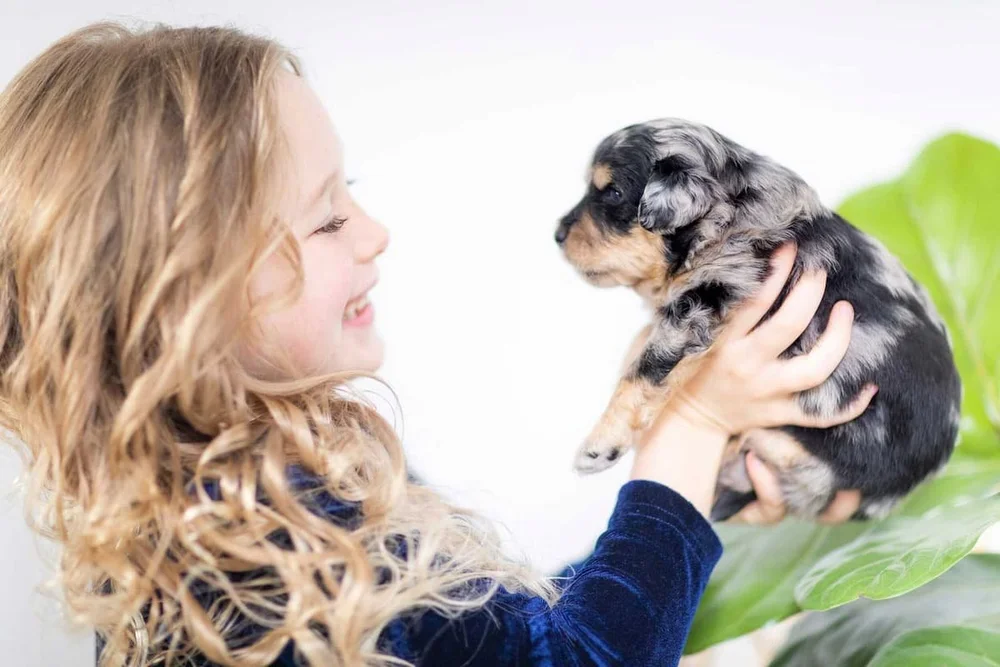 Family Integration
Matched to your household before development begins
Family Integration
Matched to your household before development begins
Busy professionals who want the outcome without the process. You have limited time but serious commitment. You don't want to troubleshoot training or manage behavioral surprises. You need a dog that integrates into your life prepared: confident, matched to your household, and developed past the stages that demand the most from an owner.
Families who want their children to grow up with an exceptional dog. You are building family memories around the dog. Through the Stokeshire Companion app, your children follow the puppy's development from first wobble to confident graduate, then welcome home a companion prepared for family life.
Couples and individuals entering a new chapter. You are starting fresh: a new home, a new phase of life, a new balance between structure and freedom. You want a dog that anchors your stability without demanding constant management. By go-home day, you have a mature, responsive companion that supports your lifestyle rather than complicating it.
Developmental science.
Breed-specific training.
The Bespoke Companion program encompasses developmental science, breed-specific training, and family integration. Explore each element in detail:
Three training tiers for Bernedoodles: Doodle School, Karlee Intensive, and Bespoke Companion.
Why this three-breed cross excels in professional training programs.
Volhard PAT testing, 12-trait evaluation, and how matching produces better outcomes.
Six critical developmental periods from neonatal through pubertal.
How early socialization and consistent relationship shape lifelong attachment.
Understanding the 6-month behavioral window and why intervention matters.
What true concierge-level training includes and red flags to avoid.
Models, pricing context, and where each Stokeshire tier fits.
The spectrum from basic obedience to companion-ready.
Questions about the
Bespoke Companion Program
Duration is set by your engagement rather than by a fixed curriculum. Every Stokeshire puppy begins in the Stokeshire Method Nursery from birth to eight weeks, continues through Doodle School foundation training from eight to twelve weeks, and a Bespoke Companion then remains in continuous development with a Stokeshire trainer beyond the twelve-week mark. Most Bespoke engagements represent roughly five to seven months of development before go-home. Longer engagements, including continuous development through nine to twelve months of age, can be structured during consultation. Your go-home date and total duration are fixed in your written agreement, and every training day in between is logged in the Stokeshire Companion app.
Your puppy begins life in our home in Medford, Wisconsin, raised alongside our family through the Nursery and Doodle School stages. Beyond twelve weeks, extended development continues with one of our contracted Stokeshire trainers working under the Stokeshire Method. The specific trainer, setting, and daily structure for your engagement are confirmed during consultation and named in your written agreement. You do not have to take our word for the daily work: every training day is logged in the Stokeshire Companion app with activity logs, weekly milestone scoring, and photo and video updates, so you follow your dog's development as it happens.
Dogs form and deepen attachments throughout life. Early socialization shapes how comfortably a dog accepts new people, places, and experiences, and consistency builds trust at any age. A Bespoke engagement is structured around both. You are matched to your dog before extended development begins, you follow daily progress in the Stokeshire Companion app, and go-home follows a written transition plan that includes an in-home consultation and twelve months of private support. Trained behavior generally transfers best when the household keeps the same routines and expectations, which is exactly what the transition plan is built to establish. We document what your dog has practiced and demonstrated. We do not guarantee future behavior.
We assess your household profile: family structure, experience with dogs, living space, activity level, and lifestyle timeline, weighed against each puppy's individual temperament, confidence, energy level, and developmental stage. Our process combines parental genetics (we breed for stable temperaments), Early Neurological Stimulation results, a structured aptitude evaluation, and sustained behavioral observation through the Canine Recovery Index, our longitudinal record of how each puppy responds to and recovers from new experiences. We decline placements we assess as mismatched, even if you are committed to waiting. Temperament matching is among the strongest predictors of long-term satisfaction and behavioral success.
Training standards for your engagement, including methods and equipment, are written directly into your training agreement rather than stated as marketing language, so the standard you were promised is the standard you can enforce. Families with specific requirements, such as reward-based-only training or restrictions on particular equipment, can have those terms named in the agreement before any deposit. Each milestone in your written plan is then practiced and logged in the Stokeshire Companion app with weekly scoring and video, so you can see how your dog is being worked, not just what the finished result looks like.
Mismatches are rare due to our rigorous matching process, but Stokeshire stands behind every placement. If a behavioral or health concern emerges within the first twelve months, we provide extensive support: consultation, training referrals, or in extreme cases, full commitment to rehoming the puppy. This is part of our twelve-month private support package. We have not had a returned puppy in over five years, because our developmental model and matching approach significantly reduce the conditions that cause mismatches in the first place. See our health guarantee and purchase agreement for full terms.
All transport is included in our program pricing. We coordinate professional, climate-controlled ground transport with certified pet transporters. Dogs travel in secure, comfortable containers with regular stops for hydration, bathroom breaks, and socialization. Most trips take two to three days, depending on distance. For distant placements, accompanied air arrangements may be available and are confirmed during consultation. Alternatively, some families choose direct pickup from Medford, Wisconsin, which allows a two-to-three-hour breeder consultation. We do not negotiate transport arrangements with third parties; all delivery is coordinated directly by Stokeshire to protect safety and welfare.
Stokeshire breeds three doodle lines: Australian Mountain Doodles (AMD), Bernedoodles, and Golden Mountain Doodles (GMD). Each line is selected for intelligence, trainability, and temperament stability. During consultation, we assess your family's experience, space, and activity level, then recommend the line generally best suited to your household. Breed selection is as important as individual puppy matching: some families thrive with the intensity of an AMD, while others do better with the gentler baseline of a GMD.
The Bespoke Companion begins at $40,000 at Stokeshire, inclusive of training duration, all transport logistics, and twelve months of private support. The exact total is fixed in writing during consultation based on breed selection, engagement duration, and go-home timeline, so there is a single number before you commit to anything. Program pricing reflects comprehensive parent health testing, limited breeding practices, months of continuous professional development, daily documentation, and ongoing support after placement. Complete parent health testing results, veterinary records, and the full purchase and training agreement are available for review before any deposit. Placement is limited to four to six families per year.
Documented every day.
The Bespoke Companion begins with a conversation about your household, your timeline, and the companion you are looking for.