
Why recovery matters more than
a first reaction.
Introducing the Canine Recovery Index™, an internal observation protocol used to study how each puppy responds to and recovers from unfamiliar experiences across several weeks of development.
A puppy notices
something unfamiliar.
One puppy approaches immediately. Another pauses, steps backward, watches a littermate investigate, and then moves closer. A third needs more time before deciding the object is safe.
The answer is not necessarily the puppy who moved first.
At Stokeshire Designer Doodles, confidence is not defined as the absence of hesitation. A confident dog notices what has changed, evaluates the situation, and returns to a settled, engaged state.
That return is what interests us. It is why we developed the Canine Recovery Index™, and why it sits inside the Stokeshire Method rather than beside it.
The Canine Recovery Index does not attempt to predict what a puppy will become. It gives us a more disciplined way to watch who the puppy is becoming.
Does the puppy remain overwhelmed, or begin gathering information?
Does the puppy return independently, or watch a littermate first?
After the first interaction, does the puppy choose to engage again?
Most importantly, how do these patterns change as the puppy gains experience?
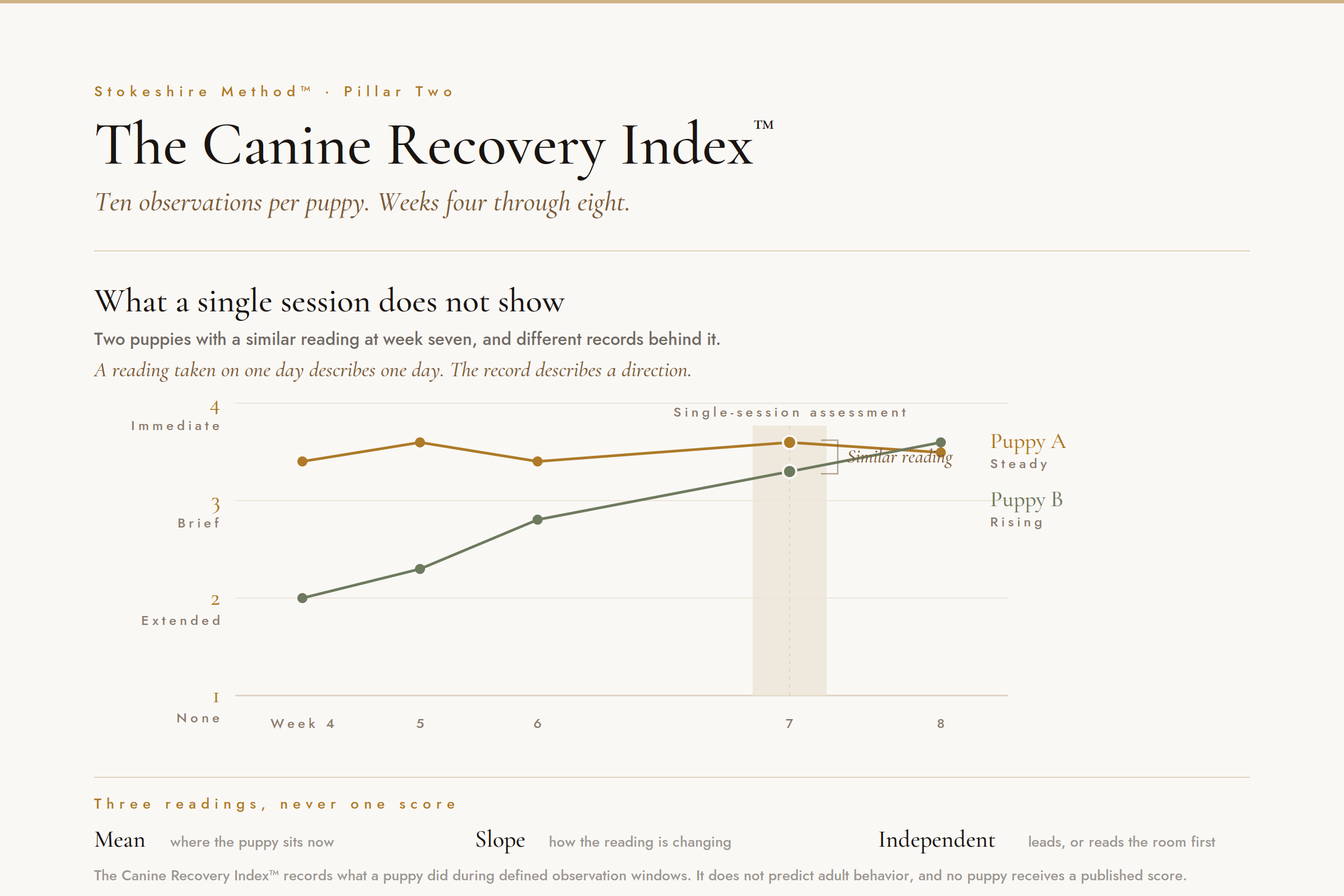
The Canine Recovery Index™ records what a puppy did during defined observation windows. It does not predict adult behavior, and no puppy receives a published score.
One observation.
One day. One set of conditions.
Puppies are commonly evaluated during a single aptitude or temperament assessment, often around seven weeks of age. Stokeshire continues to use a structured aptitude evaluation, because a carefully administered assessment can provide useful information.
But it remains one observation, conducted on one day, under one set of conditions. A puppy may be tired, hungry, overstimulated, recently awakened, unusually energetic, or affected by something that happened earlier that day. Even a well-designed assessment cannot completely separate enduring tendencies from the circumstances surrounding that particular session.
Research has also raised questions about how reliably early, one-time puppy assessments predict specific behavior in adult pet dogs. A longitudinal study following dogs from early puppyhood into adulthood concluded that the predictive validity of early tests was limited for many individual behavioral traits. We look at that research in more detail in does puppy testing matter.
That does not make puppy assessments useless. It means they are best treated as one source of information rather than a verdict. You can see how the aptitude evaluation fits the wider process in temperament testing puppies.
We are not searching for one decisive moment. We are looking for patterns.
At Stokeshire, the aptitude evaluation is considered alongside developmental records, trainer observations, daily handling, family requirements, health information, and the puppy's behavior across many different situations.
The eight-week puppy curriculum is where most of that observation happens.
A puppy can notice a great deal
and still regulate well.
A 2019 exploratory study examined physiological stress reactivity and recovery in puppies and young adult dogs by measuring several salivary markers after a behavioral test. The results were more nuanced than the assumption that a smaller initial response is always preferable. Strong initial reactivity was associated with some favorable owner-reported traits, while slower physiological recovery was associated with concerns such as lower trainability in certain measures.
The study was relatively small, and its authors concluded that the predictive capacity of the puppies' physiological responses remained uncertain. It should not be read as proof that recovery time can predict a puppy's future personality. It does, however, illustrate a distinction worth taking seriously.
A sudden sound, moving surface, unfamiliar object, or new person may reasonably produce a moment of caution. That initial response is not automatically a weakness. Dogs should notice their environment.
A puppy may appear quiet at first and still take considerably longer to return to comfortable engagement. Watching only the first reaction can cause us to miss the rest of the process.
A puppy who initially needs time but becomes progressively more efficient at recovering may be showing meaningful developmental growth. Without repeated observation, that growth remains invisible.
Development is movement.
A four-week-old puppy should not be expected to interact with novelty the way an eight-week-old puppy does. During those weeks, puppies are learning from their environment, their littermates, their mother, and the people caring for them. That is why the Canine Recovery Index™ is longitudinal. Rather than asking how a puppy performed once, we observe how the puppy's response changes across repeated developmental experiences.
Research from a working-dog breeding program supports the value of looking at change over time. In that program, improvement in behavioral ratings across the first year was associated with later selection into training, while scores recorded at a single point were not predictive in the same way.
Stokeshire puppies are not being evaluated as military or detection dogs, and findings from a specialized working-dog population cannot simply be transferred to companion doodles. The broader lesson is still useful. A developing animal's direction of change may contain information that a single score cannot capture.
The most visible puppy is not
automatically the most suitable puppy.
In many litters, the puppy who enters first receives the most immediate attention. That puppy may indeed be confident and well suited to an active family. But leading every interaction is not the only useful pattern, and there is no universal ideal, because families are not universal.
The puppy who watches first
Some puppies pause, watch what happens, and then participate. That can reflect social awareness rather than insecurity. A puppy who reads the room before acting may suit a family seeking a thoughtful, adaptable dog.
The puppy who leads
A highly independent puppy can be a rewarding match for an experienced owner who enjoys directing that energy. A busy household with older children and regular visitors may suit a different profile than a quieter home.
The puppy who improves
A puppy whose recovery improves substantially across the developmental period may be more flexible than a single seven-week assessment suggests. That pattern is only visible with repeated observation.
The puppy who needs more time
A puppy showing slower recovery is not a lesser puppy. That pattern may indicate the puppy needs additional developmental support or a more carefully selected home. It is information worth having early.
The question is not which puppy scored the highest. The question is what kind of environment is most likely to help this puppy thrive. That is the purpose of matching, and it is described step by step in how Stokeshire matches puppies to families.
What the Canine Recovery Index™
does not do.
The Canine Recovery Index™ records what a puppy did during defined observation periods. A puppy continues developing after leaving Stokeshire. Genetics, physical health, training, family routines, social experiences, adolescence, reinforcement history, and the relationship between the dog and its people will all influence future behavior.
The index never replaces professional judgment, the puppy aptitude evaluation, trainer observations, or the family application. It informs the matching conversation. It does not decide it.
Families do not receive a recovery score, and puppies are never advertised according to one. The purpose is better observation, not better marketing language. The full protocol, including standardized observation procedures, defined scoring categories, and handler-calibration practices, is part of the Stokeshire Method™ rather than a public scoring table.
Consistent observation creates a developmental record that can eventually be compared with standardized family feedback collected after puppies mature. Until enough outcome information has been collected and properly analyzed, we will not claim that a relationship between early recovery patterns and later behavior exists.
The index,
answered directly.
What is the Canine Recovery Index?
The Canine Recovery Index is an internal observation protocol used by Stokeshire Designer Doodles to record how each puppy responds to and recovers from unfamiliar experiences across several weeks of early development. Rather than relying on a single assessment, handlers observe how a puppy responds after noticing something new, whether the puppy approaches independently or watches a littermate first, how long it takes to return to comfortable exploration, and how those patterns change as the puppy gains experience. It is one input into family matching alongside the aptitude evaluation, trainer observations, and the family application.
Does the Canine Recovery Index predict adult behavior?
No. The Canine Recovery Index records what a puppy did during defined observation periods. It does not predict adult behavior. A puppy continues developing after leaving Stokeshire, and genetics, physical health, training, family routines, social experiences, adolescence, and the relationship between the dog and its people will all influence future behavior. Research suggests that recovery and developmental trajectory deserve closer attention, and the index gives Stokeshire a structured way to pay that attention.
Does Stokeshire still use a puppy aptitude test?
Yes. Stokeshire continues to use a structured aptitude evaluation, because a carefully administered assessment can provide useful information. It remains one observation conducted on one day under one set of conditions, so it is considered alongside developmental records, trainer observations, daily handling, family requirements, and health information rather than treated as a verdict on its own.
Do families receive a recovery score for their puppy?
No. Families do not receive a recovery score, and puppies are never advertised according to one. There is no universal ideal profile, because families are not universal. A busy household with older children and regular visitors may suit a different developmental profile than a quieter home seeking a lower-intensity companion. The purpose of the index is better observation, not better marketing language.
The first reaction is only
the beginning of the story.
Puppy matching will always require judgment. No form, test, or score replaces people who have raised the litter, observed the puppies daily, and understand the environment the puppy will enter. Judgment becomes stronger when it is supported by records.