
Golden Mountain Doodle
A Triple-Cross Designer Breed from Stokeshire Designer Doodles
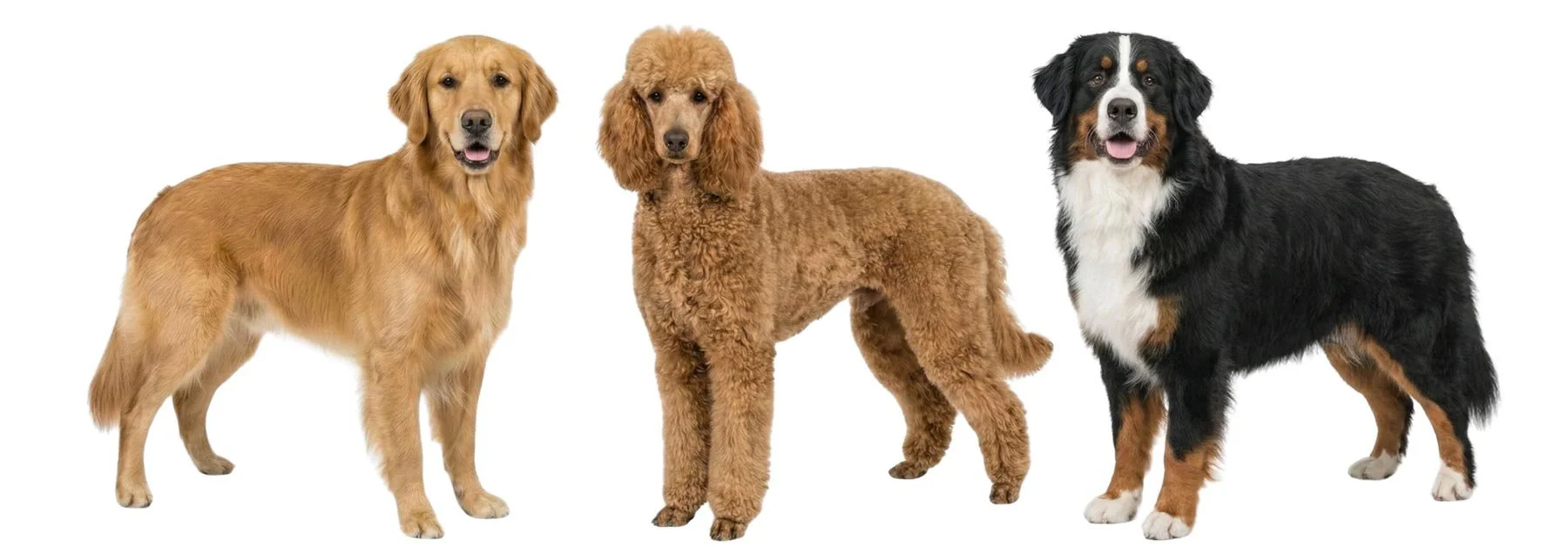
The Golden Mountain Doodle (GMD) blends the gentle sociability of the Golden Retriever, the calm devotion of the Bernese Mountain Dog, and the intelligence and low-shedding coat genetics of the Poodle. The result is a family-first companion with a teddy-bear appearance, lower energy than the Australian Mountain Doodle, and a temperament suited to homes with children, seniors, and first-time owners.
View Planned Litters Learn About the BreedWhat Is a Golden Mountain Doodle?
The Golden Mountain Doodle is a triple-cross hybrid produced by combining three established parent breeds: the Golden Retriever, the Bernese Mountain Dog, and the Poodle. Most GMD litters are produced by crossing an F1 Goldendoodle (Golden × Poodle) with an F1 Bernedoodle (Bernese × Poodle), resulting in a multigenerational cross with roughly 25% Golden Retriever, 25% Bernese Mountain Dog, and 50% Poodle genetic representation — though percentages vary depending on the specific parents involved.
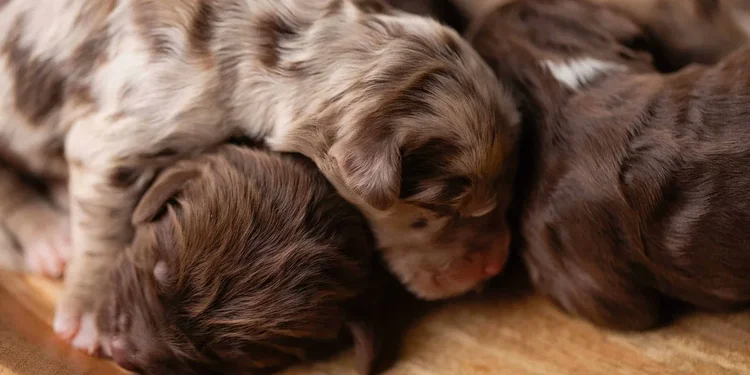
The triple-cross structure offers a meaningful health benefit: greater genetic diversity than a two-breed hybrid, which research consistently associates with lower hereditary disease expression. The trade-off is more variation in coat, color, and size within a single litter compared to a first-generation cross. At Stokeshire, every parent dog is Embark-tested for coat genetics, health markers, and breed composition before any pairing is planned.
| Breed Cross | Golden Retriever × Bernese Mountain Dog × Poodle (typically F1 Goldendoodle × F1 Bernedoodle) |
| Stokeshire Weight | Mini (25–40 lbs) · Medium (40–60 lbs) · Standard (60–90 lbs) · Ultra (90+ lbs) |
| Height | 14–28 inches at the shoulder, depending on size variant |
| Full Growth By | 12–24 months (smaller sizes mature faster) |
| Lifespan | 12–15 years typical (Minis often longer; Ultras shorter) |
| Coat | Wavy to curly, typically furnished — low to minimal shedding when furnished |
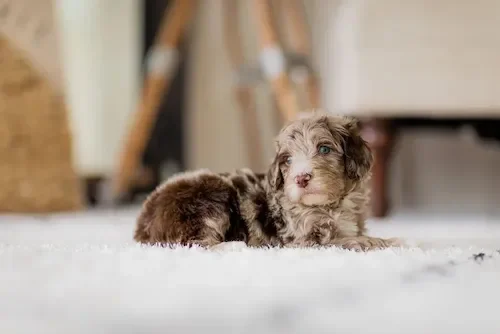
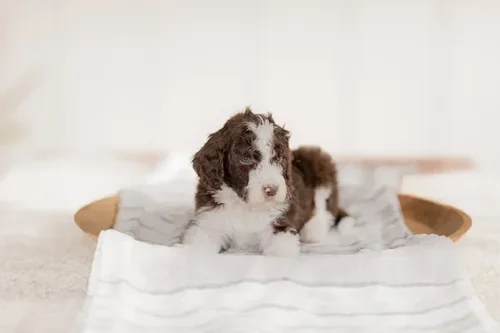
| Colors | Cream, apricot, gold, red, with white markings; tri-color possible from Bernese influence |
| Energy Level | Moderate — lower than the AMD, similar to a calm Goldendoodle |
Golden Mountain Doodle Sizes
GMD adult size is primarily controlled by the Poodle parent in the lineage. Standard Poodle crosses produce Standard and Ultra GMDs; Miniature Poodle crosses produce Medium and Mini GMDs. The Bernese and Golden contributions add baseline mass that resists very small frames — GMDs rarely reach under 25 lbs at full adult size, regardless of the Poodle lineage.
Mini Golden Mountain Doodle
25–40 lbs14–17 inches at the shoulder. Mini Poodle in the lineage. Growth complete by 12–14 months. Best suited to apartment dwellers, smaller homes, and households with elderly family members or young children who benefit from a more manageable size. Often the longest-lived variant.
Medium Golden Mountain Doodle
40–60 lbs17–22 inches. Moyen Poodle or small Standard Poodle in the lineage. Growth complete by 14–18 months. The most versatile GMD size — fits most household configurations, retains a substantive teddy-bear presence without the orthopedic concerns of giant-breed sizing.
Standard Golden Mountain Doodle
60–90 lbs22–27 inches. Standard Poodle in the lineage. Growth complete by 18–24 months. Family homes with space and time for daily structured exercise. Deep-chested — bloat (GDV) risk applies; eat in a low/slow-feed bowl, avoid exercise within an hour of meals.
Ultra Golden Mountain Doodle
90+ lbs26–30+ inches. Reverse F1B crosses (multigen doodle stud × Bernese dam) or heavy-Bernese pairings. Growth complete by 20–24 months. Strong Bernese presence, working-dog frame, calmer indoor temperament than Standards. Higher orthopedic, bloat, and cancer-screening requirements.
Golden Mountain Doodle Temperament
The Golden Mountain Doodle's temperament is the central reason families choose this cross. All three parent breeds — Golden Retriever, Bernese Mountain Dog, and Poodle — share a temperamental foundation of human-bonded sociability and trainability. The Bernese contributes calm devotion and patience with children. The Golden Retriever adds cheerful sociability, ease with strangers, and an eagerness to please. The Poodle brings cognitive sharpness, problem-solving, and trainability.
The result is a dog that settles well indoors after appropriate daily exercise, integrates easily into households with children, other pets, or frequent guests, and rarely exhibits the high-drive intensity of working-breed hybrids like the Aussiedoodle or Australian Mountain Doodle. GMDs are commonly placed with first-time dog owners, families with children, and as therapy or emotional support animals.
Trait expression varies by individual dog, lineage, and early enrichment. Stokeshire selects breeding parents for temperament stability as a primary criterion.
Golden Mountain Doodle Coat & Grooming
GMD coat type is governed by the same three gene loci that determine outcomes in every doodle cross: RSPO2 (furnishings — the beard and eyebrows that signal low-shedding coats), KRT71 (curl degree, from straight to tightly curly), and MC5R (shedding rate). A furnished, wavy-to-curly GMD will shed minimally into the environment; an unfurnished GMD with straight coat genetics will shed comparably to its Golden Retriever and Bernese parents.
Colors in the GMD typically express through the Golden Retriever and Bernese parent contributions — cream, apricot, gold, and red being most common, with white markings (including blaze, chest, and feet) from Bernese influence. Tri-color GMDs (black/white/tan or related variations) occur when Bernese coat genetics dominate. Stokeshire tests every breeding parent for coat genetics via Embark to predict litter coat outcomes before pairing.
Furnished Coats
Slicker brush plus metal comb to the skin. Mat-prone zones: collar, armpits, behind ears, base of tail. Daily during heavy shedding seasons.
All Furnished GMDs
Full bath, blow-dry, brush-out, trim, and ear-canal maintenance. Find a groomer with doodle-specific experience; ask to review their work before booking.
Between Grooms
Dog-specific shampoo and conditioner only. Always brush out fully before bathing — wet mats tighten and become much harder to remove.
Poodle-Inherited Risk
The Poodle ear canal traps moisture and debris. Weekly inspection, monthly cleaning, prompt veterinary attention for any odor, redness, or head-shaking.
Golden Mountain Doodle Health Considerations
Responsible GMD breeding accounts for health considerations from all three parent breeds. The triple-cross structure provides meaningful genetic diversity benefits — research consistently associates higher genetic diversity with reduced hereditary disease expression — but it does not eliminate the underlying health considerations of the contributing breeds. Every Stokeshire GMD breeding dog completes a comprehensive Embark genetic panel (230+ markers), with orthopedic evaluation (OFA or PennHIP) applied where appropriate to the lineage. Our breeding program meets the standards required for Good Dog certification — the third-party vetting program that audits health, welfare, and breeding standards.
Cancer Risk
Reduced compared to purebred Bernese (50–67%) and Golden (60%) through double dilution. The GMD carries three independent genomic backgrounds, reducing the concentration of breed-specific cancer alleles. Risk is lowered but not eliminated — smaller GMDs tend to carry lower cancer risk consistent with the size-cancer correlation in veterinary literature.
Hip & Elbow Dysplasia
Both the Golden Retriever and Bernese Mountain Dog are predisposed to hip dysplasia; the Bernese carries particularly high elbow dysplasia heritability (24–43%). Growth management in Standard GMD puppies — controlled exercise, large-breed puppy food, avoiding high-impact activity before growth plate closure — reduces developmental orthopedic risk.
Bloat (GDV)
Standard GMDs carry bloat risk from both the Bernese's deep chest and the Golden's large frame. Prevention: feed multiple smaller meals, use slow-feed bowls, avoid vigorous exercise around mealtimes. Prophylactic gastropexy during spay/neuter is an option for high-risk individuals. Symptoms — retching without vomiting, distended abdomen, restlessness — require immediate emergency care.
Ear Infections & Skin Allergies
Floppy ears from both the Golden and Bernese parent contribute to trapped moisture and infection risk. Weekly ear cleaning is essential — especially after swimming. Skin allergies (environmental and food-based) may affect 15–30% of GMDs. Food elimination trials, omega-3 supplementation, and early veterinary consultation help manage symptoms.
→ Complete health testing guide: OFA and Embark explained, what to ask any breeder
The health testing framework in our AMD health guide applies in full to the GMD — Bernese and Poodle screening is shared, Golden-specific tests are layered on top.
Golden Mountain Doodle vs. Australian Mountain Doodle
Both the GMD and the Australian Mountain Doodle (AMD) are triple-cross hybrids that include Bernese Mountain Dog and Poodle. The single difference — Golden Retriever in the GMD versus Australian Shepherd (Mini American Shepherd) in the AMD — has consistent downstream effects on energy, drive, and temperament.
| Feature | Golden Mountain Doodle | Australian Mountain Doodle |
|---|---|---|
| Third Parent Breed | Golden Retriever | Mini American Shepherd |
| Energy Level | Moderate | Moderate to High |
| Drive | Family-oriented sociability | Working-breed intelligence with herding heritage |
| Herding Behavior | None | Moderate — circling, nipping, redirecting |
| Best For | Families with young children, first-time owners, therapy work, calm households | Active households, experienced owners, sport & agility, working/service roles |
| Typical Colors | Cream, apricot, gold, red, tri (white markings) | Blue merle, red merle, traditional tri, phantom |
| MDR1 Drug Sensitivity | Low — Golden lineage does not carry MDR1 | Yes — Aussie lineage carries MDR1 risk |
| Coat Genetics | Identical — RSPO2 / KRT71 / MC5R | Identical |
| Bernese Health Considerations | Shared | Shared |
| Size Range | Mini (25–40) · Medium · Standard (60–90+) | Mini (20–35) · Medium · Standard (50–70+) |
The GMD and AMD are siblings in our program — same Bernese and Poodle foundation, different third breed. The GMD is the steadier family companion. The AMD is the active partner. The Australian Shepherd contribution is the difference that decides which household is the right fit.
Golden Mountain Doodle vs. Bernedoodle
The Bernedoodle (Bernese Mountain Dog × Poodle) is the closest two-breed analog to the Golden Mountain Doodle. The GMD adds Golden Retriever genetics to the Bernedoodle foundation. The result is a meaningful but subtle set of differences — most pronounced in sociability, color expression, and genetic diversity.
| Feature | Golden Mountain Doodle | Bernedoodle |
|---|---|---|
| Parent Cross | Golden × Bernese × Poodle (triple) | Bernese × Poodle (two-breed) |
| Genetic Diversity | Higher — three breeds | Lower — two breeds |
| Energy Level | Moderate | Moderate |
| Sociability with Strangers | Very High — Golden contribution | High but more reserved |
| Typical Colors | Cream, apricot, gold, red, tri | Tri, phantom, black, sable, parti, merle (in some lines) |
| Therapy Dog Potential | Excellent — Golden sociability + Bernese calm | Excellent — Bernese calm + Poodle trainability |
| Size Range | Mini (25–40) · Medium · Standard (60–90+) | See Bernedoodle Sizes guide — Micro through Standard |
| Coat Genetics | Identical — RSPO2 / KRT71 / MC5R | Identical |
| Bernese Health Considerations | Shared — Bernese lineage in both | Shared — Bernese lineage in both |
Golden Mountain Doodles at Stokeshire
Stokeshire's Golden Mountain Doodle program is built around health-tested, Embark-screened parent dogs selected for temperament stability, structural soundness, and documented health history. We produce GMD litters selectively across all four size variants — Mini, Medium, Standard, and Ultra — with every pairing planned to balance coat genetics, color expression, and parent compatibility. We do not breed for volume; we breed for outcomes.
Every Stokeshire puppy is raised in a family home with children and other animals — not in a kennel. Early Neurological Stimulation begins at Day 3. Sound desensitization, surface variation, and multi-person handling continue through all eight weeks before placement. Families receive their puppy's complete Embark results, vaccination records, and lifetime breeder support at placement.
- Embark genetic panel on every parent — coat loci, health markers, breed composition, MDR1
- Orthopedic evaluation — OFA or PennHIP — applied where appropriate to the lineage
- Color and merle genetics confirmed before any pairing
- Good Dog certified breeder — meeting third-party-audited standards for health, welfare, and breeding practices
- Wisconsin DATCP licensed #514401-DS · A+ BBB rated
- Related Stokeshire programs: Australian Mountain Doodle (our signature triple-cross), Bernedoodle, Goldendoodle, and our newest cross — The Stokeshire (Golden Australian Mountain Doodle)
Explore Golden Mountain Doodle Litters
Stokeshire raises Golden Mountain Doodles in Medford, Wisconsin, from health-tested, Embark-tested parents across all four size variants. Nationwide transport available.
View Planned Litters How the Process WorksReviewed by the Stokeshire Breeding Team · Updated June 2026
Golden Mountain Doodle FAQs
What is a Golden Mountain Doodle?
A Golden Mountain Doodle (GMD) is a triple-cross designer breed combining Golden Retriever, Bernese Mountain Dog, and Poodle genetics. Most GMD litters are produced by crossing an F1 Goldendoodle with an F1 Bernedoodle, resulting in a multigenerational hybrid with roughly equal representation from all three parent breeds. The triple-cross structure produces a calm, family-oriented temperament with the cognitive sharpness of the Poodle and the gentle sociability of both the Golden Retriever and the Bernese Mountain Dog.
How big do Golden Mountain Doodles get?
Golden Mountain Doodles come in four size variants at Stokeshire: Mini (25–40 lbs), Medium (40–60 lbs), Standard (60–90 lbs), and Ultra (90+ lbs). Adult size is influenced primarily by the Poodle parent in the lineage — Standard Poodle crosses produce Standards and Ultras; Miniature Poodle crosses produce Minis and Mediums. Adult size in any hybrid is influenced by both parents, not only the Poodle. We share parent sizes openly and prepare families for outcomes within a range — not a guarantee.
Do Golden Mountain Doodles shed?
Furnished, wavy-to-curly GMDs shed minimally into the environment — the curl structure retains shed hair within the coat rather than releasing it onto furniture and floors. Shedding level is determined by coat genetics (RSPO2 for furnishings, KRT71 for curl, MC5R for shedding rate) — not by breed label or generation. Unfurnished GMDs with straight coats shed comparably to their Golden Retriever and Bernese parents. Stokeshire tests every breeding parent for coat genetics before any pairing.
Are Golden Mountain Doodles hypoallergenic?
No dog is completely hypoallergenic. Furnished, curly-coated Golden Mountain Doodles are among the lower-shedding companion breeds and are often tolerated by allergy-sensitive individuals. However, allergen exposure — primarily the Can f 1 protein found in dander and saliva — is not equivalent to visible shedding, and clinical research consistently indicates that no breed reliably produces lower allergens for all individuals. Stokeshire does not guarantee allergy compatibility for any dog. Allergy-sensitive families are encouraged to spend time with an adult GMD before committing to a puppy.
How long do Golden Mountain Doodles live?
Golden Mountain Doodles typically live 12–15 years, with smaller sizes trending toward the longer end and Standards and Ultras toward the shorter end of the range. Lifespan is influenced by parent breed health testing quality, body weight management throughout life, diet, regular veterinary care, and the genetic diversity of the parent lines. The triple-cross structure of the GMD provides genetic diversity benefits associated with longer average lifespans compared to two-breed hybrids.
Are Golden Mountain Doodles good family dogs?
Yes — the Golden Mountain Doodle is among the strongest family-companion crosses we breed at Stokeshire. The Golden Retriever and Bernese Mountain Dog parent breeds both rank among the most family-oriented breeds in veterinary behavioral literature, and the Poodle contribution adds trainability and cognitive engagement. GMDs typically integrate well with children of all ages (with appropriate adult supervision around toddlers), get along with other dogs and cats, and welcome visitors warmly. They are commonly placed with first-time dog owners, families with young children, and as therapy or emotional support animals.
What health tests should Golden Mountain Doodle parents have?
Responsible Golden Mountain Doodle breeding requires health testing from all three parent breed lineages. The Stokeshire protocol includes: comprehensive Embark genetic testing on every breeding dog (covering progressive retinal atrophy, degenerative myelopathy SOD1, von Willebrand's disease, ichthyosis, and 230+ other markers); orthopedic evaluation — OFA or PennHIP — applied where appropriate to the parent lineage; cardiac screening on parents from Golden Retriever and Bernese lines (subaortic stenosis risk); and merle status confirmation on both parents before any pairing. Stokeshire's program meets the standards required for Good Dog certification, and we share complete Embark results with families at placement.
What's the difference between a Golden Mountain Doodle and a Bernedoodle?
The Bernedoodle is a two-breed cross of Bernese Mountain Dog and Poodle. The Golden Mountain Doodle adds Golden Retriever, creating a three-breed cross. The added breed provides three meaningful differences: higher genetic diversity (associated with reduced hereditary disease expression), increased sociability with strangers (the Golden contribution), and a different color palette (cream/gold/apricot rather than tri/phantom/merle). Both share the Bernese health considerations and the same coat genetics. The decision between them is preference, not quality.
What's the difference between a Golden Mountain Doodle and an Australian Mountain Doodle?
Both are triple-cross hybrids built on Bernese Mountain Dog and Poodle. The GMD adds Golden Retriever; the Australian Mountain Doodle (AMD) adds Mini American Shepherd (Toy Australian Shepherd). The Golden Retriever contributes calm sociability and family orientation. The Mini American Shepherd contributes herding-breed intelligence and higher drive. Families who want a steady, low-drive family companion typically choose the GMD; families seeking a more active partner with working-breed intelligence typically choose the AMD. The AMD also carries MDR1 drug sensitivity risk inherited from its Aussie lineage; the GMD does not.
How much exercise does a Golden Mountain Doodle need?
Most adult Golden Mountain Doodles need approximately 60 minutes of structured daily exercise — leash walks, fetch, swimming, hiking, or active play — plus daily mental stimulation through training sessions, puzzle feeders, or scent work. Mini and Medium variants need slightly less; Standard and Ultra variants need slightly more. For puppies of all sizes, follow the 5-minute rule: 5 minutes of structured leash exercise per month of age, twice daily, until growth plates close. High-impact repetitive exercise should be avoided during the growth phase, particularly in Standard and Ultra GMDs.
Should I consider a Goldendoodle or a Bernedoodle instead of a GMD?
It depends on what you're optimizing for. A Goldendoodle (Golden Retriever × Poodle) is a simpler two-breed cross with a fully Golden-driven temperament — cheerful, social, slightly higher energy than the GMD. A Bernedoodle is a Bernese × Poodle cross with a calmer, more reserved temperament than the Goldendoodle. The Golden Mountain Doodle sits between them: more sociable than a Bernedoodle, calmer than a Goldendoodle, and with the genetic diversity benefits of a three-breed cross. If you want the broadest Bernese tri-color expression, choose Bernedoodle. If you want classic Golden cheerfulness, choose Goldendoodle. If you want both — and the genetic diversity of three breeds — choose the GMD.