
The Science of Canine Bonding Windows
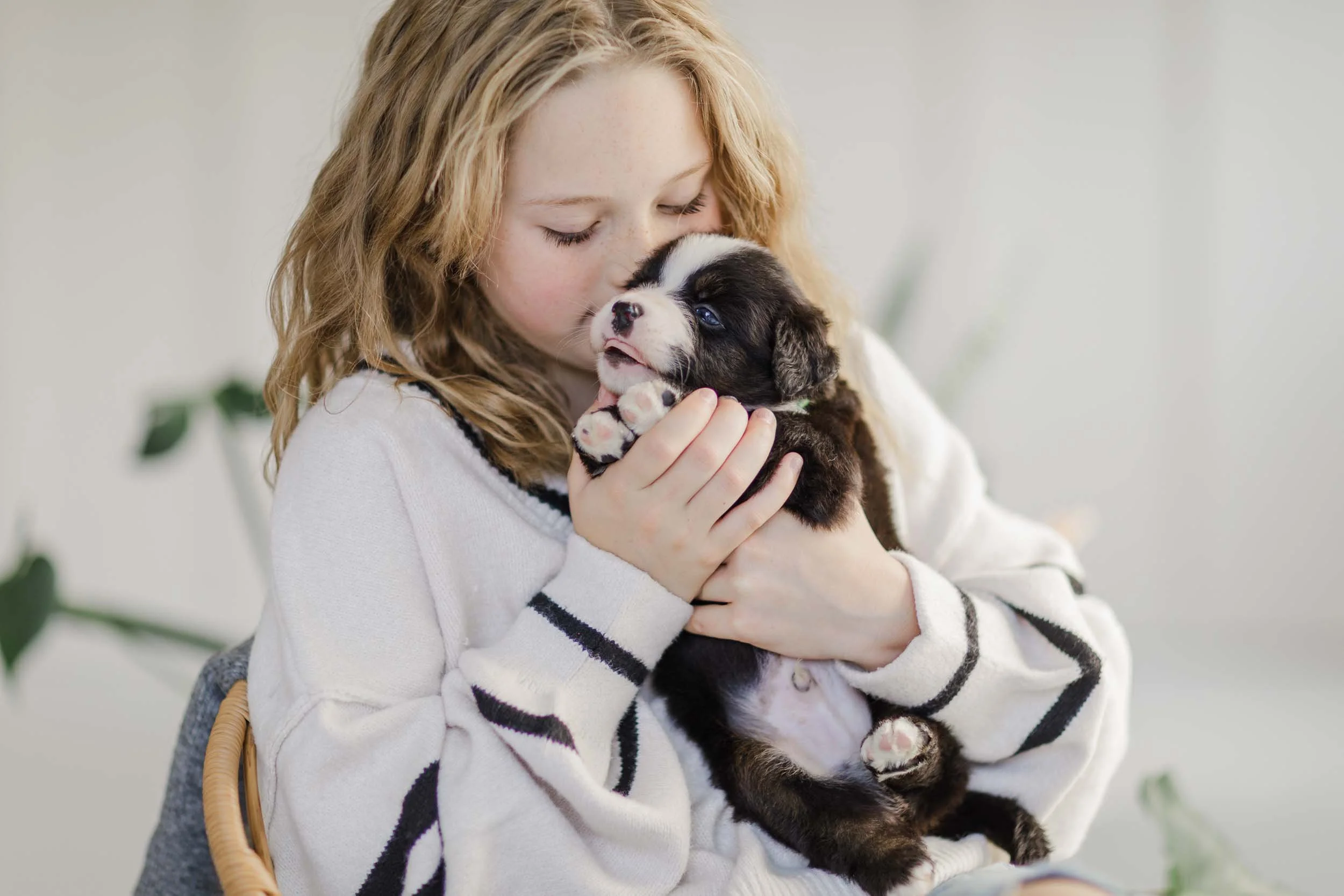
In 1965, John Paul Scott and John L. Fuller published a book that would become the foundation for modern understanding of puppy development: "Genetics and the Social Behavior of the Dog." Their research, conducted over more than a decade at Bar Harbor, Maine, identified the existence of distinct critical periods in canine development, windows of heightened neurological plasticity during which puppies are neurologically primed to learn, attach, and form relationships.
The critical bonding window they identified is not a theory. It's a measurable neurological reality. Understanding it changes how we think about puppy programs, timing, and long-term outcomes.
Scott and Fuller: The Foundational Research
Scott and Fuller conducted their research on purebred dogs (primarily Cocker Spaniels and Basenjis), observing and testing puppies from birth through six months of age. They identified four distinct developmental periods:
Neonatal period (0-2 weeks): The puppy is largely non-responsive to external stimuli. Its nervous system is immature. It sleeps, eats, and is dependent on the dam for all survival functions.
Transition period (2-3 weeks): The puppy's eyes and ears open. It begins responding to stimuli but is still largely dependent on the dam. The nervous system is beginning to mature.
Socialization period (3-14 weeks): This is the critical window Scott and Fuller identified. During this period, the puppy is neurologically primed to form associations with social partners, novel objects, and environments. The puppy is more confident and less fearful than it was or will be. Learning happens rapidly. By the end of this period, the puppy has learned what is normal and safe in its world.
Juvenile period (14 weeks onward): Neophobia (fear of new things) increases. The puppy becomes more conservative in its approach to novel stimuli. Learning is still possible, but the ease of learning and the breadth of what the puppy will accept decreases sharply.
The key insight from Scott and Fuller's work is that the socialization period is irreplaceable. Exposures that happen easily during weeks 3-14 become difficult after week 14. Relationships formed during this period become the template for relationships formed later in life.
Critically, Scott and Fuller also found that the intensity of socialization during this window matters as much as the exposure itself. A puppy merely exposed to stimuli without interactive engagement, without a trusted caregiver present to regulate the experience, showed different developmental outcomes than a puppy engaged with during socialization. The presence of a responsive, consistent adult during novel experiences changed how the puppy's brain encoded those experiences.
Primary vs. Secondary Attachment: The Distinction
Scott and Fuller's work on socialization was later synthesized with attachment research, frameworks developed by John Bowlby and Mary Ainsworth in the study of human infant-parent bonding. Researchers including John Archer and others applied this framework to dog-human relationships and found striking parallels.
A puppy forms a primary attachment to one or two main caregivers during the critical window (roughly 12-16 weeks of age, occurring within the broader socialization period). This is not a preference; it is a neurochemical bonding. The primary attachment figure becomes the puppy's "secure base," the reference point from which the puppy explores and to which it returns for comfort or regulation.
A puppy with a secure primary attachment shows specific behaviors:
Preferential seeking: When frightened or uncertain, the puppy seeks the primary attachment figure first, not just any person.
Distress on separation: The puppy shows signs of stress when the attached person is absent.
Reunion behavior: The puppy shows obvious pleasure and seeking when the attached person returns.
Use as a secure base: The puppy is more confident in novel situations when the attached person is present.
Secondary attachments form to other family members and trusted people, but they are weaker. The puppy may like and trust these people, but they are not the primary reference for emotional regulation or security.
The critical point: a puppy can only form one or two primary attachments. The brain does not work otherwise. If a puppy remains in a facility setting during the 12-16 week window, it does not form a primary attachment to the staff (who are rotating and not a consistent caregiver). It may form secondary attachments. It may develop sociability to many people. But it misses the primary attachment formation that should have been tied to its family.
When this puppy transitions home at 18 weeks or later, the family must build a primary attachment from scratch. This is neurologically and emotionally possible, but less efficient than formation during the critical window.
Social Referencing: How Puppies Learn to Be Confident
One of the most practically important discoveries from attachment research is the concept of social referencing, the ability of a puppy to read emotional cues from a trusted person and use that information to regulate its own response to a novel or ambiguous situation.
Imagine a puppy encountering a vacuum cleaner for the first time. The sound is loud, the movement is novel. The puppy does not inherently know if this is safe or dangerous. So it looks at its primary caregiver. If the caregiver appears calm, relaxed, and unsurprised, the puppy learns that the vacuum is safe. If the caregiver appears anxious or fearful, the puppy learns to be wary of the vacuum.
This happens through repeated, early interactions. The puppy that grows up with a calm, responsive caregiver who consistently "reads" novel experiences as safe develops strong social referencing ability. The puppy learns to use the relationship as an emotional reference frame. It becomes what we call "confident" or "well-socialized."
Puppies that miss the critical bonding window, or that form insecure attachments, often show weak social referencing. They may not look to people for guidance in uncertain situations. They may develop anxiety or reactivity that persists even with later training, because the underlying neurological pathway for reading human emotional cues is underdeveloped.
This explains why a puppy from a facility environment, even if it was well-socialized to stimuli, sometimes arrives home with anxiety or difficulty bonding to the family. The socialization happened, but not with the consistent presence of a trusted attachment figure. The puppy was exposed to stimuli but did not learn to use a person as a reference for safety.
What the Research Says About Bonding and Training
The research consensus is clear: training and bonding are not interchangeable outcomes.
A puppy can learn commands, impulse control, and behavioral cues in a facility without forming a primary attachment to a family. A puppy can be well-trained and anxiously attached or insecurely bonded.
A puppy that bonds first, during the critical window with its family, and trains second (leveraging the secure relationship as a foundation) shows different long-term outcomes. The training is more durable because the motivation is intrinsic (the relationship itself is reinforcing, not just the reward). The dog is more resilient during stress because it has learned to use the relationship as an anchor. The dog is more responsive to the family's emotional cues because the social referencing pathway was established during the critical window.
Modern developmental training approaches prioritize this sequencing: bonding first (which requires the puppy to be home during the critical window), training in the context of that bonding, and then continued training through subsequent critical windows (like the adolescent regression window at 4.5-7 months).
Practical Implications for Puppy Buyers
Understanding the science of critical periods changes how to evaluate a puppy program:
Timing matters neurologically, not just logistically. A program that keeps a puppy until 16 weeks is not just a program that keeps it longer. It's a program that may be keeping the puppy through the critical bonding window. If the puppy comes home at 12 weeks with some training and bonds at home, the outcome is different than if it comes home at 16 weeks after bonding with facility staff.
Socialization without attachment is incomplete. A puppy that was exposed to many stimuli but without a consistent, responsive caregiver may be friendly but not secure. Look for programs that emphasize not just exposure but also consistent caregiving and bonding during socialization.
Family integration is part of development, not a phase after development. Programs that treat family integration as a separate phase (coming after an extended training period) are not aligned with how puppy brains actually develop. The family is the developmental context. The puppy develops within the family relationship.
A program that sends puppies home mid-training during the critical bonding window is honoring the science of puppy development, not shortchanging training. It's sequencing the input in the order puppies are neurologically designed to receive it: bonding first, training in the context of that bond, and continued training through adolescence.
Stokeshire Designer Doodles structures both the 4-Week Doodle School and Bespoke Companion program around the research-backed critical periods identified by Scott, Fuller, and subsequent attachment researchers. Puppies go home during the bonding window and continue training through the developmental stages with family as the primary attachment context. This approach honors both neurological attachment science and behavioral training science, producing outcomes that reflect the full picture of puppy development.