
How to Tell if a Dog Is Pregnant : Understanding Early Signs, False Pregnancy, and What’s Normal
How to Tell if Your Dog is Pregnant
Week-by-Week Guide, False Pregnancy Insights & What’s Normal
Understanding dog pregnancy can be tricky, as hormonal changes in dogs are nearly identical whether they’re pregnant or not.
At Stokeshire, we believe knowledge replaces uncertainty. This guide will help you determine if your dog is truly pregnant, understand the week-by-week pregnancy process, and recognize false pregnancy (pseudopregnancy) — one of the most misunderstood aspects of canine care.
Last reviewed and updated for accuracy: January 2026
Table of Contents FAQ
How long are dogs pregnant?
What are the early signs of dog pregnancy?
What is false pregnancy in dogs?
How can you tell false pregnancy from real pregnancy?
What happens during a week-by-week dog pregnancy?
When can dog pregnancy be confirmed?
When should a veterinarian be contacted?
How Long Are Dogs Pregnant?
The average dog pregnancy lasts:
63 days (approximately 9 weeks)
Measured from ovulation, not the breeding date.
Since ovulation timing varies, early pregnancy signs are often unreliable without veterinary testing.
Early Signs of Dog Pregnancy
In the first few weeks, signs of pregnancy are subtle and can be mistaken for hormonal changes.
Possible early indicators:
Mild lethargy
Increased affection
Temporary appetite loss
Slight nipple enlargement
Behavioral changes
⚠️ Note: These signs also occur during false pregnancy, so observation alone cannot confirm pregnancy.
What Is False Pregnancy in Dogs?
False pregnancy (pseudopregnancy) occurs when a female dog shows pregnancy symptoms without being pregnant.
This is a normal condition that affects many intact females after their heat cycle.
Why it happens:
After every heat cycle:
Progesterone rises — regardless of conception.
Progesterone remains elevated for ~60 days.
Progesterone drops.
Prolactin (maternal hormone) increases.
This hormonal sequence mimics true pregnancy, preparing the dog’s body for puppies — even if none exist.
Common False Pregnancy Symptoms
False pregnancy symptoms typically appear 4–8 weeks after heat.
Physical symptoms:
Enlarged nipples
Mammary swelling
Milk or fluid production
Weight gain
Mild abdominal distension
Behavioral symptoms:
Nesting behavior
Carrying toys as if they’re puppies
Protective instincts
Anxiety or clinginess
Reduced or fluctuating appetite
These signs usually resolve naturally within 1–3 weeks.
False Pregnancy vs Real Pregnancy
| Symptom | False Pregnancy | Real Pregnancy |
|---|---|---|
| Nipple enlargement | ✓ | ✓ |
| Milk production | ✓ | ✓ |
| Nesting behavior | ✓ | ✓ |
| Weight gain | ✓ | ✓ |
| Puppy movement | — | ✓ |
| Ultrasound confirmation | — | ✓ |
| X-ray puppy visibility | — | ✓ |
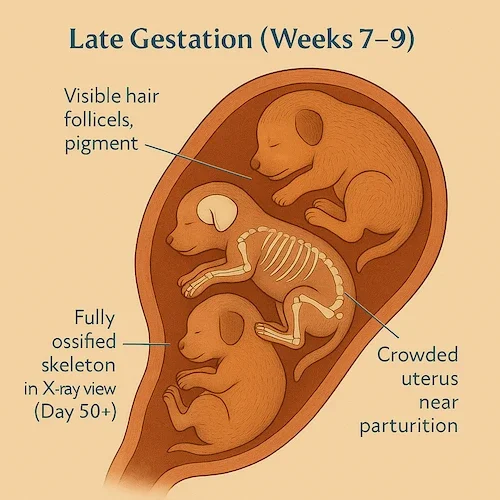
Week-by-Week Dog Pregnancy Timeline
Week-by-Week Dog Pregnancy Timeline
A clear, high-level view of what typically happens during each week of pregnancy — from fertilization to labor.
Early development begins
- Fertilization occurs.
- Embryos begin dividing.
- No visible signs.
Embryos travel to the uterus
- Embryos migrate toward the uterus.
- Dog appears normal.
Implantation window
- Embryos implant.
- Possible nausea or appetite changes.
- Early nipple color change.
Organ development begins
- Organ development begins.
- Heartbeats present.
- Slight mammary development.
Growth becomes noticeable
- Fetal skeleton formation.
- Abdominal rounding begins.
- Increased appetite.
Rapid fetal growth
- Rapid fetal growth.
- Clear belly enlargement.
- Increased rest.
Preparation phase begins
- Puppies are fully formed.
- Visible abdominal movement.
- Nesting behaviors begin.
Near full size
- Puppies are nearly full size.
- Appetite may decline.
- Mammary glands enlarge.
Labor is close
- Temperature drops below 99°F.
- Restlessness, panting.
- Labor begins within 12–24 hours.
When Can a Dog Pregnancy Be Confirmed?
| Method | Timing | Purpose |
|---|---|---|
| Relaxin blood test | Day 28+ | Confirms pregnancy hormone |
| Ultrasound | Day 28–35 | Confirms embryos |
| X-ray | Day 50–55 | Counts puppies |
Signs Labor Could be Approaching
As pregnancy nears its end, the body gives clearer signals.
Typical signs labor may begin within 24 hours:
Rectal temperature drops below 99°F
Restlessness or pacing
Panting without heat or exertion
Refusal of food
Digging or rearranging bedding
Seeking isolation or constant reassurance
If these signs appear without progression to labor, or if distress increases, veterinary guidance is essential.
When to Contact a Veterinarian
Seek veterinary guidance if:
Milk production becomes excessive.
Mammary glands become painful.
Symptoms persist longer than 4 weeks.
Dog develops fever or lethargy.
False pregnancies occur repeatedly.
You think your pup may be infertile
Frequently Asked Questions
Can you tell if a dog is pregnant at 2 weeks?
Can a dog produce milk without being pregnant?
How common is false pregnancy in dogs?
Is false pregnancy dangerous?
Conclusion
Learning how to tell if a dog is pregnant can feel overwhelming, especially when the signs aren’t always clear. Hormonal changes can look like pregnancy, timelines can vary, and it’s normal to have questions along the way. What matters most is understanding what’s normal, fertility, knowing when signs overlap, and taking the time to confirm what’s really happening.
From our family to yours, we believe good care starts with clear information and calm decision-making. Whether you’re noticing early changes, tracking a week-by-week timeline, or sorting out the difference between real and false pregnancy, you’re not alone in the process.
At Wisconsin Designer Doodles, we’re here to support you with honest guidance, responsible practices, and a deep respect for the dogs we care for. When questions come up, the goal isn’t to rush to conclusions — it’s to move forward with confidence, compassion, and the right information at every step.
About the Author and Breeder: James Stokes of Wisconsin Designer Doodles
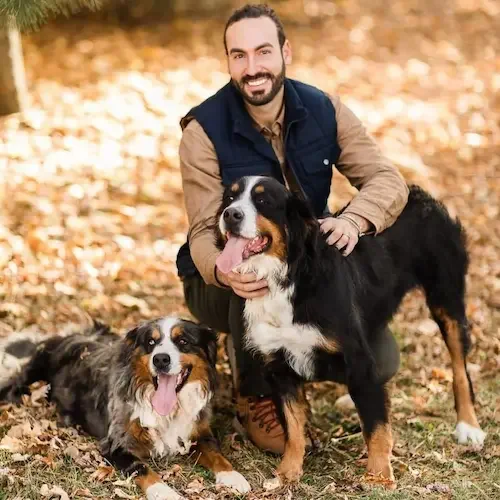
James Stokes is a trusted dog breeder of Doodles, a popular hybrid dog breed, and a responsible steward of the canine community. For over ten years, James has dedicated himself to raising healthy Bernedoodle puppies, a cross often involving the Bernese Mountain Dog and Poodle, that families can cherish, prioritizing their welfare. He works alongside his wife and children every day, ensuring each puppy from their litters receives loving care. Together, they have found wonderful homes for their Doodles across the U.S., Canada, and Mexico.
Health-tested puppies raised from proven, well-established lines and supported by a three-year genetic health guarantee, with breed-appropriate genetic testing conducted in line with current veterinarian and genetic best practices.
Hand-raised in a family home, never kept in kennels or a whelping box for too long, ensuring optimal welfare and a healthy birth environment.
Socialized early with ENS, sounds, and plenty of family time. This helps develop positive behavior and a balanced temperament and energy levels, ensuring they feel safe and relaxed, and are ready for their first vaccine and initial dog training.
Lovingly matched to each family. Every Doodle puppy from our litters is chosen based on specific criteria to fit well with their family’s way of life and needs, ensuring a perfect pet.
Part of an ethical, small-scale breeding program, driven by heart, focusing on the overall health and nutrition of each animal, including what dogs eat for optimal development.
At Stokeshire, doodles are never “just pets,” but cherished family members. They are thoughtfully raised companions—designed to become steady, intuitive members of the family for life. Every decision we make is guided by the Stokeshire Method: pairing genetics, temperament, and early-life environment to raise dogs with excellent behavior who integrate naturally into real family rhythms, upholding the dog breed standard of our program.
Our doodle puppies are known for their balanced energy, emotional intelligence, and predictable temperaments, embodying the best of their dog breed characteristics. They thrive in a wide range of households—from active families to therapy-focused homes—and are often an excellent option for those seeking allergy-friendly companions. Like our Goldendoodles and Aussiedoodles each puppy is raised with the intention of becoming deeply bonded, well-mannered, and trusted at every stage of life.
Stokeshire is proudly based in Medford, Wisconsin, but our families span far beyond the Midwest. Through our concierge-style transport and placement process, part of our comprehensive program, we safely deliver puppies across the United States and into Mexico—ensuring a calm, carefully managed transition from our home to yours. From day one, your puppy’s journey is handled with the same care and intention with which they were raised.