
Puppy Starter Kit: Inside the Stokeshire Companion Collection

When a puppy leaves Stokeshire, it arrives with a package of materials called the Companion Collection. Families often assume this is like any puppy startup kit, a collection of nice items that might be useful. The reality is more intentional. Every item in the Companion Collection serves a specific function: to maintain training consistency, support the puppy's transition, and document the puppy's learning journey.
This post walks through what the collection includes and why each element matters.
The Philosophy Behind the Collection
Dogs learn contextually. A puppy trained to sit in a specific environment, with specific equipment, for specific rewards has learned not just the command but the entire context surrounding it. When that context changes dramatically, with a new environment, equipment, and people, the dog must adjust.
The Companion Collection minimizes transition friction by maintaining consistency. The same crate the puppy has learned to love becomes the puppy's secure space at home. The same leash used in training remains the puppy's familiar tool. The same treat the puppy knows becomes its reward at home.
Over weeks, the puppy generalizes these behaviors to new contexts and equipment. But starting with continuity means the puppy doesn't have to relearn everything simultaneously as it adjusts to a new family and home.
The collection also ensures continuity of information. The Development Portfolio documents exactly what was trained, how the puppy learned it, and what works. Families don't have to guess or reinvent. They follow documented protocols that are proven to work for that specific puppy.
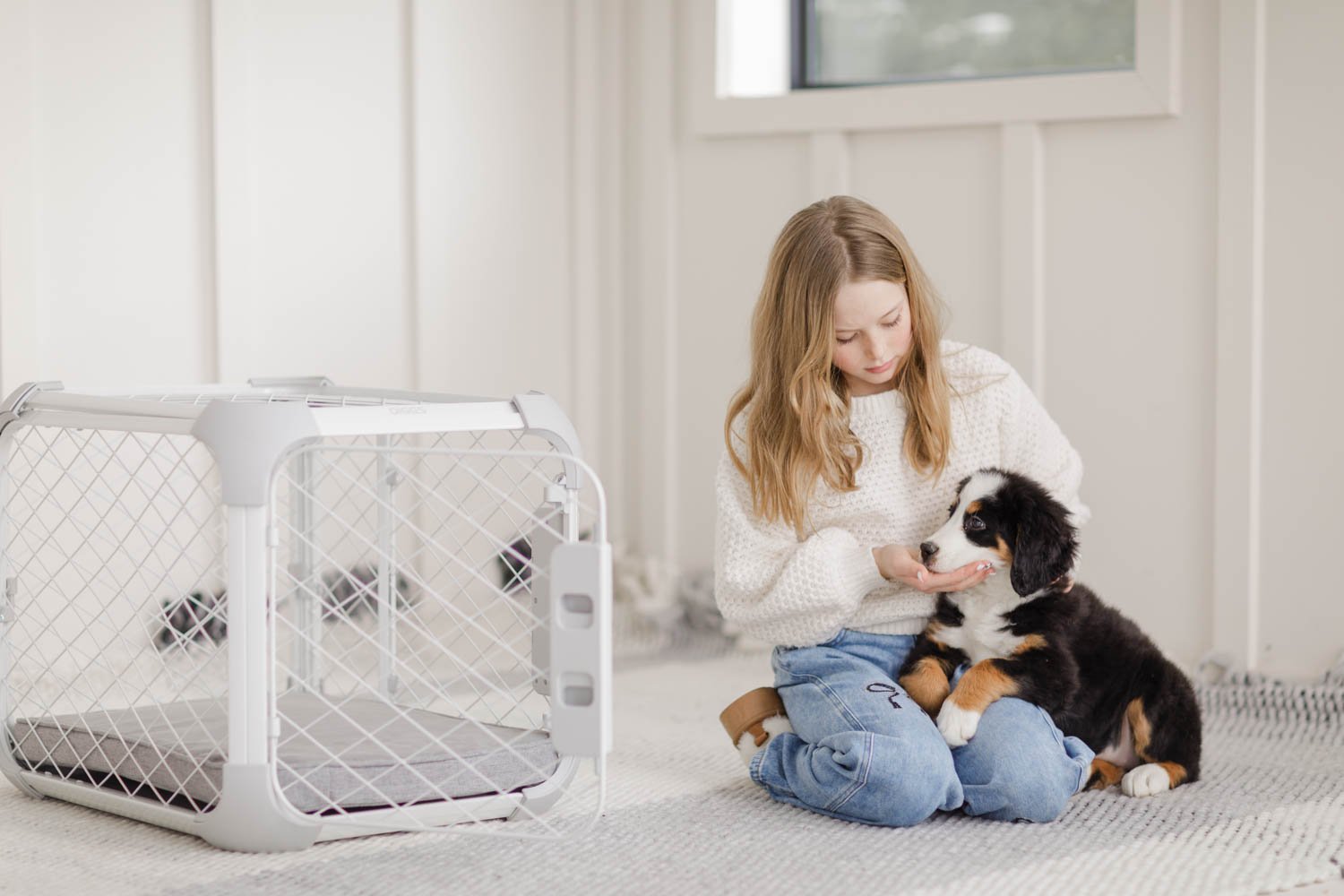
Puppy Starter Kit: What's Included in the Companion Collection
The Crate (Primary Resting Tool)
The puppy has been sleeping in a specific crate style at the breeder's facility. This crate is familiar, safe, and associated with rest and security. Families receive the identical crate so the puppy's association transfers to home. A puppy that took weeks to accept a crate at the breeder doesn't need to repeat that process at home if the crate is the same.
The crate selection reflects the puppy's size and the family's space. Wire, plastic, or soft-sided crates are chosen based on the puppy's temperament and family needs. But consistency is the priority.
Leashes and Collars
The puppy has been leash-trained using specific equipment. The collection includes the same leash style and collar. If the puppy was trained on a 6-foot leather leash, it arrives home with the same leash. If it was trained on a flat collar, the flat collar is included.
The reasoning is simple: consistency supports obedience transfer. The puppy responds reliably to equipment it knows. Over time, it generalizes to different equipment. But starting with consistency means immediate responsiveness.
Treat Pouch and High-Value Treats
Training relies on consistent, immediate rewards. The collection includes the specific treat brands used during training. If the puppy was trained with freeze-dried chicken, families receive freeze-dried chicken. If specific kibble or training-size treats were used, those are included.
The treat pouch allows families to deliver rewards the same way the trainer did, quickly during training reps, with the treat accessible. Consistency in reward delivery supports consistent behavior.
Comfort Bedding
The puppy has been resting on familiar bedding at the breeder's facility. That bedding carries the scent of the environment and other puppies. Families receive bedding that smells familiar. This provides comfort during the transition to a new home. Over time, the family can introduce new bedding, but starting with something familiar reduces stress.
The Development Portfolio
This is the heart of the collection. The Development Portfolio is a comprehensive, puppy-specific documentation of everything that was trained and how the puppy responded. It includes:
Weekly training summaries: what was worked on, how many reps, the puppy's response and progress.
Behavioral milestones: when key behaviors were understood, when the puppy became reliable, when challenges emerged and how they were addressed.
12-trait evaluations: the puppy's scores across all temperament traits at weeks 4, 8, and 12 (or at relevant intervals for extended programs).
Socialization log: exposures the puppy received, with dates and outcomes.
Equipment preferences: what tools worked best, what the puppy's responses were, what adjustments were made.
Learning style: is the puppy food-motivated, toy-motivated, or praise-motivated? Does it learn quickly or take time? Is it independent or needing frequent direction?
Continuation recommendations: specific protocols for maintaining training reps at home, progression suggestions for advanced training, management tips for challenging behaviors.
The portfolio is not generic. It's about that specific puppy. It shows the family exactly what was trained, the method used, and what worked. This eliminates guesswork and enables families to seamlessly continue the training or troubleshoot issues using documented protocols.
Bonding Period Playbook
For puppies arriving home at younger ages (Doodle School), the Bonding Period Playbook provides structured daily routine templates, feeding schedules, sleep management protocols, house-training approaches, and basic training progression. This removes guesswork during those critical first weeks at home.
Temperament-Specific Guidance Document
Beyond generic puppy advice, families receive guidance specific to their puppy's temperament profile. A high-drive puppy gets different advice than a sensitive puppy. A dog-reactive puppy gets protocols that prevent escalation. A fearful puppy gets desensitization recommendations. This personalized guidance dramatically improves the family's management of the puppy.
Training Refresher Videos
Families receive short videos demonstrating the commands their puppy already knows. This allows families to see exactly how the trainer cued the behavior, how the puppy responds, and how the reward is delivered. Many behavioral issues stem from families cueing differently than the trainer, or rewarding inconsistently. Videos show the right approach and support continuity.
Contact Information and Support Resources
Families have clear access to Stokeshire's contact information for ongoing support, questions, or challenges during the first months. This ensures families don't feel abandoned or uncertain when issues arise.

Why Each Item Matters
It's easy to dismiss the collection as luxury or excess. But each item directly supports the puppy's transition and continued development.
The crate becomes the puppy's safe space at home rather than a tool to reintroduce and rebuild acceptance. The leash and collar maintain the puppy's learned responsiveness rather than requiring retraining. The treats ensure consistent reward delivery rather than changing motivation midway through training. The familiar bedding reduces stress during a major transition. The Development Portfolio enables families to continue training without redoing foundational work.
Together, these items create a continuity system. The puppy is not being dropped into a completely new environment with new equipment, new people, and new protocols. It's transitioning into a new home while maintaining the tools and approaches it already knows.
Equipment Continuity and Behavioral Transfer
One of the most overlooked principles in dog training is that dogs learn contextually, not in a vacuum. A puppy that knows "sit" in the breeder's facility may not understand "sit" at the veterinary clinic. A puppy that walks reliably on leash during training may pull during a family walk if the environment is overstimulating.
This is not the puppy failing to understand. It's the puppy processing the new context and being temporarily confused about whether the old behavior applies in the new situation.
Equipment continuity accelerates behavioral transfer. A puppy trained with specific equipment in a specific context will generalize to new contexts more reliably if it starts with familiar equipment. The equipment becomes an anchor, a signal that the learned behaviors still apply.
Over weeks, the puppy learns that "sit" means sit regardless of leash type, crate style, or treat brand. But the transition is faster and smoother with equipment consistency.
The Role of Documentation in Long-Term Success
The Development Portfolio serves multiple functions. In the short term, it enables families to continue training seamlessly. In the long term, it provides a reference for understanding the puppy's learning history and behavioral tendencies.
If a behavioral issue emerges at 6 months, families can look at the Development Portfolio and see how a similar issue was addressed at the breeder's facility. If the puppy suddenly becomes fearful, the portfolio shows whether fearfulness was present in early assessments and how it was managed. This historical context prevents families from misinterpreting normal development as a problem, and enables them to apply previously successful management strategies.
The portfolio also supports accountability. Families have documented evidence of what was trained, how the puppy responded, and what works. This prevents miscommunication or misunderstanding about the puppy's baselines.
The Companion Collection is included with Bespoke Companion and Karlee Intensive placements. Doodle School families receive core collection items. Every collection includes the Development Portfolio - a comprehensive record of the puppy's learning journey. To learn more about what your puppy will arrive home with, contact Stokeshire for details on your specific program.