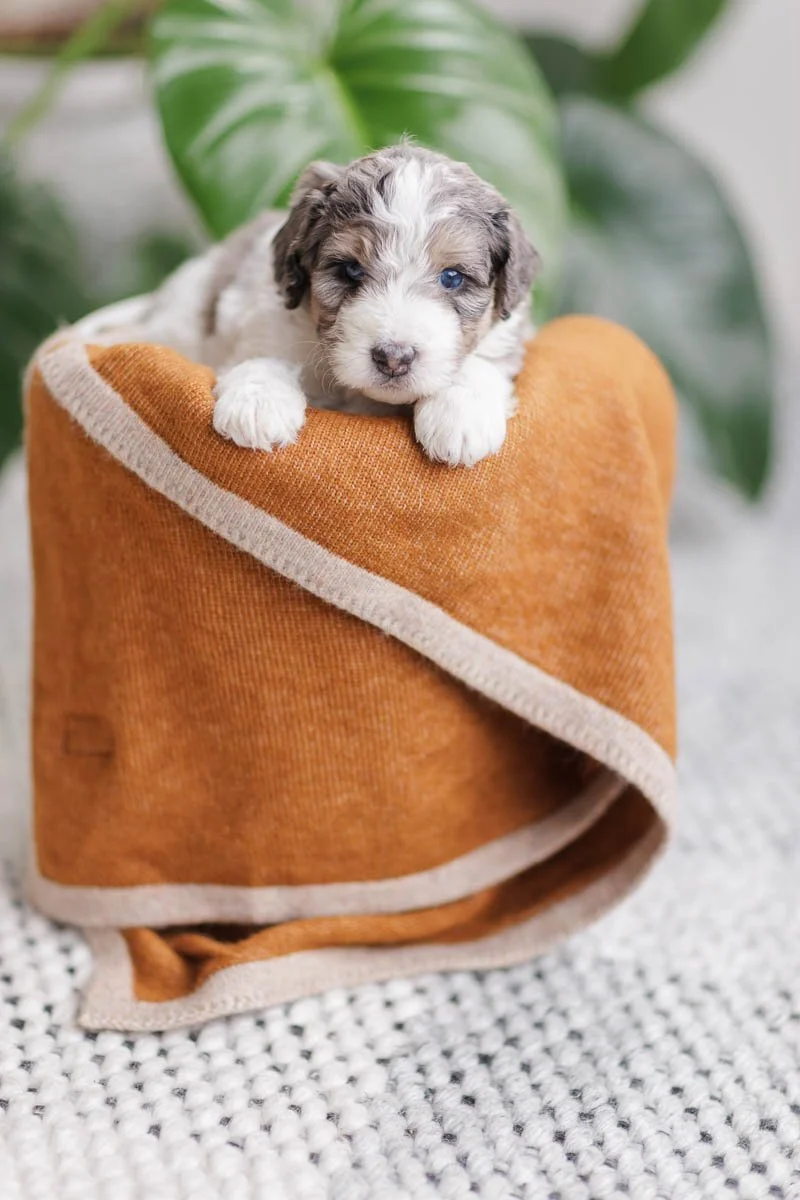
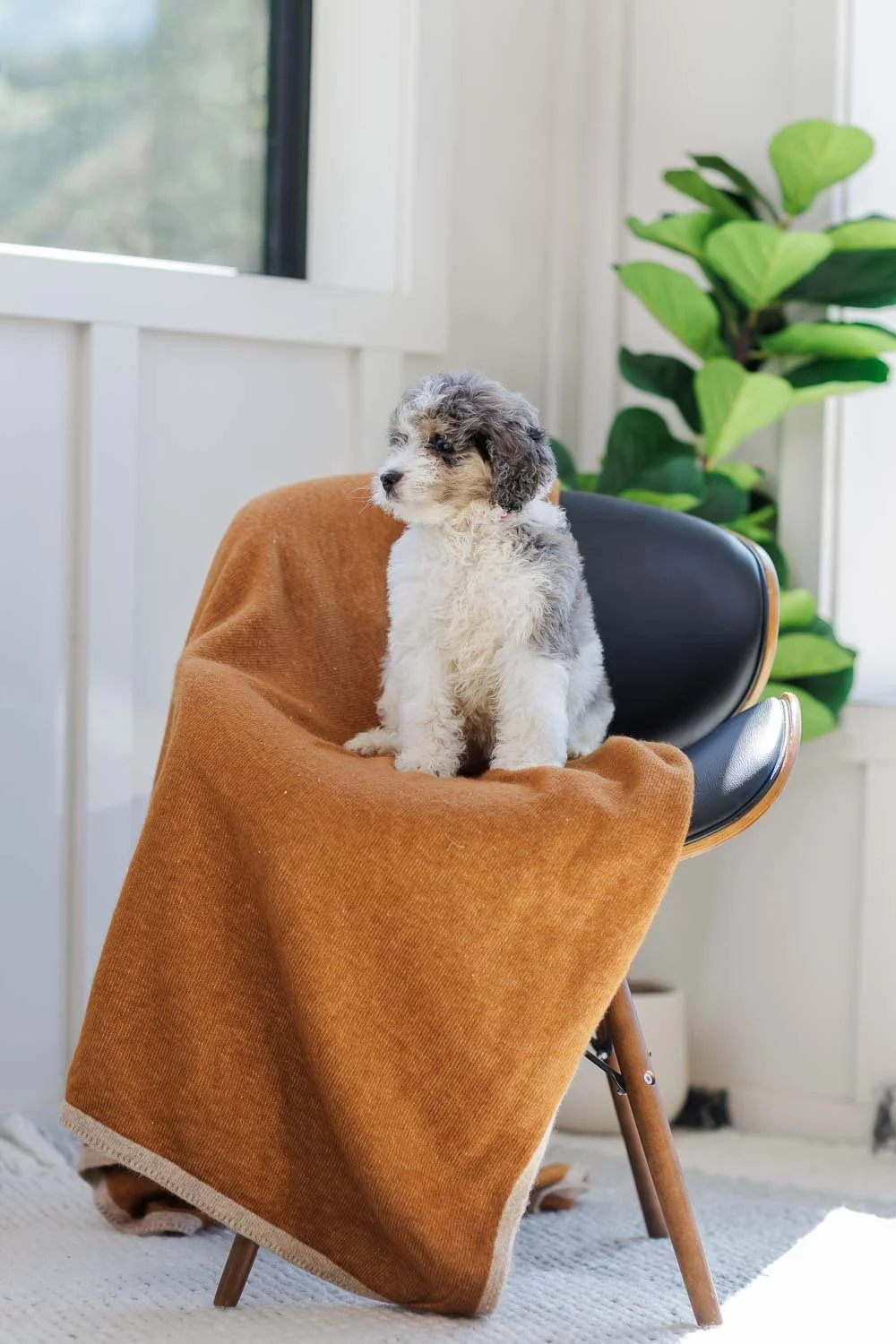
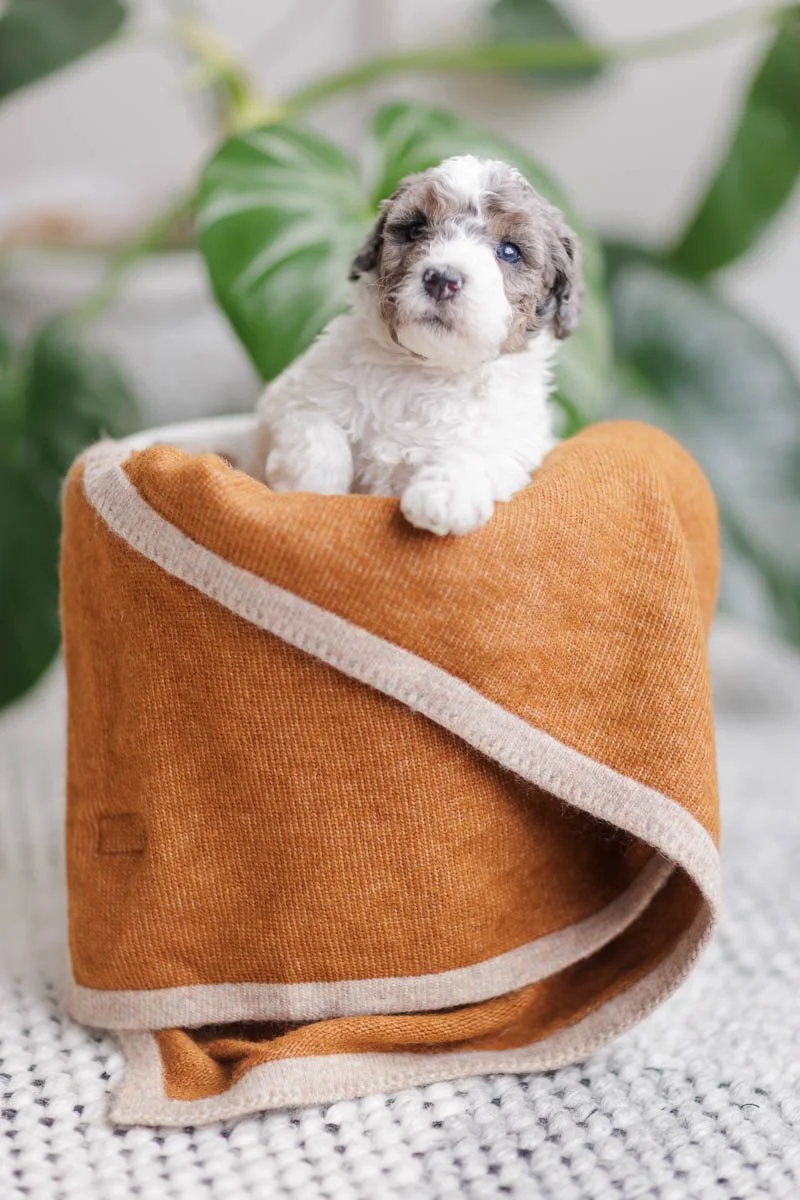
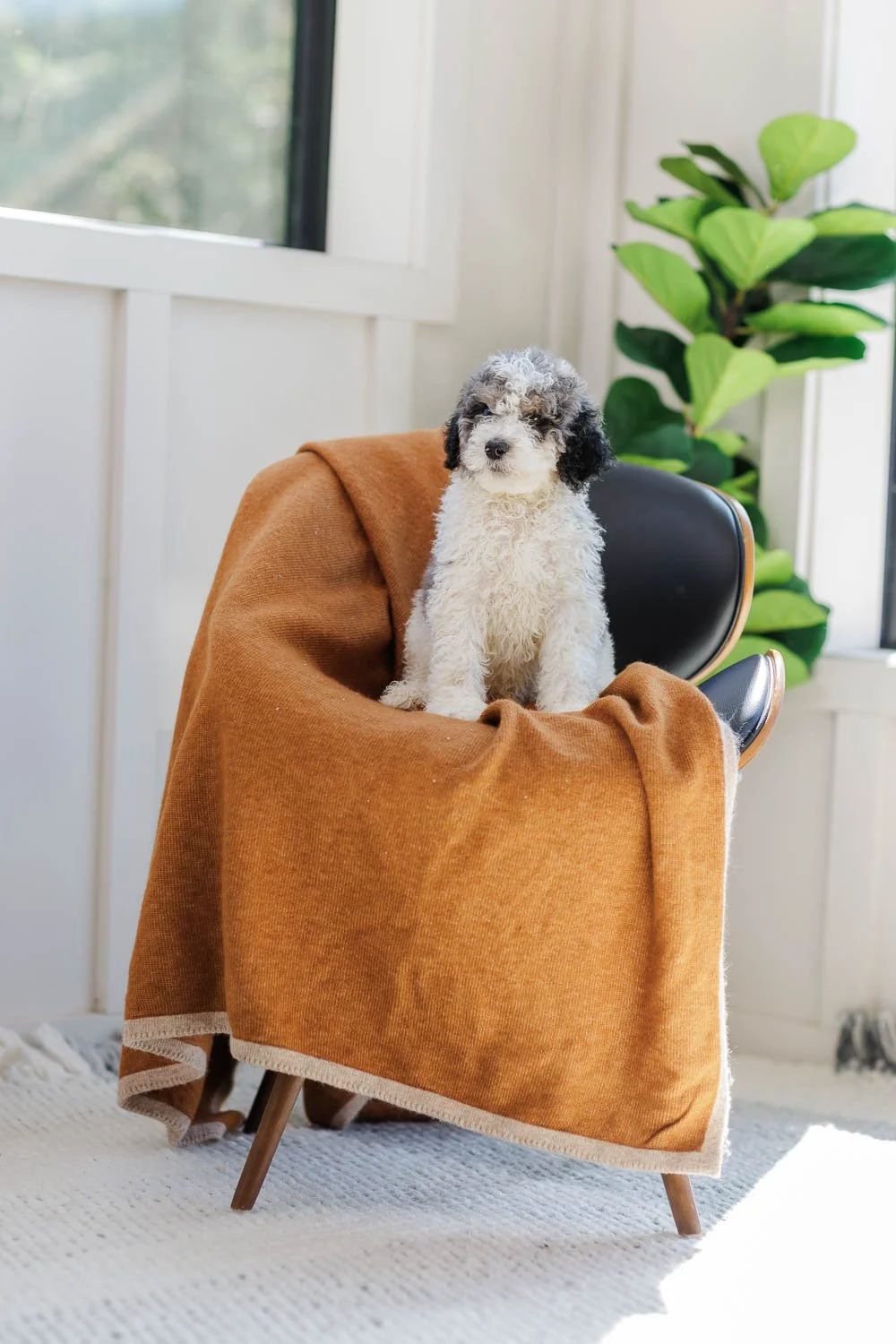
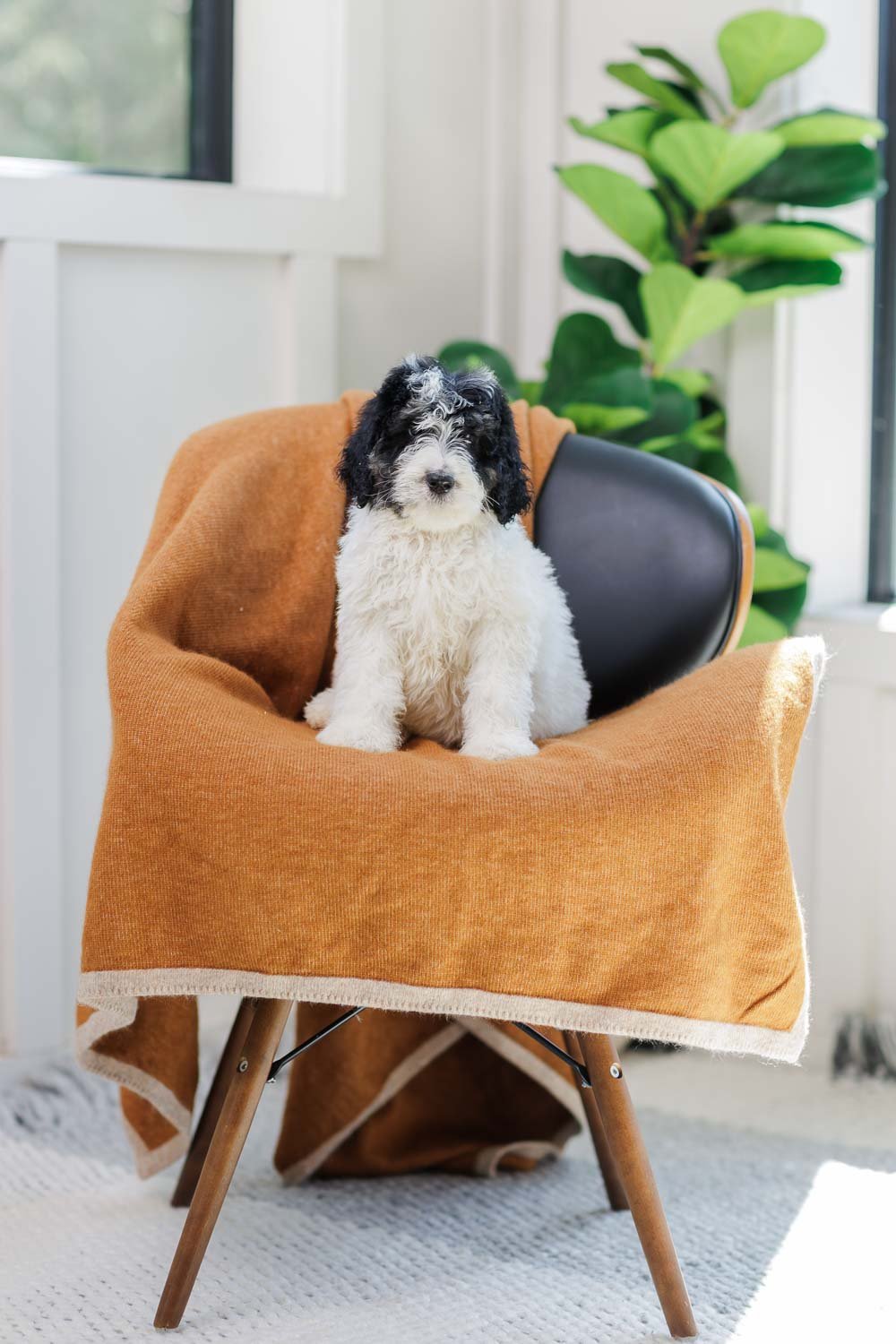
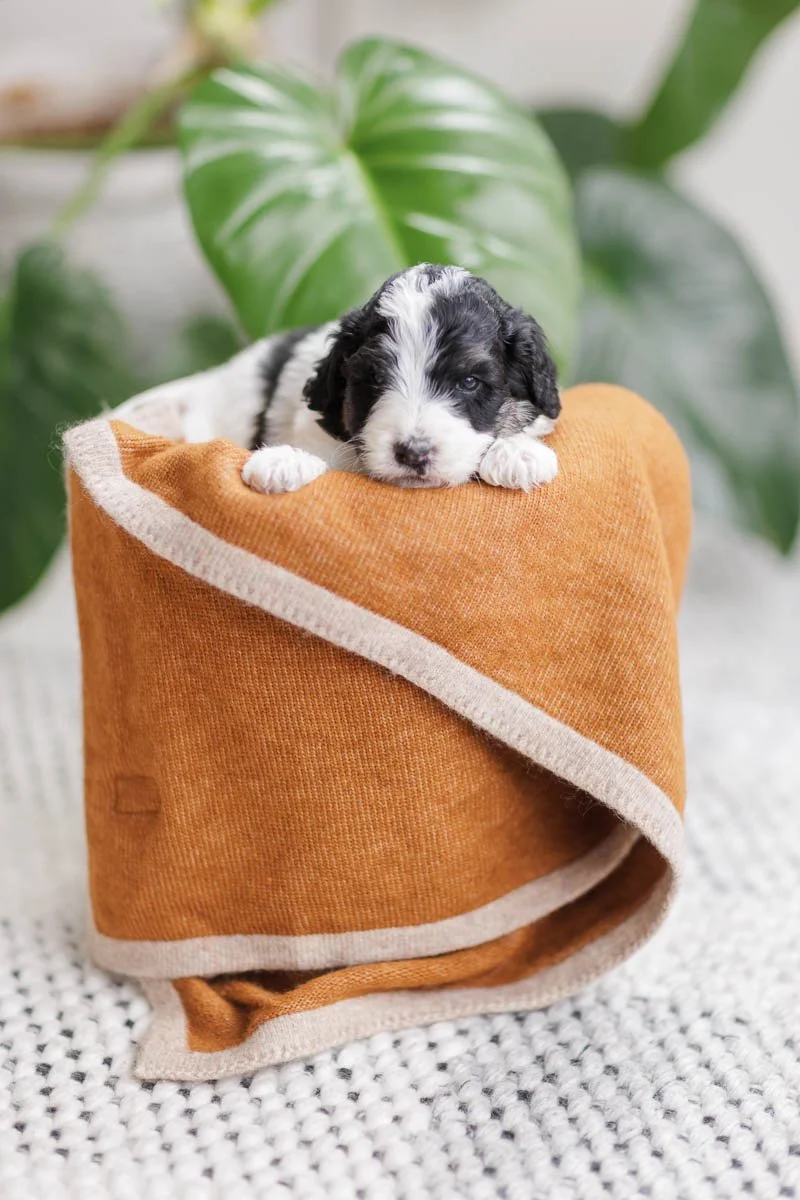
Sanna – Black & White Tri Parti Female F1B Medium Australian Mountain Doodle
Penelope × Kodiak
Seven F1B Medium Australian Mountain Doodles, raised in Medford, Wisconsin. Take-home May 29 to 30.
This litter combines Penelope, our foundational Australian Mountain Doodle dam (COI 0%), with Kodiak, an AKC-registered Standard Poodle cleared on a 248-condition panel. The result: 100% furnished coats, balanced structure, and the calm temperament profile our families come to Stokeshire for.
Meet the Seven
Tap any puppy to read the full profile. Temperament assessments are documented at week six and shared during your Match Day call.
Shepherd
Blue Merle Tri Parti Tuxedo
AvailableRead Shepherd's Profile
Eden
Black & White Tri Parti
AvailableRead Eden's Profile
Sanna
Black & White Parti, white back
AvailableRead Sanna's Profile
Chava
Blue Merle Tri
AvailableRead Chava's Profile
Eliora
Blue Merle Parti with Blaze
AvailableRead Eliora's Profile
Tirzah
Blue Merle Tri Parti
AvailableRead Tirzah's Profile
Shoshana
Blue Merle Tri with Socks
AvailableRead Shoshana's Profile
Shepherd · The Only Boy
Shepherd
Shepherd is the sole male in the Penelope × Kodiak litter, wearing the most layered coat pattern of the seven: a Blue Merle Tri Parti with Tuxedo markings. He is the litter's structural anchor, projecting toward the upper end of the medium range at maturity.
What makes Shepherd's coat distinctive?
A Blue Merle Tri Parti Tuxedo combines four genetic expressions in one coat. The merle gene mottles the base black into shades of slate and silver. The tri-color pattern adds copper or tan points above the eyes, on the cheeks, and along the legs. Parti adds large white panels across the body. Tuxedo refers to the white chest and front-paw markings that complete the formal-wear look. Shepherd is the only puppy in this litter expressing all four together.
What does F1B Medium Australian Mountain Doodle mean?
F1B is the second-generation cross. Penelope, an Australian Mountain Doodle, was bred back to a Standard Poodle (Kodiak). This back-cross shifts coat genetics toward 75% Poodle, producing reliably furnished, lower-shedding coats while preserving the Mountain Dog structure and temperament that defines the breed.
Eden · The Classic
Eden
Eden carries the most traditional show-ring look in the litter. Her Black and White Tri Parti coat reads like a 1950s magazine spread: clean panels, sharp contrast, and the warm copper accents that define a true tri.
What is a Black and White Tri Parti coat?
Tri Parti combines two distinct coat patterns. Parti refers to large blocks of white covering at least 50% of the body, paired with a second base color (in Eden's case, black). Tri adds a third color layer: copper or tan points placed above the eyes, on the cheeks, inside the legs, and beneath the tail. Eden's pattern is the canonical Bernese-style expression carried through the Mountain Doodle line.
Will Eden's coat color change as she matures?
Black and white parti coats hold their contrast better than merle patterns through maturity. Expect the copper points to deepen slightly between 6 and 18 months, and the white panels to remain crisp. Furnishings (the long facial hair and beard) will fill in fully by 9 to 12 months.
Sanna · The Standout
Sanna
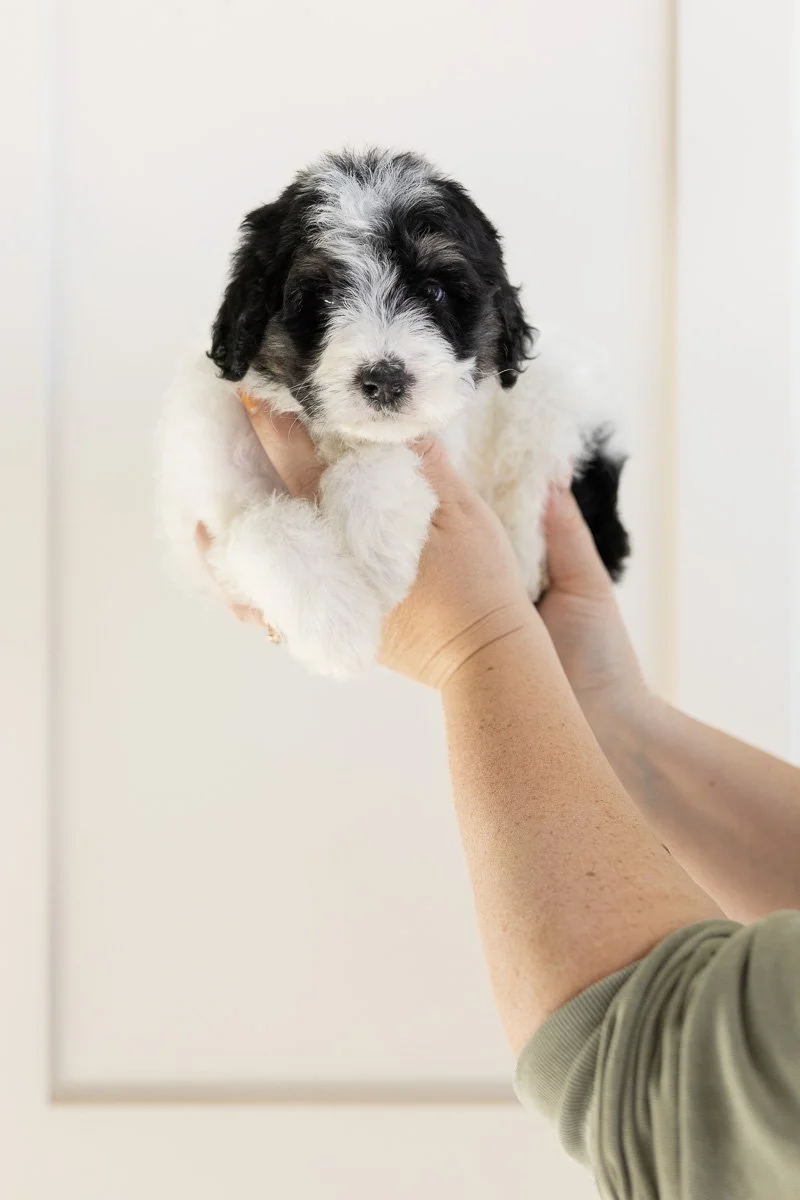
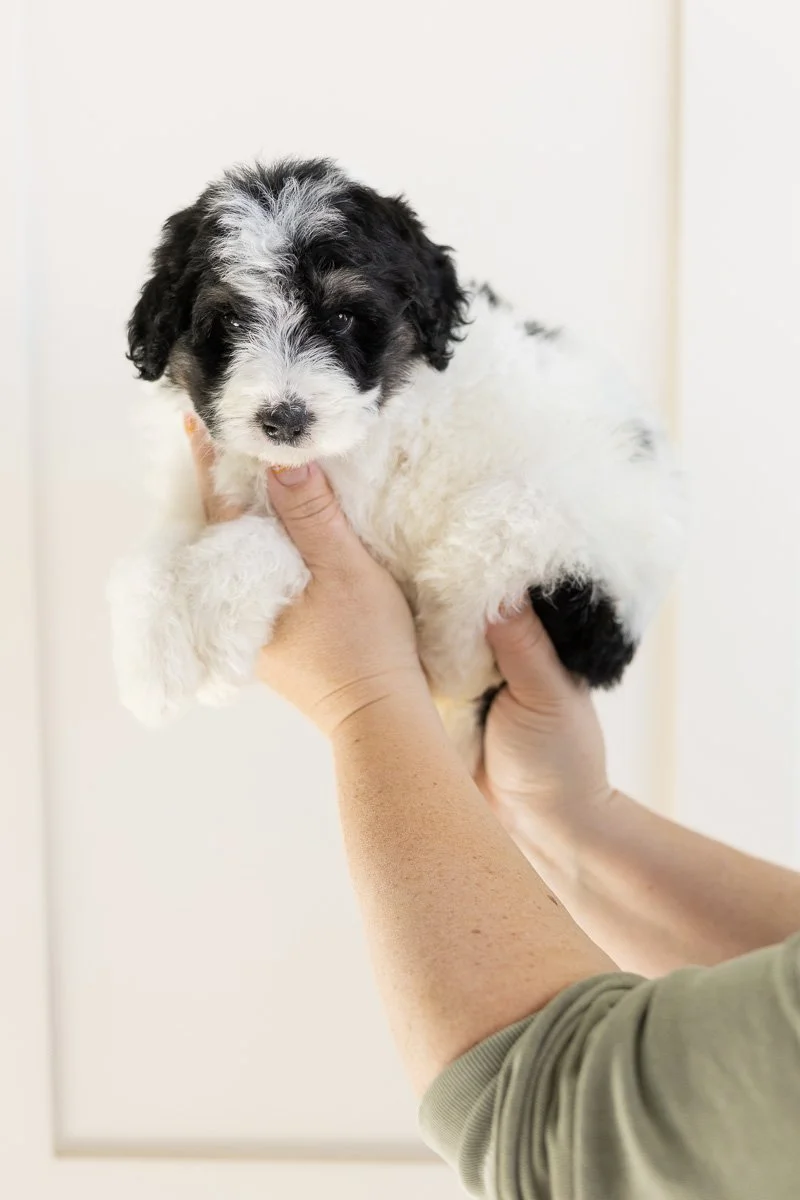
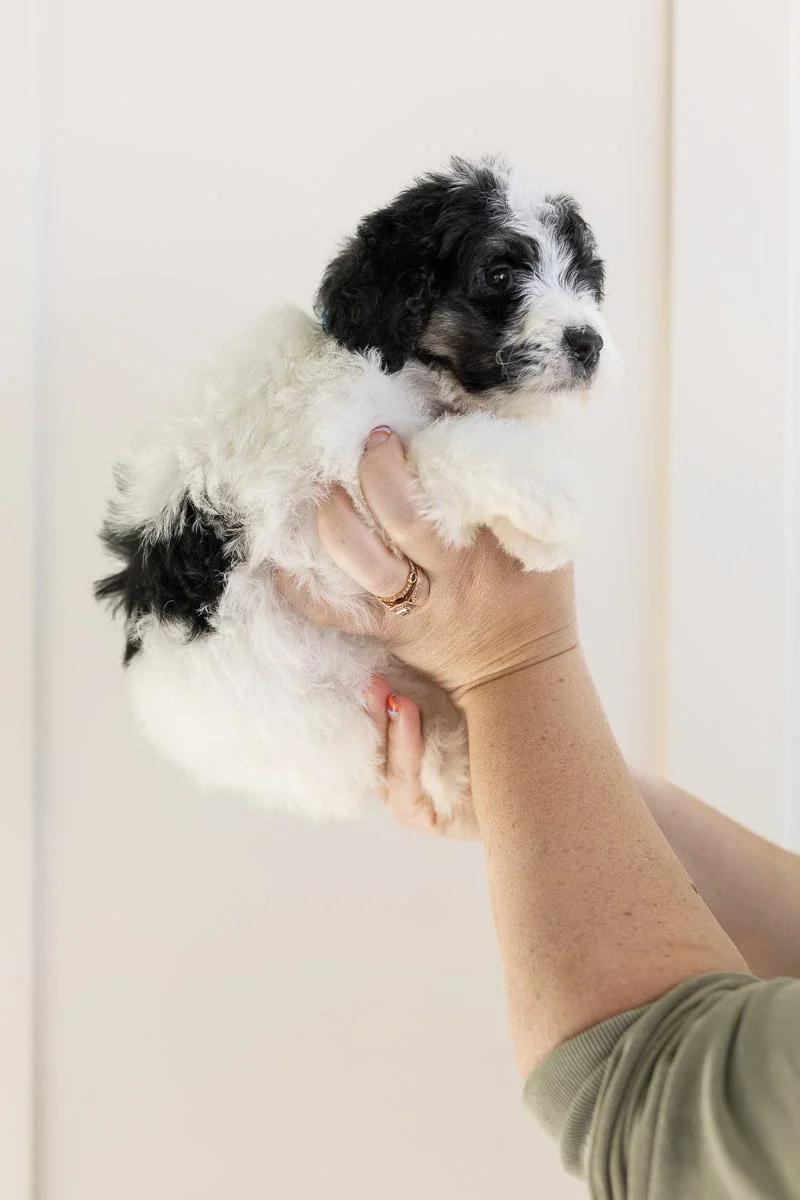
Sanna's coat carries a rare expression: a Black and White Parti with a continuous white back. The white panel runs from her shoulders down past her hips, framed by black on her flanks and head. Of the seven, she is the most photographically distinctive at first glance.
Why is a white back uncommon?
Parti expression typically distributes white asymmetrically across the body. A continuous white dorsal stripe (or full white back) requires specific gene placement during embryonic development. It is not selected for, only observed, which is part of why each parti puppy presents differently. Sanna's pattern is genetically stable and will remain consistent through her adult coat.
Are Australian Mountain Doodles considered lower-shedding?
F1B Mountain Doodles with two copies of the furnishing gene (RSPO2) typically produce lower-shedding coats than first-generation crosses. The Stokeshire program selects for full furnishings on every breeding pair, which is why every puppy in the Penelope × Kodiak litter is furnished. We do not use the term hypoallergenic. No dog is allergen-free, but lower-shedding coats reduce dander dispersion in most household settings.
Chava · The Refined Merle
Chava
Chava wears the most refined coat in the litter: a clean Blue Merle Tri without the parti panels. Her base coat is uniform slate-and-silver merle, broken only by the copper points that mark a tri expression. The result reads as solid color from a distance and reveals its complexity up close.
What is Blue Merle, genetically?
Blue Merle is the result of the merle gene (M locus) acting on a black base coat. The gene partially lightens random sections of pigment, producing patches of slate, silver, and dark gray within an otherwise black coat. It is dominant and visually identifiable at birth. Stokeshire only breeds single-merle to non-merle pairings to prevent the health concerns associated with double-merle expression.
Is the merle gene safe in Australian Mountain Doodles?
Single-copy merle (heterozygous M/m) is considered safe and is the standard for healthy merle-coated dogs. Double-merle pairings (M/M) carry significantly elevated risks for vision and hearing impairment, which is why the Stokeshire program never breeds two merle parents together. Both Penelope and Kodiak were tested at the M locus before pairing.
Eliora · The Signature Face
Eliora
Eliora carries a Blue Merle Parti coat distinguished by a clean white blaze running down the center of her face. The blaze gives her one of the most recognizable facial markings in the litter: a vertical white stripe between her eyes that finishes at her muzzle.
What is a blaze, and how is it inherited?
A blaze is a vertical white marking running from the top of the head down to the muzzle, bisecting the face. It develops from the same gene group responsible for parti and white-spotting patterns. A blaze is permanent and visible from birth. Eliora's blaze is well-defined and centered, which is the show-ideal expression.
How will Eliora's coat develop after take-home?
Blue Merle puppy coats often appear darker at 8 weeks than they will at maturity. As the adult coat grows in (typically between 6 and 14 months), the merle pattern lightens and reveals more silver tones. The blaze and white parti markings remain stable. Furnishings continue developing through 12 months, at which point the adult facial structure is fully expressed.
Tirzah · The Full Expression
Tirzah
Tirzah carries the most fully-expressed merle pattern in the litter: Blue Merle Tri Parti. Her coat layers all three signature elements (merle base, copper tri points, and large white parti panels) in balanced distribution. She is the show-coat exemplar of this breeding.
What does Blue Merle Tri Parti mean?
Three patterns layered into one coat. Merle creates the slate-and-silver mottling on the base color. Tri adds copper or tan points above the eyes, on the cheeks, on the lower legs, and beneath the tail. Parti adds large white panels distributed across the body. The combination requires inheriting at least three separate coat-pattern genes, which is why Tri Parti merles are less common in any given litter.
Do these complex coats require more grooming?
All Stokeshire furnished doodles require similar grooming regardless of color: brushing 3 to 4 times per week and professional grooming every 6 to 8 weeks. Coat color and pattern have no impact on grooming frequency. The furnishing texture (wavy vs. curly) is the variable that affects mat formation, and Tirzah's coat is currently presenting a balanced wave that is straightforward to maintain.
Shoshana · The Subtle Elegance
Shoshana
Shoshana wears a Blue Merle Tri with Socks: a clean merle base, copper tri points, and white markings limited to her four feet. She is the quietest expression in the litter, suited to families who want the merle pattern without the heavier white panels of a parti.
What does Tri with Socks mean?
Tri refers to the three-color pattern: merle base, copper points, and (in this case) white points limited to the lower legs. Socks describe white markings that stop at or below the ankle, like a pair of athletic socks pulled over the paw. Unlike parti, where white covers large body panels, socks are localized and minimal.
How do I know which puppy is the right match?
The right match is rarely the puppy you fall in love with from a photo. Coat is a starting filter, not the decision. The Stokeshire matching process pairs each family with the puppy whose temperament and energy profile aligns with the household, based on Volhard-style assessments documented at week six. During Match Day on May 17, James walks each approved family through the temperament data and recommends the strongest fit.
We do not sell puppies. We match families.
Every Stokeshire placement runs through a three-step matching process. The structure protects the puppy and the family.
Application
Tell us about your household, lifestyle, and what you are looking for. Most families complete this in under fifteen minutes. We review every application personally.
Match Day Call
James and Katie review the litter's six-week temperament assessments with you. We discuss household fit, energy alignment, and any specific needs. Not every family matches every litter, and that honesty is part of the process.
Selection & Take-Home
Approved families select in birth-order priority. A 500 dollar deposit secures your puppy. Take-home is May 29 to 30, with a structured handoff and lifetime support.
Common Questions About This Litter
F1B is the second-generation cross. An Australian Mountain Doodle dam (Penelope) was bred to a Standard Poodle sire (Kodiak), shifting genetics toward 75% Poodle. This produces reliably furnished, lower-shedding coats while preserving the Mountain Dog structure and temperament. Medium refers to the projected adult size: 40 to 60 pounds.
Stokeshire does not use the term hypoallergenic. No dog is allergen-free. F1B furnished coats produce significantly less dander than non-furnished or shorter-coated breeds, which is why many families with mild allergies tolerate them well. We strongly recommend a meet-and-greet and a consult with an allergist before placement if a household member has documented allergies.
Penelope and Kodiak both completed full Embark genetic panels (248+ conditions screened, all 19 actionable health tests clear). Penelope's COI is 0%. Both parents have OFA hip and elbow evaluations on file, plus annual cardiac and ophthalmologic clearances. Test results are reviewed during your Match Day call and provided as PDFs at take-home.
Match Day is May 17, 2026. Approved applicants schedule a 30-minute video call with James to walk through the litter's six-week temperament assessments, household-fit alignment, and final puppy selection. Selections are made in approval and birth-order priority. Take-home follows on May 29 to 30, eight weeks after birth.
A 500 dollar deposit secures your match after your Match Day call. The deposit is applied to the total placement fee, which is communicated transparently in your application response. Stokeshire does not list pricing publicly because every placement includes our full matching, education, and lifetime support framework, which is reviewed during application review.
Stokeshire prefers in-person take-home in Medford, Wisconsin. Families travel from across the Midwest, and many fly in to pick up. For families outside driving range, we coordinate flight nanny services through vetted partners. Cargo shipping is not offered. Travel logistics are reviewed during your Match Day call.
Every Stokeshire family receives lifetime breeder support, a structured 8-week-to-6-month onboarding curriculum, access to our private owner community, and direct text or email access to James and Katie for any questions. We are also available for adolescent and adult-stage support throughout the dog's life.
Choose the path that fits where you are.
Match Day is May 17. Whether you are ready to apply, want to schedule a call first, or need more time to think, there is a way in.
Recommended
Apply Now
You know what you are looking for. Complete the puppy application and we will respond within two business days.
Start ApplicationHave Questions
Schedule Match Day Call
You want to talk through fit, structure, and process before applying. Book a 15-minute consult with James.
Book CallNot This Litter
Future Litters
The timing is not right, but you want to stay informed. Join the waitlist for upcoming Stokeshire breedings.
Join Waitlist