
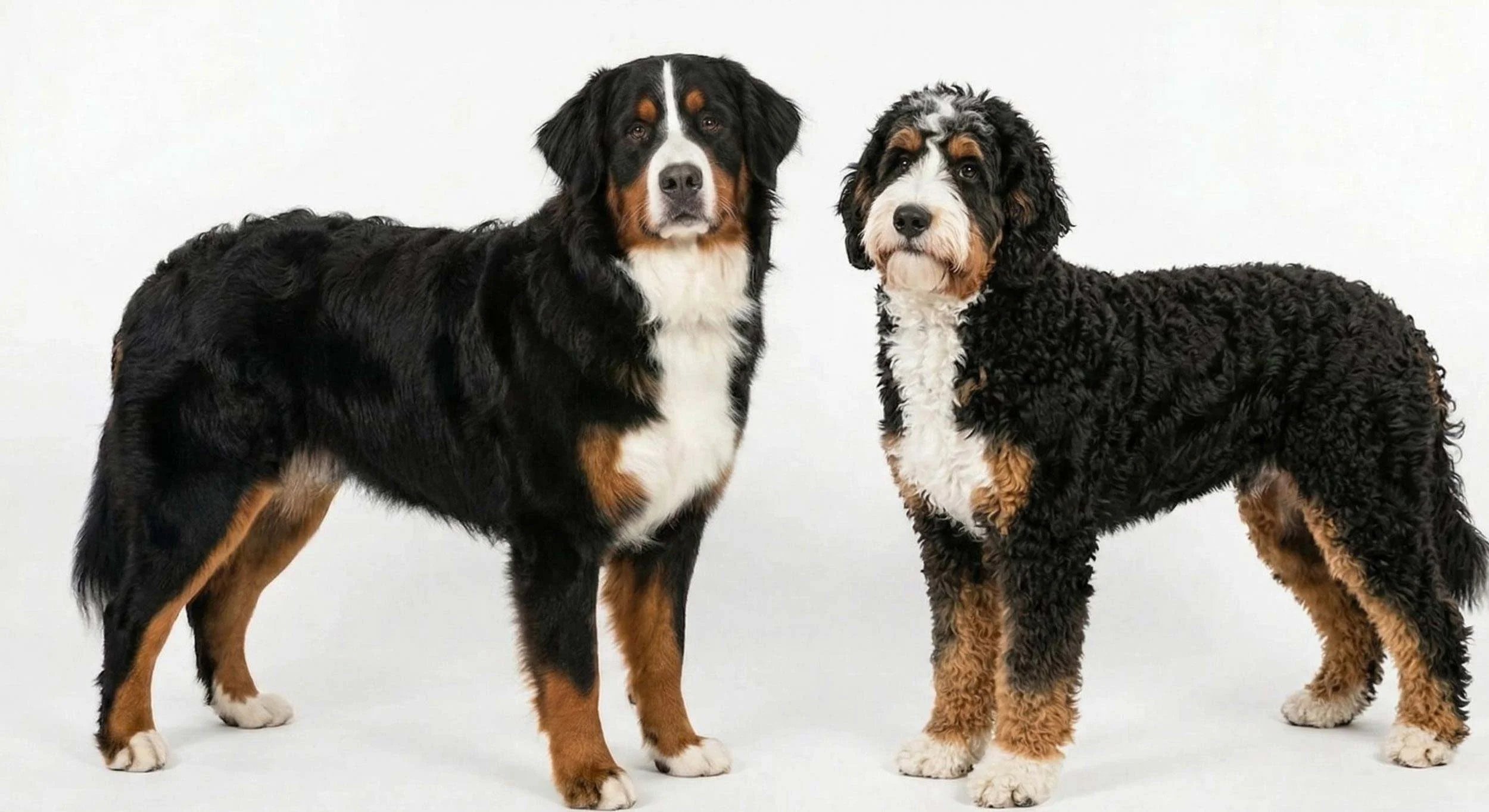
How Much Does
a Bernedoodle
Actually Cost?
The sticker price is the smallest part of the investment. What matters is the total cost of doing it right - and the far higher cost of choosing the wrong program.
A Bernedoodle is not a
$5,000 purchase.
It is a $35,000+
relationship.
Most families search "how much does a Bernedoodle cost" expecting a single number. The honest answer is that the purchase price represents roughly 15-20% of the total cost of owning a Bernedoodle over its lifetime.
This page breaks down the real numbers for 2026: what Bernedoodle puppies cost from reputable breeders, why Mini Bernedoodles carry a premium, what the first year actually requires, and why the difference between a $2,500 Bernedoodle and a $5,500 Bernedoodle is not a markup. It is a different level of care entirely.
Looking for pricing across all doodle breeds? See our complete doodle pricing guide.
Three ways to bring
a Bernedoodle home.
Each path reflects a different level of preparation. All three should begin with the same foundation: health-evaluated, genetically screened parents and structured early socialization.
A health-tested, genetically screened Bernedoodle from a program with documented evaluations, cardiac clearances, and full-panel genetic testing on both parents. Includes early socialization, veterinary examination, age-appropriate vaccinations, and program documentation.
You collect the puppy in person or arrange local transport. Training and continued development are your responsibility from day one.
Core placement plus weeks of structured early-life formation through Doodle School. Your Bernedoodle receives daily developmental training before arriving in your home - foundational routine, confidence building, socialization protocols, and basic commands already established.
Most programs at this tier include hand-delivery: your Bernedoodle travels in-cabin with a flight nanny to a major airport near you.
This is the path most families at Stokeshire choose.
Extended development programs for families who want a companion-ready Bernedoodle. Months of professional formation, structured bonding protocols, advanced socialization, and ongoing breeder support through the first year.
These programs are rare and intentionally limited. They represent the highest tier of companion preparation available from any breeding program. Learn about the Bespoke Companion program.
Bernedoodle pricing by variant.
| Variant | Notes | Core Range |
|---|---|---|
| Standard Bernedoodle | 50-90 lbs. F1 (Bernese x Poodle) or multigenerational lines. | $3,500 - $6,500 |
| Mini Bernedoodle | 25-49 lbs. Requires additional generations to achieve size safely. | $4,500 - $8,000 |
| Micro Mini Bernedoodle | Under 25 lbs. Highest complexity. Fewer reputable programs offer this size. | $6,000 - $9,000+ |
| Tri-Color (any size) | Classic Bernese black, white, and rust pattern. High demand premium. | +$500 - $2,000 |
| Merle Pattern (any size) | Blue or chocolate merle. Never bred merle-to-merle by responsible programs. | +$500 - $1,500 |
| F1 Generation | First cross: Bernese x Poodle. Maximum hybrid vigor. Less coat predictability. | $3,500 - $5,500 |
| F1B Generation | F1 Bernedoodle x Poodle. More predictable low-shedding coat. | $4,000 - $6,500 |
| Multigenerational | Multiple generations of selective breeding. Most consistent traits. | $4,000 - $7,000 |
Ranges reflect reputable breeders with documented health testing as of 2026. Prices below these ranges often indicate limited health screening or high-volume operations. Prices above typically reflect included training, delivery, or extended development programs.
The Bernese side
demands more screening.
Bernese Mountain Dogs are among the most health-challenged purebred lines. Responsible Bernedoodle breeders invest significantly more in health screening than programs working with lower-risk foundation breeds. This is a primary reason Bernedoodles cost more than Goldendoodles or Labradoodles at comparable quality levels.
The Poodle cross can improve longevity and reduce certain risks through hybrid vigor, but only when both parent dogs have been thoroughly screened first. Learn more about the Bernese Mountain Dog foundation breed.
Bernese Mountain Dogs have elevated rates of histiocytic sarcoma, an aggressive cancer. Responsible programs screen breeding stock and track lineage health outcomes across multiple generations to reduce incidence.
Hip dysplasia, elbow dysplasia, and cruciate ligament issues are documented in Bernese lines. Evaluation of both parents is standard practice. This alone costs $300-$600 per dog, plus the time investment of waiting until the dog reaches evaluation age.
Bernese Mountain Dogs carry risk for subaortic stenosis and other cardiac conditions. Board-certified cardiac and eye examinations are part of responsible screening protocols before any breeding takes place.
Comprehensive testing screens for 200+ genetic conditions, including degenerative myelopathy, von Willebrand disease, and progressive retinal atrophy. Both parents must be tested. Cost: $200-$400 per dog.
Advanced programs analyze COI to maintain genetic diversity and reduce the concentration of recessive health risks. This requires deeper pedigree research and sometimes sourcing breeding stock from distant lines at higher cost.
The first year with
a Bernedoodle is the
most expensive.
Beyond the puppy itself, the first year carries one-time setup costs that do not recur. Spay or neuter surgery, initial supplies, puppy training classes, and the accelerated veterinary visit cadence of a young Bernedoodle all compress into a single twelve-month window.
Standard Bernedoodles are large dogs that eat, groom, and medicate at large-dog prices. Mini Bernedoodles moderate some of these costs but require more frequent grooming due to coat density.
Annual Bernedoodle
budget after year one.
After the first-year setup costs, annual expenses stabilize into a predictable rhythm. Standard Bernedoodles cost more to feed and groom than minis, but both sizes require consistent professional grooming to prevent matting and skin issues.
Bernedoodle lifespans average 10-14 years depending on size, with minis trending toward the longer end. Budget for the full duration before you bring one home.
| Premium food | $800 - $1,500 |
| Professional grooming (6-8 sessions) | $700 - $1,400 |
| Routine veterinary care | $500 - $900 |
| Preventatives (flea, tick, heartworm) | $200 - $450 |
| Pet insurance | $400 - $900 |
| Toys, treats, replacements | $150 - $400 |
| Boarding / pet sitting | $0 - $1,500 |
Does not include emergency veterinary care, which can range from $1,500 to $6,000+ per incident for large breeds. Pet insurance is particularly important for Bernedoodles given the Bernese Mountain Dog's predisposition to orthopedic and oncological conditions. A single cruciate ligament repair can cost $3,000-$6,000.
Why a $5,500 Bernedoodle
is not the same as
a $2,500 Bernedoodle.
The price difference between a bargain Bernedoodle and one from a health-tested program is not profit margin. It is process. Every dollar above the commodity price pays for something that reduces your risk and improves your dog's life.
Bernedoodles from programs without documented health testing carry the full genetic risk profile of the Bernese Mountain Dog - one of the shortest-lived large breeds in existence. The savings at purchase often become the first emergency vet bill.
Full-panel genetic screening plus hip, elbow, cardiac, and ophthalmologic evaluation. Costs $2,000-$3,500 per Bernese parent dog. This is more extensive than what most other doodle crosses require because the Bernese health profile demands it.
Bernese Mountain Dogs have higher rates of whelping complications than many breeds. Pre-breeding evaluation, progesterone timing, prenatal monitoring, and emergency C-section readiness are not optional corners to cut.
Bernedoodles inherit the Bernese tendency toward handler sensitivity and cautious temperament. Structured early socialization during the critical period (weeks 3-12) is essential to prevent the shyness and anxiety that plague poorly socialized Bernedoodles.
Producing Mini Bernedoodles safely requires multiple generations of selective breeding, each with full health testing. Programs that skip generations to produce small dogs faster introduce structural and health risks that do not appear until the dog is two or three years old.
The breeder answers the phone at month three, month twelve, and year five. Health guarantee, return policy, and ongoing guidance. For Bernedoodles specifically, this long-term relationship matters because breed-specific health concerns can emerge over time.
Lifetime cost of
Bernedoodle ownership.
Bernedoodle pricing and costs.
The investment is real.
So is the return.
A well-bred Bernedoodle is not an expense. It is the foundation of a relationship that shapes your family's daily life for more than a decade.