Do Doodles Have More Behavior Problems? What the 2026 Study Shows
Quick answer: For the three crosses studied, the owner-reported evidence leans that way, but not evenly and not for every doodle. A 2026 study of 9,402 UK dogs compared Cockapoos, Cavapoos, and Labradoodles with their parent breeds on 12 behavior scales. Where a cross differed significantly from a parent breed, it scored less favorably 32 times out of 39. Results varied widely by cross, and Labradoodles scored better than Poodles on six scales. No Bernedoodles, Goldendoodles, or Mountain Doodles were studied, and no breeding program was evaluated. At Stokeshire Designer Doodles, we read the study as a reason to ask better questions about parents, early development, and matching.
A headline about doodles and behavior problems lands differently when a puppy is about to join your family. The question underneath it is practical: will this dog feel at ease in your home, cope with everyday life, and fit the life you can offer?
This article walks through what the researchers measured, what the numbers mean, where the design limits what it can tell you, and what we think responsible breeders should take from it.
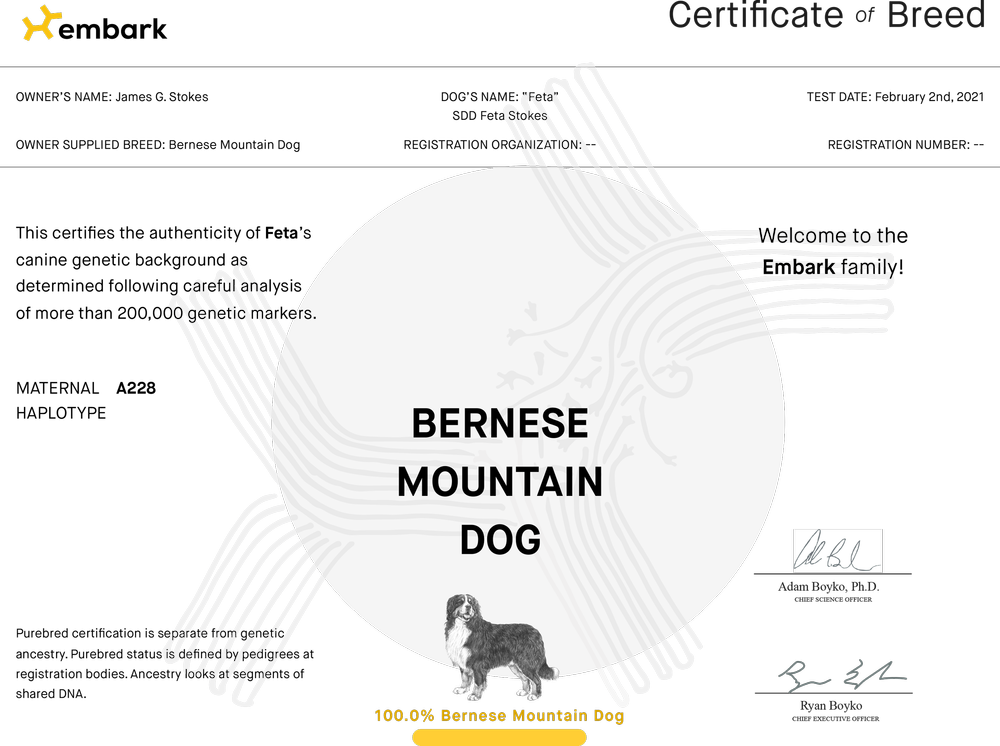
The paper, Comparing undesirable behaviours between ‘designer’ Poodle-cross dogs and their purebred progenitor breeds, was published in PLOS One on March 19, 2026, by a team led from the Royal Veterinary College (Bryson et al., 2026). Owners completed C-BARQ, the Canine Behavioral Assessment and Research Questionnaire, which the researchers scored on 12 behavior scales covering fear, aggression, separation-related problems, excitability, trainability, and more. The headline findings: Of the 9,402 dogs analyzed, 3,424 were crosses and 5,978 were purebred Cocker Spaniels, Labrador Retrievers, Cavalier King Charles Spaniels, and Poodles. Toy, Miniature, and Standard Poodles (927 dogs) were analyzed as one comparison group. Owners were UK adults whose dogs had been acquired at 16 weeks of age or younger from January 2019 onward, so every dog was under five years old. The survey ran from February to April 2023, about three years before publication. Not directly. No Bernedoodles, Goldendoodles, Aussiedoodles, Golden Mountain Doodles, or Australian Mountain Doodles were included, and no Bernese Mountain Dog, Golden Retriever, or Australian Shepherd served as a comparison breed. Cockapoos and Cavapoos made up about 83% of the crossbred dogs. The authors are clear that each cross needs its own evidence base and that extrapolating from one designer cross to another should be done with caution. For Golden Retriever crosses, a 2019 study is relevant. It drew on 5,141 dogs whose owners, from many countries, completed the same questionnaire online, and it treated the crosses as first generation. The crosses tended to fall between their parent breeds, with exceptions. Labradoodles differed significantly only from Miniature Poodles, on dog rivalry. Goldendoodles differed on four traits and scored higher on dog-directed aggression than Golden Retrievers and both Poodle varieties, and the authors summarized that Goldendoodles showed more problematic behavior than their parent breeds (Shouldice et al., 2019). That leaves a real gap. We are not aware of a published study comparing Bernedoodles, Golden Mountain Doodles, or Australian Mountain Doodles with their parent breeds in this way. Until one exists, the 2026 findings are a reason for attention, not a measurement of those crosses. One part of our program sits closer to the study. Our Munchkin Bernedoodles carry Cavalier King Charles Spaniel ancestry, usually through a Cavalier-Poodle parent. In the 2026 study, Cavapoos scored less favorably than both of their parent breeds on non-social fear and dog-directed fear, so those results are relevant to that line. The researchers compared each cross with each of its two parent breeds on 12 behavior scales: 3 crosses, 2 parent breeds, and 12 scales make 72 comparisons. Thirty-nine comparisons showed a statistically significant difference. In 32 of those 39, the cross scored less favorably. That is the source of the 82.1% figure. It does not mean that 82.1% of doodles had behavior problems, that their behavior was 82.1% worse, or that they were 82.1% more likely to bite. Across all 72 comparisons, 44.4% were less favorable, 9.7% more favorable, and 45.8% showed no statistically significant difference. A finding of no significant difference does not prove the groups were the same, and a significant difference does not by itself tell a family how large or consequential it is. The 72 comparisons are also related measurements from the same dogs, not 72 independent experiments or an overall score for being a good family dog. Labradoodles had six more favorable comparisons, five less favorable, and 13 with no significant difference. All six favorable results were against Poodles. All five unfavorable results were against Labrador Retrievers. Separation-related scores show the pattern. In the paper's supplementary tables, the average was 0.30 for Labrador Retrievers, 0.54 for Labradoodles, and 0.62 for Poodles. The Labradoodle average sits between its two parent breeds. These are questionnaire scores, where higher means more of the behavior, not percentages of dogs with a diagnosis. The Labradoodle pattern fits an intermediate profile. It does not, by itself, show that crossing created a problem larger than in either parent breed. Across all three crosses, though, the authors found little support for their starting hypothesis that the crosses would score between their parent breeds. For this population, they concluded that the crosses' behavior was generally worse than their parent breeds'. Cockapoos showed a different pattern, scoring less favorably than both parent breeds on several scales. Those findings deserve serious attention. The authors offer possible explanations, not conclusions. Labradoodles had the lowest share of first-generation dogs, which may reflect more generations of selection for behavior. They are also the largest of the three crosses and more often had a Standard Poodle parent: 40%, compared with 9% of Cockapoos and 4% of Cavapoos. Earlier studies have linked smaller size with more fear and excitability as reported by owners. Every study design answers some questions better than others. These limits matter when you move from this paper to a decision about a breeder or a puppy. The researchers did not assess parent selection, adult temperament records, early development, matching, or support after placement. Whether owners saw the puppy with its mother at pickup was part of the analysis, but one indicator cannot describe a breeding program. The purebred comparison dogs were other members of those breeds, not the parents of the crossbred dogs. The study did not follow selected sires and dams through to their puppies, so it cannot show the effect of any breeder's practices, including ours. It also does not show that any program's practices remove the risks it identified. C-BARQ is a validated, standardized questionnaire (Hsu & Serpell, 2003), and owners see behavior across daily situations that a short professional visit can miss. Still, 9,402 owner reports are not 9,402 independent behavior examinations. Owners knew what kind of dog they had, and their expectations and reading of the questions could affect their answers. The study does not establish the direction of any such bias. Recruitment ran through social media, veterinary and welfare networks, commercial channels, and Kennel Club outreach, so this was not a random sample of UK owners. The Kennel Club promoted the survey only through registered breeders of the purebred breeds, so the two groups were partly reached through different routes. The authors note both possibilities: respondents may be more welfare-conscious than average owners, and owners whose dogs had problems may have been more motivated to respond. A large sample adds information, but it does not remove selection bias. Nor can we assume that the purebred dogs came from exemplary breeders or that the crossbred dogs came from poor ones. The research did not establish either. Toy, Miniature, and Standard Poodles were pooled, even though the three crosses differed in which Poodle size was behind them. The authors acknowledge that this could affect the comparisons. The crosses also mixed generations. First-generation dogs made up about 55.5% of the crossbred sample, and only 143 dogs, about 4.2%, were reported as multigenerational. Generation was not part of the behavior models, and it was reported by owners. The results cannot tell a family that an F1, a backcross, or a multigenerational dog will have a better temperament. A generation label alone is not evidence of behavior. The models adjusted for factors including dog age, sex and neuter status, owner age and gender, first-time ownership, whether the owner worked in the canine sector, whether the puppy was seen with its mother at collection, and overall health. It would be wrong to say the researchers ignored inexperienced owners or the dogs' ages. Those adjustments do not capture training quality, time spent alone, household routines, early rearing, or a dog's accumulated experience. Crossbred dogs also lived with children more often (36.6% versus 29.4%), and children in the home was not one of the adjustment factors. These gaps could contribute to the differences. They do not show that the differences disappear. The survey captured behavior at one point in time. It did not follow the same dogs from puppyhood through adolescence into adulthood. Owners also had to own the dog at the time of the survey, so dogs already rehomed were not reported. The study cannot show lifetime rehoming rates or which breeding programs keep placements successful over time. Across all three crosses, the study found less favorable scores than the non-Poodle parent breed for three kinds of behavior: Those findings deserve attention from every breeder. Three other results from the paper are practical for families: Families should be able to ask how a breeder observes responses to unfamiliar situations, introduces age-appropriate independence, watches recovery after excitement, and helps owners continue that work after homecoming. A breeder should also be willing to discuss difficulties in its own dogs and how those experiences shape later decisions. A claim that a cross automatically inherits only the desirable traits of each parent breed is too broad. Health screening, temperament assessment, and follow-up answer different questions. Evidence in one area should not be presented as a guarantee in another. For families thinking specifically about independence, our guide Can a Doodle Be Left Alone? covers what to plan for at each age. The same research team used the same 9,402 dogs to compare health. Across 342 comparisons covering the 57 most common disorders, the crosses did not differ significantly from their parent breeds in 86.6%. They had higher odds in 7.0% and lower odds in 6.4% (Bryson et al., 2024). The authors concluded that the results challenge widespread beliefs in a hybrid vigor health advantage for these crosses, without suggesting poorer health, and that buyers should weigh breeding conditions, temperament, conformation, and the health of the parents. Our position follows the same evidence. Crossing distinct breed lines can increase genetic diversity and may reduce the likelihood that some recessive inherited conditions are expressed. It does not eliminate genetic disease or the health considerations present in the parent breeds. That is why every dog considered for the Stokeshire breeding program undergoes breed-appropriate health screening before a pairing is planned. That screening includes OFA-recorded evaluations, PennHIP hip evaluations where completed, genetic health testing through Embark, and cardiac and ophthalmologic examinations as appropriate. Public Embark profiles allow families to independently review genetic testing, and additional documentation is provided to approved applicants alongside the applicable agreement and health guarantee. No health-testing program can eliminate every genetic or developmental risk. The Stokeshire Method™ organizes our program into four pillars: Genetics, The First Fifty-Six Days, The Match, and Doodle School. The useful questions for any program are what happens at each stage, what is recorded, and how that record informs care. During the First Fifty-Six Days, puppies move through whelping, Early Neurological Stimulation (ENS), and an eight-week curriculum. Because separation-related problems were one of the study's consistent findings, one detail is worth naming: puppies in our nursery practice short, planned stretches of alone time before go-home, as our puppy curriculum describes. Between day 49 and day 56, before Match Day, each puppy completes a Volhard-based aptitude evaluation: ten scored tests and two observations, reported as twelve traits. We record the exact day each puppy is tested. The results are read alongside trainer notes, health information, developmental records, and what you tell us about your household. Our puppy evaluation page explains the instrument and its limits. Our Canine Recovery Index™ is an observation protocol for recording how puppies respond to and recover from unfamiliar experiences. It describes what a puppy did during defined observation windows. It does not predict adult behavior, and families do not receive a recovery score. Its value is consistency: it gives the matching conversation a more disciplined record. These practices make our approach open to examination. Showing that a program produces better adult outcomes takes more: systematic follow-up, clearly defined outcomes, and fair comparisons. The University of Pennsylvania's C-BARQ team describes one model, in which puppy buyers complete the questionnaire one or two years after purchase so breeders can evaluate the offspring of particular sires and dams and track behavioral selection over time (University of Pennsylvania, n.d.). That is a useful standard for the whole breeding community: keep learning from the dogs as they mature. We do not guarantee temperament, trainability, or adult behavior, and no breeder honestly can. What we observe at seven and eight weeks describes that puppy at that age. Adult behavior also depends on health, training, adolescence, and daily life after go-home. We will tell you what we observed, how we observed it, and where our observations stop. If your dog shows new or worsening fear, distress when left alone, or a sudden change in behavior, start with your veterinarian. In the 2026 study, overall health had the strongest association with behavior scores of any factor the researchers adjusted for, and the authors suggest owners first seek veterinary advice to rule out an underlying physical condition. Your veterinarian can also refer you to a veterinary behaviorist when needed. A research headline can start a conversation. These questions make it useful, with purebred and crossbred breeders alike: These questions give a family more to evaluate than a breed label, a generation label, or a promise of an effortless companion. For three UK crosses, owner-reported scores were less favorable than a parent breed in 32 of the 39 comparisons that differed significantly. That is not the same as every doodle having more problems. Labradoodles scored better than Poodles on six scales, results varied by cross, and the study did not include Bernedoodles, Goldendoodles, or Mountain Doodles. For an individual puppy, the parents, early development, health, and training may tell you more than the label. No. It covered Cockapoos, Cavapoos, and Labradoodles, compared with Cocker Spaniels, Cavalier King Charles Spaniels, Labrador Retrievers, and Poodles. A 2019 study of 5,141 dogs found that Goldendoodles differed from their parent breeds on four traits, including higher dog-directed aggression. We are not aware of a published study comparing Bernedoodles, Golden Mountain Doodles, or Australian Mountain Doodles with their parent breeds in this way. Not as a rule. In a 2024 study of the same 9,402 UK dogs, three common crosses did not differ significantly from their parent breeds in 86.6% of 342 health comparisons. Crossing distinct breed lines can increase genetic diversity and may reduce the likelihood that some recessive inherited conditions are expressed. It does not eliminate genetic disease or the health considerations present in the parent breeds. No. Temperament reflects genetics, early experience, health, training, and life after go-home. A responsible breeder can describe what it observed and how, explain how it matches puppies to households, and tell you where its observations stop. Be cautious of anyone who promises an effortless dog, a temperament guarantee, or a cross that inherits only the desirable traits of both parents. The 2026 study adds useful evidence about three Poodle crosses. It challenges blanket claims of better behavior, and it gives breeders good reason to look harder at fear, independence, and excitability. Its design also leaves real questions about other crosses, individual dogs, and breeding programs unanswered. We want families to see how their puppy is raised, understand the observations behind a match, and know where support comes from as the dog grows. We welcome questions about our methods and their limits. When you are ready to tell us about your household, start with our puppy application. This article is educational and does not replace veterinary or behavioral advice. If your dog shows fear, distress when left alone, or a sudden change in behavior, consult a licensed veterinarian.
What did the 2026 doodle behavior study find?
Which dogs were in the study?
Cross Compared with Dogs F1 share Cockapoo Cocker Spaniel and Poodle 1,856 59.7% Cavapoo Cavalier King Charles Spaniel and Poodle 985 61.3% Labradoodle Labrador Retriever and Poodle 583 33.8% All three 5,978 purebred dogs 3,424 55.5% Does it apply to Bernedoodles, Goldendoodles, or Mountain Doodles?
What does the 82.1% figure mean?
Cross Less favorable More favorable No significant difference Cockapoo 16 0 8 Cavapoo 11 1 12 Labradoodle 5 6 13 All three 32 7 33 Why did the results differ by cross?
Six limits families should understand
1. It did not compare breeding programs
2. The behavior reports came from owners
3. The sample was voluntary
4. Poodle sizes and generations were combined
5. Some owner differences were addressed, not all
6. A snapshot cannot show a dog's whole life
What should responsible breeders take from it?
What about health and hybrid vigor?
How Stokeshire approaches these questions
What we will not promise
When to call your veterinarian
Questions to ask before choosing a puppy
Frequently asked questions
Do doodles have more behavior problems than purebred dogs?
Did the 2026 study include Bernedoodles or Goldendoodles?
Are doodles healthier than purebred dogs?
Can a breeder guarantee a calm, confident puppy?
Choosing with a clearer picture
Keep reading
References