Can a Doodle Be Left Alone? How Long, by Age and Schedule
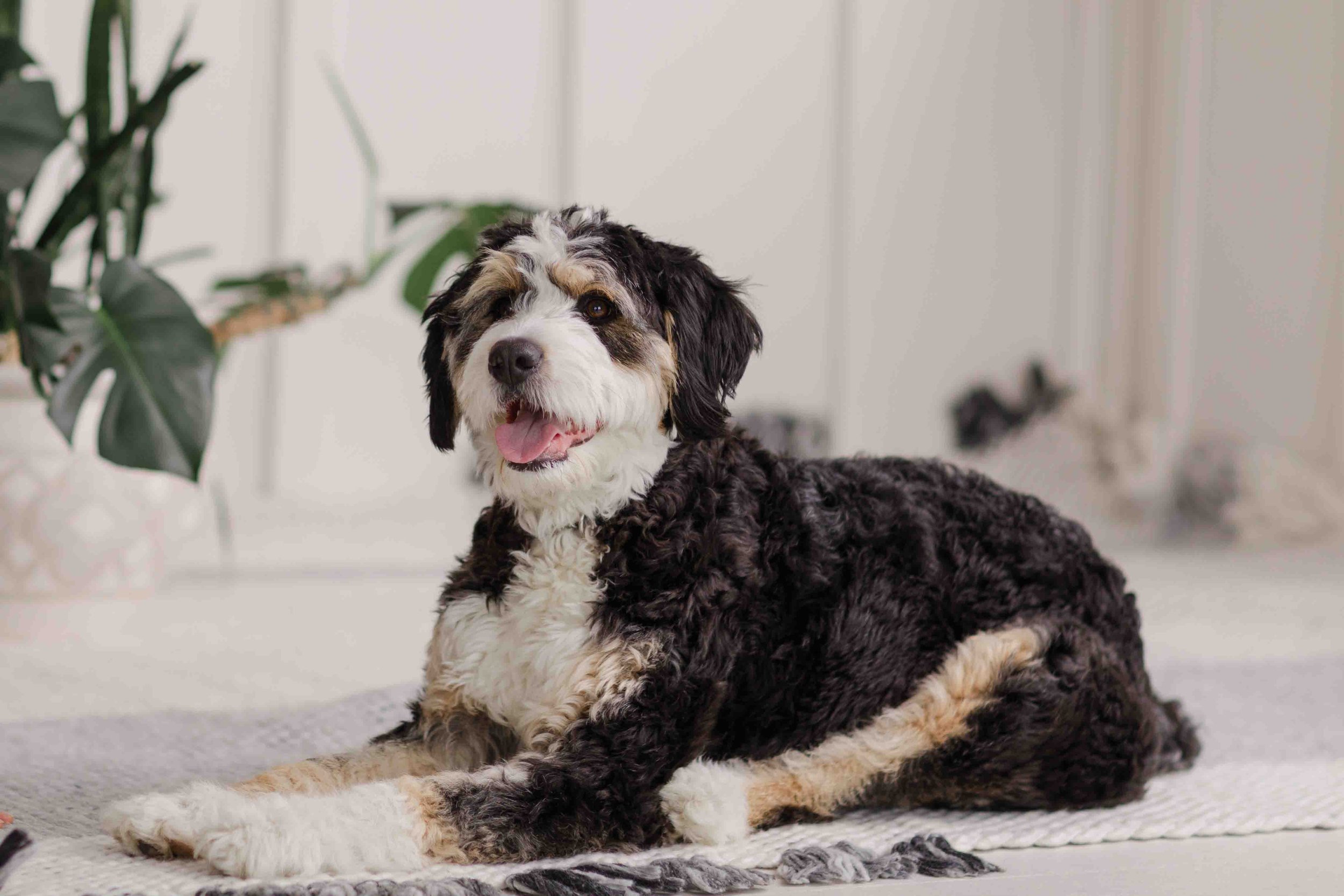
Quick answer: Usually, yes. Most adult Doodles can learn to spend a few hours alone calmly, but it is a skill that has to be taught, not a trait you can count on. Puppies need much shorter stretches, set by bladder capacity and experience; a puppy under ten weeks can typically wait about an hour. Our go-home guidance caps daytime crate time at four hours, and young puppies need far less. A Doodle who follows you from room to room does not, on that basis alone, have separation anxiety. Breed tendencies matter less than the individual puppy, her training, and your weekday, which is why, at Stokeshire Designer Doodles, we ask about your schedule before we match a puppy to your family.
It is 7:40 on a Tuesday morning. The laptop bag is by the door, your keys are in your hand, and a twelve-week-old puppy has worked out what the laptop bag means.
Whether she spends the next two hours asleep or at the crate door has less to do with her breed than most of the internet suggests. It has more to do with what she practiced before today, and whether anyone planned the middle of your day.
This guide covers the whole question: how long a Doodle can be alone at each age, how alone time is taught, how to tell a velcro dog from an anxious one, and what a full-time job actually requires.
How long can a Doodle be left alone? Hours by age
The numbers most people are looking for are bladder numbers. The American Kennel Club's general guide is about one hour for puppies under ten weeks, about two hours at ten to twelve weeks, and roughly one hour per month of age from three months on. Even adult dogs, it advises, should not go much longer than six to eight hours without a bathroom break (Driver, 2025).
Treat those as ceilings for her bladder, not targets for alone time. A puppy who can physically wait four hours may not yet be able to spend four hours alone calmly.
| Age | Bladder ceiling (AKC) | What to plan for |
|---|---|---|
| Under 10 weeks | About 1 hour | Very short, planned separations inside the house. Puppies who go home at eight weeks pick up here, with crate practice already started in our nursery. |
| 10 to 12 weeks | About 2 hours | Short alone time built around naps. Puppies who complete Doodle School™ come home around twelve weeks with crate routines already started. |
| 3 months | About 3 hours | Longer stretches only when her potty habits and her response say she is ready. |
| 4 to 6 months | About 4 to 6 hours | Independence becomes a deliberate training goal. Daytime crate time stays at four hours or less. Longer days need a pen or gated room and a midday break. |
| 6 months to adult | Up to 6 to 8 hours | Adolescence can loosen skills that looked finished. Step back a rung rather than push through. |
| Adult | 6 to 8 hours is an outer limit | A few hours is a reasonable everyday expectation for a dog with a foundation. Age, health, and temperament change the number. |
Why alone time has to be taught
Veterinary guidance on prevention is short. The risk that a puppy will become fearful or anxious when left alone can be reduced by letting her spend time alone regularly and comfortably during the day, ideally in a safe place of her own (Borns-Weil, 2025). The word doing the work is comfortably. Alone time that happens only when you have to leave, for as long as you have to be gone, teaches a different lesson.
It follows the same logic as the Developmental Confidence Circuit™ at the center of the Stokeshire Method™: notice something new, evaluate it, recover, choose to engage. A closing door is something new. The goal is not a puppy who never notices you leave. It is a puppy who notices, recovers, and goes back to her chew.
The Independence Ladder™
We break alone time into six rungs. The ladder borrows the logic of the graduated-departure training veterinary behaviorists use for dogs with separation distress, applied early and gently as prevention: begin where the puppy is relaxed, add one small step, and move up only when the step before it is easy (Borns-Weil, 2025; Lindell et al., 2026).
- Settle near you. She rests on a bed or mat while you are in the room and not interacting with her. Ready to move on when she lies down and stays relaxed without being asked again.
- Settle in her own space. A crate, exercise pen, or gated room, with you still in view and a chew or food toy to work on. Ready when she eats, chews, or naps there while you move around the house.
- Out of sight, still home. You step behind a door or into the next room, for seconds at first, then minutes. Ready when she stays with her chew instead of watching the door.
- Out the door. Short, real departures: the mailbox, the trash, the car. Come back before the food toy is finished (Lindell et al., 2026). Ready when she is still busy or resting when you walk back in.
- Everyday absences. Longer departures whose length varies instead of climbing in a straight line, increased only while they are well tolerated. Ready when she eats, rests, plays, or sleeps normally while you are gone.
- Independence. The grown dog moves between company and solitude without distress. It is not a finish line. It is a skill you keep, and adolescence may take a rung or two back.
The four rules
Move up only from relaxed. If she will not eat, will not settle, or keeps her eyes on the door, the rung is too high. Come down. That is the method working, not failing.
Change one thing at a time. Longer, or farther, or a new room, or a new time of day. Never two at once.
Protest settles. Distress builds. A little whining that fades on its own is protest. When you can, wait for a quiet moment before opening the crate, so she does not learn that noise opens doors. Drooling, frantic attempts to get out, soiling, or crying that grows louder is distress, and distress is not something to wait out. Stop the session and go back down a rung. If distress shows up even at the easier rungs, stop the exercises and talk with your veterinarian; pushing on can make some dogs more sensitive to departures rather than less (Lindell et al., 2026).
Keep comings and goings quiet. When you come back, give a brief hello, then sit down nearby until she relaxes (Lindell et al., 2026). Your return should be ordinary, not an event.
The first rungs start before your puppy leaves us. Alone-time practice begins in the litter weeks, something veterinary behaviorists writing for VCA note many breeders do (Lindell et al., 2026). Our nursery curriculum introduces the crate in week four and builds in crate naps by week eight, so your puppy has already practiced resting on her own before go-home day.
Puppies who stay for Doodle School or Bootcamp™ keep climbing with our trainers. Crate rest, naps, and nighttime settling are part of every day, and Doodle School trainers score crate behavior and independence on our weekly rubric. Puppies who go home at eight weeks keep climbing in your kitchen. The ladder is the same either way.
Velcro dog vs. separation anxiety: not the same thing
A Bernedoodle who follows you from the kitchen to the laundry room is most likely telling you she likes you. That is not a diagnosis.
Current veterinary guidance is direct on this point: dogs that show close attachment behaviors, such as following family members around the house, are at no greater risk of separation anxiety than dogs that do not (Borns-Weil, 2025). In a study of 75 dogs, those with separation anxiety spent no more time in contact with or close to their owners during an attachment test than dogs without it (Parthasarathy & Crowell-Davis, 2006).
The evidence is not unanimous. An older study of dogs already seen for behavior problems found extreme following more common among the dogs diagnosed with separation anxiety (Flannigan & Dodman, 2001). The practical point holds either way. Whether your dog follows you tells you little. What she does after the door closes tells you a great deal.
Separation problems are not one condition, either. Researchers who analyzed 762 dogs found distinct profiles, including frustration-driven and boredom-related patterns alongside fear-based distress (de Assis et al., 2020). And they are less common than the internet implies. In a survey of more than 13,000 Finnish pet dogs, owners reported separation-related behavior in about 5 percent, the least common of the anxiety traits studied, compared with 32 percent for noise sensitivity (Salonen et al., 2020).
What can look like separation anxiety
A diagnosis of separation distress requires ruling out the other common causes first (Borns-Weil, 2025). Here is how they tend to differ.
| What is going on | What you tend to see | What helps |
|---|---|---|
| Attachment | Follows you around at home; relaxed once you have left | Nothing to fix. Keep practicing alone time. |
| Protest | Brief whining or barking after you leave, then she settles | Short sessions. Open the crate after a quiet moment. |
| Boredom or play | Chewing or exploring with a loose, busy body | Exercise and mental work before you leave, and a food toy while you are gone. |
| Incomplete house training | Accidents whether you are home or not | Back to the potty schedule, with shorter stretches. |
| Noise or outside triggers | Barking at deliveries, dogs, or sounds outside | Move her resting space away from windows and doors. |
| Confinement distress | Upset by the crate or gate itself; may be calm loose in a safe room | Rebuild the crate slowly, or use a gated room instead. |
| Separation-related distress | Crying that builds, damage at doors or windows, soiling, drooling, pacing, not eating while alone | Go back down the ladder, and call your veterinarian. |
To know which one you have, watch. Point a phone camera at her space and review the first half hour after you leave. Merck's guidance calls video recording an invaluable diagnostic tool (Borns-Weil, 2025). It will tell you more than the state of the room when you get home.
Can I get a Doodle if I work full-time?
Yes, with a plan. The question is not your job title. It is how many hours the dog would be alone, at what age, and who covers the middle of the day.
| Your schedule | What to plan for |
|---|---|
| Working from home | The risk is too much contact, not too little. A puppy who is never apart from you never practices being apart. We recommend scheduling crate time at least twice a day while someone is still home, so being apart is normal before it is necessary. |
| Hybrid | Home days are for climbing the ladder, not for constant shadowing. Build everyday absences on home days before the first office day. |
| Two adults out of the house | Workable, with a plan for the first months: a midday person (a walker, family member, or sitter), a puppy-safe pen or gated room, a potty schedule, and alone-time practice on evenings and weekends. Daytime crate time stays at four hours or less, and well under that for a young puppy. |
| Frequent travel | A matching question as much as a training one. Tell us on your application. Puppies differ in how easily they handle new places and new people, and we watch that for weeks before Match Day. |
| Routinely 8 to 10 hours alone | Longer than AKC advises even an adult dog should go without a bathroom break, and far longer than a puppy can manage. It does not rule you out. It means the plan needs another person in the middle of the day, and we would rather talk about that before Match Day than after. |
Daycare can be part of the answer once your puppy is ready for it. Our guide to socializing a Doodle puppy before daycare covers what ready looks like.
Do some Doodle breeds handle alone time better?
Broad tendencies exist, and they are smaller than most people expect. In a study of more than 2,000 genotyped dogs and 18,000 owner surveys, breed explained about 9 percent of the variation in behavior between individual dogs (Morrill et al., 2022). The puppy in front of you matters more than the name of the cross.
With that caution, here is how five common Doodle crosses compare on independence in our Doodle Temperament Comparison, which rates seven traits across ten breeds.
| Doodle | Independence rating | What to plan for |
|---|---|---|
| Bernedoodle | Low. Often called a velcro dog. | Start the ladder in the first week home and keep the steps small. Wanting you nearby is attachment, not a problem. |
| Golden Mountain Doodle | Low to moderate | A predictable routine and gradual alone time. |
| Australian Mountain Doodle | Low to moderate | Pair alone time with real mental work: training, food puzzles, sniffing games. |
| Goldendoodle | Moderate | Exercise and enrichment before departures. Independence still has to be taught. |
| Aussiedoodle | Low. An intense bond. | Boredom can look like an alone-time problem, so plan daily mental work. |
These are broad tendencies, not predictions. Individual temperament, development, training, and routine matter more than the breed label.
How we use this when we match a puppy
Our puppy application asks what an average weekday looks like in your home. We read that answer closely, because it tells us how much alone time a puppy will need to learn, and how soon.
At Match Day, weeks of observation, the Volhard-based aptitude evaluation, and your household context come together in one match. Our Canine Recovery Index™ records how each puppy responds to and recovers from unfamiliar experiences, including whether she approaches on her own or waits for a littermate. It describes what a puppy did. It does not predict how a grown dog will handle an empty house, and it is one input among several.
Our goal is not to talk you into or out of a puppy. It is to choose well, with real information on both sides.
The useful question is not whether a Doodle can be left alone. It is whether this dog can learn to feel safe when you are gone, and whether we know enough about your life to choose that dog well.
Start with the two-minute Dream Dog Quiz for breed and coat fit, then tell us about your weekday in the puppy application.
What we will not promise
No breeder can promise that a puppy will never struggle with being alone, and we do not. Doodle School and Bootcamp build foundations. They do not produce a finished dog, and skills practiced with our trainers have to be practiced at home.
Expect a wobble in adolescence. In one study, dogs at eight months were more likely than at five months to repeatedly ignore a "sit" cue from their caregiver, while their response to a stranger improved (Asher et al., 2020). If alone time slips during that stretch, it is usually a phase, not a failure. Go back a rung or two and climb again. Our guide to adolescent regression covers the rest of that season.
When to call your veterinarian
Call your veterinarian if you see injuries from escape attempts, heavy drooling, house soiling only when she is alone, refusal to eat while alone, or distress that builds instead of settling. Call as well if a dog who was comfortable alone suddenly is not; a sudden change in behavior deserves a medical look before a training plan. Separation distress is diagnosed only after other causes are ruled out, and treatment is a behavior-modification plan that sometimes includes medication prescribed by a veterinarian (Borns-Weil, 2025; Lindell et al., 2026). There is nothing shameful in that. Medicine is sometimes part of behavior care, and a veterinary behaviorist can help when a plan needs more than a ladder.
Frequently asked questions
How long can a Doodle puppy be left alone?
Not long at first. AKC's general guide is about one hour under ten weeks, about two hours at ten to twelve weeks, and roughly an hour per month of age after that, as a bladder ceiling rather than an alone-time target. Our go-home guidance caps daytime crate time at four hours, but a young puppy's real limit is what her bladder can hold at her age. Build up with short, planned separations that grow only while your puppy stays relaxed.
How long can an adult Doodle be left alone?
A few hours is a reasonable everyday expectation for an adult Doodle with a solid foundation. AKC advises that even adult dogs should not go much longer than six to eight hours without a bathroom break. A full workday plus a commute usually needs a midday walk or visit, whatever the breed.
Do Bernedoodles have separation anxiety?
Some do, as some dogs of every breed do. Bernedoodles are often deeply people-oriented, but following you from room to room is not, by itself, separation anxiety. Veterinary guidance holds that dogs with close attachment behaviors are at no greater risk than dogs without them. What helps is teaching alone time from the first week home, in small steps.
Can Goldendoodles be left alone?
Usually, once alone time has been taught. PetMD notes that Goldendoodles can be prone to separation anxiety and advises against leaving them home alone for more than eight hours (Kaowthumrong, 2025). Plan exercise and mental work before you leave, a food toy while you are gone, and a midday break on long days.
Should I crate my Doodle while I am at work?
For shorter stretches, a crate she already likes can be a safe place to rest. Our go-home guidance caps daytime crate time at four hours, and less for a young puppy. For a longer day, use a pen or gated room and bring in a midday walker, family member, or sitter.
Will a second dog fix separation anxiety?
Not reliably. Some dogs are calmer with another dog in the house, and some are not (Lindell et al., 2026). In one large study, having other pets at home was not associated with separation anxiety (Flannigan & Dodman, 2001). A second dog can be good company, but it is not a treatment plan, and raising two puppies at once brings its own challenges.
Is it too late if my adult dog already struggles?
No. Start with your veterinarian, who can rule out other causes first. The same graduated approach is then used with adult dogs, often with a veterinary behaviorist's help. Start at the rung where your dog is relaxed, even if that rung is you standing in the next room.
Keep reading
- Doodle Temperament Comparison: seven traits across ten breeds
- Match Day: how we match puppies to families
- Doodle School: four weeks of foundation training in a trainer's home
- Bootcamp: crate, potty, and settling in 10 to 14 days
- Preparing for go-home day
- Socializing a Doodle puppy before daycare
References
- Asher, L., England, G. C. W., Sommerville, R., & Harvey, N. D. (2020). Teenage dogs? Evidence for adolescent-phase conflict behaviour and an association between attachment to humans and pubertal timing in the domestic dog. Biology Letters, 16(5), 20200097. https://doi.org/10.1098/rsbl.2020.0097
- Borns-Weil, S. (2025). Behavior problems of dogs. In Merck Veterinary Manual. https://www.merckvetmanual.com/behavior/behavior-of-dogs/behavior-problems-of-dogs
- de Assis, L. S., Matos, R., Pike, T. W., Burman, O. H. P., & Mills, D. S. (2020). Developing diagnostic frameworks in veterinary behavioral medicine: Disambiguating separation related problems in dogs. Frontiers in Veterinary Science, 6, 499. https://doi.org/10.3389/fvets.2019.00499
- Driver, S. (2025, October 29). How long can a puppy be left alone? Tips for separation anxiety. American Kennel Club. https://www.akc.org/expert-advice/training/how-long-leave-puppy-alone/
- Flannigan, G., & Dodman, N. H. (2001). Risk factors and behaviors associated with separation anxiety in dogs. Journal of the American Veterinary Medical Association, 219(4), 460–466. https://doi.org/10.2460/javma.2001.219.460
- Kaowthumrong, P. (2025, February 18). Goldendoodle dog breed health and care (J. Cornett, Reviewer). PetMD. https://www.petmd.com/dog/breeds/goldendoodle
- Lindell, E., Horwitz, D., & Landsberg, G. (2026, September 25). Separation-related distress in dogs: Synopsis. VCA Animal Hospitals. https://vcahospitals.com/know-your-pet/dog-behavior-problems-separation-anxiety
- Morrill, K., Hekman, J., Li, X., McClure, J., Logan, B., Goodman, L., Gao, M., Dong, Y., Alonso, M., Carmichael, E., Snyder-Mackler, N., Alonso, J., Noh, H. J., Johnson, J., Koltookian, M., Lieu, C., Megquier, K., Swofford, R., Turner-Maier, J., . . . Karlsson, E. K. (2022). Ancestry-inclusive dog genomics challenges popular breed stereotypes. Science, 376(6592), eabk0639. https://doi.org/10.1126/science.abk0639
- Parthasarathy, V., & Crowell-Davis, S. L. (2006). Relationship between attachment to owners and separation anxiety in pet dogs (Canis lupus familiaris). Journal of Veterinary Behavior, 1(3), 109–120. https://doi.org/10.1016/j.jveb.2006.09.005
- Salonen, M., Sulkama, S., Mikkola, S., Puurunen, J., Hakanen, E., Tiira, K., Araujo, C., & Lohi, H. (2020). Prevalence, comorbidity, and breed differences in canine anxiety in 13,700 Finnish pet dogs. Scientific Reports, 10, 2962. https://doi.org/10.1038/s41598-020-59837-z
This article is educational and does not replace veterinary care. If your dog shows distress when alone, or any sudden change in behavior, consult a licensed veterinarian.