
What Every Doodle Breeder Should Know About Inherited Eye Disorders
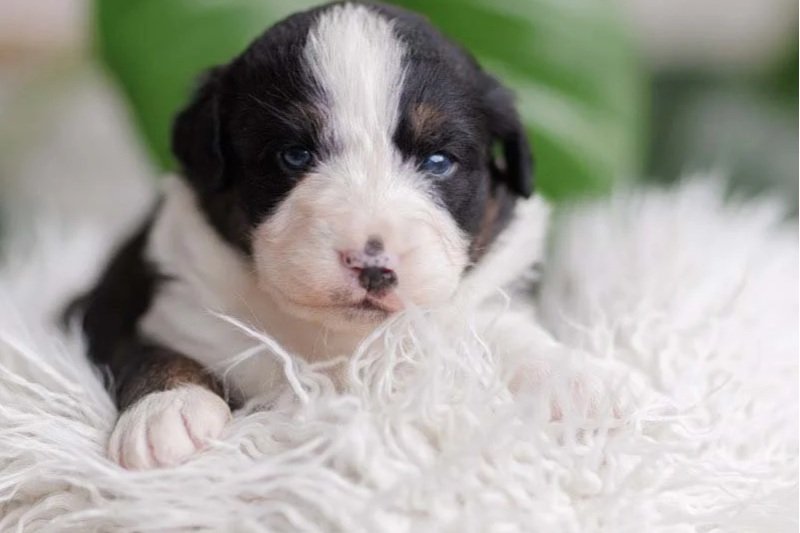
An educational overview of the ACVO/OFA CAER framework, what it means for designer breeds, and how genetic diversity changes the conversation.
The American College of Veterinary Ophthalmologists (ACVO) publishes a reference document known informally as "The Blue Book." Now in its 16th edition (2024), it catalogs every ocular disorder proven or presumed to be inherited in purebred dogs, along with breeding recommendations for each. It is the scientific backbone behind the OFA Companion Animal Eye Registry (CAER) examination, which is considered the gold standard for clinical eye screening in breeding programs.
If you breed doodles, you have probably seen buyers ask about CAER results. You may have also noticed something when you opened the document: it is written entirely for purebred dogs.
That distinction matters. Not because designer breeders can ignore eye health, but because the genetic dynamics at play in a crossbreeding program are fundamentally different from those in a closed registry. Understanding that difference is what separates an informed breeder from one who is simply checking boxes.
How the Blue Book Is Organized
For each purebred breed, the Blue Book lists known ocular disorders alongside three key pieces of information: the inheritance pattern (when known), scientific references, and a breeding recommendation. That recommendation falls into one of three categories.
"NO" means a dog diagnosed with the condition should not be bred. "Breeder option" means the condition has been observed in the breed but the breeder may use clinical judgment. "Passes with no notation" means the finding is considered insignificant.
For the Golden Retriever, there are 14 listed disorders, 7 of which carry a "NO" breeding recommendation. For the Standard Poodle, there are 12 listed disorders. For the Bernese Mountain Dog, 4. For the Australian Shepherd, 16.
Every one of these breed pages is built on data collected from purebred populations within closed registries. The statistical incidence figures, the inheritance patterns, and the breeding recommendations are all calibrated to dogs whose gene pools are, by design, restricted.
Inheritance Patterns and Why They Matter
The most important column in the Blue Book's disorder tables is the one labeled "Inheritance." It tells you how a condition is passed from parent to offspring, and it determines whether crossbreeding changes the risk profile.
Autosomal recessive conditions require two copies of the variant (one from each parent) to produce an affected dog. A dog with one copy is a carrier but is clinically normal. This is the most common inheritance pattern for serious inherited eye diseases, including progressive retinal atrophy (PRA-prcd, GR-PRA1, GR-PRA2), oculoskeletal dysplasia, and several others.
Autosomal dominant conditions require only one copy of the variant to affect the dog. These are less common in the Blue Book but do exist. HSF4-associated cataracts in the Australian Shepherd are the most notable example. One copy of the mutation can produce clinical cataracts, sometimes with incomplete penetrance.
Polygenic conditions are influenced by multiple genes, often in combination with conformation. Entropion and ectropion fall into this category. Skull shape, skin weight, orbital structure, and eyelid anatomy all contribute.
Unknown inheritance is listed for the majority of conditions in the Blue Book. When the ACVO writes "Not defined," it means the mode of inheritance has not been scientifically established. Pigmentary uveitis in Golden Retrievers, corneal dystrophy, and uveal cysts all fall into this category.
Where Hybrid Vigor Enters the Conversation
Heterosis, commonly called hybrid vigor, refers to the tendency of crossbred offspring to exhibit greater genetic diversity than either parent breed. In the context of inherited disease, this matters most for autosomal recessive conditions.
Here is the mechanism in plain terms. A recessive disorder requires two copies of the same faulty gene. Within a purebred population, both parents draw from the same restricted gene pool, which increases the probability that both carry the same recessive variant. When you cross two genetically distinct breeds, the odds of both parents carrying the same breed-specific recessive mutation drop substantially.
Consider PRA-prcd, one of the most common inherited retinal diseases across multiple breeds. A Golden Retriever may carry one copy without any clinical signs. If that dog is bred to another Golden Retriever who also carries one copy, 25% of the litter will be affected. But if that same Golden Retriever is bred to a Poodle who does not carry the prcd variant, zero puppies in the litter can be affected. Some may be carriers, but none will develop the disease.
Now consider GR-PRA1 (SLC4A3), which is specific to the Golden Retriever. A Poodle does not carry this variant. A Bernese Mountain Dog does not carry it. An Australian Shepherd does not carry it. In a crossbreeding program, the breed-specific nature of many recessive variants means the risk is diluted by design, not by accident.
This is what breeders mean when they reference hybrid vigor in the context of health. It is not a marketing term. It is a genetic reality, specific to recessive inheritance, and supported by the same principles that underpin the Blue Book itself.
Where Hybrid Vigor Does Not Apply
Intellectual honesty requires naming the limits of this advantage.
Autosomal dominant conditions are not mitigated by crossbreeding. If one parent carries a dominant mutation, approximately 50% of offspring will inherit it regardless of the other parent's breed. HSF4 cataracts in Australian Shepherds are the clearest example. A breeder producing Aussiedoodles who uses an Australian Shepherd carrying HSF4 will produce affected puppies whether the other parent is a Poodle, a Bernese, or any other breed. DNA testing is the only safeguard.
Polygenic conditions driven by conformation (entropion, ectropion, macroblepharon) are influenced by skull structure and facial anatomy. Crossbreeding may alter conformation enough to reduce risk, but it is not a reliable preventive measure. These conditions still require clinical evaluation.
Conditions with unknown inheritance cannot be predicted genetically. Pigmentary uveitis in Golden Retrievers, for example, typically does not present until age 5 to 10. There is no DNA test. The inheritance pattern has not been defined. A clinical eye examination by a board-certified veterinary ophthalmologist is the only way to screen for it, regardless of whether the dog is purebred or crossbred.
The Role of CAER in a Crossbreeding Program
DNA testing and CAER exams serve different functions, and neither replaces the other.
Comprehensive genetic panels like Embark test for known mutations with identified genetic markers. They are powerful for autosomal recessive conditions where the causal variant has been mapped. For a multigen Goldendoodle, an Embark panel can confirm clearance on PRA-prcd, GR-PRA1, GR-PRA2, and dozens of other conditions with high confidence.
A CAER examination evaluates the phenotype: the clinical appearance of the eye at the time of examination. It detects conditions that have no DNA test, conditions that develop later in life, and conditions whose genetic basis is not yet understood. The exam includes indirect ophthalmoscopy and slit lamp biomicroscopy following pupil dilation, performed by a Diplomate of the ACVO.
For any breeding program, purebred or designer, the most complete approach layers both: genetic testing to screen for known recessive and dominant variants, and clinical examination to catch what genetics alone cannot.
What This Means for Responsible Doodle Breeders
The Blue Book was written for purebred dogs because that is where the data exists. Closed registries generate the controlled populations needed for genetic studies. The ACVO Genetics Committee is transparent about this: their recommendations are based on statistical data from breed-specific registry submissions and published research.
Designer breeding programs operate in a different genetic landscape. The gene pools are broader. The recessive disease burden is lower by the nature of the cross. But the responsibility to screen is not lower. It is different in emphasis.
For breeders working with intentional crosses, the priority framework looks like this.
First, genetic test both parents are comprehensive. Embark or an equivalent panel covers the known recessive and dominant variants across all contributing breeds. This is non-negotiable.
Second, know your lineage. Multi-generational phenotypic data, tracking which conditions have or have not appeared across litters and lines, is real evidence. It does not replace formal testing, but it provides context that no single-generation test can offer.
Third, pursue clinical screening. CAER exams, OFA cardiac evaluations, and orthopedic assessments address what DNA cannot. For programs scaling toward long-term breed development, building these records is an investment in credibility and in the health of every dog produced.
The Blue Book does not yet include a chapter on mixed breeds. That may change as data accumulates. In the meantime, responsible breeders can use its framework to inform their own standards, adapted to the genetic realities of the populations they are building.
This post is intended as an educational resource for breeders and prospective puppy families. It does not constitute veterinary advice. Consult a licensed veterinarian or board-certified veterinary ophthalmologist for clinical guidance specific to your dog.
Stokeshire Designer Doodles is a therapy-grade breeding and development program based in Medford, Wisconsin. Our breeding dogs are genetically tested through Embark's comprehensive panel, and we track health outcomes across generations. Learn more at wisconsindesignerdoodles.com.