
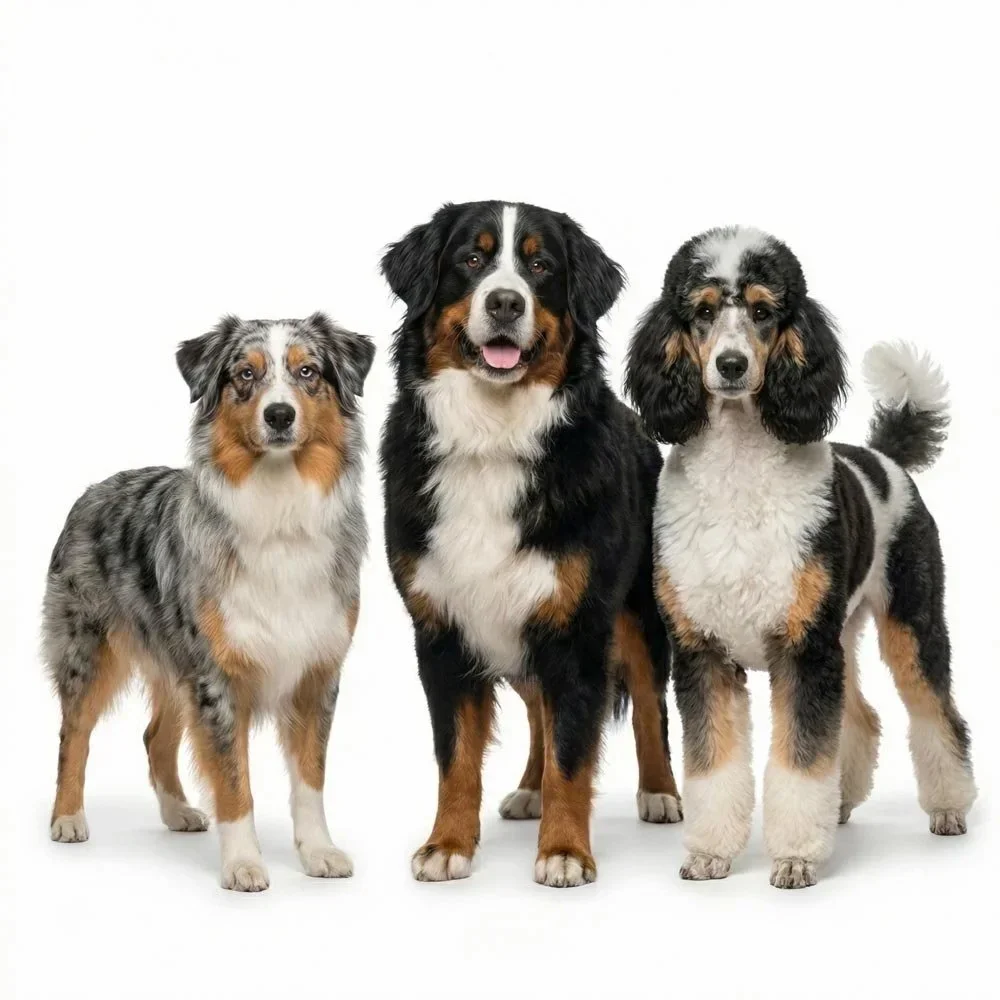
The Aussie Bernedoodle:
A Complete Breed Guide
The Aussie Bernedoodle is a triple-cross hybrid combining the Bernese Mountain Dog, Australian Shepherd, and Poodle. It is the same cross most breeders now call the Australian Mountain Doodle — designed for calm temperament, working intelligence, and low-shedding coat genetics.
Also known as: Australian Mountain Doodle · Swiss Doodle · Aussie Mountain Doodle · Aussiebernedoodle
View Planned Litters Naming GuideAussie Bernedoodle — Quick Facts
| Breed Type | Designer hybrid — triple cross. Not AKC or FCI recognized. |
| Parent Breeds | Bernese Mountain Dog × Australian Shepherd × Poodle |
| Other Names | Australian Mountain Doodle (AMD), Swiss Doodle, Aussie Mountain Doodle, Aussiebernedoodle |
| Not the Same As | The Australian Bernedoodle — a different cross using Bernese × Australian Labradoodle. See naming guide below. |
| Size Range | Toy/Micro (10–24 lbs), Mini (25–35 lbs), Medium (35–50 lbs), Standard (50–100 lbs) |
| Coat Types | Wavy, curly, furnished, or unfurnished — determined by RSPO2, KRT71, and FGF5 genetics |
| Shedding | Low to moderate (furnished coats shed least) |
| Temperament | Intelligent, loyal, calm, emotionally attuned, trainable |
| Lifespan | 10–16 years (smaller dogs live longer) |
| Best For | Active families, allergy-sensitive homes, therapy dog programs, first-time owners with training commitment |
| Pricing | $3,000–$5,500 from health-tested programs. See Stokeshire pricing. |
What Is an Aussie Bernedoodle?
An Aussie Bernedoodle is a triple-cross hybrid produced by combining three parent breeds: the Bernese Mountain Dog, the Australian Shepherd, and the Poodle. The cross is designed to bring together the calm, devoted temperament of the Bernese, the working intelligence and trainability of the Australian Shepherd, and the low-shedding coat genetics of the Poodle.
The term "Aussie Bernedoodle" was coined around 2015 by breeders who first paired Aussiedoodles with Bernedoodles. As the cross gained popularity, "Australian Mountain Doodle" became the more widely adopted name across breeding programs, registries like GoodDog.com, and marketplace platforms like PuppySpot. Both names describe the same genetic cross.
At Stokeshire Designer Doodles, we use Australian Mountain Doodle as our primary name for this cross and define it specifically as Bernese Mountain Dog × Australian Shepherd × Poodle.
The Bernese provides the calm anchor. The Aussie provides the intelligence and drive. The Poodle provides the coat. Together, they produce one of the most balanced family companions in the doodle world.
Aussie Bernedoodle vs. Australian Bernedoodle vs. Australian Mountain Doodle
The naming around this cross is the single most confusing element for families researching the breed. Three similar-sounding names describe two genetically different dogs. Understanding the distinction is important before choosing a breeder or committing to a puppy.
The Three-Breed Cross (Bernese × Australian Shepherd × Poodle)
This is the cross described on this page. All of the following names refer to the same genetic combination:
- Aussie Bernedoodle — the original name, coined circa 2015
- Australian Mountain Doodle (AMD) — the most widely adopted professional name
- Aussie Mountain Doodle — common shortening
- Swiss Doodle — regional variant emphasizing the Bernese Mountain Dog's Swiss heritage
- Aussiebernedoodle — one-word variant appearing on some breeder sites
Regardless of the name used, the parent breeds are the same: Bernese Mountain Dog, Australian Shepherd, and Poodle. No Labrador, no Cocker Spaniel, no Irish Water Spaniel.
The Australian Bernedoodle — A Different Cross Entirely
The Australian Bernedoodle is a separate hybrid that pairs a Bernese Mountain Dog with an Australian Labradoodle. The Australian Labradoodle is not a simple Lab-Poodle cross — it is a multi-generational breed originally developed for service work in Australia, incorporating genetics from the Labrador Retriever, Poodle, English and American Cocker Spaniels, and sometimes the Irish Water Spaniel or Curly Coated Retriever.
This means the Australian Bernedoodle has a fundamentally different genetic architecture than the Aussie Bernedoodle. There is no Australian Shepherd in the Australian Bernedoodle. The temperament profile, energy level, and health screening requirements differ accordingly. The Australian Bernedoodle tends toward the intuitive, service-oriented personality of its Labradoodle lineage, while the Aussie Bernedoodle carries the herding intelligence and athletic drive of the Australian Shepherd.
Side-by-Side: The Two Crosses
| Feature | Aussie Bernedoodle / AMD | Australian Bernedoodle |
|---|---|---|
| Parent Breeds | Bernese + Australian Shepherd + Poodle | Bernese + Australian Labradoodle |
| Australian Shepherd | Yes — core parent breed | No |
| Labrador Genetics | No | Yes — via Australian Labradoodle |
| Cocker Spaniel Genetics | No | Yes — via Australian Labradoodle |
| Merle Colors | Yes — from Aussie parent | No — merle not present in Labradoodle lines |
| MDR1 Drug Sensitivity | Yes — from Aussie parent (requires DNA testing) | No — not present in Labradoodle lineage |
| Herding Drive | Moderate — inherited from Australian Shepherd | None — no herding breed in the cross |
| Energy Level | Moderate to high | Low to moderate |
| Temperament Style | Herding intelligence + Bernese calm + Poodle responsiveness | Service-dog intuition + Bernese calm + Labradoodle softness |
| Best For | Active families, therapy work, sport/obedience, outdoor lifestyle | Calmer households, companion-focused homes, therapy work |
| Primary Advocates | Blue Skye Doodles, Cottonwood Creek, Stokeshire | SwissRidge Kennels |
A Note on "Swiss Doodle"
The name "Swiss Doodle" is most commonly used as a regional synonym for the Aussie Bernedoodle / Australian Mountain Doodle — the three-breed cross described on this page. However, a small number of programs use "Swiss Doodle" to describe a Greater Swiss Mountain Dog × Poodle cross, which is a different breed entirely. The Greater Swiss Mountain Dog has a short coat, a more formidable guard-dog temperament, and distinct health considerations from the Bernese. If you encounter the term "Swiss Doodle," confirm whether the program is using Bernese or Greater Swiss Mountain Dog genetics.
The Three Breeds Behind the Aussie Bernedoodle
Each parent breed contributes distinct traits that define the cross. The Bernese Mountain Dog provides calm devotion and patient temperament — originally bred as a Swiss draft dog. The Australian Shepherd provides herding intelligence, athleticism, and the merle coat genetics behind the breed's striking color patterns. The Poodle provides trainability, emotional attunement, and the RSPO2 furnishings gene responsible for low-shedding coats.
Bernese Mountain Dog
Gentle-giant temperament, loyalty, patience with children. Purebred Bernese have a median lifespan of only 6–8 years, with elevated rates of histiocytic sarcoma affecting roughly 25% of the breed population. The Aussie Bernedoodle cross was developed in part to extend this critically short lifespan through hybrid vigor.
Australian Shepherd
Sharp problem-solving, handler focus, and athletic drive. Median lifespan of approximately 13.7 years. Introduces merle coat genetics and moderate herding instinct. Carries the MDR1/ABCB1 drug sensitivity variant at approximately 50% prevalence — all Aussie Bernedoodle puppies should be DNA-tested before drug exposure.
Poodle
Trainability, emotional responsiveness, and coat genetics. The Poodle contributes the RSPO2 furnishings gene and MC5R shedding variant that make low-shedding doodle coats possible. The Poodle size used (Standard, Mini, or Toy) is the primary driver of adult Aussie Bernedoodle size. Median lifespan 12–15 years.
→ Full parent breed profiles on the Australian Mountain Doodle breed guide
Aussie Bernedoodle Temperament
The Aussie Bernedoodle was designed to occupy the temperament middle ground between its parent breeds. The Bernese Mountain Dog's calm, devoted nature balances the Australian Shepherd's high-drive intelligence, while the Poodle's emotional responsiveness ties both together. The result, in well-bred and well-socialized dogs, tends to be a companion that is spirited and engaged during activity but possesses a natural "off switch" that allows settling indoors — something purebred Australian Shepherds and Aussiedoodles often lack.
Breed ancestry is a meaningful but modest predictor of individual behavior. Environment, socialization quality, and training method play larger roles in shaping the adult dog. With that framing, Aussie Bernedoodles from responsible programs tend to be adaptable, people-oriented, emotionally attuned, and highly responsive to positive reinforcement training.
Trait ratings are relative comparisons based on typical parent breed characteristics. Individual dogs vary significantly.
Herding Instinct and Socialization
Because the Australian Shepherd is a herding breed, Aussie Bernedoodles may inherit moderate herding behaviors — circling, nipping at heels, or attempting to manage the movement of children and other animals. This is a genetic trait that responds well to redirection into structured activities (fetch, agility, nose work) rather than correction. The Bernese lineage generally softens this drive compared to a purebred Aussie or Aussiedoodle, but early socialization during the 3–14 week developmental window remains essential.
→ Bernedoodle vs. Australian Mountain Doodle — detailed temperament comparison
Aussie Bernedoodle Size: How Big Do They Get?
Adult size depends primarily on the Poodle parent used in the cross. No specific adult size is guaranteed in any hybrid breeding program.
| Size | Adult Weight | Adult Height | Lifespan Est. |
|---|---|---|---|
| Toy / Micro | 10–24 lbs | 12–18 in | 14–16 years |
| Mini | 25–35 lbs | 17–20 in | 13–15 years |
| Medium | 35–50 lbs | 18–22 in | 12–14 years |
| Standard | 50–100 lbs | 23–29 in | 10–13 years |
Mini and medium sizes are the most popular among suburban families. The market strongly prefers wavy coats in the mini-to-medium range.
→ Full size guide: growth timelines, growth plate protection, and apartment suitability by size
Aussie Bernedoodle Coat Types and Colors
Whether an Aussie Bernedoodle sheds, how curly it looks, and whether it is appropriate for allergy-sensitive homes are all determined by specific, testable gene variants. Four loci matter most: RSPO2 (furnishings), KRT71 (curl), MC5R (shedding rate), and FGF5 (coat length). Furnished dogs with curly or wavy coats shed the least but require the most grooming. Unfurnished Aussie Bernedoodles shed comparably to their Bernese or Aussie parent and are not appropriate for allergy-sensitive households.
The most important coat gene. Controls facial hair — beard, eyebrows, moustache. Furnished (FF or Ff) = classic doodle look, significantly lower shedding. Unfurnished (ff) = natural face, moderate to heavy shedding.
Determines coat curl tightness. Two copies = tight curly; one copy = wavy; zero = straight. Curlier coats shed less but mat faster. Wavy is the most common and widely preferred in Aussie Bernedoodle programs.
Influences hair growth cycle turnover. Poodles typically carry the low-shedding variant. Shedding is multigenic — no single gene guarantees a non-shedding outcome.
Inherited from the Australian Shepherd parent. Creates the blue merle and red merle patterns unique to Aussie-based crosses. Two merle-carrying dogs must never be bred together — double-merle offspring face serious risk of blindness and deafness.
Common Aussie Bernedoodle Colors
The Australian Shepherd parent introduces merle possibilities that standard Bernedoodles cannot produce. The Bernese contributes the tri-color foundation. Common patterns include:
Grey, black, and white marbling with copper points. Often paired with blue or heterochromatic eyes. The most sought-after Aussie Bernedoodle pattern.
Chocolate, red, and cream marbling with copper points. Warm-toned variant of the merle pattern.
Black or brown base with white markings and copper/tan points. The classic Bernese-influenced pattern.
Base color with secondary markings above eyes, cheeks, legs, and chest. Poodle-inherited pattern.
Two predominant colors, typically with significant white. Clean, striking appearance.
Single color throughout — black, chocolate, or cream. Less common in Aussie Bernedoodle litters.
Aussie Bernedoodle Health: The Genetic Rescue
A significant motivation for developing the Aussie Bernedoodle was the devastating health profile of the purebred Bernese Mountain Dog. Purebred Bernese have a coefficient of inbreeding approaching 0.40, a median lifespan of only 6–8 years, and cancer-related mortality rates estimated between 50% and 67% of the breed population. Histiocytic sarcoma — an aggressive immune-cell cancer — affects roughly one in four Bernese.
The Aussie Bernedoodle introduces the genetic diversity of the Australian Shepherd (median lifespan approximately 13.7 years) and the Poodle (median lifespan 12–15 years). This hybridization shifts the mortality curve, often providing families an additional 4–6 years of companionship compared to a purebred Bernese.
| Purebred Bernese Mountain Dog | 6–8 years |
| Australian Shepherd | 12–15 years |
| Standard Poodle | 12–15 years |
| Aussie Bernedoodle / AMD | 10–16 years |
Key Health Screening Requirements
Because the Aussie Bernedoodle combines genetics from three breeds, health screening must address risks from all three parent lines. Responsible programs perform the following as a minimum:
DNA Testing (Embark or Equivalent)
- MDR1 / ABCB1 — drug sensitivity (from Aussie parent)
- Degenerative Myelopathy (SOD1)
- Progressive Retinal Atrophy (PRA)
- Von Willebrand's Disease
- Collie Eye Anomaly (CEA)
- Hereditary Cataracts (HSF4)
Orthopedic Evaluation
- Hip dysplasia — OFA radiographic evaluation
- Elbow dysplasia — OFA evaluation
- Patella evaluation (mandatory for Mini and Toy sizes)
- Growth plate protection for puppies until skeletal maturity
Additional Screening
- Cardiac evaluation — OFA or vet cardiologist
- Eye exam (CAER) — veterinary ophthalmologist
- Bloat risk management (Standard sizes)
- Coefficient of inbreeding (COI) analysis
→ Full health testing guide: OFA and Embark explained, MDR1 medication list, what to ask breeders
Aussie Bernedoodle vs. Bernedoodle vs. Aussiedoodle
The Aussie Bernedoodle sits in the middle of the doodle temperament spectrum — calmer than the Aussiedoodle, more engaged than the Bernedoodle. Understanding where it falls relative to the other common crosses helps families match the right dog to their lifestyle.
| Feature | Aussie Bernedoodle / AMD | Bernedoodle | Aussiedoodle |
|---|---|---|---|
| Parent Breeds | Bernese + Aussie + Poodle | Bernese + Poodle | Aussie + Poodle |
| Energy Level | Moderate–High | Low–Moderate | High–Very High |
| Off Switch | Yes — settles indoors | Strong — naturally calm | Often lacking |
| Trainability | Very high — fast acquisition, strong retention | High — but may negotiate | Very high — demands engagement |
| Herding Drive | Low–Moderate | None | Moderate–High |
| Merle Colors | Yes | No | Yes |
| MDR1 Risk | Yes | No | Yes |
| Best For | Active families who also want a calm house dog | Calmer households, cuddly companion | Very active families, sport and agility work |
→ Full comparison: AMD vs. Bernedoodle vs. Aussiedoodle — trait meters and who-it's-for guide
Explore Every Topic in Detail
Each guide below expands a section of this page into a dedicated, deeply researched resource.
Aussie Bernedoodle FAQs
Is an Aussie Bernedoodle the same as an Australian Mountain Doodle?
Yes. Both names describe the same triple-cross hybrid: Bernese Mountain Dog × Australian Shepherd × Poodle. "Aussie Bernedoodle" was the original name coined around 2015. "Australian Mountain Doodle" is the more widely adopted professional name used by most breeding programs today, including Stokeshire. Swiss Doodle, Aussie Mountain Doodle, and Aussiebernedoodle are additional synonyms for the same cross.
What is the difference between an Aussie Bernedoodle and an Australian Bernedoodle?
Despite the similar names, these are genetically different crosses. The Aussie Bernedoodle combines Bernese Mountain Dog, Australian Shepherd, and Poodle. The Australian Bernedoodle combines Bernese Mountain Dog with an Australian Labradoodle — a multi-generational breed that includes Labrador Retriever, Cocker Spaniel, and Poodle genetics but no Australian Shepherd. The temperament, energy level, color possibilities, and health screening requirements differ between the two. Always confirm exact parent breeds with any breeder.
Are Aussie Bernedoodles good family dogs?
Yes. When raised with proper socialization and training, Aussie Bernedoodles are strong family dogs. The Bernese lineage contributes patience and gentleness with children. The Poodle and Australian Shepherd genetics make them responsive to household routines and engaged with family activities. They require 60–90 minutes of daily exercise and consistent mental stimulation — families who provide both will find them highly rewarding companions.
How big do Aussie Bernedoodles get?
Adult size depends on the Poodle parent. Mini Aussie Bernedoodles typically reach 25–35 lbs and 17–20 inches. Medium sizes reach 35–50 lbs and 18–22 inches. Standards reach 50–100 lbs and 23–29 inches. Toy and Micro sizes (10–24 lbs) are available in some programs. Mini and medium sizes are the most popular for suburban families.
Are Aussie Bernedoodles hypoallergenic?
No dog is completely hypoallergenic. Aussie Bernedoodles with furnished, curly coats are among the lower-shedding companion breeds available, and many allergy-sensitive families live comfortably with them. Coat genetics — specifically RSPO2 and KRT71 — determine the real-world shedding experience. Unfurnished Aussie Bernedoodles shed comparably to their Bernese or Aussie parent and are not appropriate for allergy-sensitive homes. Families with severe allergies should spend time with an adult dog before committing.
How much do Aussie Bernedoodles cost?
Aussie Bernedoodle pricing from health-tested, program-bred sources typically ranges from $3,000 to $5,500 depending on size, coat genetics, generation, and breeder program. Smaller sizes and rare color patterns like blue merle tri-color often command higher pricing. Lower prices from untested sources often reflect absent health panels or inadequate socialization. Stokeshire publishes current pricing at wisconsindesignerdoodles.com/puppy-pricing.
How long do Aussie Bernedoodles live?
Aussie Bernedoodles typically live 10–16 years, with smaller sizes living longer. This represents a significant improvement over the purebred Bernese Mountain Dog's median lifespan of 6–8 years. The hybrid vigor from combining three genetically diverse breeds dilutes the Bernese's cancer burden and extends life expectancy. Toy/Micro sizes often reach 14–16 years. Standards typically live 10–13 years.
What is MDR1 and why does it matter for Aussie Bernedoodles?
MDR1 (ABCB1) is a gene mutation inherited from the Australian Shepherd parent that causes life-threatening sensitivity to common medications including ivermectin, loperamide (Imodium), and certain anesthetics. Approximately 50% of Australian Shepherds carry this variant. Aussie Bernedoodle puppies should be DNA-tested for MDR1 before any drug exposure. Responsible breeders test all breeding dogs and provide results to families. This mutation is not present in standard Bernedoodles because the Bernese and Poodle do not carry MDR1.
Do Aussie Bernedoodles have merle coloring?
Yes. The Australian Shepherd parent introduces the merle gene (PMEL/SILV locus), producing blue merle and red merle patterns that standard Bernedoodles cannot produce. Merle coloring is one of the distinguishing visual features of the Aussie Bernedoodle compared to a standard Bernedoodle. Two merle-carrying dogs must never be bred together — double-merle offspring face significant risk of blindness and deafness. Responsible breeders confirm merle status on all breeding dogs via DNA testing.
Can Aussie Bernedoodles be therapy dogs?
Many Aussie Bernedoodles carry the temperament foundation suited for therapy work — calm, emotionally attuned, trainable, and comfortable with varied handling. Formal therapy dog certification requires evaluation through organizations like Pet Partners, the Alliance of Therapy Dogs, or Therapy Dogs International. Therapy dogs and service dogs are legally distinct categories. Stokeshire does not guarantee therapy certification outcomes — these depend on individual temperament and the certifying organization's evaluation.
About the Breeder
About the Stokeshire Aussie Bernedoodle Program
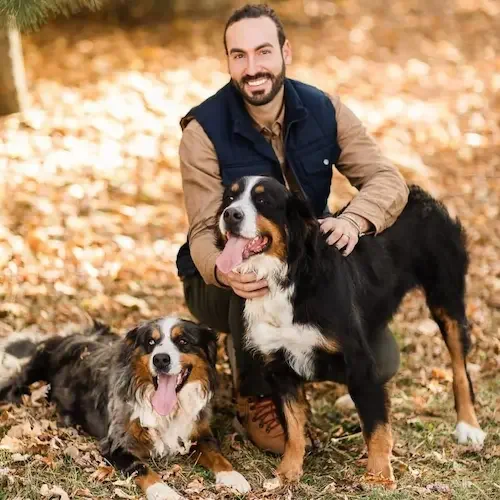
Explore Available Aussie Bernedoodle Puppies
Stokeshire Designer Doodles raises Australian Mountain Doodles (Aussie Bernedoodles) in Medford, Wisconsin, with health-tested parents, Early Neurological Stimulation from Day 3, and a structured temperament-matching process. Nationwide transport available.
View Planned Litters How the Process WorksReviewed by the Stokeshire Breeding Team · Updated March 2026