Mini Aussiedoodle
Part of the Aussiedoodle Breed Guide at Stokeshire Designer Doodles
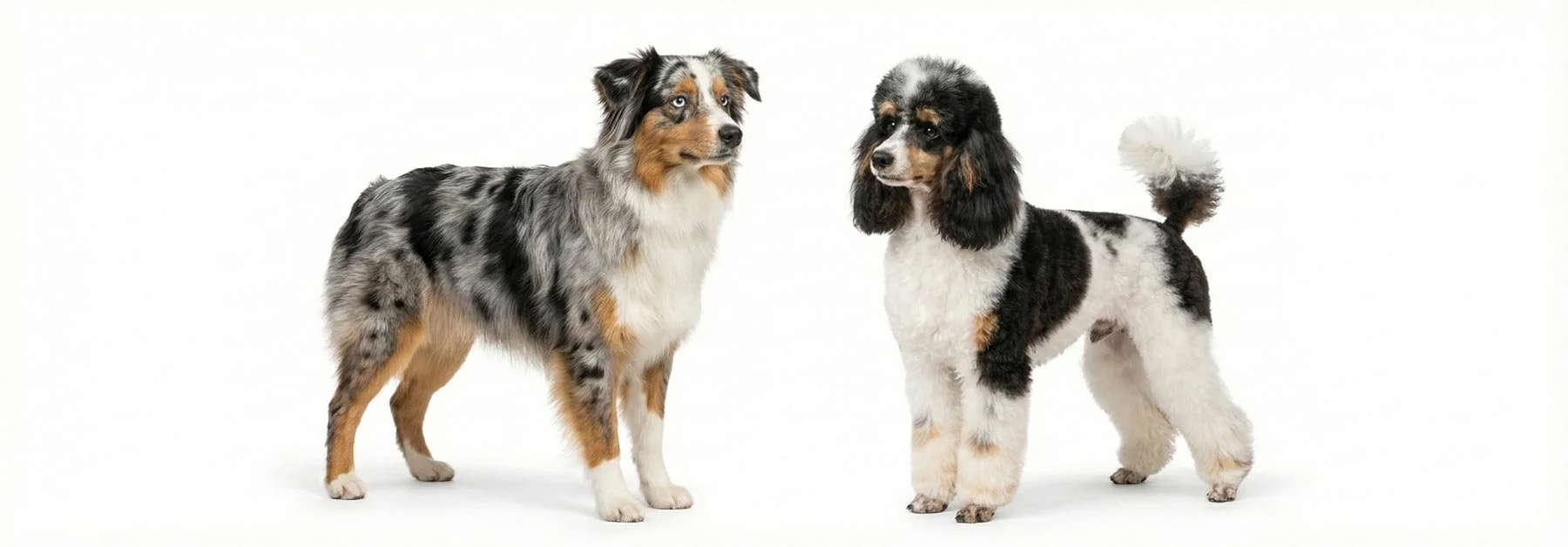
The Mini Aussiedoodle is a hybrid cross between a Mini American Shepherd and a Miniature Poodle. Per the Stokeshire Doodle Size Standard, the Mini class typically matures at 26 to 35 lb and 14 to 17 in at the withers, with working-dog intelligence, a furnished low-shedding coat, and a herding drive that requires consistent daily training. Stokeshire also breeds the Mini Australian Mountain Doodle, a closely related cross with a calmer temperament profile at the same size class.
Compare with Mini AMD View Planned LittersWhat Is a Mini Aussiedoodle?
A Mini Aussiedoodle is a cross between a Mini American Shepherd (also called the Miniature American Shepherd) and a Miniature Poodle. The breed combines the Australian Shepherd's herding intelligence and physical drive with the Poodle's furnished, low-shedding coat genetics. At Stokeshire, Mini Aussiedoodles are produced from Embark-tested parents screened for coat genetics, MDR1 drug sensitivity, and orthopedic soundness where appropriate to the lineage.
The Mini sits between the Toy (10–20 lbs) and Standard Aussiedoodle in size — a family-scale dog with the full working-breed temperament intact. These are not a calmer alternative to the Toy; they carry the same intelligence demand, energy level, and training requirement in a larger frame. Families who want that intelligence with a softer temperament edge should also read about the Mini Australian Mountain Doodle below.
| Breed Cross | Mini American Shepherd × Miniature Poodle |
| Size Class | Mini, per the Stokeshire Doodle Size Standard |
| Typical Weight | 26 to 35 lb (typical, not guaranteed; 15 to 20 percent variance possible) |
| Height at Withers | 14 to 17 in |
| Anchor | Couch-armrest height |
| Full Growth By | Approximately 12 months |
| Typical Lifespan | 12 to 15 years |
| Coat | Wavy to curly, furnished — low to minimal environmental shedding |
| MDR1 Risk | Yes — Australian Shepherd lineage. All Stokeshire breeding dogs tested. |
| Colors Available | Blue merle, red merle, black tri, red tri, phantom, sable, parti |
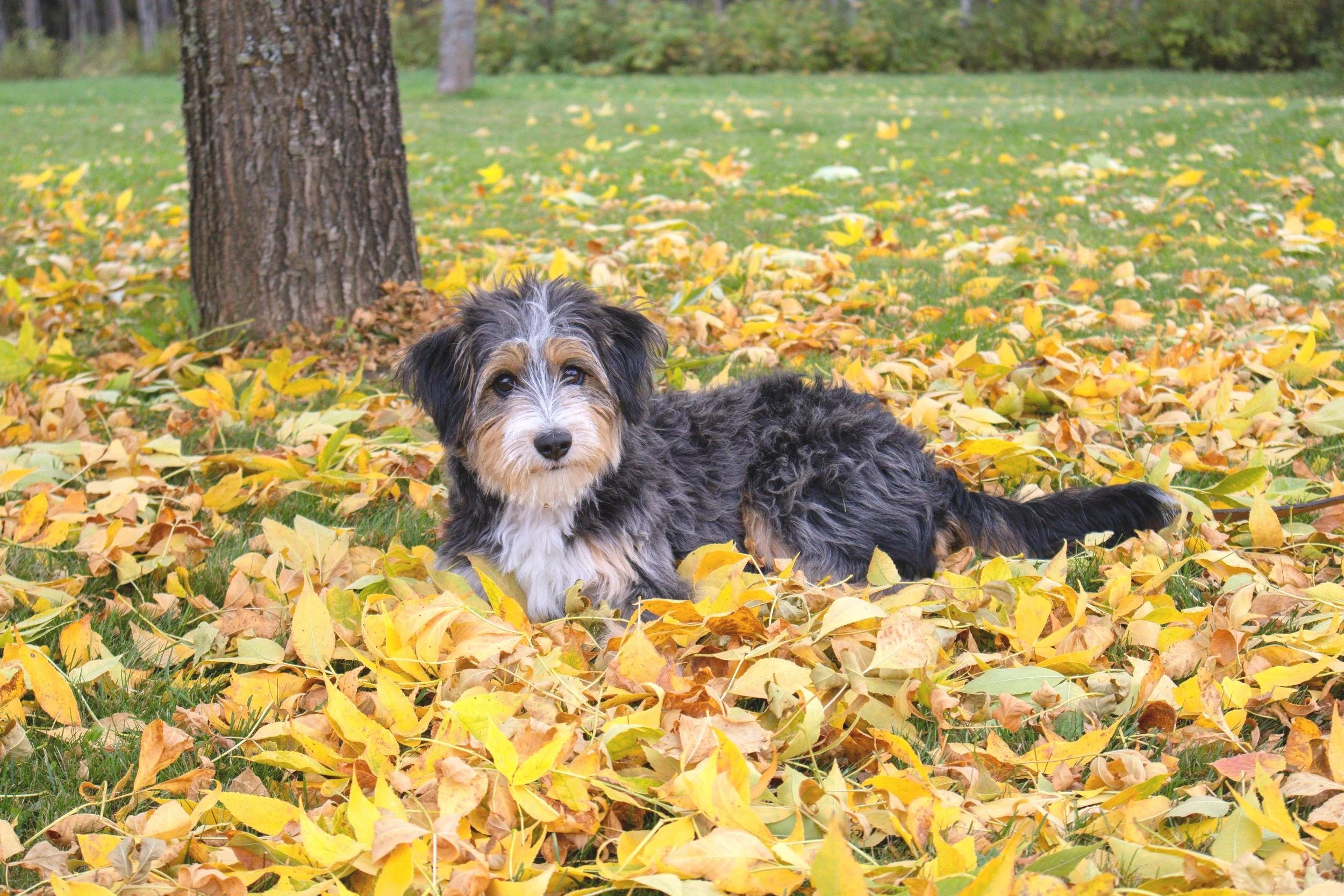
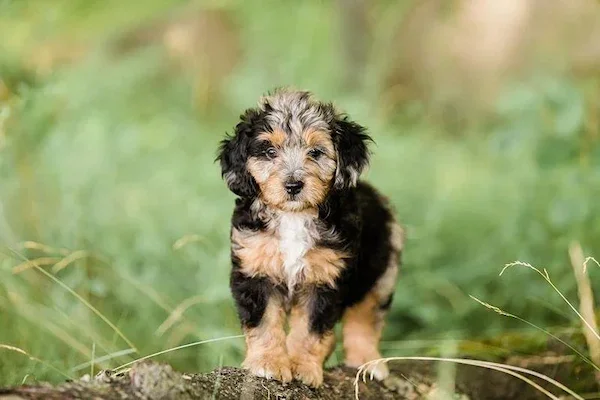
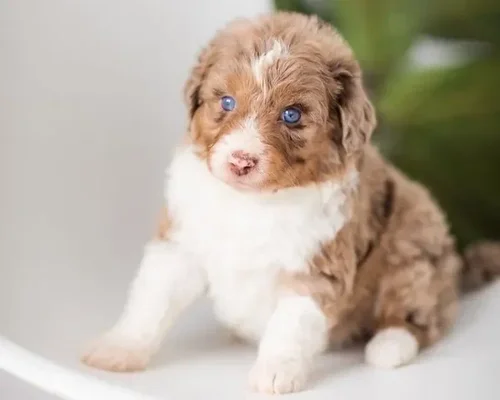
Mini Aussiedoodle Temperament
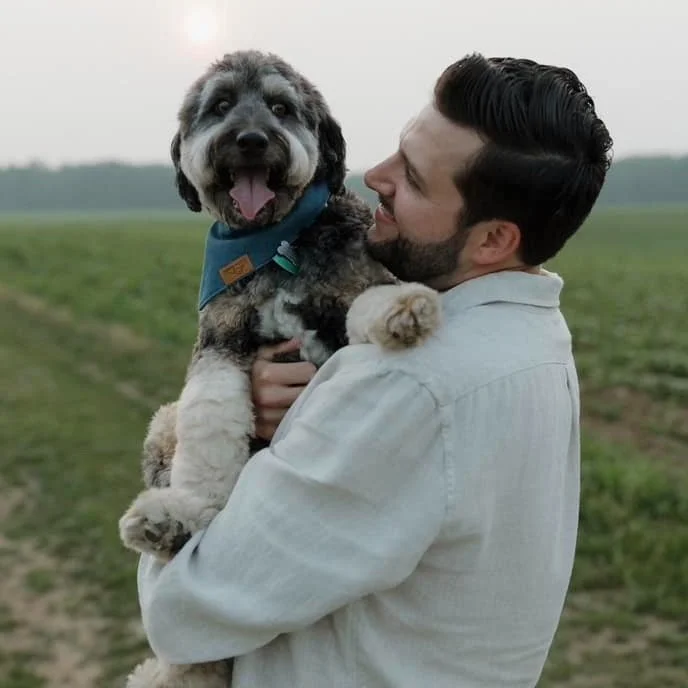
The Mini Aussiedoodle is an intelligent, handler-bonded, high-drive dog. The Mini American Shepherd was bred for working cattle and sheep — that instinct does not disappear in a companion setting. In a home environment it presents as rapid learning, intense focus on movement, herding behavior toward children and other pets, and a deep need for purposeful daily activity. These are not traits that reduce with age or socialization alone; they require consistent, skilled training beginning from the first week in the home.
The Poodle contribution adds working trainability and a strong desire to stay connected with the handler — which, combined with the Aussie drive, produces a dog that learns extremely quickly and that patterns both wanted and unwanted behaviors with equal efficiency. Training inconsistency has a faster consequence curve with this cross than with lower-drive breeds.
* Furnished coats only. Shedding depends on RSPO2/KRT71/MC5R genetics — not breed label. No dog is allergen-free.
Mini Aussiedoodle Coat & Grooming
Mini Aussiedoodle coat type is controlled by three testable gene loci — RSPO2 (furnishings), KRT71 (curl degree), and MC5R (shedding rate) — not by generation label or color. A furnished, curly-coated Mini Aussiedoodle will shed minimally. An unfurnished dog sheds comparably to its Australian Shepherd parent. Stokeshire tests all breeding dogs for coat genetics before any pairing. The low-shedding properties that many families want are genetically confirmed — not assumed from the breed cross.
Curly & Wavy Coats
Slicker brush plus metal comb through to skin. Mat-prone zones: collar, armpits, ears, base of tail. Daily brushing during coat transition (5–8 months).
All Furnished Coats
Full bath, blow-dry, brush-out, and trim. Find a groomer familiar with doodle coat structure — not all groomers are.
Curly-Coat Risk
Poodle ear canals trap moisture and debris. Weekly inspection and monthly cleaning. Prompt veterinary attention for any odor or redness.
High Mat-Risk Period
The puppy coat blows out as the adult coat grows in. Brushing frequency should increase to daily during this period to prevent mats from setting in.
→ Full grooming guide: mat zone breakdown, tool list, bathing sequence, puppy introduction protocol
The AMD grooming guide applies equally to Mini Aussiedoodle coats — the coat gene structure is identical.
Mini Aussiedoodle Health Considerations
Mini American Shepherd Lineage
- MDR1/ABCB1 — DNA test. Drug sensitivity affecting ivermectin-based heartworm preventatives and other medications. Essential before any preventative medication is prescribed.
- Hereditary cataracts (HSF4) — DNA test. Aussie-specific; distinct from PRA.
- Progressive retinal atrophy (PRA) — DNA test, multiple variants
- Collie Eye Anomaly — DNA test
- Hip & elbow dysplasia — OFA radiographic evaluation where appropriate to the lineage
- Degenerative myelopathy — SOD1 DNA test
Miniature Poodle Lineage
- Patellar luxation — OFA evaluation (primary small-to-medium Poodle orthopedic concern)
- Progressive retinal atrophy (prcd-PRA) — DNA test
- Von Willebrand's disease Type 1 — DNA test
- Degenerative myelopathy — SOD1 DNA test
- Sebaceous adenitis — skin condition with Poodle-line prevalence; clinical awareness
- Dental health — regular dental care important for medium-size Poodle lines
→ Complete health testing guide: OFA, Embark, MDR1 drug list, and six questions to ask any breeder
Considering a Mini Aussiedoodle? Meet the Mini AMD.
Stokeshire's primary breeding focus is the Australian Mountain Doodle — a cross that shares the Mini American Shepherd and Poodle genetics of the Mini Aussiedoodle, with one addition: Bernese Mountain Dog through a Bernedoodle parent. That single genetic difference produces a calmer temperament profile, lower herding intensity, and a dog that many families find significantly easier to live with — at the same size, same coat structure, and same low-shedding qualities.
Temperament
The Bernese contribution tempers the Aussie's herding instinct and high-wire energy. Mini AMDs are still intelligent and trainable — they're calmer at rest and less likely to redirect onto children or other pets.
Size & Coat
Both crosses sit in the Mini class per the Stokeshire Doodle Size Standard: typically 26 to 35 lb and 14 to 17 in at the withers. The coat gene structure is identical. RSPO2, KRT71, and MC5R govern shedding and curl across both lines.
Family Fit
Homes with young children, first-time dog owners, or households without daily sport or training structure tend to do better with the Mini AMD. The Bernese influence adds a steadiness that suits family life without sacrificing trainability.
Health Testing
The health testing framework is the same across both crosses. Every breeding dog completes a full Embark genetic panel — covering MDR1, PRA, coat genetics, and 230+ conditions — with orthopedic evaluation (OFA or PennHIP) applied where appropriate to the lineage. Merle status is confirmed on both parents before any pairing. Our program meets the standards required for Good Dog certification.
| Feature | Mini Aussiedoodle | Mini AMD (Stokeshire Focus) |
|---|---|---|
| Parent Cross | Mini American Shepherd × Mini Poodle | Mini American Shepherd × Bernedoodle (adds Bernese Mountain Dog) |
| Size Class (Mini) | 26 to 35 lb · 14 to 17 in | 26 to 35 lb · 14 to 17 in (same class) |
| Energy Level | High | Moderate to High |
| Herding Drive | Moderate–High | Lower — Bernese tempers herding instinct |
| Calm Indoors | Moderate — needs structured exercise first | Good — settles more readily with less prompting |
| With Young Children | Good with training; herding nipping possible | Very good; calmer default temperament |
| Coat Genetics | Identical — RSPO2/KRT71/MC5R | Identical — same coat gene loci |
| MDR1 Risk | Yes | Yes — shared Aussie lineage |
| Best For | Experienced owners, active/sport households, consistent trainers | Family homes, first-time owners, homes with young children |
| Stokeshire Availability | Selective litters | Primary program — most litters |
Mini Aussiedoodles at Stokeshire
Stokeshire produces Mini Aussiedoodle litters selectively — this is a secondary program to our Australian Mountain Doodle focus, and litter frequency reflects that. When we do produce a Mini Aussiedoodle litter, it comes from the same health-tested, Embark-screened foundation that governs all of our breeding decisions.
Every puppy is raised in a family home with children and other animals. Early Neurological Stimulation begins at Day 3. Sound desensitization, surface variation, and multi-handler exposure continue through all eight weeks. Families receive their puppy's complete Embark results, vaccination records, and lifetime breeder support at placement.
- Embark panel — coat loci, MDR1, PRA, eye disease variants, 230+ health conditions
- Orthopedic evaluation (OFA or PennHIP) applied where appropriate to the lineage
- Merle status confirmed on both parents before any pairing
- Good Dog certified — third-party vetting of health, welfare, and breeding practices (view our profile)
- Wisconsin DATCP licensed #514401-DS
Families uncertain between a Mini Aussiedoodle and a Mini AMD are encouraged to schedule a consultation — the right fit depends on household energy, experience level, and lifestyle.
Explore Aussiedoodle & AMD Litters
Stokeshire raises Mini Aussiedoodle and Australian Mountain Doodle litters in Medford, Wisconsin, from health-tested, Embark-screened parents. Nationwide transport available.
View Planned Litters How the Process WorksReviewed by the Stokeshire Breeding Team · Updated June 2026
Mini Aussiedoodle FAQs
How big do Mini Aussiedoodles get?
Per the Stokeshire Doodle Size Standard, the Mini class typically matures at 26 to 35 lb and 14 to 17 in at the withers. Full growth is typically reached by approximately 12 months. Adult size is typical, not guaranteed. Individual puppies may finish 15 to 20 percent above or below the band. Final size is influenced primarily by the Miniature Poodle parent and confirmed at maturity.
What is the difference between a Mini Aussiedoodle and a Toy Aussiedoodle?
The primary difference is size class. Per the Stokeshire Doodle Size Standard, Mini Aussiedoodles typically mature at 26 to 35 lb and 14 to 17 in at the withers, while Toy Aussiedoodles typically mature at up to 15 lb and under 13 in. Adult size is largely determined by whether the cross uses a Miniature Poodle or a Toy Poodle parent. Temperament, intelligence demand, exercise needs, and herding drive are similar across both sizes. These are not behaviorally calmer dogs in a smaller frame. Choose between sizes based on household space and travel logistics, not on the assumption that smaller means easier.
Do Mini Aussiedoodles shed?
Furnished Mini Aussiedoodles with wavy or curly coats shed minimally into the environment — the coat retains shed hair within the curl rather than releasing it onto furniture and floors. Shedding level is determined by coat genetics (RSPO2, KRT71, MC5R), not by breed label or generation. Unfurnished dogs shed comparably to their Australian Shepherd parent. Stokeshire tests all breeding dogs for coat genetics before any pairing.
Are Mini Aussiedoodles hypoallergenic?
No dog is completely hypoallergenic. Furnished, curly-coated Mini Aussiedoodles are among the lower-shedding companion breeds and may be well-tolerated by many allergy-sensitive individuals. Allergen exposure is not equivalent to visible shedding — clinical research shows no breed reliably produces lower allergens for every person. Stokeshire does not guarantee allergy compatibility for any dog. Allergy-sensitive families are encouraged to spend time with an adult dog from the program before committing.
What is the difference between a Mini Aussiedoodle and a Mini AMD?
Both crosses share Mini American Shepherd and Poodle genetics. The Mini Australian Mountain Doodle adds Bernese Mountain Dog through a Bernedoodle parent, which tends to produce a calmer temperament, lower herding drive, and a dog that settles more readily in a family home. Coat gene structure, low-shedding qualities, and health testing requirements are identical between the two crosses. Stokeshire's primary breeding focus is the Mini AMD — families uncertain between the two are encouraged to schedule a consultation.
What is MDR1 and why does it matter for Mini Aussiedoodles?
MDR1 (ABCB1) is a gene mutation common in herding breeds including the Mini American Shepherd that causes sensitivity to certain medications — particularly ivermectin-based heartworm preventatives, some anesthetics, and other drugs that are otherwise safe. Because every Mini Aussiedoodle carries Mini American Shepherd genetics, MDR1 status must be tested before any preventative medications are prescribed. Stokeshire tests all breeding dogs for MDR1 and provides status documentation to families at placement. Share this with your veterinarian at the first wellness visit.
How much exercise does a Mini Aussiedoodle need?
Mini Aussiedoodles generally require at least 60 minutes of structured daily exercise — leash walks, fetch, agility work, or active play — plus daily mental stimulation through training sessions and puzzle work. Physical exercise alone is not sufficient; working-heritage dogs that are physically exercised but mentally under-stimulated develop nuisance behaviors regardless of space or size. Two to three daily training sessions of 10–15 minutes each, starting from the first week in the home, are strongly recommended.
How long do Mini Aussiedoodles live?
Mini Aussiedoodles typically live 12 to 15 years based on parent-breed expectations. Lifespan may be influenced by parent health testing quality, body condition management throughout life, diet, dental care, and regular veterinary attention. Genetic health screening of both parent dogs, particularly Embark DNA panels and orthopedic evaluation where appropriate, is associated with healthier offspring across the lifespan.
Is a Mini Aussiedoodle good for families with young children?
Mini Aussiedoodles can be excellent family dogs in homes with consistent training and structured daily exercise. However, their herding instinct — inherited from the Mini American Shepherd — may present as circling, nipping at heels, or attempting to redirect the movement of young children. This is normal working-breed behavior, not aggression, and it responds well to early training. Families with very young children or without prior working-breed experience often find the Mini AMD — a closely related cross with Bernese Mountain Dog — to be a more naturally settled fit in a family home.
All sizes, generations, coat genetics, herding behavior, health testing, and AMD comparison.