
How to Include Your Dog in Your Wedding, and Prepare Them for the Day

Weddings & Training
The ideas are easy to find. The preparation is what makes the day go well for your dog.
Quick answer: Choose one role your dog can handle, such as portraits, walking down the aisle, or carrying a sign as ring bearer. Start practicing six to eight weeks ahead. Assign a handler who is not in the wedding party, and plan for your dog to leave once their part is done. Most dogs do best with a short appearance, usually photos before the ceremony, rather than the whole day. If your dog cannot yet settle calmly in a busy public place, a portrait session is the right place to start.
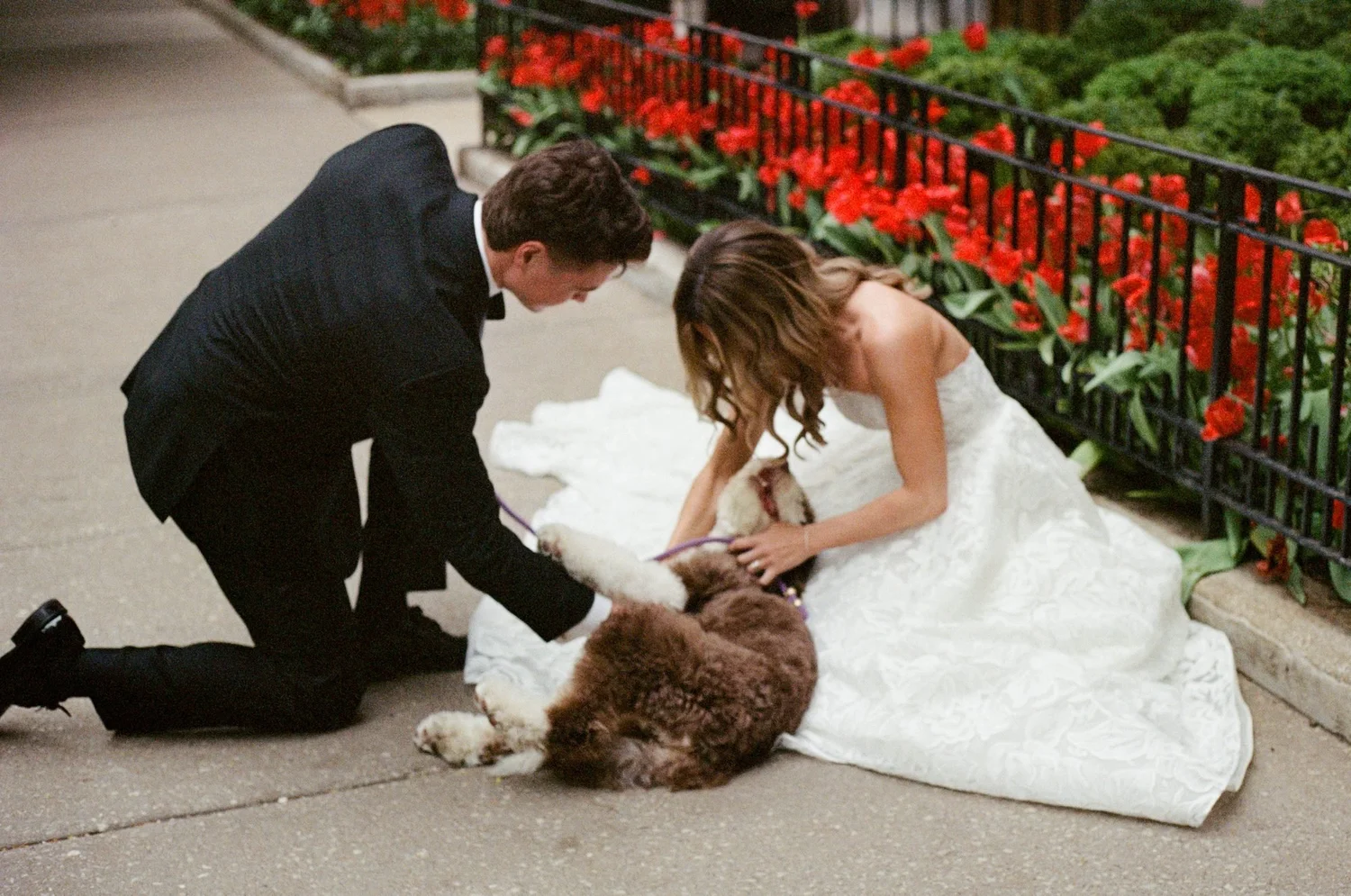
Nikki and Alec brought Macaroni, their Australian Mountain Doodle, home to Chicago in December 2025. That spring, at about six months old, she was with them on their wedding day: on a tulip-lined sidewalk, on a purple leash, greeting the groom and rolling over at the bride's feet.
Macaroni is truly the best pup and we feel so lucky to have had her with us on our wedding day. Nikki & Alec · Chicago, Illinois
Photos like theirs are why so many couples want their dog in the wedding. What the photos do not show is the planning that keeps a dog relaxed in a gown-and-tuxedo crowd. As breeders who also train, we see both sides: the families who plan for it, and the families who learn on the day. This guide is the plan.
Choose your dog's role
Pick one role and do it well. Each one asks something different of your dog.
| Role | What it asks of your dog | Time on site |
|---|---|---|
| Portraits only | Greeting calmly, holding a sit or down for the camera | About 20 to 45 minutes |
| Walking down the aisle | Loose-leash walking past seated guests, then settling | Ceremony length plus arrival |
| Ring bearer | Same as the aisle, plus focus at the front | Ceremony length plus arrival |
| Ceremony guest | Settling on a mat through music, applause, and quiet | 30 to 60 minutes |
| Reception | Food, noise, dancing, and late hours | Several hours; rarely a good fit |
Times are general planning ranges, not rules. Your dog's age and experience matter more than the schedule.
A note on ring bearers
We recommend the real rings stay with a person. Let your dog carry a sign, a flower, or an empty ring pouch, and have the best man or the handler hold the rings. A dog who stops to sniff the front row is charming. A ring lost in the grass is not.
If your dog will not attend
Some dogs are happier at home, and that is a fine answer. You can still include them with an engagement session together, their portrait on a welcome sign or in the program, a signature drink named after them, or a quick visit with the photographer before you leave for the venue.
Is your dog ready? An honest checklist
Before you plan around your dog, test them in a public place that looks like your venue. If you can check most of these, your dog is likely ready for a ceremony role. If not, plan for portraits and keep practicing.
- Settles on a mat for 10 minutes or more in a busy place
- Greets strangers with all four feet on the floor
- Walks on a loose leash past people, food, and other dogs
- Accepts being touched and held by people they have just met
- Recovers within a few seconds from a sudden noise such as clapping
- Rides in the car and waits calmly in a new place
- Responds to the handler, not only to you
A six-to-eight-week preparation plan
Weeks 8 to 6: Foundations
- Teach a settle on a mat. The mat becomes your dog's spot at the ceremony and in the car. Build it at home first.
- Polish greetings. Reward four-on-the-floor every time. Lace and dark wool show every paw print.
- Introduce the gear. If your dog will wear a bow tie, flower collar, or bandana, start now, a few minutes at a time.
Weeks 6 to 3: Take it in public
- Practice the mat and greetings at outdoor cafes, parks, and storefronts. Increase the distraction slowly.
- Add the sounds of a wedding: applause, music through a speaker, a camera shutter.
- Have friends in long dresses and suits practice greetings, kneeling, and holding your dog's paw for a photo.
- Hand the leash to your handler for part of every session.
Weeks 3 to 1: Rehearse
- Visit the venue or photo location if you can, and walk the route your dog will take.
- Run a full dress rehearsal with the handler: arrival, the role, and the exit.
- Confirm the venue allows dogs and ask whether they require anything in writing.
The week of the wedding
- Schedule grooming three to five days before, not the morning of, so your dog is clean and calm rather than freshly handled.
- Keep the normal feeding, walking, and sleep routine.
- Give your dog real exercise before arrival, then a quiet rest before their part begins.
Your dog needs a handler, and it should not be you
You will be busy, and your dog will read your nerves. Choose someone your dog already knows and trusts who is not in the wedding party. Their whole job is the dog.
The handler's kit:
- Leash and a spare, the settle mat, and a familiar chew
- Water and a collapsible bowl
- High-value treats in a pouch, plus waste bags
- A lint roller and wipes for the couple's clothes
- Your veterinarian's number and the nearest emergency clinic
- A crate or a ride home, with a set time to leave
Agree on an exit signal ahead of time. If your dog is panting hard, yawning repeatedly, pulling away, or will not take treats, the handler takes them out without asking. A dog who leaves early is a success, not a failure.
Wedding-day safety
- Food and drink. Chocolate, grapes and raisins, xylitol in sugar-free sweets, onions and garlic, and alcohol can all be dangerous for dogs (ASPCA). Ask guests not to feed your dog, and keep them away from cocktail hour and the cake table.
- Flowers and decor. Tell your florist a dog will be present, and check your arrangements against the ASPCA's list of plants toxic to dogs. Keep candles, petals, and floral wire out of reach.
- Heat and pavement. Plan shade and water for outdoor ceremonies. Test pavement with the back of your hand; if you cannot hold it there for several seconds, it is too hot for paws.
- ID. Your dog should wear a collar with a current tag all day, even under a flower collar.
Getting the photos
Macaroni's photos were taken on city sidewalks, not at the altar. That is often the simplest plan: a short portrait session before the ceremony, when your dog is fresh and the crowd has not arrived.
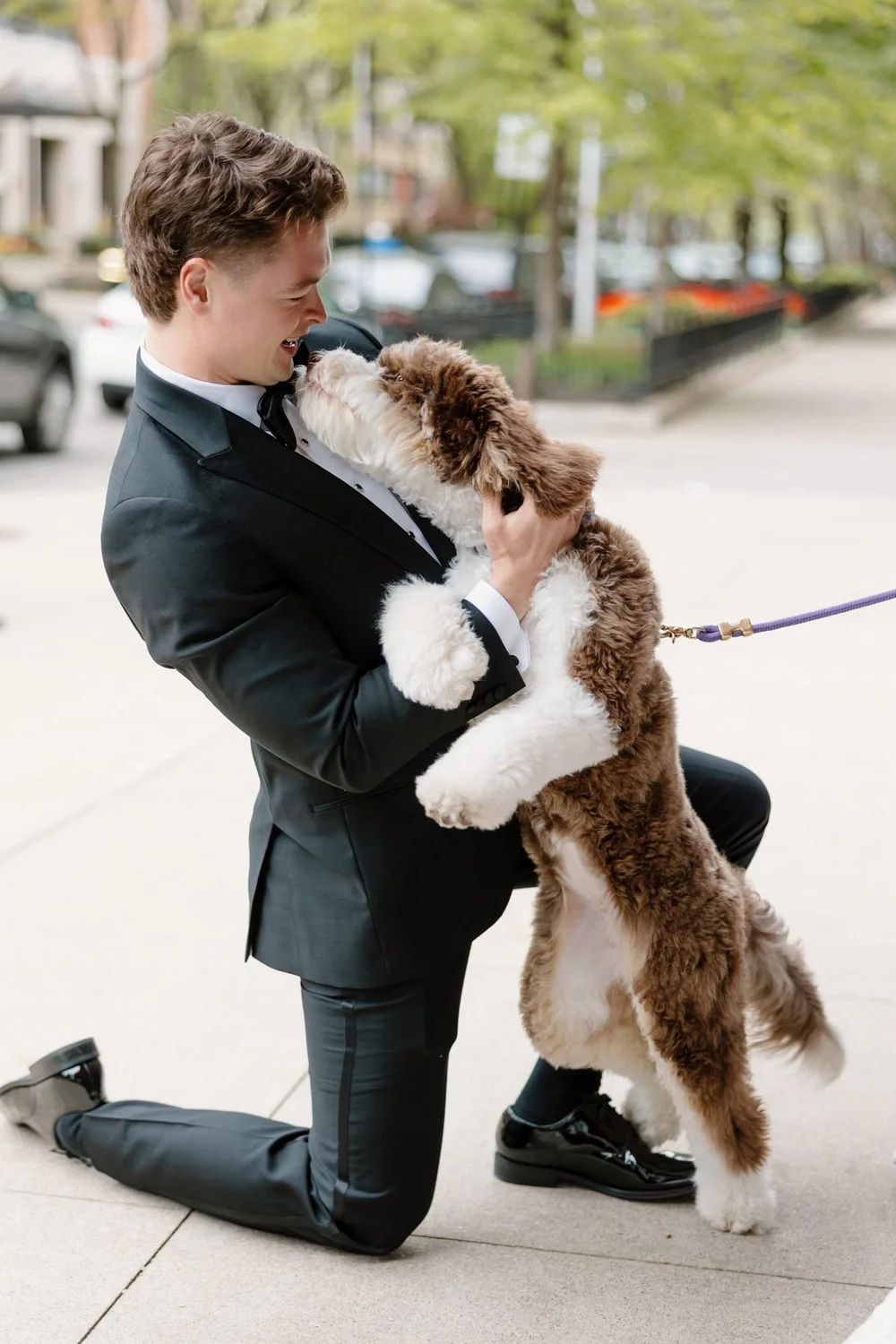
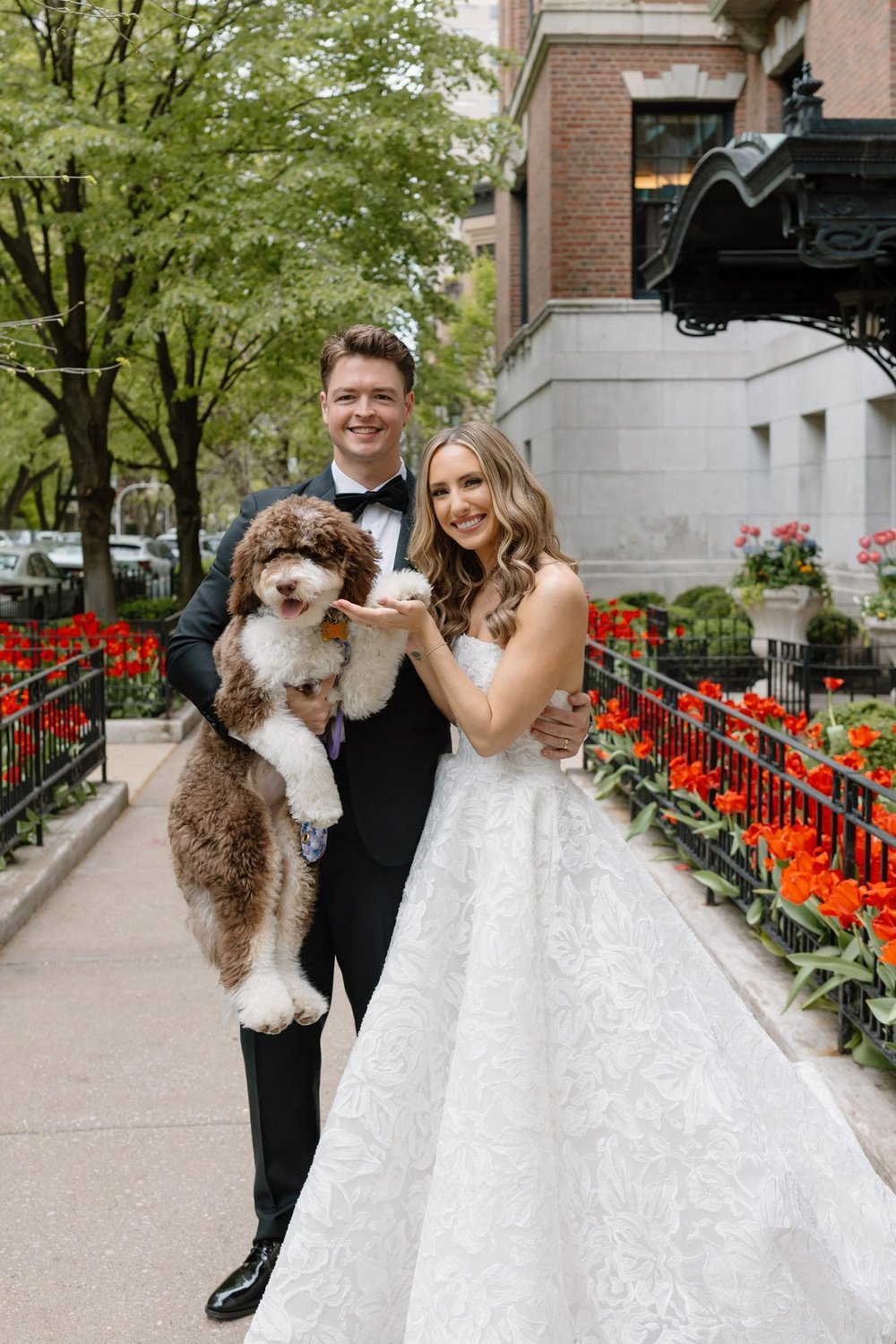
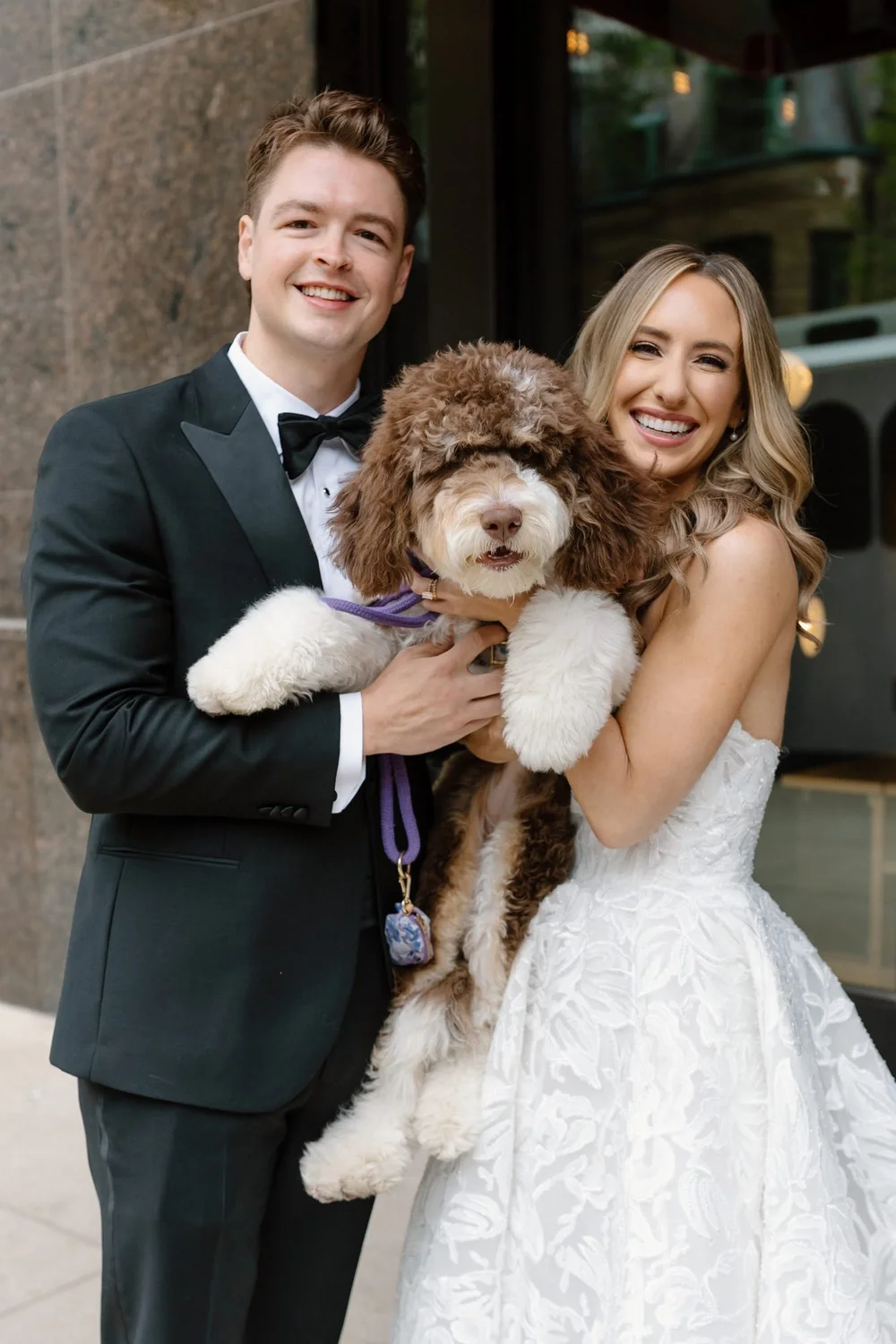
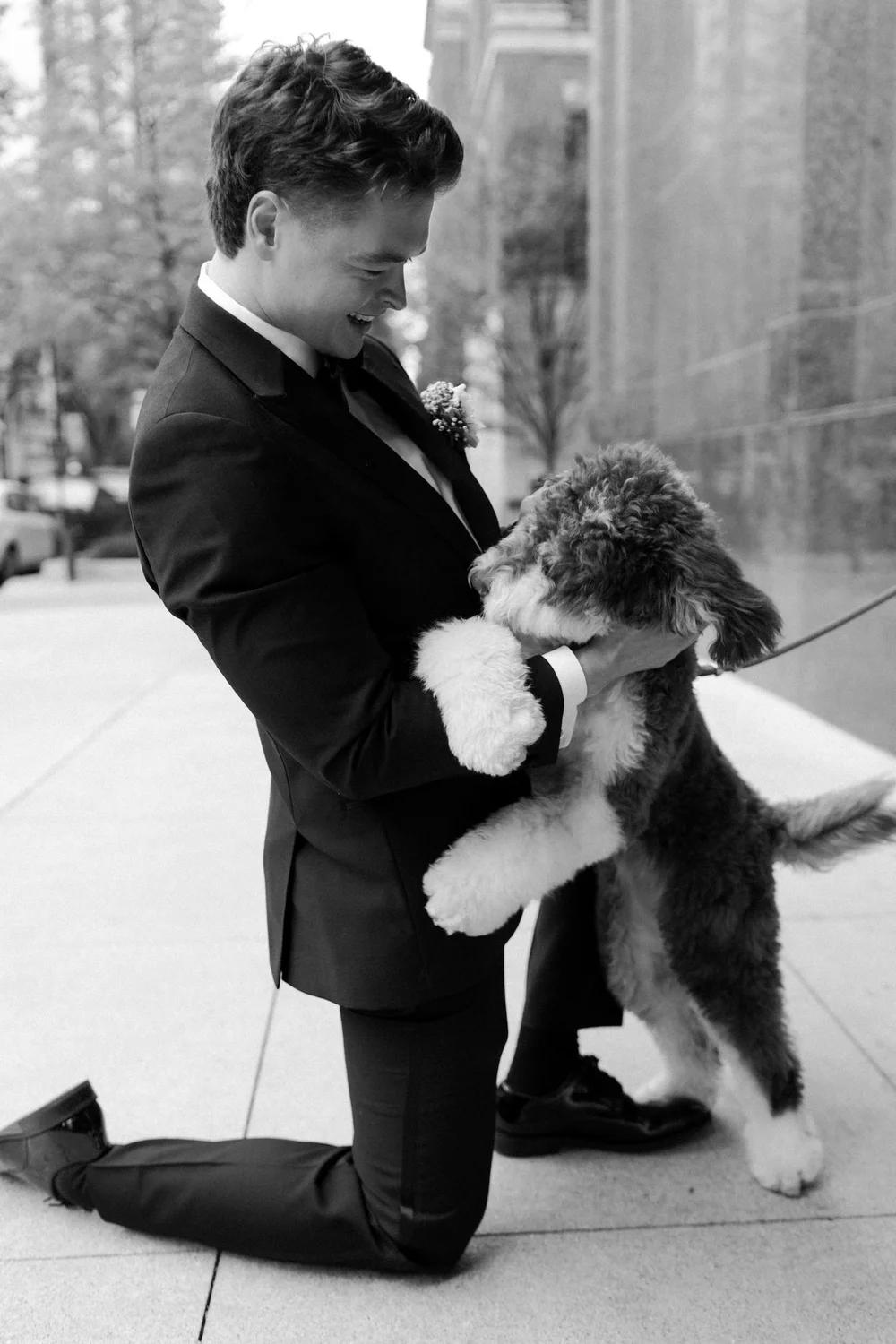
Wedding photography by Cailynn Wolfgang Photography.
- Tell your photographer early so they plan the dog portraits into the timeline.
- Keep the session to 15 or 20 minutes of your dog's attention.
- Have the handler stand just behind the photographer with a treat or a squeaker to get your dog's eyes.
- Do the dog portraits first, then hand the leash off before the formal group photos.
If your dog is still a puppy
Macaroni was about six months old on the wedding day, which is a common age for this question. Puppies at that age tend to have short attention spans and can be going through the stage where new things feel bigger than they did a month before (see the two puppy fear stages and your puppy at 6 months).
For a puppy, we generally recommend portraits only. Keep the visit short, keep the experience positive, and go home before your puppy is tired. A good first big outing builds confidence for every outing after it.
If you are planning a wedding and a puppy in the same year, tell us when you apply. We can talk through timing, and our trainers can work on settle, greetings, and handling before your puppy comes home.
When training help makes sense
Most of this plan you can do yourself. If your wedding is close and your dog still jumps, pulls, or cannot settle in public, a focused stretch of professional training can close the gap. Bootcamp is our a la carte training for exactly that kind of goal, and Doodle School builds these foundations before a Stokeshire puppy goes home.
Stokeshire Training
Bespoke preparation for your dog's big day
Calm greetings, a reliable settle, and a dog who walks with you rather than ahead of you. Tell us your date and your dog's role, and we will plan from there.
Frequently asked questions
Can my dog be the ring bearer?
Yes, if your dog can walk on a loose leash past seated guests and settle at the front. We recommend the real rings stay with a person while your dog carries a sign, a flower, or an empty ring pouch.
How far ahead should I start preparing my dog for our wedding?
Start six to eight weeks ahead. That gives you time to build a settle and calm greetings at home, practice in public places, and run a full rehearsal with your handler.
Should my dog stay for the reception?
Usually not. Receptions bring food, alcohol, loud music, dancing, and late hours. Most dogs do best with a short appearance for photos or the ceremony, then a ride home with their handler.
Can a puppy be in a wedding?
A puppy can join a short portrait session. Macaroni was about six months old on her family's wedding day. For puppies we generally recommend portraits only, a short visit, and going home before the puppy is tired.
What should the dog handler bring?
A leash and a spare, a settle mat, water and a bowl, treats, waste bags, a lint roller, your veterinarian's number, and a crate or a ride home with a set time to leave.
Keep reading
- Macaroni's Chicago wedding feature
- Doodles for Chicago families
- Leash Training 101
- How impulse control shapes doodle puppy behavior
- Board and train vs. developmental training
References
- ASPCA. (n.d.). People foods to avoid feeding your pets. aspca.org
- ASPCA. (n.d.). Toxic and non-toxic plants: dogs. aspca.org
This article reflects Stokeshire Designer Doodles' training experience and is provided for educational purposes. It is not individualized veterinary or behavioral advice. If your dog shows signs of stress or illness, contact your veterinarian. Venue rules on dogs vary; confirm them with your venue.
James Stokes & Katie Stokes
Founders, Stokeshire Designer Doodles
A family-run breeding and development program in Medford, Wisconsin, established 2020. Licensed by the Wisconsin Department of Agriculture, Trade and Consumer Protection (License #514401-DS). James on LinkedIn
Last reviewed October 2026