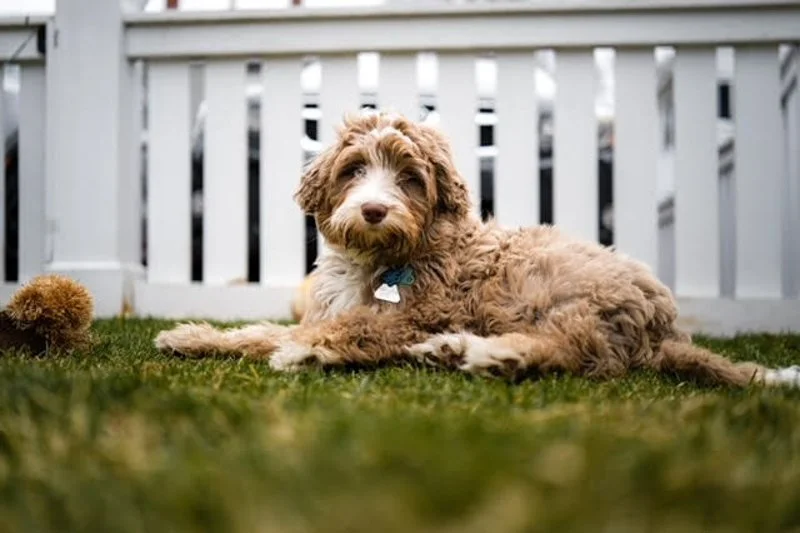
Two Puppy Fear Stages That Shape Your Dog for Life
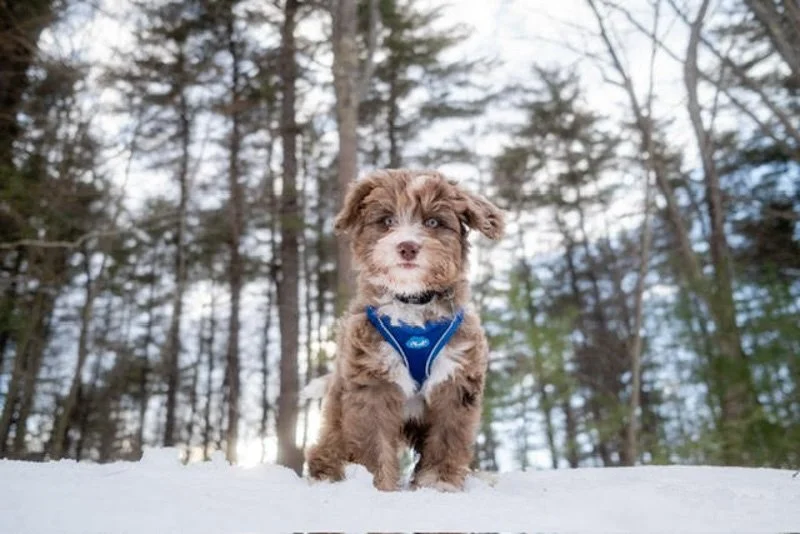
Puppy Fear Stages: What Changes, When, and What To Do
Somewhere between eight and twelve weeks, most puppies become more cautious than they were. Somewhere in adolescence, many become cautious again — and noticeably harder to train.
Both shifts are normal. Neither runs on a schedule precise enough to mark on a calendar, and that distinction matters more than it sounds, because treating a range as a deadline leads people to force exposure while the window is supposedly open.
This article covers what actually changes, what the evidence supports, and what to do — which is mostly the opposite of what instinct suggests.
First, the Honest Framing
You will find a great deal of content specifying that the first fear period runs 8 to 11 weeks and the second 6 to 14 months, stated as fact.
The underlying pattern is real. Puppies do commonly pass through phases of heightened caution, and adolescence does bring measurable change. The precision is where popular guidance overreaches.
Research examining the onset of fear-related avoidance behaviour in puppies found it varies considerably by breed (Morrow et al., 2015). Your Bernedoodle and your neighbour's terrier are not working from the same clock, and neither is your Bernedoodle's littermate.
So the ranges below are typical, not prescriptive. What matters is recognising the behaviour when you see it, whenever you see it — not counting weeks.
At Stokeshire Designer Doodles, this is the same principle behind the Canine Recovery Index™: we watch what a puppy does after something gives it pause, rather than assuming a developmental stage on a date.
The Early Caution Phase: Roughly 8 to 12 Weeks
What it looks like
A puppy who investigated everything last week now hesitates. A bin that was scenery becomes suspicious. A person in a hat is a problem. Something the puppy walked past twice yesterday now produces a wide detour and a hard stare.
The behaviour often appears abruptly, which is what alarms people. Nothing has gone wrong. The puppy's evaluation of novelty is becoming more discriminating, which is developmentally appropriate — an animal that finds nothing worth caution is not well-calibrated.
This phase also collides with going home. A puppy leaves the only environment it has known, meets a new family, a new floor plan, new sounds, and a car journey, all in one day. Some of what families read as a fear period is the entirely reasonable response of a young animal to everything changing at once.
What to do
Let the puppy choose. Set the situation up and let it approach on its own. A puppy that steps toward something unfamiliar by choice learns that unfamiliar things can be investigated. A puppy carried toward it learns that unfamiliar things happen to it. The lesson is never the object. It is agency.
Stay boring. Your puppy is reading you. Bright reassurance, high-pitched encouragement, and scooping the puppy up all confirm that something is happening. Calm indifference is more useful than comfort.
Keep an exit available. A puppy that can retreat will usually return. A puppy that is cornered has no way to demonstrate recovery.
Pair, don't push. Food, play, and calm handling alongside the new thing — at whatever distance the puppy is comfortable.
Keep routine steady. Predictable feeding, sleep, and handling give a puppy a stable baseline to work from.
What not to do
Do not force exposure. Overwhelming a puppy at full intensity — flooding — risks producing a dog that has stopped responding rather than one that has genuinely settled. The welfare literature consistently finds animals given control over their exposure fare better than those without it. This is why no Stokeshire puppy is ever placed on equipment, carried through an obstacle, or held against something it is actively avoiding.
Do not punish fear. Correcting a frightened puppy teaches it that showing caution has consequences. It does not teach confidence; it teaches concealment, which removes your only early warning.
Do not over-shelter either. The opposite error is real. Dogs with less socialisation during puppyhood tend to show more fear of strangers, more fear of other dogs, and greater noise sensitivity as adults (Puurunen et al., 2020). Current veterinary guidance places the primary socialisation window in the first three months of life (AVSAB, 2008). Keep going — gently, voluntarily, at low intensity.
Do not stack major changes. If you can avoid scheduling the move, the boarding, and the first grooming appointment in the same fortnight, avoid it.
The Adolescent Phase: Roughly 6 to 14 Months
This one has better evidence behind it, and it is the phase that catches families off guard.
What it looks like
The dog that had a reliable recall at six months now considers your request and declines. Training that felt finished comes apart. Caution returns, sometimes about things the dog was previously fine with. Reactivity may increase — barking at dogs across the street, wariness of visitors.
Owners commonly read this as failure, either theirs or the dog's. It is neither.
What the evidence shows
A study of dogs in the adolescent phase documented a temporary reduction in trainability around eight months of age, alongside increased conflict behaviour toward the caregiver specifically — not toward strangers (Asher et al., 2020). The effect was transient.
That last detail is worth sitting with: the dog is most difficult with you, and it passes. This is one of the better-supported findings in the developmental literature, and it maps closely to what families actually report.
Timing varies with size and maturation rate. Smaller dogs generally move through it earlier than larger ones.
What to do
Recognise it as a phase, and hold the line calmly. Consistency matters more here than in any other period, and so does not escalating.
Lower the difficulty rather than raising the pressure. Shorten sessions. Go back to easier environments. Rebuild rather than push through.
Manage the environment. Reduce exposure to triggers you cannot yet handle well. This is not avoidance; it is not rehearsing failure.
Increase constructive outlets. Physical exercise and problem-solving work both help. An under-exercised adolescent doodle is a different animal from an adequately exercised one.
Adjust your expectations, not your standards. Expect less reliability. Do not abandon the rules.
Get help early if reactivity is escalating. Adolescent reactivity that is rehearsed for months is harder to resolve than adolescent reactivity addressed in weeks.
What not to do
Do not conclude the training failed. Loss of reliability during adolescence is expected. Starting over with a harsher method is the common mistake, and it damages the relationship the rest of the dog's training depends on.
Do not escalate corrections. A more sensitive nervous system responds to increased pressure by becoming more, not less, reactive.
Do not force social interactions. An adolescent dog that is wary of another dog should not be walked into that dog's face to "get over it."
Do not stop socialising. Reduce intensity. Do not withdraw.
Where Breeding and Early Development Fit
Fear responses are not created by the environment alone. Heritability estimates for canine behavioural traits generally fall in the low to moderate range, below 0.4 for most traits (Hradecká et al., 2015) — meaning genetics set a range, and early experience shapes where within that range a dog lands.
That is the reasoning behind the Developmental Confidence Circuit™. Beginning at roughly three and a half to four weeks, our litters move through a rotating environment of unstable surfaces, novel textures, controlled sound, unfamiliar objects, and new people — always voluntary, always at reduced intensity, always paired with something positive.
The objective is not a puppy that notices nothing. A puppy that fails to register a change in its environment has not demonstrated confidence; it has demonstrated inattention. The objective is a puppy that notices, evaluates, and returns to a settled state — because recovery is the thing that can actually be observed, encouraged, and recorded.
Puppies arrive at their new homes having met a great deal of novelty on their own terms. That is a foundation for the phases described above. It is not a substitute for working through them.
What we observe across those weeks informs Match Day — including which households suit a more sound-sensitive or more cautious puppy, since those are placement questions rather than deficiencies.
What This Article Cannot Promise
Every dog moves through development differently. The ranges here are typical, not universal, and the onset of fear-related behaviour varies by breed and by individual.
We do not guarantee temperament or disposition, trainability, or that any dog will pass through these phases without difficulty. Structured early development and consistent, positive handling improve the odds. They do not remove the variables.
If your dog's fear or reactivity is severe, escalating, or involves aggression, work with a qualified professional — and speak with your veterinarian, since pain and medical conditions can present as behavioural change. Our 4-Week Doodle School covers foundational work, and our training team can advise on whether a referral is the right next step.
The Short Version
Caution is not a defect. It is a young animal gathering information.
What matters is not whether your puppy hesitates, but whether it comes back — and what you do in the interval. Stay calm, keep the exit open, let the puppy choose, and do not mistake a phase for a permanent state.
Most of them come back. That is the whole point of raising them this way.
Research Notes
American Veterinary Society of Animal Behavior. (2008). AVSAB position statement on puppy socialization.
Asher, L., England, G. C. W., Sommerville, R., & Harvey, N. D. (2020). Teenage dogs? Evidence for adolescent-phase conflict behaviour and an association between attachment to humans and pubertal timing in the domestic dog. Biology Letters, 16(5), 20200097.
Hradecká, L., Bartoš, L., Svobodová, I., & Sales, J. (2015). Heritability of behavioural traits in domestic dogs: A meta-analysis. Applied Animal Behaviour Science, 170, 1–13.
Morrow, M., Ottobre, J., Ottobre, A., Neville, P., St-Pierre, N., Dreschel, N., & Pate, J. L. (2015). Breed-dependent differences in the onset of fear-related avoidance behavior in puppies. Journal of Veterinary Behavior, 10(4), 286–294.
Puurunen, J., Hakanen, E., Salonen, M. K., Mikkola, S., Sulkama, S., Araujo, C., & Lohi, H. (2020). Inadequate socialisation, inactivity, and urban living environment are associated with social fearfulness in pet dogs. Scientific Reports, 10, 3527.
Stokeshire Designer Doodles is a family-run breeding and development program in Medford, Wisconsin, licensed by the Wisconsin Department of Agriculture, Trade and Consumer Protection, license 514401-DS.
The Canine Recovery Index™, Developmental Confidence Circuit™, and Stokeshire Method™ are proprietary components of Stokeshire Designer Doodles' puppy-development and matching program.