
How Impulse Control Shapes Doodle Puppy Behavior
Impulse control is the skill that separates a puppy who greets guests with calm confidence from one who launches off the floor, grabs a sleeve, and can't settle for twenty minutes. It's not obedience in the traditional sense. It's a puppy's developing ability to pause between feeling something and acting on it — and it shapes nearly every interaction your Doodle will have for the rest of their life.
At Stokeshire, impulse control is one of ten behavioral domains we track across every puppy's development. Alongside socialization, recall, crate training, leash work, desensitization, and confidence building, it forms a core pillar of the Stokeshire Method — our structured approach to raising dogs who regulate themselves from the inside out, not because someone is standing over them.
This guide covers what impulse control actually looks like in Doodle puppies, why arousal plays such a central role, what families can do at home to support it, and when a pattern crosses from normal puppy behavior into something that needs professional attention.
What Impulse Control Looks Like in Doodle Puppies
Young puppies experience the world at full intensity. Every sound, smell, person, and movement registers with urgency. That's normal — their brains are still building the neural pathways that allow them to slow down, evaluate, and choose a measured response instead of reacting on instinct.
In practical terms, impulse control shows up as a puppy's ability to:
Greet people without jumping or mouthing
Transition from play to calm without extended wind-down
Wait briefly before meals, doorways, or leash clips
Engage in play without escalating to grabbing, nipping, or roughness
Settle in a busy room without constant redirection
These aren't tricks. They're signs that a puppy's emotional regulation is developing on track. When they're absent — or when they appear one day and vanish the next — it usually means the puppy is bumping up against their arousal threshold.
The Role of Arousal in Puppy Behavior
Arousal is the piece most families don't see clearly until it becomes a problem.
A puppy's arousal level is their overall state of physiological and emotional activation. Low arousal looks like a dog resting on a mat or chewing quietly. Moderate arousal looks like an engaged, responsive dog on a walk. High arousal is where things start to unravel — barking, spinning, jumping, mouthing with force, grabbing clothing, or struggling to respond to any cue at all.
The challenge with Doodles specifically is that many of them are built from breeds with high intelligence, strong people-orientation, and working-line drive. Poodle cognition paired with Bernese loyalty or Australian Shepherd intensity creates dogs who bond deeply and feel everything with significant force. That combination is exactly what makes them extraordinary family dogs — and exactly what makes arousal management a non-negotiable part of their development.
Arousal stacks. Excitement, noise, novelty, frustration, fatigue, and fast movement all add to the total. A puppy who handles a calm greeting at the door beautifully may fall apart when that greeting includes three kids running, a doorbell, and a new visitor all at once. That inconsistency isn't random. It means the dog crossed a threshold — and once they're over it, impulse control drops fast.
This is not aggression. It's a dog whose nervous system has outrun their ability to self-regulate. But when rough, arousal-driven responses get rehearsed repeatedly, they become the behavior the dog reaches for first. That's why early intervention matters so much.
Why Doodles Develop Impulse Control at Different Rates
No two puppies hit the same milestones on the same timeline. Several factors shape how quickly self-regulation emerges:
Genetics. Temperament traits like sensitivity, confidence, energy level, and recovery speed are inherited. Some Doodles show early patience. Others approach the world at full throttle for months before the pause button starts working. Both are within normal range — what matters is the trajectory.
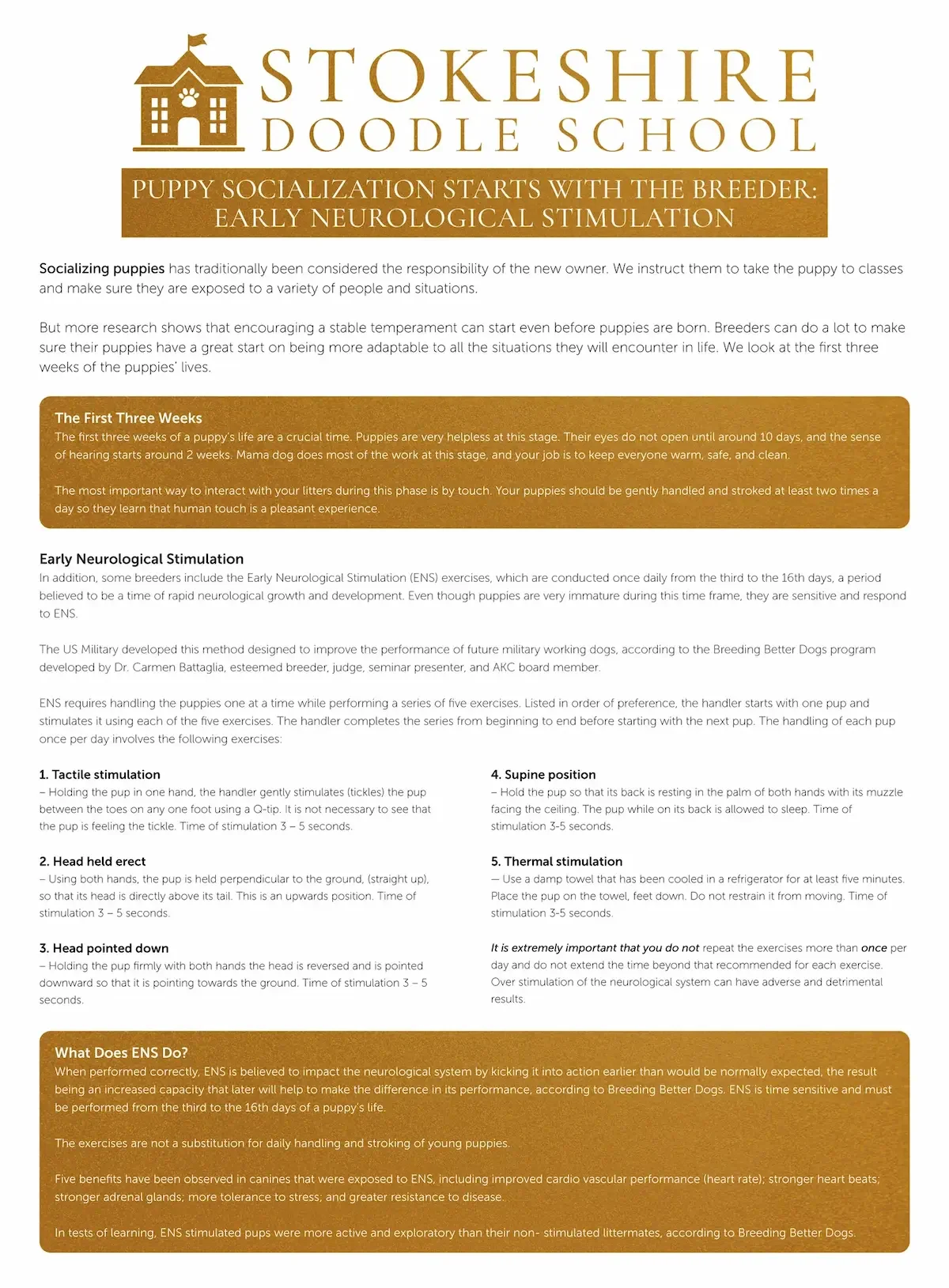
Early neurological work. At Stokeshire, structured development begins before puppies open their eyes. Early Neurological Stimulation (ENS) introduces brief, controlled stress during critical developmental windows — not to overwhelm, but to teach the nervous system a foundational lesson: stress can be experienced and resolved safely. Puppies who learn this early develop stronger stress recovery and better emotional regulation as they mature.
Touch and handling. Steady, intentional human contact from the first days of life helps regulate heart rate, supports bonding, and teaches puppies that connection brings comfort, not chaos. This is why Stokeshire puppies are hand-raised in our home — never kennel-raised, never isolated from family rhythms.
Home environment. Active households with children, other pets, and busy schedules introduce constant stimulation, which can temporarily slow the visible emergence of calm behaviors. Quieter homes offer fewer distractions but also fewer chances to practice regulation under pressure. Both environments support healthy development when expectations are realistic and guidance is consistent.
Everyday Behaviors Connected to Impulse Control
Many behaviors that frustrate new Doodle families are directly tied to developing self-regulation. Seeing them as developmental signposts rather than defiance changes the entire approach:
Jumping during greetings reflects excitement and desire for connection. The puppy isn't being rude — they haven't yet learned to channel that energy into a calmer response.
Mouthing and nipping are natural exploratory behaviors, especially during high arousal or when a puppy is overtired. Puppies investigate the world with their mouths. The issue isn't the behavior itself — it's the intensity and frequency.
Grabbing clothing or toys with force happens when enthusiasm outpaces restraint. A puppy who grabs a sleeve during an exciting greeting is demonstrating an arousal spike, not a training failure.
Vocal excitement during transitions — barking before walks, whining at mealtimes, vocalizing when visitors arrive — signals anticipation that the puppy hasn't yet learned to manage internally.
With time, structure, and reward-based guidance, these behaviors soften. Families typically notice calmer greetings, more cooperative play, and smoother transitions between activity and rest as impulse control matures.
Habits That Support Calmer Behavior at Home
Dogs who struggle with arousal and impulse control do better when daily life feels steady and predictable. The interventions that matter most aren't dramatic training sessions — they're quiet, consistent habits repeated every day.
Predictable routines. Regular meals, consistent walk times, and built-in rest periods lower a dog's baseline arousal. A puppy who is already running hot from an unpredictable schedule is far more likely to make poor choices when excitement spikes.
Structured play. Fast, chaotic games can push some dogs over the edge, especially if they already tend toward grabbing, mouthing, or escalating. Shorter play sessions with deliberate pauses built in help keep arousal from spiraling. End play while the dog is still making good choices — not after they've already crossed the line.
Proactive management during busy moments. Guests arriving, children moving fast, the energy surge before a walk — these are predictable triggers. Redirect to a toy before mouthing starts. Clip on a leash during high-energy transitions. Send the dog to a familiar settle spot before the room gets loud. These steps may seem small, but repeated daily, they shape the dog's default response to excitement.
Reward-based training. For dogs who already struggle when overstimulated, adding pressure, corrections, or fear to the equation makes things worse, not better. Calm timing, clean repetition, and realistic expectations change the entire dynamic. The Stokeshire Companion App provides structured guidance for families working through these foundations at home.
Adequate rest. Overtired puppies make poor decisions, just like overtired children. A puppy who seems "wired" late in the evening often needs enforced downtime, not more exercise. Crate training, when introduced thoughtfully, gives puppies a reliable place to decompress.
When Behavior Starts to Feel More Serious
Some puppies get mouthy when they're excited and recover quickly. The moment passes, the puppy settles, and life moves on. That's normal development.
Other puppies develop a pattern that's harder to dismiss:
Bites get firmer over time
Grabbing at hands, sleeves, or legs happens more frequently
Recovery after an arousal spike takes longer
The same scenarios keep playing out even when the family intervenes consistently
That's usually the point where it stops being something a puppy will "grow out of." Rough behavior during stress or excitement can become a genuine safety concern — and it changes the mood in a home. People get tense, dogs pick up on that tension, and the cycle feeds itself.
For families in the Midwest and beyond, a serious bite incident can carry consequences that extend well past the moment itself — from medical bills to liability questions. Resources like Chicago dog bite lawyers exist for situations that have already escalated, but the better path is always prevention through early, structured intervention.
This is where professional support makes a real difference. A qualified trainer or veterinary behaviorist can assess the full picture, identify the patterns driving the behavior, and help put safer routines in place before things escalate. At Stokeshire, families who need behavior modification support work with Karlee, our therapy-informed training partner, who specializes in arousal regulation and nervous system-based approaches.
If your dog's behavior is creating tension or safety concerns in your home, don't wait for it to resolve on its own. Early intervention is always easier than late-stage correction.
Developmental Phases Are Normal — Plan for Them
Impulse control does not develop in a straight line. Puppies move through growth spurts, fear periods, adolescent regression, and energy shifts that can temporarily affect behavior. A puppy who felt settled and responsive last week may seem more reactive, mouthy, or distractible this week.
These fluctuations are part of normal neurological development. They are not setbacks — they're the brain reorganizing. Balanced exposure, adequate rest, and emotional safety help puppies move through each phase successfully.
Families who measure progress over weeks and months rather than individual days tend to see the most consistent long-term outcomes.
A Foundation Built Before Day One
At Stokeshire, impulse control development doesn't start when a puppy goes home. It starts during the first critical days of life through ENS protocols, intentional handling, environmental enrichment, and the steady rhythms of a working family home. By the time a puppy reaches Match Day, they've already had weeks of structured exposure designed to strengthen the very neural pathways that support self-regulation.
That foundation is designed to be continued at home. Through our Doodle School program, the Stokeshire Companion App, and ongoing access to training resources, we equip families to reinforce what we've started — building a dog who doesn't just behave well under supervision, but who can regulate themselves from the inside out.
The goal has never been a dog who performs on command. The goal is a dog who recovers quickly from excitement, handles novel situations with composure, and makes safer, calmer choices because their nervous system was developed with intention from the very beginning.
Ready to meet the kind of dog this process produces?
Frequently Asked Questions
What is impulse control in Doodle puppies?
Impulse control is a puppy's developing ability to pause between a stimulus and their response. Rather than reacting immediately to excitement, noise, or novelty, a puppy with emerging impulse control can slow down, assess, and choose a measured behavior. In Doodle breeds, where intelligence and people-orientation run high, this skill is especially important for creating a calm, well-adjusted family companion. Impulse control is one of ten behavioral domains tracked at Stokeshire as part of our structured development program.
What does arousal have to do with my puppy's behavior?
Arousal is the overall level of physiological and emotional activation a dog is experiencing at any given moment. When arousal is moderate, a puppy can learn, respond to cues, and make good choices. When arousal spikes — from excitement, noise, fast movement, or stacking triggers — impulse control drops rapidly. Understanding arousal thresholds helps families recognize when their puppy is approaching the point where self-regulation breaks down, and intervene before behavior escalates.
Why does my Doodle puppy seem calm one moment and out of control the next?
Arousal stacks. A puppy who handles a calm greeting well may lose composure when that same greeting includes running children, a doorbell, and an unfamiliar guest all at once. The inconsistency isn't random — it reflects the puppy crossing their arousal threshold. Predictable routines, structured play with built-in pauses, and proactive management during high-energy moments help keep arousal from reaching the tipping point.
When should I be concerned about my puppy's mouthing or nipping?
Mouthing during play and excitement is normal puppy behavior. It becomes a concern when bites grow firmer over time, the puppy targets hands, sleeves, or legs with increasing frequency, recovery after an arousal spike takes longer, or the same patterns repeat despite consistent intervention. If rough behavior during excitement is creating tension or safety concerns in your home, consulting a qualified trainer or veterinary behaviorist is the appropriate next step.
How does Stokeshire prepare puppies for impulse control development?
Stokeshire's structured development begins in the first days of life through Early Neurological Stimulation, intentional handling, environmental enrichment, and daily family rhythms. These early protocols are designed to strengthen the neural pathways that support stress recovery, emotional regulation, and self-control. By the time a puppy reaches Match Day, they have a neurological foundation built for calmer, more adaptive responses to the world around them. Families then continue this work at home using our Doodle School program and the Stokeshire Companion App.
Does my home environment affect how fast impulse control develops?
Yes. Active households with children, multiple pets, and busy schedules introduce constant stimulation, which can temporarily slow the visible emergence of calm behaviors. Quieter homes may show faster surface-level settling but provide fewer opportunities to practice regulation under real pressure. Both environments support healthy development when expectations are realistic, routines are predictable, and guidance is consistent. Adequate rest and enforced downtime are important regardless of household activity level.

James Stokes is a reputable dog breeder of Doodles, a popular hybrid dog breed, and a responsible steward of the canine community. For over ten years, James has dedicated himself to raising healthy Doodle puppies that families can cherish, prioritizing their welfare. He works alongside his wife and children every day, ensuring each puppy from their litters receives loving care. Together, they have found wonderful homes for their Doodles across the U.S., Canada, and Mexico.
Health-tested puppies raised from proven, well-established lines and supported by a three-year genetic health guarantee, with breed-appropriate genetic testing conducted in line with current veterinarian and genetic best practices.
Hand-raised in a family home, never kept in kennels or a whelping box for too long, ensuring optimal welfare and a healthy birth environment.
Socialized early with ENS, sounds, and plenty of family time. This helps develop positive behavior and a balanced temperament and energy levels, ensuring they feel safe and relaxed, and are ready for their first vaccine and initial dog training.
Lovingly matched to each family. Every Doodle puppy from our litters is chosen based on specific criteria to fit well with their family’s way of life and needs, ensuring a perfect pet.
Part of an ethical, small-scale breeding program, driven by heart, focusing on the overall health and nutrition of each animal, including what dogs eat for optimal development.
At Stokeshire, doodles are never “just pets,” but cherished family members. They are thoughtfully raised companions—designed to become steady, intuitive members of the family for life. Every decision we make is guided by the Stokeshire Method: pairing genetics, temperament, and early-life environment to raise dogs with excellent behavior who integrate naturally into real family rhythms, upholding the dog breed standard of our program.
Our doodle puppies are known for their balanced energy, emotional intelligence, and predictable temperaments, embodying the best of their dog breed characteristics. They thrive in a wide range of households—from active families to therapy-focused homes—and are often an excellent option for those seeking allergy-friendly companions. Like our Goldendoodles and Bernedoodles, which are popular hybrid dog breeds, each puppy is raised with the intention of becoming deeply bonded, well-mannered, and trusted at every stage of life.
Stokeshire is proudly based in Medford, Wisconsin, but our families span far beyond the Midwest. Through our concierge-style transport and placement process, part of our comprehensive program, we safely deliver puppies across the United States and into Mexico—ensuring a calm, carefully managed transition from our home to yours. From day one, your puppy’s journey is handled with the same care and intention with which they were raised.
Related Reading: Ready to build lasting impulse control in your doodle? Learn more about our 4-Week Doodle School — a comprehensive foundational training program designed for the modern family dog.