
What Does Merle mean in dogs?
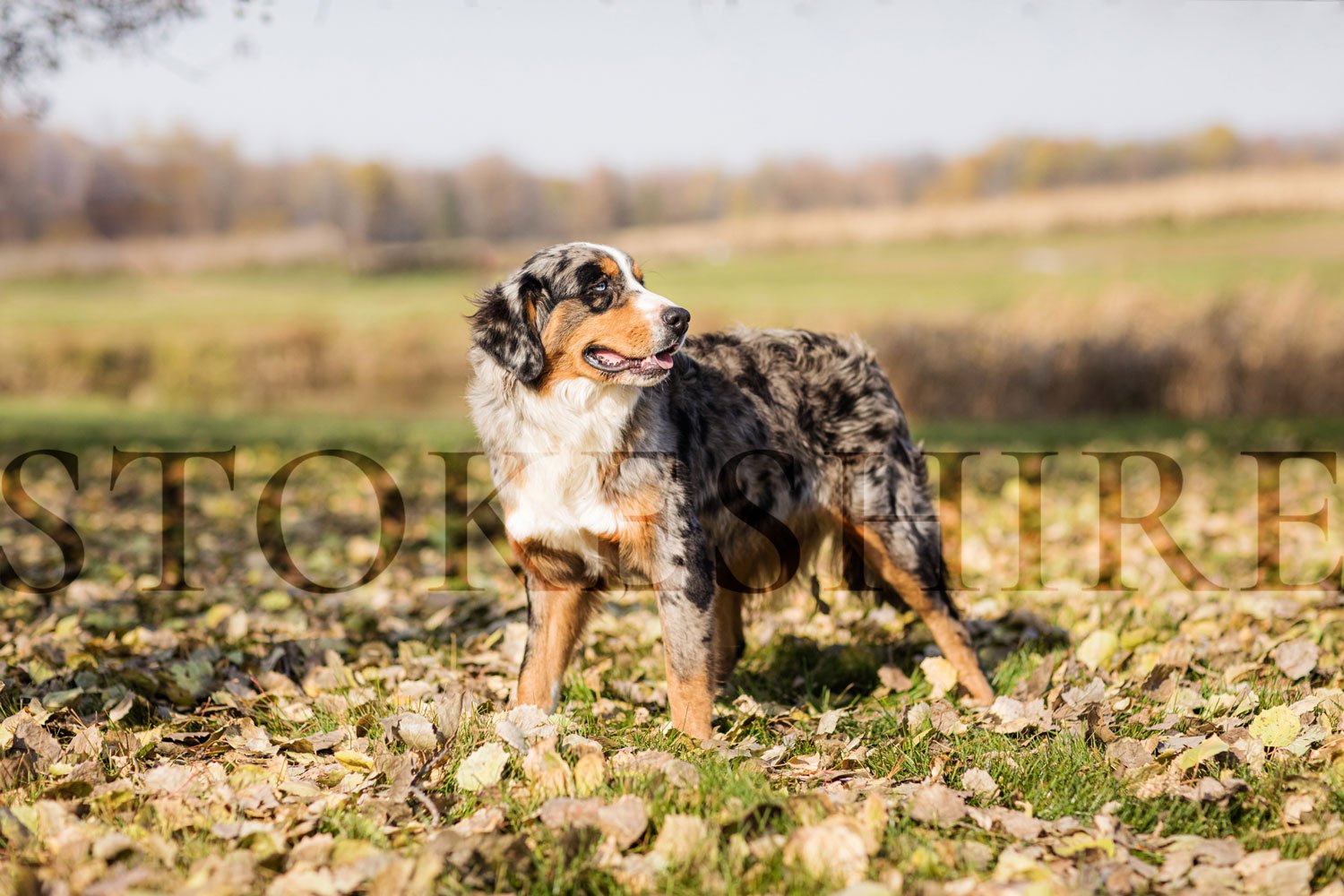
In the realm of Stokeshire Designer Doodles, the captivating allure of blue merle and red merle coat patterns from a blend of Poodles and Australian Shepherds has ignited a profound fascination among dog aficionados and breeders. These distinct coat variations, characterized by a mesmerizing blend of blue or red with gray and white hues, have become emblematic of the breed's genetic diversity and beauty.
The Blue and Red Merle Doodles: A Display of Genetic Splendor
Blue merle and red merle doodles, both stunning in their unique ways, exhibit intelligence, trainability, and an affable nature. Contrary to conventional color perceptions, the "blue" and "red" in their names aren't straightforward representations but rather hues enhanced by the merle gene. This genetic influence intensifies the base coat colors, creating the captivating blue or red appearance admired in these endearing companions.
Decoding the Complexity of Coat Color Genetics
The inheritance of coat color in dogs, especially the manifestation of the merle gene, is an intricate puzzle. Unlike simple dominant or recessive traits, coat color inheritance involves numerous genes and their nuanced interactions. In blue merle and red merle coats, particular loci like the "e" locus play significant roles, among other genes that contribute to the spectrum of colors observed in these dogs.
The manifestation of blue and red merle patterns extends beyond specific breeds, encompassing a range of dogs like Australian Shepherds, Aussiedoodles, Australian Mountain Doodles, Poodles, and Bernedoodles. However, within these breeds, the expression of the blue or red merle pattern varies extensively, showcasing a rich array of blue or red, gray, and white patches. Each dog becomes a canvas of distinctive hues, making the blue and red merle patterns captivating and diverse traits.
Expertise in Merle Gene Breeding and Responsible Practices
Experts dedicated to Stokeshire Designer Doodles uphold a robust Merle policy, emphasizing responsible breeding practices. They possess a deep understanding of the intricate nature of coat color inheritance, navigating the complexities with utmost care and consideration. Adhering to ethical breeding standards, they strive to conserve the essence of the blue and red merle coats while prioritizing the health and well-being of the dogs.
Beyond Aesthetics: Health and Temperament
While the blue and red merle coats boast stunning aesthetics, it's essential to highlight that these variations are purely cosmetic traits with no bearing on a dog's health or temperament. The focal point remains on nurturing dogs with exceptional qualities—intelligence, amicability, and trainability—while appreciating the captivating aesthetic appeal of their coats.

The merle gene can impact eye color in dogs. In dogs with a merle coat pattern, the gene causes patches of the coat to have a lighter color, often appearing as a blue or yellow-ish color. This same gene can also cause changes in the pigmentation of a dog's iris, leading to differently colored eyes, a condition known as heterochromia. This can result in a dog having one blue eye, one brown eye, or eyes with a mix of both blue and brown. It is important to note that not all dogs with the merle gene will have different colored eyes, and the exact expression of heterochromia can vary between individual dogs.
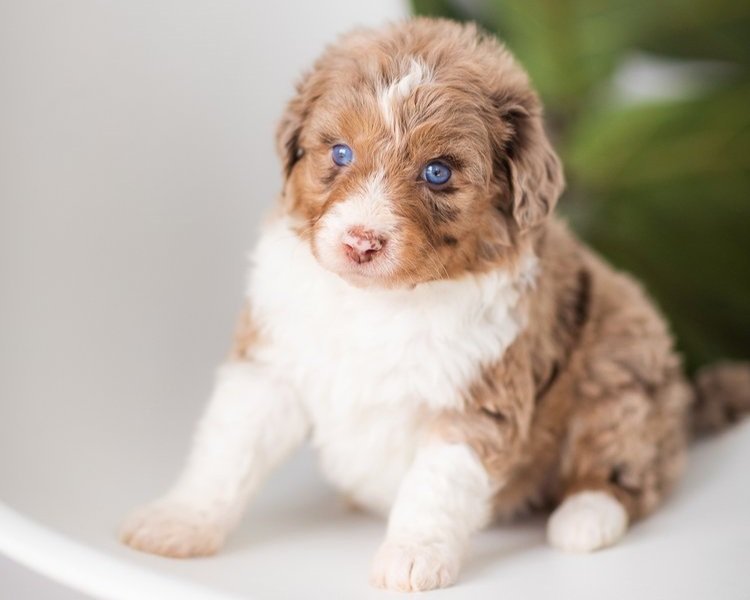
F1 Mini Red Merle Tri Aussiedoodle
It's important to note that designer dogs, like red merle doodles, can vary significantly in appearance and temperament, as they may inherit a mix of characteristics from their parent breeds. It's always a good idea to research both parent breeds when considering any designer dog to get a sense of what traits the puppy may inherit.
Merle coat coloration is characterized by a mottled or patchy appearance, with lighter and darker areas of coloring within the same coat. This coat color is caused by a genetic mutation that affects the production of pigment in the hair. Merle doodles can have a wide range of coat colors and patterns depending on the genetics of the parent dogs.
Like other doodle breeds, merle doodles are often sought after for their intelligence, low-shedding coats, and friendly dispositions. However, it is important to be aware that any crossbred dog can inherit traits from either parent breed, and it is important to carefully research the breed and individual dog before committing to owning one.
Merle arises from a mutation in the pigment gene PMEL (this mutation “M*” going forward). M* disrupts PMEL expression, leading to a mottled or patchy coat color. Dogs with the “M*m” genotype are likely to appear merle or phantom merle, that is, the dog is not obviously merle patterned but has a merle allele; dogs with the “M*M*” genotype are likely to appear merle or double merle. Dogs with the “mm” genotype are unlikely to appear merle. At STOKESHIRE we avoid double merle crosses.
Are Merles rare?
Merle coats in dogs are considered relatively rare compared to solid-colored coats. The rarity of merle coats varies depending on the breed and the specific color variation (such as blue merle or red merle).
For some breeds, such as Australian Shepherds or Collies, merle coats are more common and are even recognized as a standard coat color within the breed. However, in other breeds or mixed breeds where the merle gene isn't as prevalent or desired, merle coats might be less common.
The rarity of merle coats can also be influenced by breeding practices. Ethical breeders often carefully plan matings to avoid certain genetic issues associated with the merle gene, like potential health concerns in double merle (two copies of the merle gene) dogs. This responsible breeding can sometimes make merle coats less common within specific breeding programs.
In essence, while merle coats might not be the most common coat color across all dog breeds, their prevalence can vary significantly based on breed standards, breeding practices, and the genetic makeup of specific breeding lines.
Merle Genetics
Here is a Punnett square for a cross between two dogs, both Bb (heterozygous non-brown):
| B | b--|---|--B | BB| Bbb | Bb| bb25% of these two dogs will have puppies with brown coats. To make a Punnett square for a cross between a dog with the merle gene and a dog without it, you first need to know the parents' genotypes for the merle gene. For simplicity, let's say the merle gene has two types: M for merle and m for non-merle. A dog with genotype MM has a merle coat, while a dog with genotype mm doesn't. A dog with genotype Mm also has a merle coat, since the dominant allele M hides the recessive allele m. This Punnett square shows the result of crossing a dog with genotype Mm (having one M and one m allele) with a dog with genotype mm (having two m alleles).
  | M | m
--|---|--
M | MM| Mm
m | Mm| mm
In this Punnett square, we see that half of the babies would have the Mm genes, showing the merle coat. The other half would have the mm genes without the merle coat. This is just a theory of what the babies could be like, and in reality, the babies might have different genes or looks because the merle gene is complex and interacts with other genes.
Merle Mutation information
The M* mutation is a unique type of transposable element, which is a retrotransposable viral element commonly known as a SINE. It has inserted itself into the PMEL gene, which is responsible for coat pigmentation, and has disrupted its function. This rapid mutation can occur in a single generation or even across a cell division, resulting in phenotypic merle dogs producing puppies with different lengths of merle alleles. Some dogs may even have several merle alleles, making them mosaics. The length of the merle allele ultimately determines the coat pattern of the dog.
If you have been breeding Aussiedoodles, it's possible that you've come across some unexpected and non-standard coat patterns. These could include white body splashes, dilute-looking pups, brownish or off-shading on black offspring, excessive white offspring despite one parent being phenotypically solid, Merle offspring that were not expected, a solid pup when one parent is M/M and all pups should be Merle, or an unusual Tweed Merle pattern unlike that of the Merle parent and other litter mates. The Tweed phenotype is described as a Merle pattern that expresses random shaded-in or solid areas, usually with two or three distinguishable shades. It was once thought to be a modifier of Merle but is now known to be created by several different Merle genotypes.
Mosaicism, also known as somatic mosaicism or somatic mutation, refers to the presence of multiple types of cells with different genotypes in one dog's body. Merle mosaicism occurs when the poly-A tail in one cell is shortened during early embryo development. This mutation is then replicated during cell division. The shortened allele will only be present in some adult cells and in different parts of the body. Out of 308 tested Merle dogs, 56 were found to be mosaics. This means that on average, 18% or 1 out of every 5.5 dogs have 3 or more different alleles on the M locus, showing that mosaic results are not uncommon. Dogs tested as m/Mc or Mc/Mc can safely be bred with those carrying the M allele, as the Mc allele acts the same as non-Merle. A dog with the Mc/M genotype will not have any pigment deleted to white due to this allele combination.
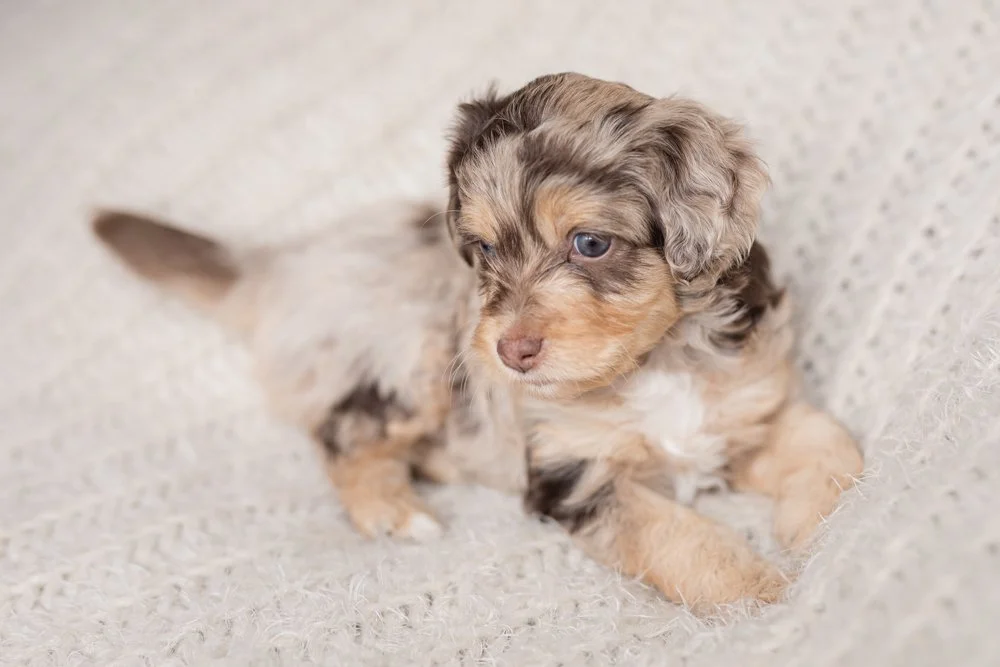
Red Merle Tri Mini Aussiedoodle Puppy with Blue Green Eyes
"Many solid dogs are actually cryptic or phantom merles and can produce both Merle and double merles. A cryptic ghost or phantom Merle is a dog which phenotypically appears to be a non-merle or very faint patches of Merle that can go unnoticed. Animals that do not present the Merle phenotype may possess the Merle genotype and subsequently produce Merle offspring. These dogs are known as cryptic Merles."
In 2006, Dr. Leigh Anne Clark and her team identified a semi-dominant genetic mutation responsible for the merle coat color pattern seen in many dog breeds such as the Australian shepherd, collie, border collie, and dachshund. The merle coat color is characterized by areas of normal, melanistic pigmentation separated by areas of diluted pigmentation. Unlike the many known simple, mendelian phenotypic traits of dogs, merle dogs are the result of a SINE element in the canine PMEL gene that contains a polyadenine (poly[A]) tail of variable length resulting in phenotypic heterogeneity, as reported by two independent groups in 2018 (Murphy et al. and Ballif et al.).
The length of the poly(A) tail varies from dog to dog, resulting in a spectrum of colors and patterns that have been grouped into at least 4 phenotypic merle groups based on the length of the individual’s poly(A) tail. The groups are "cryptic," "atypical," "classic," and "harlequin," with cryptic merle dogs showing no coat color changes or only very small merle patches. Atypical merle dogs can have several different changes to their coat, including reddish undertones, diluted coat color, or other anomalies.
Classic merle dogs have large, irregularly shaped fully pigmented regions separated by areas of diluted coat color. In some cases, classic merle dogs may only display coat color dilution in limited areas of the body. Dogs with the longest poly(A) tail display a pattern referred to as harlequin in which hair between dilute and fully pigmented regions is completely white. In some cases, dogs in this group have a pattern known as “patchwork” or “tweed” in which the coat displays multiple colors of multiple shades, with or without white.
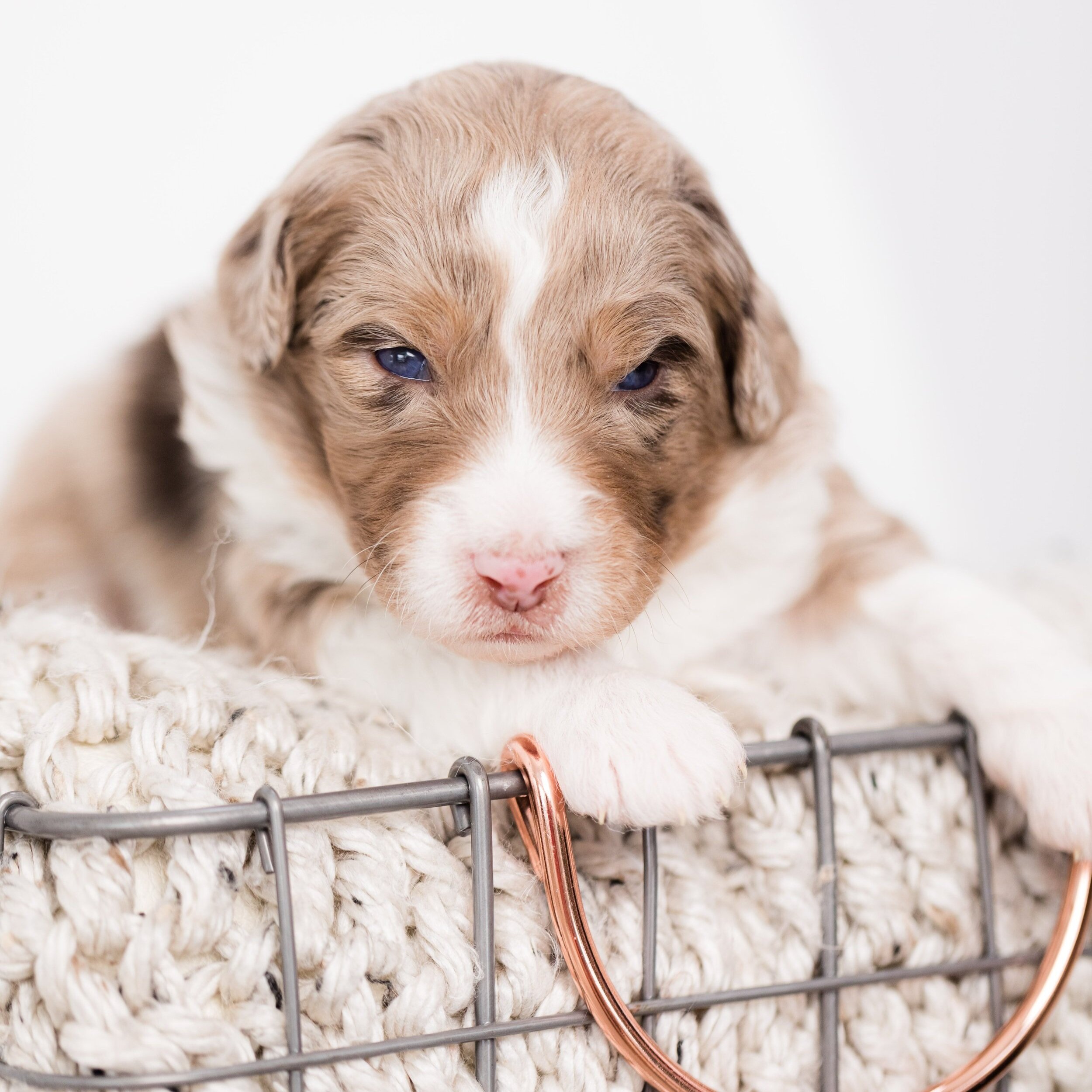
Red Merle Doodle with Blue Eyes
Though these general phenotypic groups associated with poly(A) tail length apply to the majority of merle dogs, multiple examples of exceptions to these groups have been reported, indicating that other factors also contribute to the merle phenotype of an individual.
Somatic vs Germline Mosaicism
Repetitive DNA sequences and poly(A) tracts such as the one on the merle-associated insertion are known to be prone to error during replication due to an inherent inability of the enzyme, DNA polymerase to accurately replicate the template DNA strand. The resulting strand slippage and mispairing of nucleotides can result in either contraction or expansion of the original sequence. While most contractions or expansions tend to change the tail length by only a few bases, in some cases, large contractions or expansions occur.
Errors occurring in somatic cells during cell divisions related to development result in variability in the length of the poly(A) tail from cell to cell of an individual. The genetic changes related to this phenomenon, known as somatic mosaicism, cannot be inherited by the individual’s offspring and are likely responsible for the randomness of the merle pattern. Murphy et al. speculated that variability in poly(A) tail length from cell to cell may underlie the merle phenotype due to the variable impact on pigmentation. Errors occurring in the germ cells of merle dogs during gametogenesis result in ova and sperm with variable poly(A) tail lengths; a phenomenon known as germline mosaicism. Genetic changes occurring in the PMEL gene during gametogenesis in merle dogs are passed on to offspring during reproduction.
Merle Association with Disease
The merle coat pattern in dogs is highly desirable to dog lovers and breeders due to its beauty and unpredictability. However, it also comes with great breeder responsibility because of the way merle is inherited and related health concerns. Dogs inherit one copy of the merle insertion from a single parent to display a traditional merle coat since merle is a semi-dominant trait. But, dogs with two copies of the merle insertion are at risk of being born with an extreme white phenotype with limited areas of pigmentation which is often diluted. These “double merle” dogs are also prone to auditory and ophthalmologic aberrations such as deafness, microphthalmia, and colobomas, as well as a variety of other abnormalities.
Interestingly, homozygous merle dogs that inherit insertions with poly(A) tail lengths in the small, “cryptic” range are less likely to display disease phenotypes, despite technically being “double merle”. Some bloodlines regularly produce homozygous mutants with one copy of the cryptic merle insertion and one copy of the classic merle insertion without producing diseased dogs. However, the rare and unpredictable chance of large expansions in the poly(A) tail in gametes of cryptic merle dogs make recommendations to routinely breed cryptic merle to classic merle dogs difficult to make.
Offspring inheriting an expanded allele from the cryptic merle parent (expanding back to a classic merle size) and a classic merle allele from the merle parent will be at very high risk of the extreme white and disease phenotypes. Therefore, Paw Print Genetics recommends that all dogs expected to be bred to a merle dog undergo genetic testing at the M (merle) Locus for the merle insertion. If the non-merle dog has the insertion (regardless of length), the safest and most predictable approach to avoid producing merle-related disease would be to find a different, non-merle mate that has not inherited the mutation.

Red Merle Tri Poodle Puppy with Blue Eyes
Though it is commonly recognized that dogs homozygous for the merle insertion are at high risk of pathology, in at least one study, heterozygous merle dogs were also reported to be at a significantly increased risk of unilateral or bilateral deafness compared to dogs without the mutation. Another study also found a significant correlation between deafness and the merle phenotype without consideration to genotype. In addition, merle puppies with two blue eyes (a common finding in merle dogs) and merle puppies with an excessive amount of white on the head were also significantly more likely to display deafness. However, since genotypes were not obtained in this study, it is possible that some of the deaf dogs in this study were actually homozygous for the me” appearance.
Merle in dogs is indeed a captivating and complex genetic trait that transcends breed boundaries, indicating an ancient mutation existing prior to the formation of distinct dog breeds. The SILV gene, associated with the merle pattern, plays a pivotal role in producing a matrix that holds pigment in place. However, when this gene carries an insertion of extra genetic material, it creates "holes" in the matrix, allowing pigment granules to escape, resulting in the faded and marbled coat characteristic of the merle pattern.
The variability in the extent of the merle pattern on dogs' coats, such as having it solely on the face versus covering the entire body, stems from the instability of the length of this genetic insertion. During embryonic development, as cells divide and proliferate, the size of the insertion can fluctuate. Some cells may exhibit nearly normal matrix production, leading to patches of fully pigmented coat.
Merle-coated dogs thus represent a mosaic of cellular copies originating from cells with varying degrees of matrix imperfections. The size of each patch of merle pattern depends on the timing of the mutation event during embryogenesis, with larger patches descending from earlier mutations.
This intricate process makes merle a fascinating color pattern, both aesthetically and genetically. Dog breeders and geneticists are intrigued by merle due to its complexity and the intriguing mosaic nature it creates in dogs' coats, contributing to the allure and beauty of this distinctive trait across diverse breeds.
“Unraveling the Mysteries of Merle.” Merle-sine-insertion-from-mc-mh, merle-sine-insertion-from-mc-mh.webnode.page/unraveling-the-mysteries-of-merle.