
Australian Mountain Doodle:
Complete Breed Guide
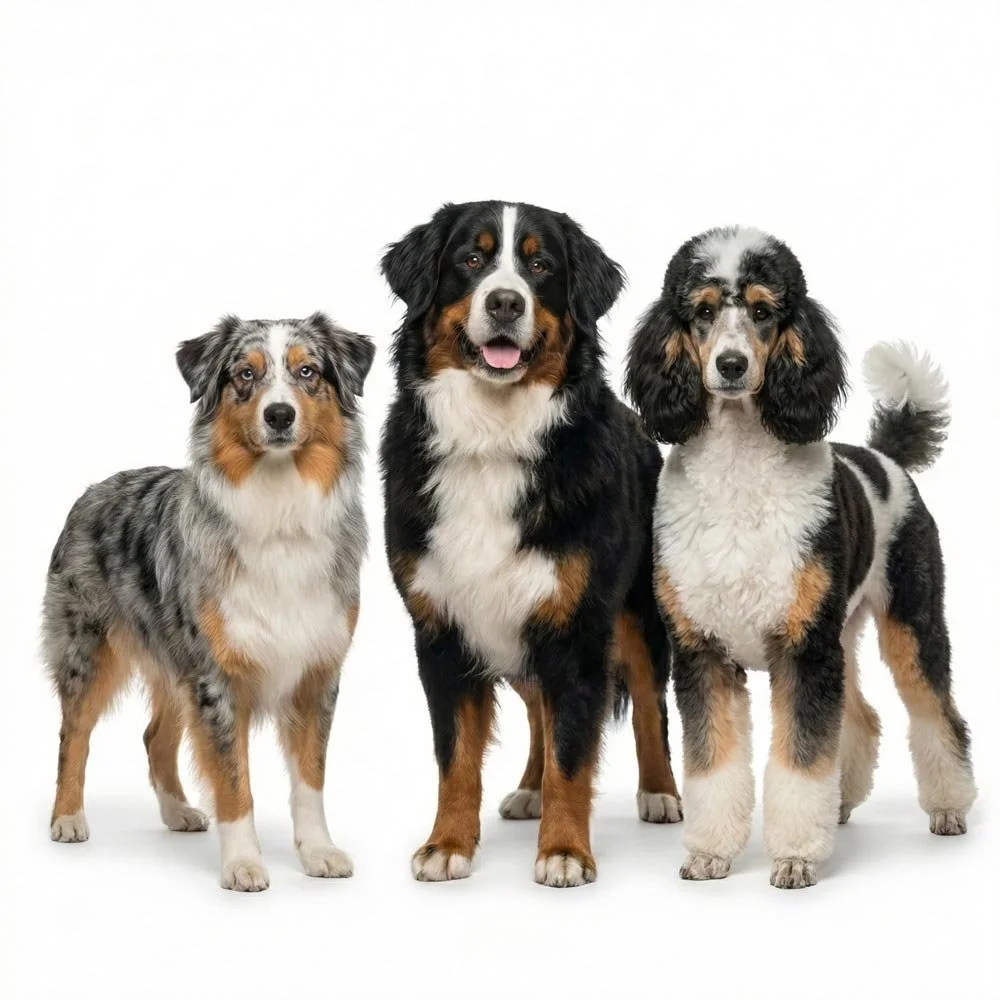
The Australian Mountain Doodle is a triple-cross hybrid dog created by combining the Bernese Mountain Dog, Australian Shepherd, and Poodle — designed to bring together the calm temperament of the Bernese, the working intelligence of the Australian Shepherd, and the low-shedding coat genetics of the Poodle.
Also known as: Swiss Doodle · Aussie Mountain Doodle · Aussiebernedoodle · Australian Bernedoodle
View Planned Litters Learn About the Breed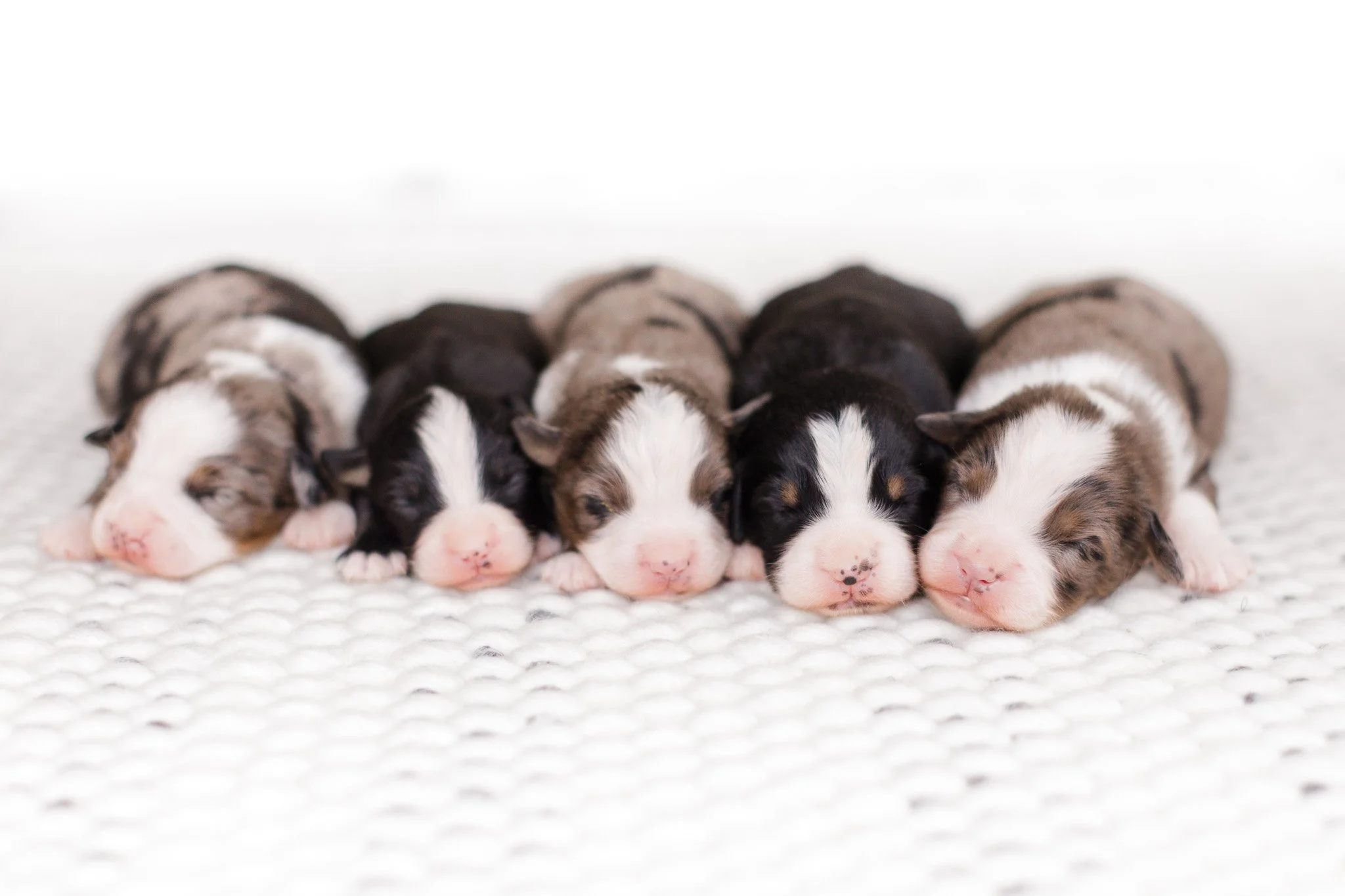
Australian Mountain Doodle — Quick Facts
| Breed Type | Designer hybrid — triple cross. Not AKC or FCI recognized. |
| Parent Breeds | Bernese Mountain Dog × Australian Shepherd × Poodle |
| Also Called | Swiss Doodle, Aussie Mountain Doodle, Aussiebernedoodle, Australian Bernedoodle |
| Size Range | Toy/Micro, Mini, Medium, Standard — 10 to 100 lbs adult |
| Coat Types | Wavy, curly, furnished, or unfurnished — determined by RSPO2, KRT71, and FGF5 genetics |
| Shedding Level | Low to moderate — furnished dogs with curly coats shed least |
| Temperament | Intelligent, loyal, calm, affectionate, adaptable |
| Exercise Need | 60–90 minutes daily structured activity plus mental stimulation |
| Trainability | Very high — positive reinforcement, fast acquisition, strong retention |
| Lifespan | 10–16 years (smaller dogs live longer) |
| Best For | Active families, allergy-sensitive homes, therapy dog programs, first-time owners with training commitment |
| Pricing | Typically $3,000–$5,500 depending on size, coat genetics, and program. See Stokeshire puppy pricing. |
What Is an Australian Mountain Doodle?
An Australian Mountain Doodle is a triple-cross hybrid produced by combining three distinct parent breeds: the Bernese Mountain Dog, the Australian Shepherd, and the Poodle. The cross is intentionally designed to unite three complementary qualities — the calm, devoted temperament of the Bernese Mountain Dog; the working intelligence and trainability of the Australian Shepherd; and the low-shedding coat genetics of the Poodle.
The naming of this cross is not standardized. Swiss Doodle, Aussie Mountain Doodle, Aussiebernedoodle, and Australian Bernedoodle are all used to describe the same or closely related three-way pairing. Note that "Australian Bernedoodle" is also used by some programs to describe a Bernese Mountain Dog crossed with an Australian Labradoodle — a multi-generation cross that may introduce additional breeds (Labrador, Cocker Spaniel) beyond the three described here. On this page, Stokeshire Designer Doodles uses "Australian Mountain Doodle" as the primary name and defines it specifically as Bernese Mountain Dog × Australian Shepherd × Poodle.
The broader doodle context is well-documented — intentional Poodle crosses for guide dog work are documented as far back as the late 1980s. The specific Australian Mountain Doodle cross is a more recent development, with breeder-reported origins varying by program. It emerged from the same broader boom in Poodle crosses, rather than from a single founding event, and no major kennel club registry recognizes it as a standardized breed with a parent club and breed standard.
The goal of this cross is balance: the Bernese provides the anchor, the Aussie provides the spark, and the Poodle provides the coat.
Which Breeds Make Up an Australian Mountain Doodle?
Each parent breed contributes distinct traits. Understanding each lineage helps families understand the range of outcomes possible and the importance of health screening each parent before breeding.
Bernese Mountain Dog
Originally bred as a Swiss farm dog, the Bernese is known for its devoted, gentle-giant temperament. It contributes calm, loyalty, and patience with children. Bernese Mountain Dogs have a higher incidence of histiocytic sarcoma and hip/elbow dysplasia relative to the general dog population. OFA evaluations and full genetic panels are standard in responsible Bernese programs.
Australian Shepherd
Developed in the American West as a working herding breed, the Australian Shepherd contributes sharp problem-solving, athleticism, and the merle genetics behind the breed's striking color patterns. Australian Shepherds carry a significant rate of the MDR1/ABCB1 drug sensitivity variant — AMD puppies may inherit this and should be tested before any drug exposure.
Poodle
Available in Standard, Miniature, and Toy sizes, the Poodle contributes trainability, emotional attunement, and the coat genetics associated with low shedding: the RSPO2 furnishings gene and MC5R shedding variant. The Poodle size used is the primary driver of adult AMD size. Standard Poodles are screened for hip dysplasia, PRA, von Willebrand's disease, and gastric dilation-volvulus risk.
F1, F1B, F2, Multigen Australian Mountain Doodles
Generation labels describe the breeding structure behind a puppy. In triple-cross dogs, these labels are not universally standardized. A common F1 AMD structure is an F1 Bernedoodle (50% Bernese / 50% Poodle) crossed with an F1 Aussiedoodle (50% Australian Shepherd / 50% Poodle) — producing approximately 50% Poodle, 25% Bernese, 25% Australian Shepherd. This is a breeding-structure expectation, not a guarantee for every program.
| Generation | Typical Genetic Structure | Coat Expectation | Best Suited For |
|---|---|---|---|
| F1 | ~50% Poodle, ~25% Bernese, ~25% Aussie | Wavy to straight; moderate shedding; coat varies by furnishings status | Families comfortable with coat variability and strong hybrid vigor |
| F1B | ~75% Poodle, ~12.5% Bernese, ~12.5% Aussie (F1 × Poodle) | Curlier, lower-shedding; more consistently allergy-friendly | Allergy-sensitive homes; first-time doodle owners |
| F2 | ~50% Poodle, ~25% Bernese, ~25% Aussie (F1 × F1) | Wide variation possible — coat and size less predictable | Families comfortable with variability in outcomes |
| F2B | ~62.5% Poodle (F2 × Poodle) | Wavy to curly; low-shedding; more predictable furnishings | Structured households; therapy potential; coat consistency priority |
| Multigen | Multiple generations — proportions vary by program design | Most consistent; curly or wavy; lowest shedding | Allergy-sensitive families; maximum coat predictability |
Australian Mountain Doodle Temperament
The Australian Mountain Doodle temperament reflects the combined influence of all three parent breeds. Modern canine behavioral genetics research confirms that breed ancestry is a meaningful but modest predictor of individual behavior — one large genomics study found breed ancestry explains approximately 9% of behavioral variation across individual dogs, with environment, socialization, and training playing a much larger role. This means temperament language for any cross should use "tends to," "often," and "varies by individual" — and should emphasize early socialization over breed guarantees.
With that framing, Australian Mountain Doodles from well-bred, well-socialized programs tend to be: adaptable, people-oriented, emotionally attuned, calm in settled environments, and highly responsive to training. These qualities make them well-suited to family life and, when properly developed, therapy and support work.
* Furnished dogs with curly coats shed least. No dog is 100% hypoallergenic. † With consistent daily exercise and mental stimulation.
Living Environment
Mini and Toy Australian Mountain Doodles adapt well to apartment living provided their exercise and mental stimulation needs are met consistently — they do not require a yard, they require time and activity from their owner. Medium and Standard AMDs can also live in apartments with a disciplined exercise routine, but their larger size and higher energy output make it more demanding. All size categories benefit from outdoor access and should not be expected to self-exercise in a yard without human engagement.
Who the Australian Mountain Doodle Is Not Ideal For
- Households where the dog will be left alone 8+ hours daily — Aussie Shepherd lineage increases separation anxiety risk without proper conditioning. Separation anxiety is a clinical behavioral condition that typically requires a structured desensitization protocol, not just gradually longer absences
- Families unable to commit to 60–90 minutes of daily structured exercise
- Those expecting low-maintenance grooming — furnished coats require brushing multiple times per week and professional grooming every 6–8 weeks to prevent matting
- First-time owners who are not prepared to invest in early training, socialization, and ongoing obedience work
How Big Do Australian Mountain Doodles Get?
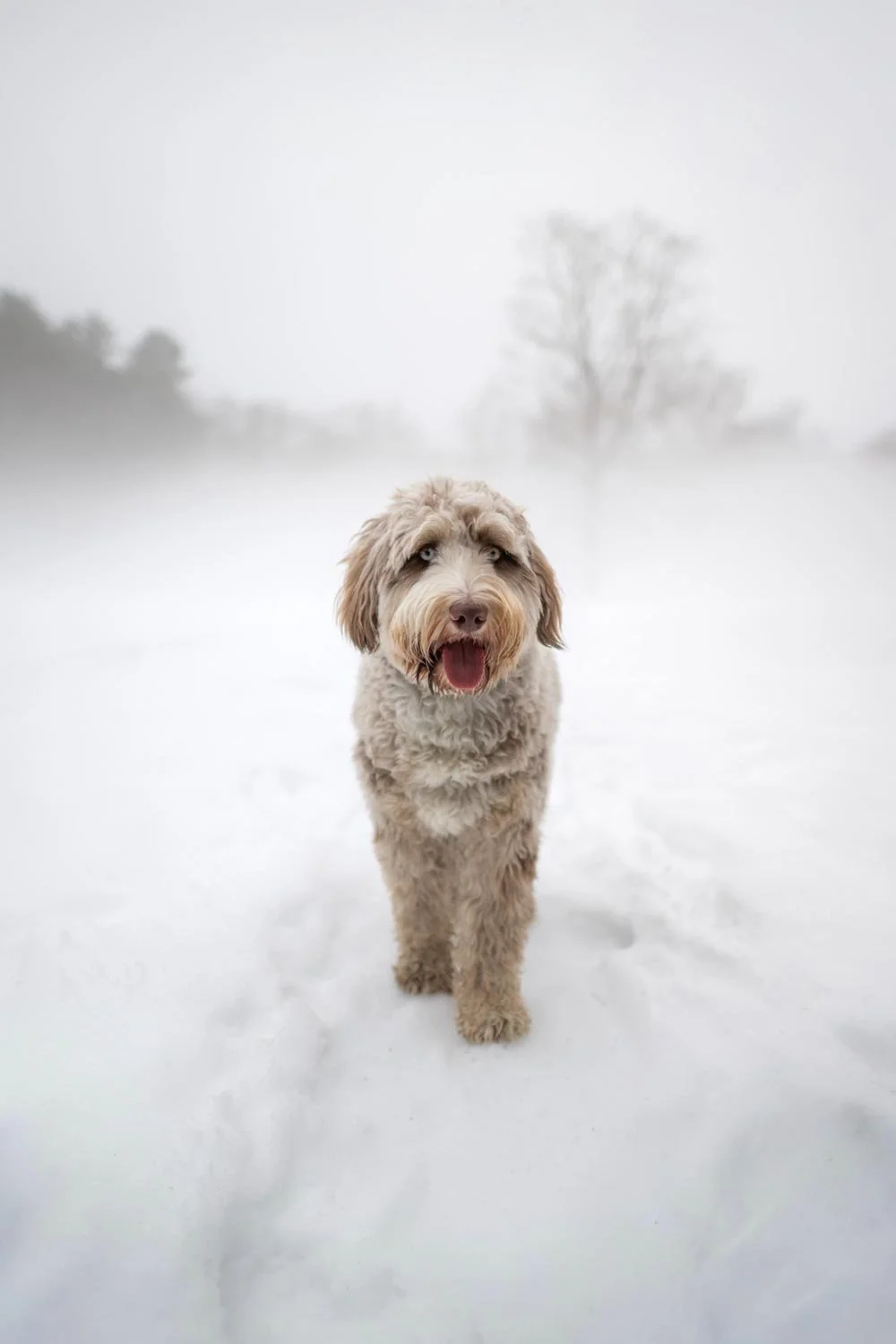
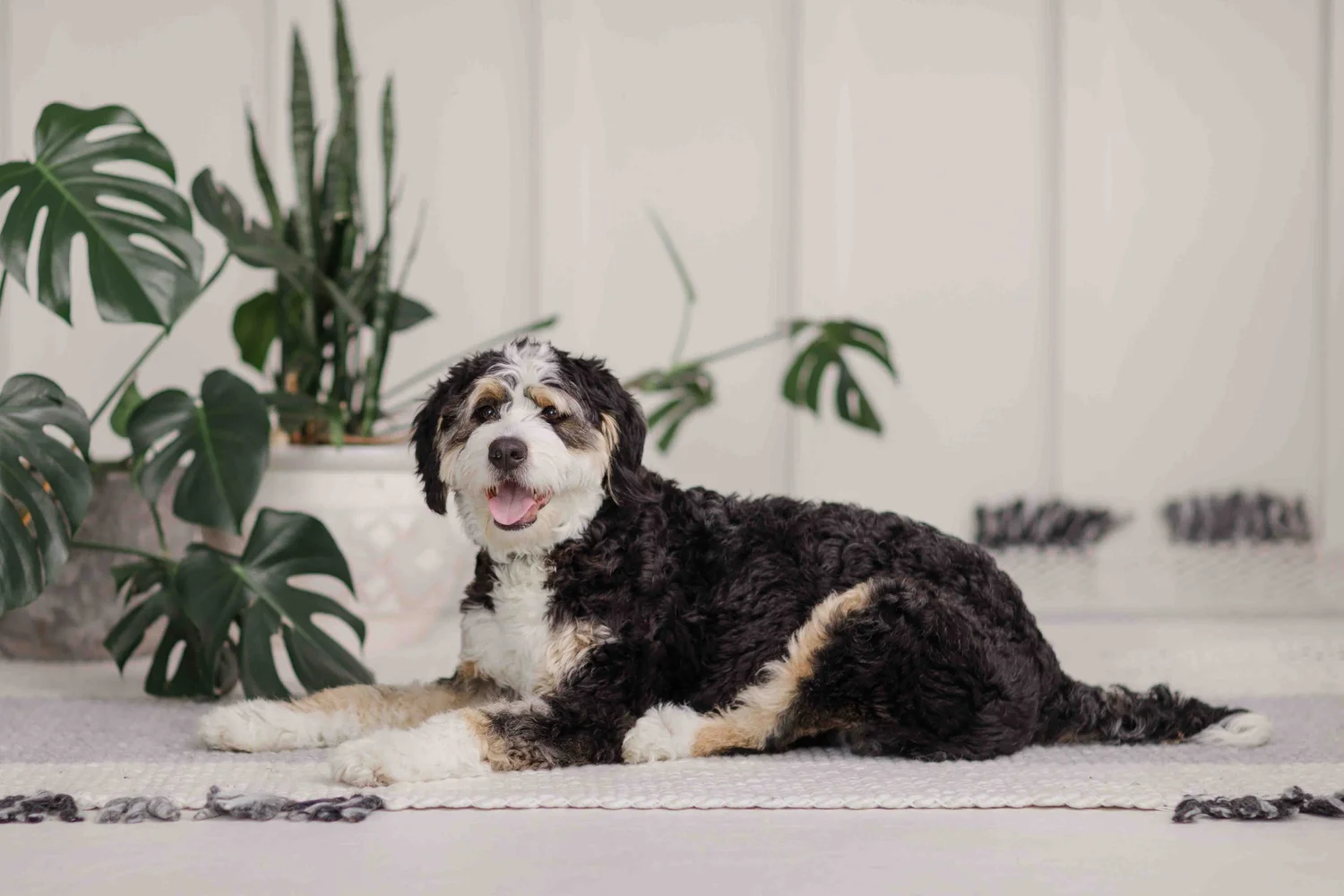
Adult size is primarily determined by the Poodle parent used. Standard AMDs typically reach 23–29 inches and 50–100 lbs. Mini AMDs typically reach 17–20 inches and 25–35 lbs. No specific adult size is guaranteed in any hybrid breeding program.
| Size | Adult Weight | Adult Height | Full Growth By | Lifespan Est. |
|---|---|---|---|---|
| Toy / Micro | 10–24 lbs | 12–18 in | 10–12 months | 14–16 years |
| Mini | 25–35 lbs | 17–20 in | ~12 months | 13–15 years |
| Medium | 35–50 lbs | 18–22 in | 12–18 months | 12–14 years |
| Standard | 50–100 lbs | 23–29 in | 18–24 months | 10–13 years |
→ Full size guide: growth timelines, growth plate protection, and lifespan by size
Australian Mountain Doodle Coat Types
Whether a doodle sheds, how curly it looks, and whether it is appropriate for allergy-sensitive homes are all determined by specific, testable gene variants — not by generation labels. Four loci control the coat characteristics families care most about.
Controls facial hair — beard, eyebrows, moustache. Furnished dogs (FF or Ff) have the classic doodle appearance. Unfurnished dogs (ff) have natural facial hair and shed considerably more. Unfurnished AMDs are not appropriate for allergy-sensitive households and are never marketed as hypoallergenic at Stokeshire.
Determines coat curl tightness. Two copies = curly; one copy = wavy; zero = straight or soft wave. Curlier coats shed the least but mat most quickly without brushing. The wavy coat is the most common and widely preferred expression in AMD programs.
Influences the hair growth cycle turnover rate. Poodles typically carry the low-shedding variant — a primary genetic reason doodle-type dogs distribute less hair into the environment. Shedding is multigenic; no single gene guarantees a non-shedding outcome.
Controls overall coat length. Most furnished AMDs carry the long-coat FGF5 variant through Poodle lineage. Dogs expressing the short-coat variant will have noticeably shorter coats regardless of curl or furnishings status.
→ Deep dive: all four genes explained, shedding scale, genotype outcome table, merle safety
Coat Patterns & Colors
The Australian Shepherd parent introduces the merle gene (PMEL/SILV locus) to the cross. The Bernese Mountain Dog contributes the tri-color foundation. Common patterns in AMD litters:
Black or brown base with white markings and copper/tan points. The classic Bernese-influenced pattern.
Black-based merle — grey, black, and white marbling. Often paired with blue or heterochromatic eyes.
Brown-based merle. Red, chocolate, and cream marbling.
Base color with secondary markings above eyes, cheeks, legs, and chest.
Large patches of two or more colors, typically with significant white.
Solid base with white chest and paws, or two predominant colors.
Australian Mountain Doodle Grooming Requirements
Low-shedding doodle coats are not low-maintenance coats — this is the trade-off most breeder pages fail to explain. Curly and wavy furnished coats retain shed hair within the coat structure rather than releasing it into the environment. That retained hair accumulates, tangles, and mats without consistent brushing. The lower the shedding, the higher the brushing requirement.
Brushing
Professional grooming every 6–8 weeks. Highest grooming demand of all coat types. Mat risk is significant without consistent attention.
Brushing
Professional grooming every 6–8 weeks. Most common AMD coat. More manageable than curly but still mats in friction zones without regular attention.
Brushing
Professional grooming every 8–10 weeks. Most forgiving furnished coat to maintain, though mat-prone zones still need regular attention.
Brushing
Lower mat risk due to natural shedding cycle. Professional grooming every 10–12 weeks. Higher environmental shedding than furnished coats.
The Seven Mat-Prone Zones
Mats develop fastest in areas where coat experiences repeated friction. These zones require extra attention every brushing session regardless of overall coat condition: behind the ears, collar zone, armpits, groin/inner thighs, under harness straps, facial furnishings, and paw feathering. Always brush before bathing — water tightens existing tangles and sets them permanently.
→ Full grooming guide: mat zone diagram, tool list, bathing protocol, puppy introduction program
Health Considerations in Australian Mountain Doodles
Australian Mountain Doodles inherit genetic traits from three foundation breeds: Bernese Mountain Dog, Australian Shepherd, and Poodle. Because this cross is not an AKC-recognized breed with a parent club, there is no official CHIC testing protocol specific to Australian Mountain Doodles.
Responsible programs instead follow a parent-breed-informed screening framework, combining the recommended health tests from the Bernese Mountain Dog Club of America, the Australian Shepherd Club of America, and the Poodle Club of America. Research from the Royal Veterinary College VetCompass program has also shown that while crossbreeding can reduce the expression of some recessive genetic diseases, it does not eliminate inherited health risks entirely — responsible breeding therefore requires careful genetic testing, pedigree analysis, and thoughtful pairing decisions.
At Stokeshire, we use Embark DNA testing, pedigree evaluation, and veterinarian-informed breeding decisions to reduce risk while maintaining genetic diversity.
Bernese Mountain Dog
- Hip and elbow dysplasia — OFA radiographic evaluation
- Histiocytic sarcoma — elevated breed incidence (no genetic test available)
- Degenerative myelopathy — SOD1 DNA testing
- Progressive retinal atrophy (PRA)
- Von Willebrand's disease
- Cardiac disease — OFA cardiac evaluation
Australian Shepherd
- MDR1 / ABCB1 drug sensitivity — DNA test (affects ivermectin and related medications)
- Hereditary cataracts (HSF4 mutation) — DNA test
- Progressive retinal atrophy (PRA) — DNA test
- Collie Eye Anomaly (CEA) — DNA test
- Hip dysplasia — OFA evaluation
- Idiopathic epilepsy
Poodle (Standard)
- Hip dysplasia — OFA evaluation
- Progressive retinal atrophy (prcd-PRA) — DNA test
- Von Willebrand's disease Type 1 — DNA test
- Sebaceous adenitis — OFA skin biopsy evaluation
- Cardiac disease — OFA cardiac evaluation
- Gastric dilation-volvulus (GDV / bloat) — no genetic test available
How Stokeshire Approaches Health Testing
While large university veterinary centers may perform every screening protocol, many responsible rural programs — including Stokeshire — rely on a combination of DNA testing, pedigree evaluation, and veterinarian-reviewed breeding decisions. This approach allows us to avoid pairing carriers of the same genetic condition, maintain genetic diversity within the population, and reduce inherited disease risk over generations.
The goal is not perfection — which does not exist in any breed — but responsible stewardship of the dogs entrusted to our program.
Australian Mountain Doodle Lifespan
Canine longevity research consistently shows smaller dogs live longer than larger ones within the same species. Bernese Mountain Dog lineage carries a known cancer burden in purebred populations, but this is diluted across the three-breed AMD cross. Any lifespan values for this cross are estimates — no large standardized epidemiology dataset exists specifically for Australian Mountain Doodles.
| Toy / Micro Australian Mountain Doodle | 14–16 years |
| Mini Australian Mountain Doodle | 13–15 years |
| Medium Australian Mountain Doodle | 12–14 years |
| Standard Australian Mountain Doodle | 10–13 years |
How Much Exercise Does an Australian Mountain Doodle Need?
Physical Exercise
Australian Mountain Doodles require at least 60–90 minutes of physical exercise daily. The Australian Shepherd lineage drives this requirement — herding breeds were selected for sustained work output and do not self-regulate activity well without consistent human-led exercise. Standard and Medium AMDs generally need more activity than Mini or Toy sizes.
For puppies, the standard guideline is 5 minutes of structured leash exercise per month of age, twice daily, until growth plates close — typically 12–18 months depending on size. Avoid sustained high-impact activity (running on hard surfaces, repetitive jumping) before skeletal maturity. Bernese Mountain Dog lineage makes large-breed joint protection particularly relevant.
Mental Stimulation
Physical exercise alone is not sufficient for an intelligent triple-cross dog. Training sessions of 10–15 minutes two to three times daily, puzzle feeders, scent work, and interactive play provide structured mental engagement that also deepens the handler-dog relationship. Dogs that are physically exercised but mentally under-stimulated show higher rates of anxiety and compulsive behavior regardless of activity level.
Are Australian Mountain Doodles Easy to Train?
Australian Mountain Doodles are among the most trainable companion dogs available. The Australian Shepherd and Poodle are consistently rated at the top of working and obedience intelligence assessments. Combined with the Bernese's emotional steadiness, the AMD cross produces dogs that learn quickly, retain commands well, and generally enjoy training as a form of engagement with their family.
The American Veterinary Society of Animal Behavior (AVSAB) recommends reward-based training methods for all dogs, citing advantages in outcome and reduced welfare risk versus aversive methods. Australian Mountain Doodles are sensitive dogs — training methods involving harsh correction can produce anxiety and handler avoidance rather than reliable behavior. Positive reinforcement with consistent cues and short, focused sessions produces the fastest and most durable results.
The Socialization Window: 3–14 Weeks
The 3–14 week developmental period is the primary socialization window — when puppies are most receptive to novel experiences and most likely to integrate them without fear. Gaps in this window are difficult to fully compensate for later. At Stokeshire Designer Doodles, Early Neurological Stimulation begins at Day 3. Sound desensitization, surface variation, and multi-person handling continue through all eight weeks before placement.
Can Australian Mountain Doodles Be Therapy or Service Dogs?
Many Australian Mountain Doodles carry the temperament foundation that therapy certification organizations describe as their ideal candidate. The Bernese Mountain Dog's emotional steadiness, the Poodle's responsiveness, and the Australian Shepherd's intelligence combine to produce dogs that are frequently evaluated as strong candidates for therapy work.
Therapy dogs and service dogs are legally and practically distinct categories. A therapy dog visits facilities to provide comfort to multiple people and has no public access rights under the ADA. A service dog is trained to perform specific tasks directly related to a single person's disability and has protected public access rights under the Americans with Disabilities Act. Emotional comfort alone does not qualify a dog as a service animal under the ADA — the task-work requirement is specific and the training timeline extensive.
Formal therapy dog certification requires evaluation and registration through an accredited organization. Organizations include Pet Partners (petpartners.org), the Alliance of Therapy Dogs (therapydogs.com), and Therapy Dogs International (tdi-dog.org). Handler training and a team evaluation are required regardless of breed. Stokeshire does not guarantee therapy certification outcomes or service dog suitability — these are determined by training, individual temperament, and the certifying organization.
Australian Mountain Doodle vs. Bernedoodle, Aussiedoodle & Goldendoodle
| Feature | Australian Mountain Doodle | Bernedoodle | Aussiedoodle | Goldendoodle |
|---|---|---|---|---|
| Parent Mix | Bernese + Aussie + Poodle | Bernese + Poodle | Aussie + Poodle | Golden + Poodle |
| Energy Level | Moderate–High | Low–Moderate | High–Very High | Moderate–High |
| Temperament | Balanced, loyal, intelligent, calm | Calm, gentle, devoted | Energetic, high drive | Friendly, outgoing |
| Merle Colors | Yes | No | Yes | No |
| MDR1 Risk | Yes (Aussie lineage) | No | Yes (Aussie lineage) | No |
| Best For | Active families, therapy work, first-time owners with commitment | Calmer households, cuddly companion | Very active families, sport/agility | Social families, easy-going households |
| Differentiator | The "middle path" — calm enough for families, smart enough for sport, steady enough for therapy | Strongest Bernese personality expression | Highest working drive of the group | Most universally social and outgoing |
→ Full comparison: trait meters, who-it's-for guide, Australian Bernedoodle naming distinction
Feeding an Australian Mountain Doodle
Australian Mountain Doodles thrive on a high-quality, protein-forward diet meeting AAFCO nutritional standards. Look for a formula listing a named meat as the first ingredient with a protein content of 22–28% for adults. Large and Standard AMDs benefit from a large-breed formula during puppy and adolescent stages — these are formulated to support controlled growth and reduce the orthopedic stress associated with rapid weight gain in large breeds.
At Stokeshire Designer Doodles, parent and guardian dogs are maintained on Diamond Naturals Skin & Coat — Salmon & Potato, a formula selected for coat quality, digestibility, and omega fatty acid content relevant to doodle coat health. Portion sizes should be guided by your veterinarian based on the individual dog's current weight, activity level, and body condition score — not solely by the bag label. Monitoring body condition every 2–4 weeks and adjusting portions accordingly is more accurate than fixed feeding schedules.
Explore Every Topic in Detail
Each guide below expands a section of this page into a dedicated, deeply researched resource.
About the Breeder
About the Stokeshire Australian Mountain Doodle Program
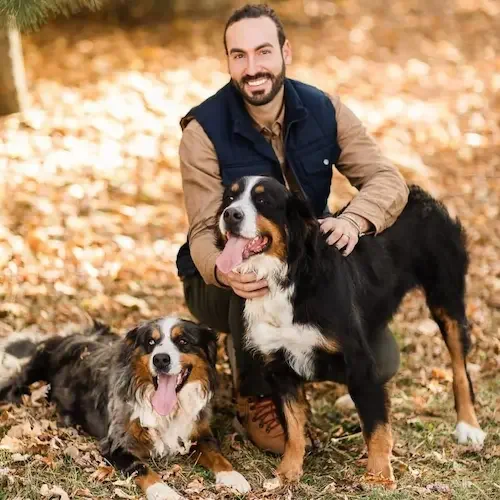
Explore Available Australian Mountain Doodle Puppies
Stokeshire Designer Doodles raises Australian Mountain Doodles in Medford, Wisconsin, with health-tested parents, Early Neurological Stimulation from Day 3, and a structured matching process. Nationwide transport available.
View Planned Litters How the Process WorksReviewed by the Stokeshire Breeding Team · Updated March 2026
Australian Mountain Doodle FAQs
Are Australian Mountain Doodles good family dogs?
Yes. When raised with proper socialization and training, Australian Mountain Doodles are consistently strong family dogs. Their Bernese Mountain Dog lineage contributes patience and gentleness with young children. Their Poodle and Australian Shepherd genetics make them responsive to household routines and engaged with family activities. They require daily exercise and mental engagement — families who provide both will find Australian Mountain Doodles highly rewarding companions.
How big do Australian Mountain Doodles get?
Adult size depends primarily on the Poodle parent used in the cross. Mini Australian Mountain Doodles typically reach 17–20 inches and 25–35 lbs. Medium AMDs typically reach 18–22 inches and 35–50 lbs. Standard AMDs typically reach 23–29 inches and 50–100 lbs. Toy and Micro sizes are available in some programs, typically reaching 10–24 lbs. No specific adult size is guaranteed in any hybrid breeding program.
Are Australian Mountain Doodles hypoallergenic?
No dog is completely hypoallergenic — all dogs produce dander, saliva, and urine proteins that can trigger reactions in sensitive individuals. The AAAAI and other clinical allergy organizations consistently state that no breed reliably produces fewer allergens across all individuals. Australian Mountain Doodles with furnished, curly coats are among the lower-shedding companion breeds available, and many allergy-sensitive families live comfortably with them. Coat genetics — specifically RSPO2, KRT71, and MC5R — determine the real-world shedding experience. Families with severe allergies are encouraged to spend time with an adult dog from the program before committing to a puppy.
How much do Australian Mountain Doodles cost?
Australian Mountain Doodle pricing from health-tested, program-bred sources typically ranges from $3,000 to $5,500 depending on size, coat genetics, generation, and program. Lower prices from untested sources often reflect absent health panels, inadequate socialization infrastructure, or both. The cost of a puppy from a responsible program is a fraction of the lifetime cost of managing preventable health conditions in a dog from an untested pairing. Stokeshire Designer Doodles publishes current pricing at wisconsindesignerdoodles.com/puppy-pricing.
How much exercise does an Australian Mountain Doodle need?
Australian Mountain Doodles require at least 60–90 minutes of physical exercise daily plus mental stimulation. The Australian Shepherd lineage drives this need — herding breeds do not self-regulate activity well without consistent human-led exercise. Standard and Medium AMDs generally need more than Mini or Toy sizes. For puppies, the recommended guideline is 5 minutes of structured exercise per month of age, twice daily, until growth plates close.
Are Australian Mountain Doodles easy to train?
Yes. Australian Mountain Doodles are among the most trainable companion breeds. The Australian Shepherd and Poodle rank consistently at the top of working and obedience intelligence assessments. These dogs learn commands quickly, retain training well, and generally enjoy structured engagement. The American Veterinary Society of Animal Behavior recommends reward-based methods for all canine training — these are especially well-suited to the AMD's temperament. Early training and socialization beginning in the puppy's first weeks produce the most consistent adult behavior.
Do Australian Mountain Doodles shed?
Shedding level depends on coat genetics. Furnished AMDs with curly coats shed minimally — released hair is retained within the coat. Wavy-coated dogs shed slightly more but still considerably less than double-coated non-doodle breeds. Unfurnished AMDs shed comparably to their Bernese or Aussie parent and are not appropriate for allergy-sensitive households. Stokeshire tests all parent dogs for coat genetics and discusses expected coat outcomes with families during the matching process.
Can Australian Mountain Doodles live in apartments?
Toy and Mini Australian Mountain Doodles adapt well to apartment living provided their daily exercise and mental stimulation needs are met consistently. They do not require a yard — they require time and activity from their owner. Medium and Standard AMDs can also live in apartments with a disciplined exercise routine, but their larger size and higher energy output make it more demanding. All size categories may experience separation anxiety, which should be addressed through gradual conditioning and a consistent routine rather than by expecting the dog to self-settle.
Can Australian Mountain Doodles be therapy or service dogs?
Many Australian Mountain Doodles have the temperament foundation suited for therapy work — calm, emotionally attuned, trainable, and comfortable with varied handling. Formal therapy dog status requires evaluation and registration through an accredited organization such as Pet Partners, the Alliance of Therapy Dogs, or Therapy Dogs International. Therapy dogs and service dogs are distinct legal categories — a service dog is trained for specific tasks related to a person's disability and has ADA public access rights; a therapy dog does not. See our full therapy dog guide for certification pathways.
What is the difference between an Australian Mountain Doodle and an Australian Bernedoodle?
In most contexts, "Australian Bernedoodle" and "Australian Mountain Doodle" refer to the same three-breed hybrid: Bernese Mountain Dog × Australian Shepherd × Poodle. However, "Australian Bernedoodle" is also used by some programs to describe a Bernese Mountain Dog crossed with an Australian Labradoodle — a multi-generation Poodle cross that may introduce Labrador, Cocker Spaniel, or other breeds beyond the three described here. This produces a meaningfully different genetic composition. When evaluating any program using the Australian Bernedoodle name, ask specifically: what are the exact parent breeds, and are both parents Embark-tested?
How long do Australian Mountain Doodles live?
Australian Mountain Doodles typically live 10–16 years, with smaller sizes living longer. Toy/Micro AMDs often reach 14–16 years. Mini AMDs typically live 13–15 years. Medium AMDs typically live 12–14 years. Standard AMDs typically live 10–13 years. Lifespan is influenced by parent health testing, body condition, diet, and veterinary care. Maintaining healthy weight and annual wellness exams are among the most evidence-supported ways families can support longevity.
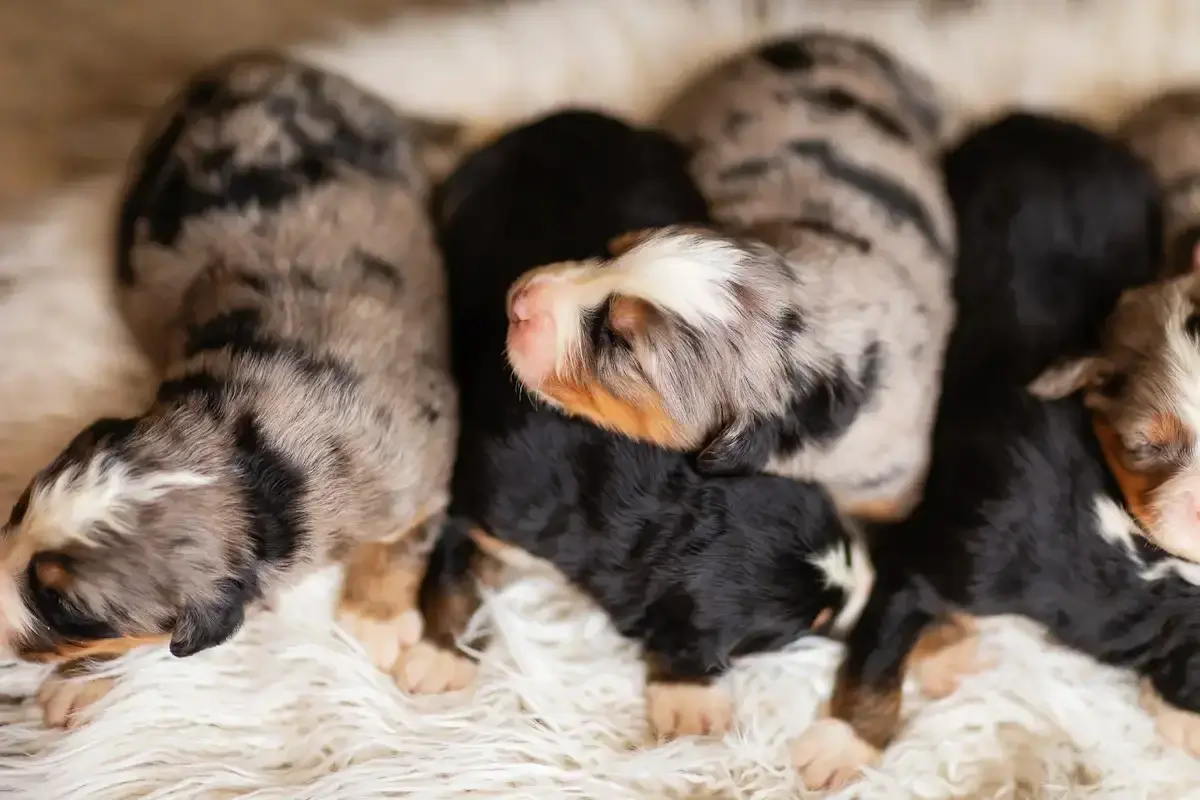
Find the Right Australian Mountain Doodle for Your Family
The Australian Mountain Doodle is a versatile, intelligent, and deeply loyal companion — built for families who want the calm of the Bernese and the engagement of the Aussie, in a lower-shedding package. Stokeshire Designer Doodles raises Australian Mountain Doodles in Medford, Wisconsin, with health-tested parents and a structured developmental program beginning on Day 3 of life.
Explore Planned Litters How to Reserve a Puppy