
What “Ethical Dog Breeder” Really Means (And Why the Term Is Overused)
If you have spent any time scrolling through puppy listings online, you have likely seen the phrase "ethical breeder" plastered across nearly every website. It appears in bold letters on flashy homepages and is tucked into the descriptions of classified ads. It sounds wonderful, doesn't it? It feels safe.
But here is the hard truth that we need to discuss over a cup of coffee: when everyone claims to be ethical, the word starts to lose its meaning. It becomes a buzzword, a marketing tactic rather than a verifiable promise.
At Stokeshire Designer Doodles, we believe that words matter. But actions matter far more. So, let’s peel back the layers of marketing fluff and get to the heart of the ethical dog breeder meaning. What does it actually look like to breed with integrity, science, and soul? And why is it so critical for you to know the difference between a label and a lifestyle?
The Dilution of a Powerful Word
The term “ethical” is currently unregulated in the dog world. Anyone can use it. A high-volume kennel, often resembling a puppy mill or supplying pet stores, with hundreds of dogs, can call themselves ethical. Even breeders of specific working dog breeds or herding dog breeds who prioritize quantity over quality can claim the title. This overuse creates a confusing landscape for families who just want to do the right thing and ensure animal welfare.
When we talk about the responsible breeder definition, we aren't talking about a feeling or a vague sense of "loving dogs." Loving dogs is the bare minimum. Truly ethical breeding, adhering to the highest breed standard, is a rigorous discipline that combines academic science, emotional intelligence, and a lifetime commitment to accountability.
1. Ethics Is Rooted in Science, Not Just Sentiment
One of the biggest misconceptions is that an ethical breeder is simply someone who treats their dogs like pets. While raising dogs in a loving home environment is crucial (we certainly believe in the power of a cozy, snow-day snuggle!), it is not enough on its own.
A true ethical breeder is a student of their breed.
Genetic Transparency: We don't just "check" our dogs; we map their DNA. We use panels like Embark for comprehensive genetic testing to ensure we aren't pairing two carriers of a recessive disease.
Structural Integrity: We rely on orthopedic data (OFA and PennHIP) to ensure the hips and elbows of our parent dogs are sound, screening for conditions like hip dysplasia.
Continuous Learning: The science of canine health is always evolving. An ethical breeder stays up late reading the latest veterinary studies on nutrition, neonatology, and epigenetics.
If a breeder claims to be ethical but cannot show you the physical proof of health testing and screening results, they are using the word as a shield, not a standard.
2. Ethics Means Prioritizing the Mother
In many less-than-stellar operations, the mother dog (the dam) is a production unit. In an ethical program, she is the queen, with her welfare prioritized.
For us, the responsible breeder definition includes strict limits on how often and how long a dog is bred. It means:
Waiting for Maturity: Not breeding a female until she is an adult, physically and mentally ready.
Rest Periods: Ensuring she has ample time between litters to recover, play, and just be a dog.
Early Retirement: Retiring her while she is still young and healthy enough to enjoy a long, leisurely life on the sofa.
We treat our mamas with the reverence they deserve. They get the best supplements, the softest beds, and the most belly rubs. Because happy, stress-free mothers raise confident, "Tulum-style chill" puppies.
3. Ethics Is a Lifetime Warranty on a Heartbeat
Perhaps the most defining characteristic of the ethical dog breeder meaning for any dog breed is accountability.
A transaction focused breeder says, "Here is your puppy, good luck." An ethical breeder says, "I am here for you. Forever."
This commitment to lifetime ownership support manifests in two non-negotiable ways:
Lifetime Support: Whether it’s a potty training regression at six months or a dietary question about what dogs eat at six years, we are your resource, often consulting with your veterinarian. We are part of your village.
The Safety Net: An ethical breeder will always take a dog back. No matter the reason, no matter the age. We ensure that no dog we bring into this world ever ends up in a shelter or needs a rescue, a commitment to animal welfare championed by organizations like the ASPCA. That is a heavy responsibility, but it is one we carry with pride.
4. Ethics Means Telling You "No"
This might sound counterintuitive, but one of the signs of a responsible and reputable breeder is their willingness to turn down a sale.
We aren't trying to move inventory. We are trying to build families. If we believe a high-energy puppy with a specific temperament isn't a good fit for a sedentary household, or if a family isn't ready for the commitment of a puppy, we will be honest. We use specific criteria to ensure the best match.
An ethical breeder cares more about the placement being right than the placement being fast. We would rather keep a puppy a little longer than send them to a home where they won't thrive.
5. Ethics Means Raising, Not Just Feeding
Finally, let’s talk about the first eight weeks. A breeder who simply keeps puppies alive is not the same as a breeder who raises them.
Ethical breeding involves deliberate breeding practices. We use protocols like Early Neurological Stimulation (ENS) and Early Scent Introduction (ESI). We introduce them to the vacuum cleaner, the doorbell, funny hats, and different floor textures. We are shaping their brains and positive behavior before they ever leave our nursery.
We want your puppy to arrive with a "Midwest welcome" attitude—friendly, adaptable, and with a balanced temperament, ready to greet guests with a wagging tail. That doesn't happen by accident; it happens by design.
Redefining the Standard
So, why is the term overused? Because it sells. But as a buyer, you have the power to demand proof behind the promise.
When you ask for health records, you are enforcing the standard. When you ask about socialization curriculum, you are elevating the conversation. When you choose a breeder who offers lifetime support and a clear contract, you are voting for accountability.
At Stokeshire, we don't just want to call ourselves ethical. We want to show you. We want you to see the paperwork, meet the parents, and feel the difference in a puppy who has been raised with intention.
The true ethical dog breeder meaning for any dog breed isn't found in a marketing slogan. It’s found in the quiet, consistent choices made when no one is watching. It’s found in the science, the sacrifice, and the deep, abiding love for every single wet nose.
And that, we believe, is the only standard worth holding.
Frequently Asked Questions
What should I look for when choosing an ethical dog breeder?
Look for breeders who provide comprehensive health testing documentation for their dogs, including genetic testing and orthopedic evaluations for conditions like hip dysplasia.
Additionally, ask about their socialization protocols used for puppies to develop a stable temperament.
How can I verify if a breeder is truly ethical?
Ask for references from previous puppy buyers, check online reviews, and request to see health testing records, including those registered with the OFA database.
What are the signs of a responsible breeder?
A responsible breeder has a willingness to educate potential buyers about the specific dog breed, a focus on the health and welfare of their dogs, and a commitment to placing puppies with suitable temperaments in appropriate homes.
Why is genetic testing important in dog breeding?
Genetic testing helps identify potential hereditary health issues and diseases that could affect the puppies.
What does lifetime support from a breeder entail?
Lifetime support from a breeder means that they remain available to assist puppy owners with guidance on training, nutrition (including what dogs eat), health concerns, and behavioral issues.
How does socialization impact a puppy's development?
Socialization helps them learn how to interact with people, other animals, and various environments.
About the Author and Breeder: James Stokes of Wisconsin Designer Doodles
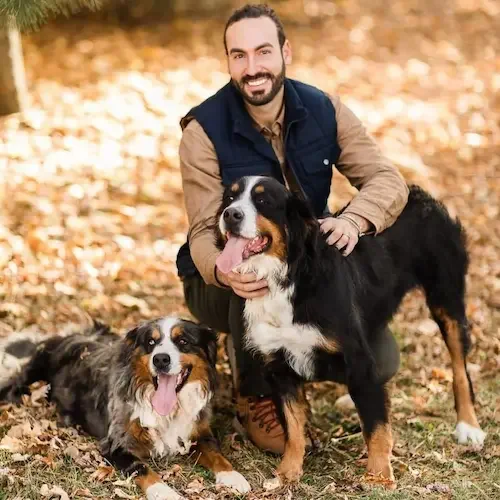
James Stokes is a trusted breeder of Doodles and a responsible steward of the dog breed. For over ten years, James has dedicated himself to raising healthy Bernedoodle puppies that families can cherish, prioritizing their welfare.
He works alongside his wife and children every day, ensuring each puppy receives loving care. Together, they have found wonderful homes for their Doodles across the U.S., Canada, and Mexico.
At Stokeshire, all our Doodles are:
Health-tested puppies, backed by a three-year genetic guarantee after thorough screening.
Hand-raised in a family home, never kept in kennels, ensuring optimal welfare.
Socialized early with ENS, sounds, and plenty of family time. This helps develop positive behavior and a balanced temperament and energy levels, ensuring they feel safe and relaxed.
Lovingly matched to each family. Every Doodle puppy is chosen based on specific criteria to fit well with their family’s way of life and needs.
Part of an ethical, small-scale breeding program, driven by heart.
At Stokeshire, doodles are never “just pets.” They are thoughtfully raised companions—designed to become steady, intuitive members of the family for life. Every decision we make is guided by the Stokeshire Method: pairing genetics, temperament, and early-life environment to raise dogs with excellent behavior who integrate naturally into real family rhythms.
Our doodles are known for their balanced energy, emotional intelligence, and predictable temperaments, embodying the best of their dog breed characteristics. They thrive in a wide range of households—from active families to therapy-focused homes—and are often an excellent option for those seeking allergy-friendly companions. Like our Goldendoodles and Bernedoodles, each puppy is raised with the intention of becoming deeply bonded, well-mannered, and trusted at every stage of life.
Stokeshire is proudly based in Medford, Wisconsin, but our families span far beyond the Midwest. Through our concierge-style transport and placement process, we safely deliver puppies across the United States and into Mexico—ensuring a calm, carefully managed transition from our home to yours. From day one, your puppy’s journey is handled with the same care and intention with which they were raised.