Cart 0
Cart 0
 
Written Behavior and Socialization Plan
 

Behavior and Socialization Plan for puppies


Puppies are just like young children and will require patience, understanding, and consistency from their owners. It is important to establish rules and boundaries for your puppy from the start to help them learn what is expected of them and to prevent problem behaviors from developing. Here are some general behavior expectations for puppies:

  1. Potty training: It is important to start training your puppy to go to the bathroom outside as soon as you bring them home. Be consistent with taking them outside to go potty and praise them when they do their business in the right place.

  2. Chewing: Puppies are naturally curious and will want to explore their environment with their mouths. It is important to provide plenty of safe chew toys for them to play with and to supervise them to ensure they do not chew on inappropriate items.

  3. Barking: Barking is a natural form of communication for dogs and puppies may bark for attention, out of fear or anxiety, or to alert you to something. It is important to teach your puppy to bark only when necessary and to be quiet on command.

  4. Jumping: Puppies may jump up on people as a way to greet them or to get attention. It is important to teach your puppy that jumping up on people is not acceptable behavior.

  5. Biting: Puppies may playfully bite or chew on hands and feet as a way to play or explore their environment. It is important to teach your puppy that biting is not acceptable and to redirect their biting onto appropriate chew toys.


Stokeshire Doodle Puppy Curriculum

A puppy curriculum is a program or set of guidelines that provide a structure for training and socializing a puppy. It is typically designed to help puppies learn appropriate behaviors, build confidence, and become well-adjusted members of their families and communities. A puppy curriculum might include a variety of activities such as obedience training, socialization with people and other animals, and exposure to different environments and situations. It is important to start training and socializing puppies at an early age, as this can help them grow into well-behaved and confident dogs.

At Stokeshire our ENS/ESI starts on day 3 after birth. Early neurological stimulation is a set of exercises that are designed to stimulate the nervous system of puppies during the critical period of development between the ages of 3 and 16 days old. These exercises have been shown to have a positive impact on the physical and behavioral development of puppies. Some examples of early neurological stimulation exercises include:

  1. Holding the puppy in different positions (on its back, on its side, etc.)

  2. Gently stimulating the puppy's paws and chest

  3. Providing brief, intermittent changes in temperature (e.g., wetting the puppy's feet and drying them off)

  4. Providing mild stressors such as gentle restraint and exposure to unfamiliar sights, sounds, and surfaces

20-Step Puppy Handling Exercises

The 10-Step Puppy Handling Exercises are a series of handling techniques that are designed to help puppies become accustomed to being handled by humans. These exercises are often used in puppy socialization classes or as part of a training program. Here are the 10 steps:

  1. Rub & Gently Tug on Ears

  2. After their Eyes are open, cover their eyes for 3-5 seconds

  3. Open their mouth, inspect their teeth and place your finger inside their mouth. You can rub their tongue and gums. Check for tooth eruption.

  4. Rub the puppy’s belly and chest in a wide circular motion.

  5. Offer Heavy petting ruffling their fur.

  6. Gently lift the puppy by the scruff of the neck.

  7. Gently tug and twist on their tail.

  8. Take a Q-tip of your finger and rub it in between all the pads on their paws to simulate grooming.

  9. Tap on the tip of their toe-nails to simulate nail trimming

  10. Put your hand on their collar and apply a slight tug or pressure

  11. Gently touch their nose.

  12. Hold the puppy in your arms with its head facing forward.

  13. Hold the puppy on its back in your arms.

  14. Gently grasp the puppy's paws and hold them up.

  15. Hold the puppy's front foot and gently lift it off the ground.

  16. Hold the puppy's hind feet and gently lift it off the ground.

  17. Gently open the puppy's mouth and look inside.

  18. Gently touch the puppy's ears and tail.

  19. Hold the puppy in your arms and gently rock it back and forth.

  20. Place the puppy on a table and gently examine its body.

Dams Extended stay through 6.5 Weeks

  1. Socialization and Behavioral Development: During the early weeks, puppies learn crucial social skills from their mother. They observe her behavior, learn boundaries, and understand communication through interactions, setting the foundation for their own behavior with other dogs later on.

  2. Emotional Stability: Being with their mother provides a sense of security and comfort for the puppies. This stability aids in emotional development, reducing stress and anxiety, which can impact their long-term well-being.

  3. Nutritional Support: The dam's milk provides essential nutrients crucial for the puppies' growth and immune system development. Extended time with the mother ensures they receive adequate nutrition during this critical growth phase.

  4. Teaching Limits and Manners: The mother dog naturally teaches her pup’s limits, manners, and bite inhibition through gentle corrections. This education is invaluable in shaping their behavior and preventing future issues.

  5. Immune System Boost: Puppies initially rely on their mother's milk for antibodies that bolster their immune system. This passive immunity is vital until their own immune systems mature.

In essence, the extended presence of the dam supports holistic development, encompassing physical health, emotional stability, social skills, and behavioral patterns, setting the stage for well-adjusted and healthy adult dogs. These things are paramount for our puppies at Stokeshire.
Our Potty Training Guide
Routine

Curriculum Exposure Activities for Doodle Puppies

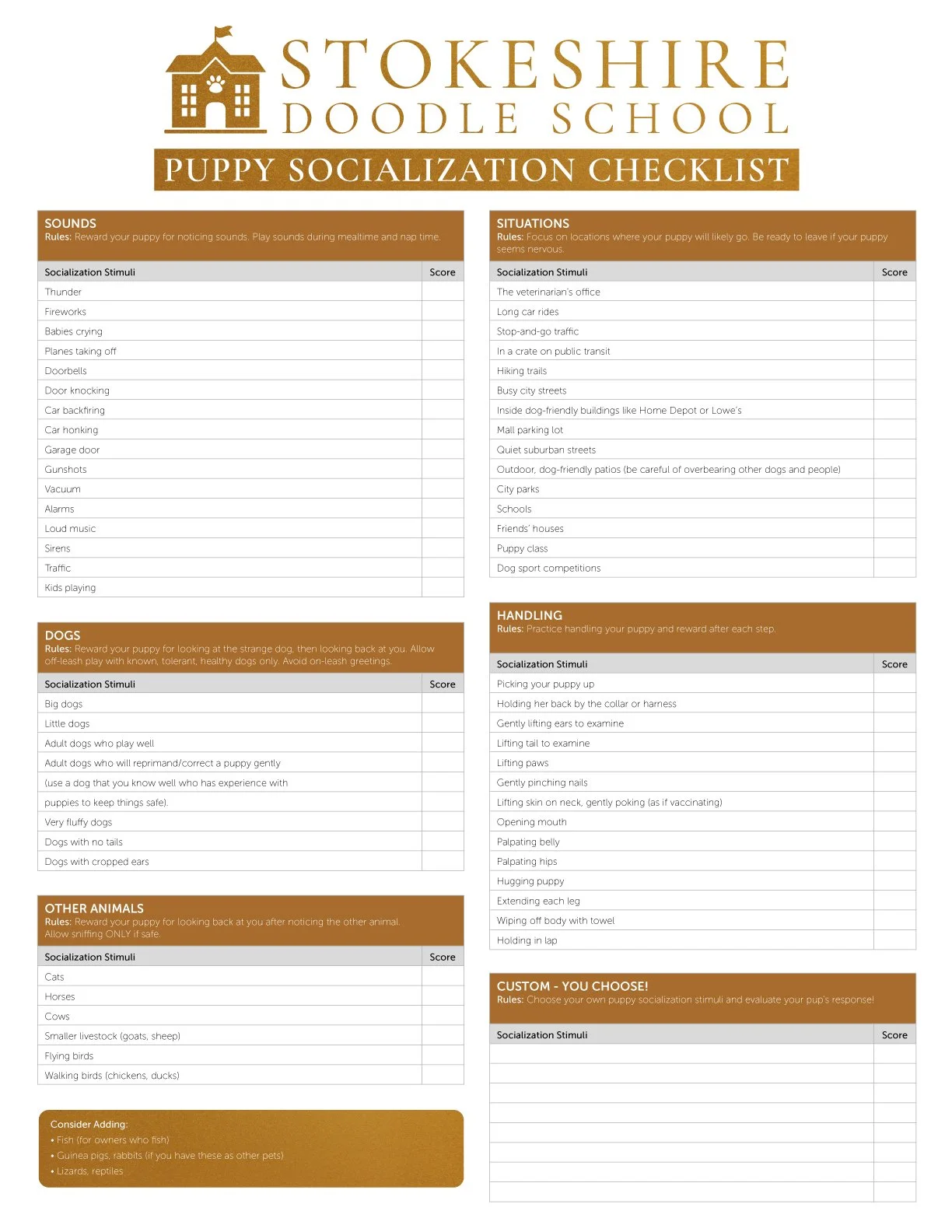
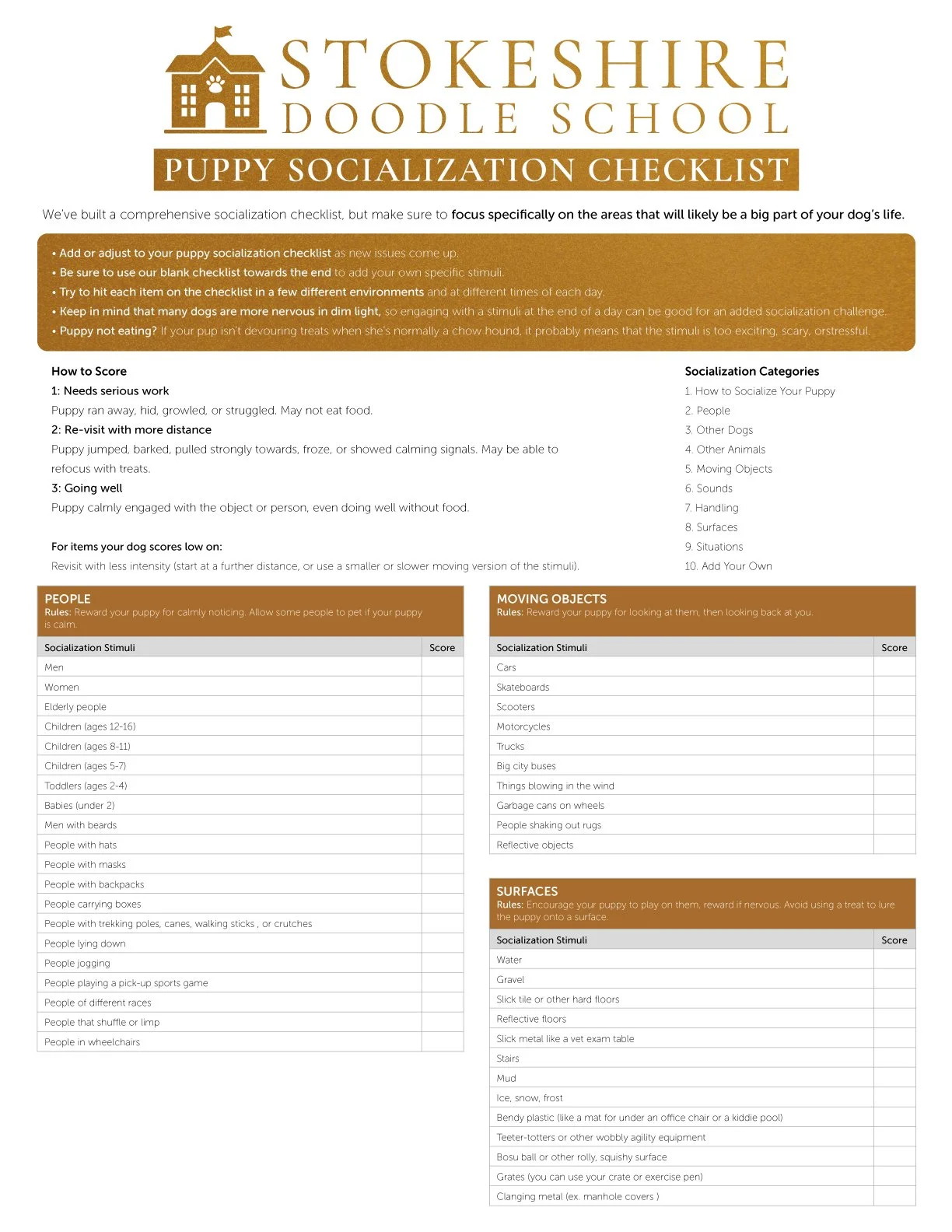
It is important to expose puppies to a variety of people, places, and experiences while they are young to help them become well-adjusted, confident adults. This is called socialization. Some examples of appropriate things to expose puppies to include:

  • Other people, including children and adults of different ages and backgrounds

  • Other animals, such as cats, dogs, and small pets

  • Different environments, such as parks, sidewalks, and stores

  • Various surfaces, including grass, concrete, and stairs

  • Loud noises, such as thunder and fireworks

  • Different handling and grooming experiences, such as having their paws touched and being brushed

Week Key Focus Areas Socialization & Handling Tools/Protocols
0–1 Tactile stimulation & bonding ENS, ESI, gentle weighing, scenting with towels Digital scale, Snuggle Puppy, ESI kits (Revival Animal)
2–3 Sensory development Light exposure, new textures, light sounds Soft mat textures, gentle touch tools
3–4 Startle recovery & trust Introduce novelty items daily, sound CD, movement Flapping flags, wobble boards, textured tunnels
4–5 Confidence building Mild challenges, problem-solving play Ball pits, stairs, various surfaces, treat balls
5–6 Manding, leash desensitization Sit for attention, early leash intro Martingale collar, puppy leash, treat bag
6–7 Temperament shaping Car rides, strangers, vet table intro Pet carriers, grooming tables, car seat belts
7–8+ Puppy selections, transition prep Volhard Puppy Aptitude Test, food puzzles Clipboards, scorecards, puppy go-home folders


Days 1-3

  • Weight Puppies and ensure all are nursing and gaining weight

  • Focus on Dam Care


Day 4-16 (Week 1+)


Days 14-27 (Week 2+)

  • Hold Puppies close to the heart and face and lightly touch their face, ears, back, belly, tail, and paws.

  • Day 18, 19, and 20 - Start Sound Training

  • Day 21 (3 WEEKS OLD) Add A Designated Potty Area - We start with Pee Pads

  • Add a shallow bowl of water in their whelping area.

  • Keep the nursery at 72 degrees.


Days 22-28 (Week 3)

  • Introduce Puppy Mush near the end of the week

  • Focus on creating a stable environment

  • Limit the amount of handling time.

  • Add Novelty Item Daily


Days 28-34 (Week 4)

  • Sleep Inside, Potty Outside Concept

  • Leave Potty Box in the Same Location, Extend the living space

  • Puppy Mush Formula Introduction - Weaning Stage Begins

  • Handling Exercises Increase in Intensity & Pressure

  • Let nervous puppies fall asleep in your arms


Days 35-41 (Week 5)

  • New Onsite Location for Play Activities

  • Introduction to two new people - Handwashing and removing shoes. Parvosol and antibacterial soap

  • Continue 10-step puppy handling

  • Move Dam to Kennel for periods of the day when she is not nursing

  • Feeding Time say, “Puppy, Puppy, Puppy”


DAYS 42-56 (WEEK 6)

  • Water Introduction

  • Wood Pile Exercise

  • 1 hr 2x Daily for Exercises

  • Can be inside and outside

  • Neutral Dog Introduction

  • Puppy Testing Week

  • Vet Visit

  • Fenbendazole Deworming Week


Empowered Breeder Guide


Standards of Care


Food and water requirements

  • Feeding at least once a day, unless health needs demand a different schedule.

  • Proper amount and type of nutrition based on age, size, weight, health, and condition.

  • Uncontaminated and palatable food stored in clean containers.

  • Fluid and uncontaminated water, available all day or as often as necessary to keep dogs hydrated.

  • Durable, clean food and water containers (disinfected at least once a week).


Health and veterinary care requirements

  • Humane handling, without physical harm or unnecessary injury.

  • Daily body, mobility, and behavior checks.

  • Grooming as often as necessary to maintain dog health, comfort, and welfare; including preventing matted hair and overgrown nails.

  • Dogs with communicable diseases are separated from other susceptible animals.

  • Veterinary exams as often as necessary to assure adequate care. o Timely veterinary care for sick, diseased or injured dogs and when necessary, legal and humane euthanization.


Exercise requirement

  • Reasonable daily exercise based on breed, size, age, and condition.

  • Daily access to an indoor or outdoor area where dogs can run.

  • No repetitive unsupervised activity, such as running on a treadmill, except for good cause

Grouping and separation requirements

  • Separation into compatible groups.

  • Females in estrus kept separated from sexually intact males except for breeding.

  • Potentially harmful aggressive dogs are kept separate from other dogs.

  • Puppies under 4 months are kept separate from all adults except dam or foster dam, unless under direct supervision.


Behavior and socialization requirements

  • Daily, full-body physical contact with other compatible dogs, unless there’s good cause to avoid it.

  • Daily positive human contact besides feeding time.

  • Safe toys in the primary enclosure, unless there’s a good cause to remove them.

  • A written plan for meeting these requirements, with instructions to employees and agents


Veterinary care

  • DATCP may require a license holder to have a licensed veterinarian examine a dog that shows signs of illness, injury, or neglect.


Standards of care (indoor enclosures)

 
  • Be large enough for the dam to stretch out so all puppies can nurse at the same time, and for the number and temperament of the puppies. 

  • Include an area where the dam is not accessible to the puppies (a solid floor is not required in this area).

  • Nursery enclosures are primary enclosures for puppies between weaning and 4 months. They must be large enough to allow all the puppies to turn around, stand up, lie down, and move normally, and to encourage socialization and exercise. 

  • Temporary enclosures for one dog do not have to meet primary enclosure size standards if:

    • Only one dog is in the enclosure at a time. 

    • The dog is in the enclosure for 12 hours a day or less. 

    • The enclosure is large enough to accommodate the length of the dog’s body from tip of the nose to base of the tail. 

o The dog can stand normally and comfortably, turn around, and lie down. 


Floors and interior surface requirements

  • Enclosures shall be structurally sound and maintained in good repair to protect dogs from injury. 

  • Dirt floors are prohibited. 

  • Floors and other interior surfaces must be built and maintained to keep dogs clean, dry and safe, and must be regularly cleaned and sanitized. 

  • Metal wire mesh floors are allowed if: 

    • The wire is coated to prevent injury to dogs’ feet. 

    • The wire is a heavy enough gauge to prevent sagging and injury to dogs’ feet. 

    • Openings in stainless steel or wire mesh floors must be small enough to prevent the smallest dog’s feet from going through or becoming entangled. 

Stacked primary enclosure requirements

  • Floor of top enclosure 52 inches or less from the floor of the room. 

  • Stacking arrangement that allows for safe dog handling, adequate ventilation and temperature control, easy cleaning and sanitization, and easy inspection.

  • Fully ventilated front and solid floor (or non-solid floor with a solid catch pan) that is easy to clean and sanitize in each stacked enclosure. 

    • Stacked enclosures are stable when filled to maximum capacity. 

    • No feces, urine, dirt, or debris falling from higher enclosures to those below. 

Lighting, temperature, and ventilation requirements

  • Enough natural or artificial light on a day-night cycle to assure proper care, maintenance and inspection of the facility and the dogs. 

  • Heating and cooling are based on the ability of the breed to adjust to temperature changes, with protection from heat, cold, and humidity that may harm the dogs’ health. An indoor facility must be heated at a minimum of 50° F

  • Adequate ventilation with fresh or filtered air to minimize odors, drafts, ammonia levels and condensation. 

  • Indoor-outdoor air exchange is required.

Cleaning and sanitizing requirements

  • Feces removed from primary enclosures, exercise areas, and other holding areas at least once a  day and more often if necessary for dogs’ health and comfort. 

  • Primary enclosures and other holding areas are cleaned and sanitized as often as necessary to keep them free of accumulated dirt, debris, and disease hazards (Disinfected at least once a week).

  • Primary enclosures were cleaned and sanitized before new dogs were placed in them. 

  • Dogs removed from enclosures and holding areas before cleaning and sanitizing and not returned until the area is dry. 

  • Clean, dry, breed-appropriate bedding or solid resting place appropriate for breed, age, and condition, unless other arrangements are necessary for the dog’s health and safety. 

  • Pests and parasites shall be controlled as necessary to maintain dog health and comfort.

Standards of care (outdoor enclosures) 

Dogs kept outdoors must be

  • Able to tolerate temperatures and conditions based on breed, age, health, and condition.

  • Acclimated to the temperatures that may occur. 

  • The minimum area, not including any dog shelter, is determined by size of the largest dog, measured from the tip of the nose to the base of the tail, and by the size and total number of dogs in the enclosure. o First calculate size needed for the largest dog in the enclosure

    • Largest dog up to 10 inches nose to tail, 4.5 square feet. 

    • Largest dog 11-16 inches nose to tail, 8 square feet. 

    • Largest dog 17-22 inches nose to tail, 12 square feet. 

    • Largest dog 23-26 inches nose to tail, 18 square feet. 

    • Largest dog 27-30 inches nose to tail, 24 square feet. 

    • Largest dog more than 30 inches nose to tail, 30 square feet. 

    • Then add this much space for each additional dog: 

    • Each dog up to 10 inches nose to tail, 3.375 square feet.

    • Each dog 11-16 inches nose to tail, 6 square feet.

    • Each dog 17-22 inches nose to tail, 9 square feet.

    • Each dog 23-26 inches nose to tail, 13.5 square feet.

    • Each dog 27-30 inches nose to tail, 18 square feet. 

    • Each dog more than 30 inches nose to tail, 22.5 square feet. 

 Construction requirements

  • Enclosures shall be structurally sound and maintained in good repair to protect dogs from injury. 

  • Built and maintained to prevent escape. 

  • Any roof or overhead screen at least 12 inches higher than standing height of tallest dog.

Shade and windbreak, other than the dog shelter, required adequate to accommodate all dogs in the enclosure. 

  • A windbreak provides protection against cold temperatures that may adversely affect the health of dogs. 

Outdoor tethering permitted only if: 

o Dog is of a breed, age, health, and condition that can tolerate tethering. 

o Dog can easily enter and lie down in the dog shelter. 

o Dog is not pregnant or nursing pups. 

o Tether is at least 6 feet long and longer if necessary for the size of the dog, has an anchor swivel, cannot become entangled with anything, and is attached to a non-tightening collar or harness large enough for the dog. 

Outdoor tethering is prohibited at animal shelters or control facilities for more than 4 hours a day meeting above conditions, with a responsible person present. 

Run or exercise area requirements

o Access at least 30 minutes a day. 

o Large enough for the dog’s size and temperament, considering the number using the area at the same time, and so the dog can run. 

o Shade area big enough for all dogs using the exercise area. 

o Shelter not needed unless the area is also the primary enclosure.

Cleaning and sanitation

o Feces removed from outdoor primary enclosures, exercises areas, and other dog holding areas  at least once a day and more often if necessary for dogs’ health and comfort. 

o Interior surfaces of dog shelters that cannot be readily cleaned and sanitized must be replaced when worn or soiled. 

o Primary enclosures and other holding areas cleaned and sanitized, where possible, to keep them free of accumulated dirt, debris, and disease hazards. 

o Pests and parasites are controlled as necessary to maintain health and comfort. 

o Clean, dry, breed-appropriate bedding or solid resting place appropriate for breed, age, and condition, unless other arrangements are necessary for dog’s health and safety. 

Transporting dogs 

Portable enclosure requirements

o Water-resistant and cleanable material with ventilation, designed to keep all dogs inside clean,  dry and safe. 

o Securely closed when in use. 

o Cleaned and sanitized between use for different dogs, and more often as necessary. o Secured to prevent reasonably foreseeable movement that could injure dogs, and positioned to provide enough air for all dogs to breathe normally, to keep the entrance accessible for emergencies, to protect all dogs from the elements, and to prevent excreta from falling on dogs. 

Care during transport

o Protect at all times from hypothermia or hyperthermia, including use of heating or cooling if  necessary. 

o Enough room for each dog to turn, stand and lie down, except if dogs are transported during a  dog trial. 

o Food and water according to “general standards of care” listed above. 

o Separate incompatible dogs. 

o Visually inspect each dog every four hours. 

o Remove each dog from the vehicle at least every 12 hours, and allow to urinate, defecate and  exercise, unless the vehicle is equipped to meet those needs. 

o Remove dogs from the vehicle in a timely fashion at the destination. 

Transport vehicle requirements

o All dogs need fresh or filtered air, without injurious drafts. 

o Dog cargo space built and maintained to minimize exhaust fumes seeping in.

Prohibited conduct 

∙ License holders, their employees or their agents may not: 

o Interfere with a DATCP inspection or assault an inspector. 

o Fail to produce evidence or records requested by DATCP, without just cause. 

o Misrepresent a dog’s breed or pedigree. 

o Move a diseased dog in violation of current laws. 

o Knowingly accept dogs from someone not properly licensed, unless that person accepted the  dogs to protect them and promptly reported the acceptance to DATCP. 

o Convey custody or control of a dog to a person who is not properly licensed.

7 - Week selling chart

Behavior and Socialization Plan for Adult Dogs

  1. Morning Exercise: first thing in the morning provide some exercise and allow them to use the bathroom in the yard at Stokeshire

  2. Breakfast: Feed adult dogs breakfast and make sure they have access to fresh water. Be sure to use the recommended amounts for each dog in their kennel.

  3. Playtime: Spend some time playing with your dog and providing mental stimulation. This could include training sessions, interactive toys, or just playing fetch.

  4. Rest: Allow your dog some time to rest and relax during the day. This is a good time for them to sleep or just lay in a quiet place.

  5. Evening Exercise: Allow for another walk in the evening before dinner. Yard play.

  6. Dinner: Feed your dog their dinner and make sure they have access to fresh water.

  7. Rest: Allow your dog some more time to rest and relax in the evening before bed.

Daily, full-body physical contact with other compatible dogs, unless there’s good cause to avoid it.

Daily positive human contact besides feeding time.

Safe toys in the primary enclosure.