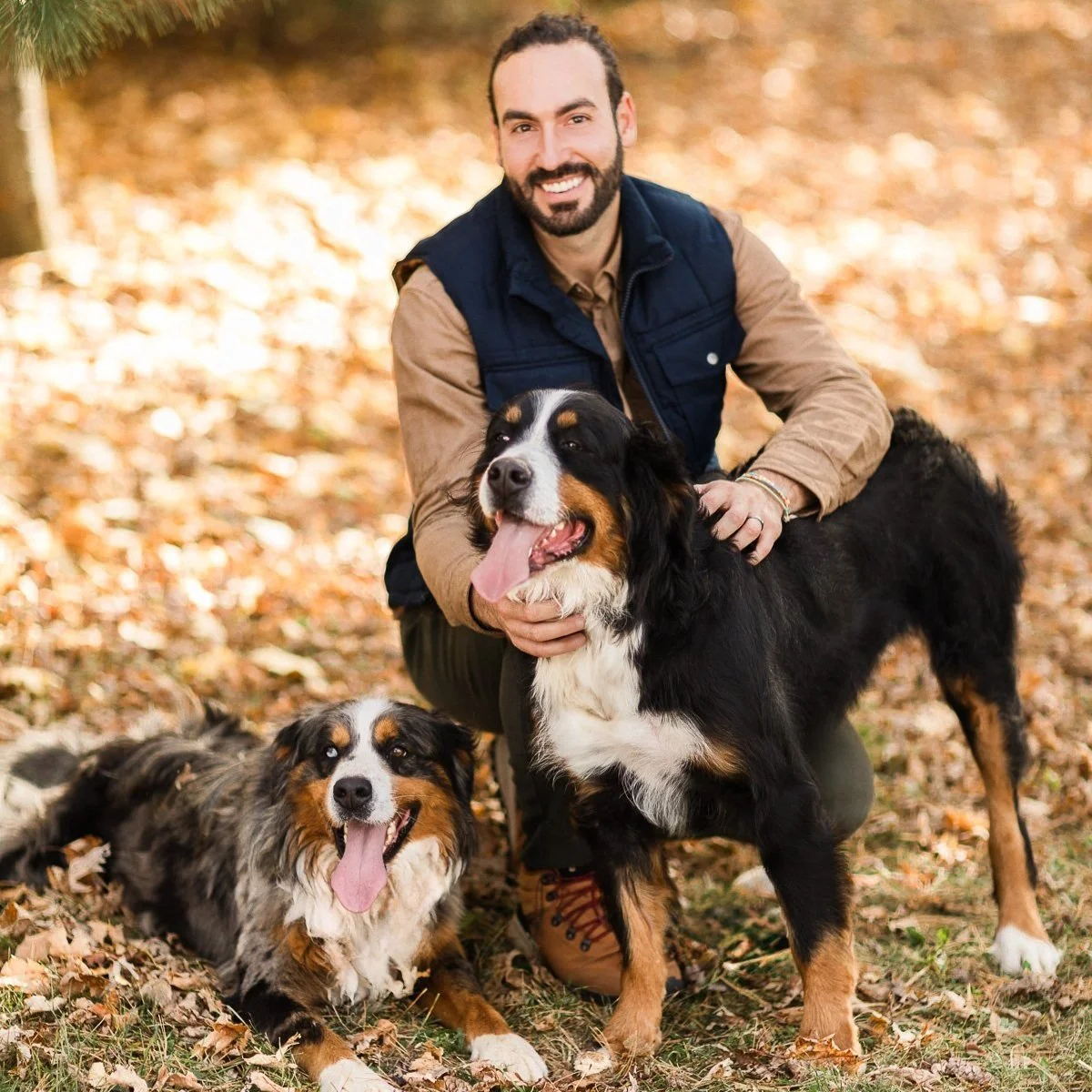
Australian Mountain Doodle:
Complete Breed Guide
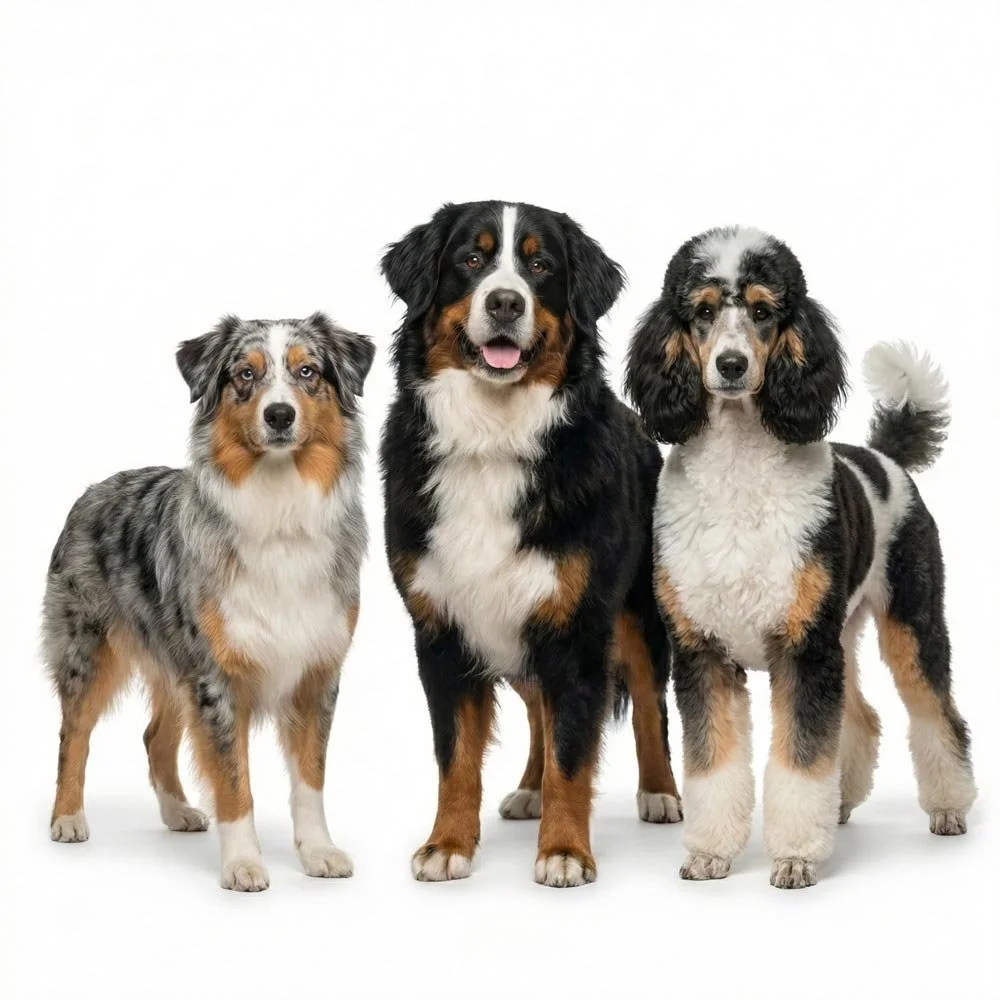
The Australian Mountain Doodle is a triple-cross hybrid combining the Bernese Mountain Dog, Australian Shepherd, and Poodle. Bred by Stokeshire Designer Doodles in Medford, Wisconsin since 2020 using documented Utah stock dog lineage and full health-tested parent breeds.
Also known as: Swiss Doodle · Aussie Mountain Doodle · Aussiebernedoodle · Australian Bernedoodle
View Planned Litters Our Origin Story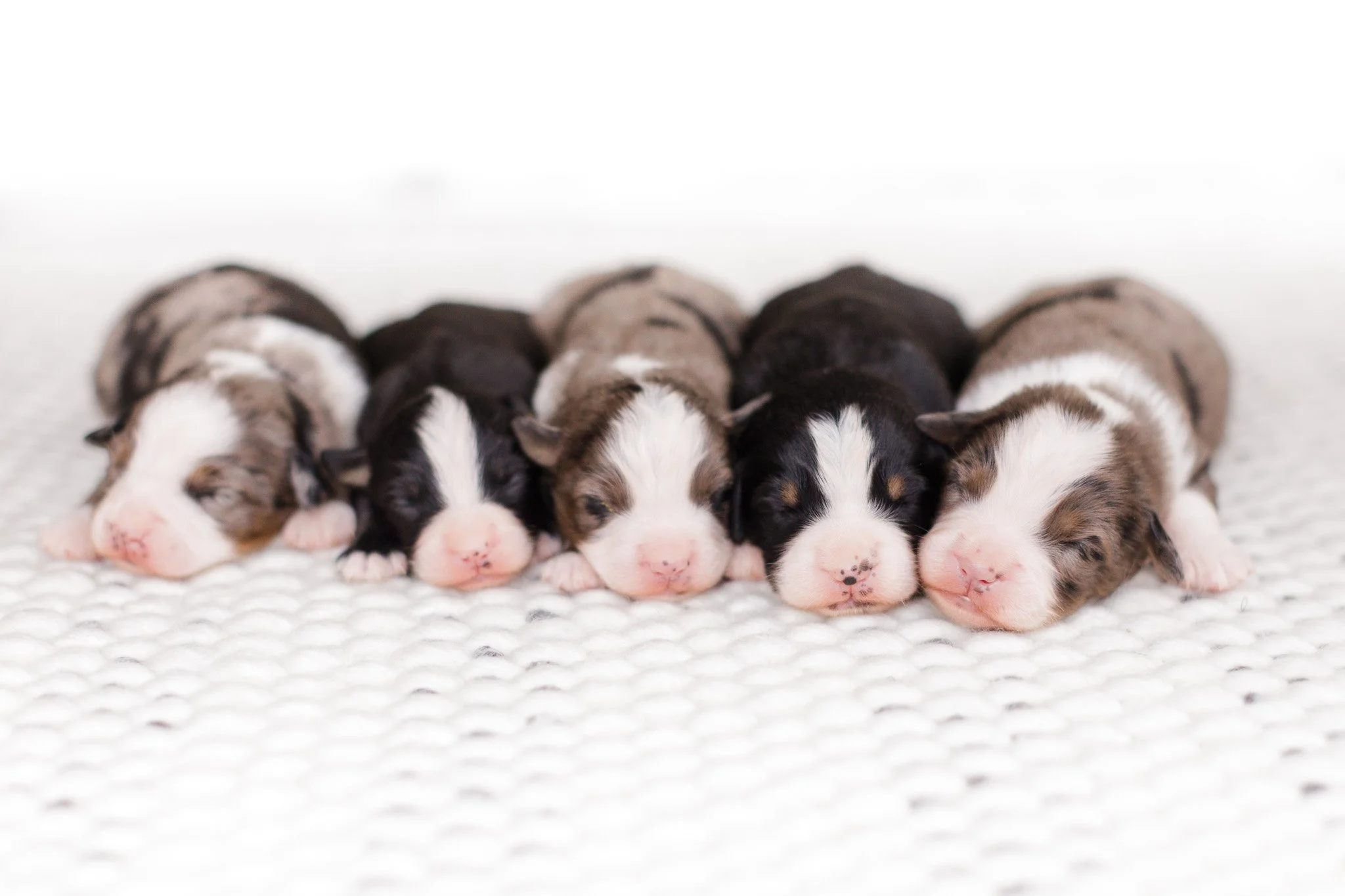
Australian Mountain Doodle: Quick Facts
| Breed Type | Designer hybrid. Triple cross. Not AKC or FCI recognized. |
| Parent Breeds | Bernese Mountain Dog × Australian Shepherd × Poodle |
| Stokeshire Origin | Brought to the Midwest in 2020 using Utah stock dog Mini Australian Shepherd lineage |
| Also Called | Swiss Doodle, Aussie Mountain Doodle, Aussiebernedoodle, Australian Bernedoodle |
| Size Range | Toy/Micro, Mini, Medium, Standard. 10 to 100 lbs adult |
| Coat Types | Wavy, curly, furnished, or unfurnished. Determined by RSPO2, KRT71, MC5R, and FGF5 genetics |
| Shedding Level | Low to moderate. Furnished dogs with curly coats shed least. |
| Temperament | Intelligent, loyal, calm, affectionate, adaptable |
| Exercise Need | 60 to 90 minutes daily structured activity plus mental stimulation |
| Trainability | Very high. Positive reinforcement, fast acquisition, strong retention. |
| Lifespan | 10 to 16 years. Smaller dogs tend to live longer. |
| Best Suited For | Active families, allergy-sensitive homes, therapy dog programs, first-time owners with training commitment |
| Where We Breed | Stokeshire raises Australian Mountain Doodles in Medford, Wisconsin. Nationwide transport available. |
| Pricing | $4,000 to $5,500 from Stokeshire depending on size, coat genetics, and program. Current pricing may vary by litter, training, and transport. See Stokeshire puppy pricing. |
How Stokeshire Brought the Australian Mountain Doodle to the Midwest
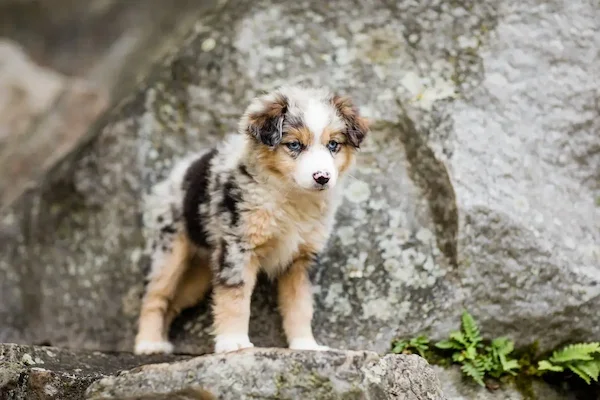
SDD Olivet Stokes · Foundation Mini Aussie · ASDR Registered
In 2020, Stokeshire Designer Doodles began developing the Australian Mountain Doodle as an intentional Midwest breeding program. The goal was specific: combine the calm anchor of the Bernese Mountain Dog, the working intelligence of the Australian Shepherd, and the low-shedding coat genetics of the Poodle into a single cross that would excel in family life, training-intensive roles, and therapy work.
The decision that shaped everything afterward was the genetic foundation. Rather than sourcing pet-line Australian Shepherds bred primarily for appearance, Stokeshire selected Utah stock dog Miniature Australian Shepherds registered with the American Stock Dog Registry (ASDR). Stock dog lineage represents decades of selection by working farmers, ranchers, and herding professionals who bred for temperament consistency, trainability, stress resilience, and health robustness across generations.
That selection logic is what we apply to our foundation breeding decisions. Stock dogs were historically bred to work alongside humans in demanding conditions, respond to subtle cues, and adapt to novel environments. We believe these selection priorities inform the baseline temperament we look for in every Australian Mountain Doodle produced at Stokeshire, though individual outcomes always depend on environment, socialization, and training.
The Stokeshire AMD Foundation Lineage
Stokeshire's foundation Miniature Australian Shepherd, SDD Olivet Stokes (ASDR registration ASDM-WI-2102204), carries direct lineage from three established Utah stock dog programs known for consistent temperament and athletic soundness:
Why Stock Dog Foundation Matters in Doodle Breeding
Most doodle programs source from pet-line or show-line parent breeds selected primarily for color, coat, or conformation. Stock dog lineage represents a different selection priority: functional working traits that, in our program experience, can contribute to better-fit outcomes for family companion work, therapy placement, and advanced training. Selection priorities are not destiny, but they shape the starting point.
- Temperament selection priority. Stock dog programs have historically selected for consistent working temperament across generations. In our program experience, this foundation has supported more predictable temperament outcomes during structured puppy assessment.
- Training-oriented selection. These dogs were bred to respond to subtle communication. We have found this background can contribute to responsive training acquisition, though individual results vary significantly with handler skill, consistency, and environment.
- Functional health selection. Working stock dog programs maintain health through selection pressure, since dogs that cannot work are not bred. We view this as a meaningful complement to formal veterinary health testing, not a replacement for it.
- Adaptability selection. Stock dogs were historically conditioned to work in novel, unpredictable environments. We believe this can contribute to baseline adaptability we look for in therapy-adjacent temperament candidates, though training and environment ultimately shape these outcomes more than ancestry alone.
Selection logic is not a guarantee. Environment, socialization, and training shape outcomes more than ancestry alone. But starting with documented stock dog lineage establishes a deliberate genetic baseline aligned with the traits Stokeshire's families value most.
What Is an Australian Mountain Doodle?
An Australian Mountain Doodle is a triple-cross hybrid produced by combining three distinct parent breeds: the Bernese Mountain Dog, the Australian Shepherd, and the Poodle. The cross is intentionally designed to unite three complementary qualities: the calm, devoted temperament of the Bernese; the working intelligence and trainability of the Australian Shepherd; and the low-shedding coat genetics of the Poodle.
The naming of this cross is not standardized across breeders. Swiss Doodle, Aussie Mountain Doodle, Aussiebernedoodle, and Australian Bernedoodle all describe the same or closely related three-way pairing. Note that "Australian Bernedoodle" is also used by some programs to describe a Bernese Mountain Dog crossed with an Australian Labradoodle, which is a different multi-generation cross that may introduce additional breeds beyond the three described here.
On this page, Stokeshire Designer Doodles uses "Australian Mountain Doodle" as the primary name and defines it specifically as Bernese Mountain Dog × Australian Shepherd × Poodle. For families weighing this cross against related doodle breeds, our Australian Mountain Doodle vs. Bernedoodle vs. Aussiedoodle comparison walks through the practical differences in detail.
The broader doodle context is well documented. Intentional Poodle crosses for guide dog work date to the late 1980s. The Australian Mountain Doodle cross is a more recent development, with breeder-reported origins varying by program. Stokeshire's contribution was bringing the cross to the Midwest in 2020 using Utah stock dog Mini Australian Shepherd genetics, establishing a regional program with documented lineage and structured early development protocols.
The goal of this cross is balance. The Bernese provides the anchor. The Aussie provides the spark. The Poodle provides the coat.
Why Three Breeds Instead of Two?
Every deliberate breeding program answers a specific question: what problem does this cross solve that simpler crosses do not? Both Bernedoodles and Aussiedoodles are excellent crosses with established markets. The Australian Mountain Doodle exists because each two-way cross has limitations that the three-way cross addresses.
Stability Without Spark
Bernedoodles tend to deliver calm and devotion but may lack the working drive that makes advanced training and therapy work engaging for high-intelligence dogs. Some Bernedoodles plateau in training or struggle with boredom in low-stimulation environments.
Drive Without Anchor
Aussiedoodles tend to deliver intelligence and trainability but often carry higher energy and herding instincts that require experienced owners. They excel with active families but can struggle in settled therapy or guardian roles requiring sustained calm.
Calm Sharpness
The Australian Mountain Doodle splits the difference. The Bernese anchor (~25%) may help moderate energy and herding behavior. The Aussie (~25%) contributes problem-solving and working-dog foundation. The Poodle (~50%) provides coat genetics and trainability. Our goal: a dog calm enough for therapy-adjacent work, sharp enough for advanced training. Individual outcomes always depend on temperament, environment, and training.
The Stokeshire Method Applied to AMD
Stokeshire's AMD program layers four practices that compound genetic potential into observable outcomes:
- Intentional genetics. Stock dog Mini Aussie foundation. Health-tested Bernese parents (OFA, full genetic panels). Standard or Miniature Poodles screened for hip dysplasia, PRA, von Willebrand's disease, and gastric dilation-volvulus risk.
- Early neurological stimulation. Begins at 3 days old. Five-exercise protocol developed for working dog programs that has been shown to enhance stress resilience, cardiovascular response, and adaptability.
- Structured socialization. Exposure to varied surfaces, sounds, people, and environments during the critical 3 to 12 week window when puppies form lifelong associations.
- Temperament matching. Each puppy is assessed individually using a structured protocol (Volhard Puppy Aptitude Test plus Stokeshire-specific criteria) and matched to families or roles based on fit, not arrival order.
This integrated approach is what distinguishes the Stokeshire AMD from other Bernese/Aussie/Poodle crosses that may use different genetic starting points or skip early development protocols. The cross itself matters. The development around the cross matters more.
Which Breeds Make Up an Australian Mountain Doodle?
Each parent breed contributes distinct traits. Understanding each lineage helps families anticipate the range of outcomes possible and recognize why health screening on each parent is essential before breeding.
Bernese Mountain Dog
Originally bred as a Swiss farm dog, the Bernese is known for its devoted, gentle-giant temperament. It contributes calm, loyalty, and patience with children. Bernese Mountain Dogs have a higher incidence of histiocytic sarcoma and hip/elbow dysplasia relative to the general dog population. OFA evaluations and full genetic panels are standard in responsible Bernese programs.
Australian Shepherd
Developed in the American West as a working herding breed, the Australian Shepherd contributes sharp problem-solving, athleticism, and the merle genetics behind the breed's striking color patterns. Australian Shepherds carry a significant rate of the MDR1/ABCB1 drug sensitivity variant, and AMD puppies may inherit this. Testing before any drug exposure is essential.
Poodle
Available in Standard, Miniature, and Toy sizes, the Poodle contributes trainability, emotional attunement, and the coat genetics associated with low shedding: the RSPO2 furnishings gene and MC5R shedding variant. The Poodle size used is the primary driver of adult AMD size. Standard Poodles are screened for hip dysplasia, PRA, von Willebrand's disease, and gastric dilation-volvulus risk.
F1, F1B, F2, Multigen Australian Mountain Doodles
Generation labels describe the breeding structure behind a puppy. In triple-cross dogs, these labels are not universally standardized. A common F1 AMD structure is an F1 Bernedoodle (50% Bernese / 50% Poodle) crossed with an F1 Aussiedoodle (50% Australian Shepherd / 50% Poodle), producing approximately 50% Poodle, 25% Bernese, 25% Australian Shepherd. This is a breeding-structure expectation, not a guarantee for every program.
| Generation | Typical Genetic Structure | Coat Expectation | Best Suited For |
|---|---|---|---|
| F1 | ~50% Poodle, ~25% Bernese, ~25% Aussie | Wavy to straight. Moderate shedding. Coat varies by furnishings status. | Families comfortable with coat variability and strong hybrid vigor |
| F1B | ~75% Poodle, ~12.5% Bernese, ~12.5% Aussie (F1 × Poodle) | Curlier, lower-shedding. May suit some allergy-sensitive homes. | Allergy-sensitive homes. First-time doodle owners. |
| F2 | ~50% Poodle, ~25% Bernese, ~25% Aussie (F1 × F1) | Wide variation possible. Coat and size less predictable. | Families comfortable with variability in outcomes |
| F2B | ~62.5% Poodle (F2 × Poodle) | Wavy to curly. Low-shedding. More predictable furnishings. | Structured households. Therapy potential. Coat consistency priority. |
| Multigen | Multiple generations. Proportions vary by program design. | Most consistent. Curly or wavy. Lowest shedding. | Allergy-sensitive families. Maximum coat predictability. |
Australian Mountain Doodle Puppies for Sale in Wisconsin
Stokeshire offers three structured entry points for families seeking an Australian Mountain Doodle from our Medford, Wisconsin program. Each tier reflects a different level of preparation and investment. Nationwide transport available. Current pricing may vary by litter, training package, color genetics, and transport requirements.
Reserve a puppy from a current or planned AMD litter. Choose your pairing based on pedigree, color genetics, and projected coat outcome.
From $4,000* Browse Litters → Tier 2 · Available Now Available AMD PuppiesCurrently available Australian Mountain Doodle puppies ready for placement. Temperament-matched and developmentally prepared for transition.
From $4,500* View Available → Tier 3 · Bespoke Trained AMD CompanionsFully trained Australian Mountain Doodles delivered with foundational obedience, socialization, and optional therapy or advanced companion preparation.
From $9,500* Explore Bespoke →*Starting prices. Current pricing varies by litter, training package, color genetics, and transport requirements. See Stokeshire puppy pricing for complete details.
Australian Mountain Doodle Temperament
The Australian Mountain Doodle temperament reflects the combined influence of all three parent breeds. Modern canine behavioral genetics research confirms that breed ancestry is a meaningful but modest predictor of individual behavior. One large genomics study found that breed ancestry explains approximately 9% of behavioral variation across individual dogs, with environment, socialization, and training playing a much larger role. This means temperament language for any cross should use "tends to," "often," and "varies by individual," and should emphasize early socialization over breed guarantees.
With that framing, Australian Mountain Doodles from well-bred, well-socialized programs tend to be: adaptable, people-oriented, emotionally attuned, calm in settled environments, and highly responsive to training. These qualities make them well suited to family life and, when properly developed, therapy and support work.
* Furnished dogs with curly coats shed least. No dog is 100% hypoallergenic. † With consistent daily exercise and mental stimulation.
Living Environment
Mini and Toy Australian Mountain Doodles adapt well to apartment living provided their exercise and mental stimulation needs are met consistently. They do not require a yard, they require time and activity from their owner. Medium and Standard AMDs can also live in apartments with a disciplined exercise routine, but their larger size and higher energy output make this more demanding. All size categories benefit from outdoor access and should not be expected to self-exercise in a yard without human engagement.
Who the Australian Mountain Doodle Is Not Ideal For
- Households where the dog will be left alone 8+ hours daily. Australian Shepherd lineage can increase separation anxiety risk without proper conditioning. Separation anxiety is a clinical behavioral condition that typically requires structured desensitization, not just gradually longer absences.
- Families unable to commit to 60 to 90 minutes of daily structured exercise
- Those expecting low-maintenance grooming. Furnished coats require brushing multiple times per week and professional grooming every 6 to 8 weeks to prevent matting.
- First-time owners not prepared to invest in early training, socialization, and ongoing obedience work
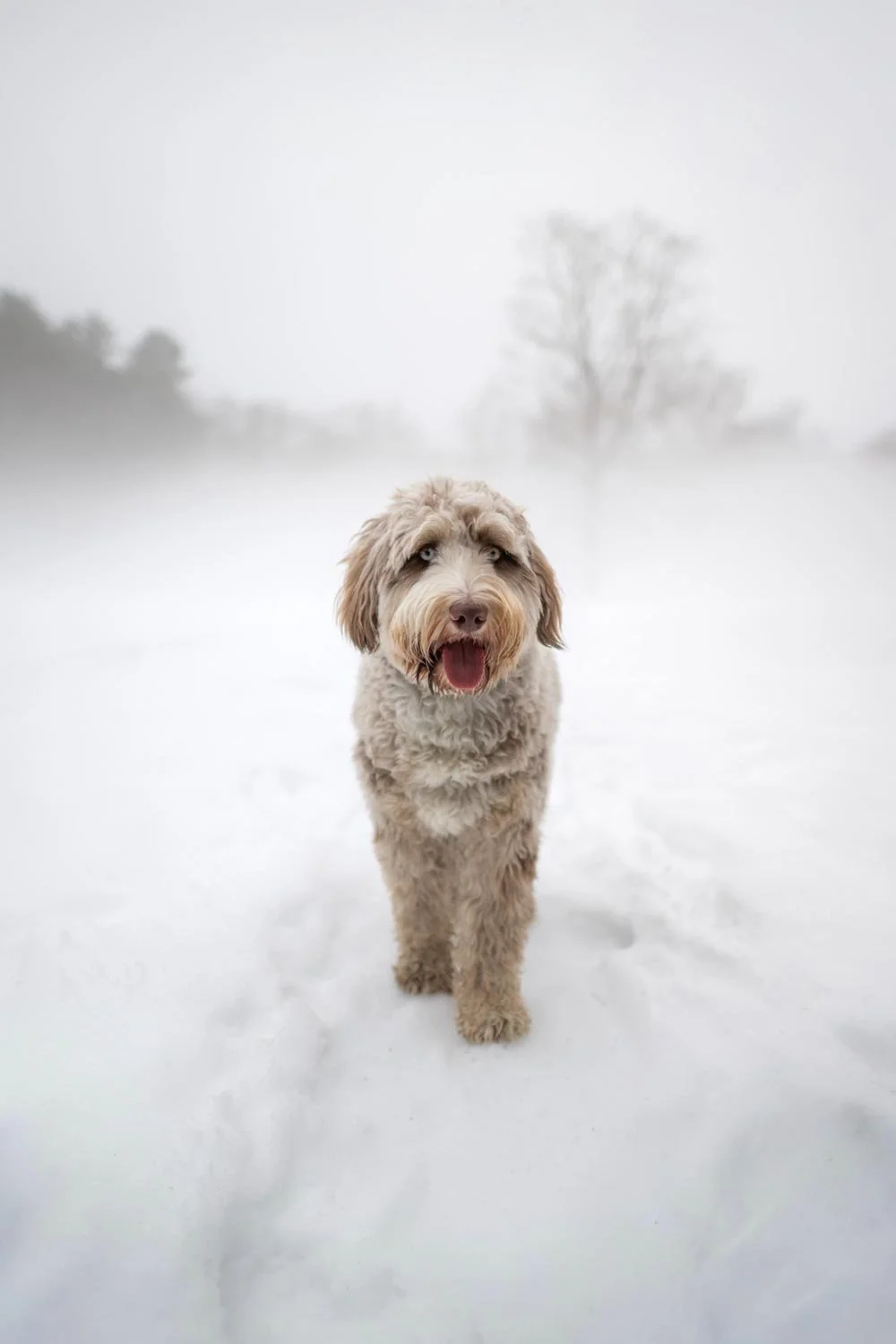
The AMD as a Modern Family Dog
Specifications describe the dog. They do not describe the life with the dog. Most families who choose a Stokeshire Australian Mountain Doodle are not optimizing for a single trait. They are looking for a companion that quietly fits the shape of their home: present at the kitchen island in the morning, settled under the desk during work calls, attentive on the trail, calm at the cabin, patient with the youngest member of the family.
The AMD tends to suit families who want a dog that meets them where they are. Active households appreciate the working-dog intelligence and stamina. Settled households appreciate the Bernese-influenced calm. Households with children often value the patience and emotional attunement that comes through in well-socialized puppies. Households that travel value the adaptability that allows an AMD to settle into a hotel room, a guest house, or a new routine without unraveling.
What we have observed across 548+ family placements is that AMDs tend to fit best with people who want a dog deeply integrated into daily life, not relegated to a backyard or a corner. They thrive on inclusion, structure, and consistency. They are not low-engagement dogs. They are companions, in the older sense of the word: present, attentive, and woven into the rhythm of the family.
For families weighing whether the AMD suits their lifestyle specifically, the Stokeshire Dream Dog Quiz walks through household structure, activity level, experience with dogs, and goals to identify whether an AMD, a different doodle cross, or a different size and generation might fit best.
How Big Do Australian Mountain Doodles Get?
Adult size is primarily determined by the Poodle parent used. Standard AMDs typically reach 23 to 29 inches and 50 to 100 lbs. Mini AMDs typically reach 17 to 20 inches and 25 to 35 lbs. No specific adult size is guaranteed in any hybrid breeding program.
| Size | Adult Weight | Adult Height | Full Growth By | Lifespan Est. |
|---|---|---|---|---|
| Toy / Micro | 10 to 24 lbs | 12 to 18 in | 10 to 12 months | 14 to 16 years |
| Mini | 25 to 35 lbs | 17 to 20 in | ~12 months | 13 to 15 years |
| Medium | 35 to 50 lbs | 18 to 22 in | 12 to 18 months | 12 to 14 years |
| Standard | 50 to 100 lbs | 23 to 29 in | 18 to 24 months | 10 to 13 years |
→ Full size guide: growth timelines, growth plate protection, and lifespan by size
Australian Mountain Doodle Coat Types
Whether a doodle sheds, how curly it looks, and whether it is appropriate for allergy-sensitive homes are all determined by specific, testable gene variants, not by generation labels. Four loci control the coat characteristics families care most about.
Controls facial hair: beard, eyebrows, moustache. Furnished dogs (FF or Ff) have the classic doodle appearance. Unfurnished dogs (ff) have natural facial hair and shed considerably more. Unfurnished AMDs are not appropriate for allergy-sensitive households and are never marketed as hypoallergenic at Stokeshire.
Determines coat curl tightness. Two copies produce curly. One copy produces wavy. Zero produces straight or soft wave. Curlier coats shed least but mat most quickly without brushing. Wavy is the most common and widely preferred expression in AMD programs.
Influences the hair growth cycle turnover rate. Poodles typically carry the low-shedding variant, a primary genetic reason doodle-type dogs distribute less hair into the environment. Shedding is multigenic. No single gene guarantees a non-shedding outcome.
Controls overall coat length. Most furnished AMDs carry the long-coat FGF5 variant through Poodle lineage. Dogs expressing the short-coat variant will have noticeably shorter coats regardless of curl or furnishings status.
→ Deep dive: all four genes explained, shedding scale, genotype outcome table, merle safety
Coat Patterns & Colors
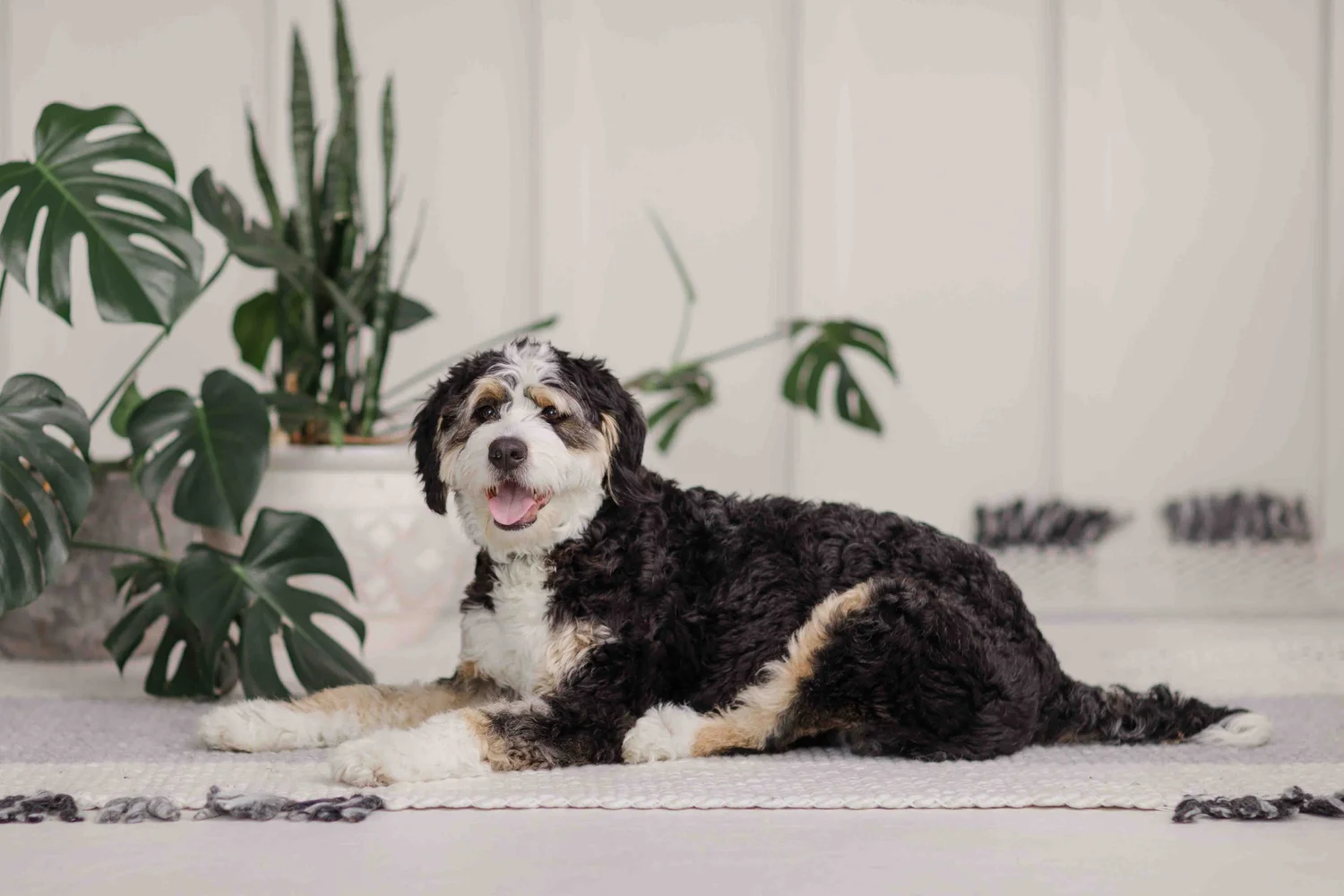
The Australian Shepherd parent introduces the merle gene (PMEL/SILV locus) to the cross. The Bernese Mountain Dog contributes the tri-color foundation. Common patterns in AMD litters, including the striking parti and merle parti combinations, are summarized below.
Black or brown base with white markings and copper/tan points. The classic Bernese-influenced pattern.
Black-based merle. Grey, black, and white marbling. Often paired with blue or heterochromatic eyes.
Brown-based merle. Red, chocolate, and cream marbling.
Base color with secondary markings above eyes, cheeks, legs, and chest.
Large patches of two or more colors, typically with significant white. See full parti guide →
Solid base with white chest and paws, or two predominant colors.
Australian Mountain Doodle Grooming Requirements
Low-shedding doodle coats are not low-maintenance coats. This is the trade-off most breeder pages fail to explain. Curly and wavy furnished coats retain shed hair within the coat structure rather than releasing it into the environment. That retained hair accumulates, tangles, and mats without consistent brushing. The lower the shedding, the higher the brushing requirement.
Brushing
Professional grooming every 6 to 8 weeks. Highest grooming demand of all coat types. Mat risk is significant without consistent attention.
Brushing
Professional grooming every 6 to 8 weeks. Most common AMD coat. More manageable than curly but still mats in friction zones without regular attention.
Brushing
Professional grooming every 8 to 10 weeks. Most forgiving furnished coat to maintain, though mat-prone zones still need regular attention.
Brushing
Lower mat risk due to natural shedding cycle. Professional grooming every 10 to 12 weeks. Higher environmental shedding than furnished coats.
The Seven Mat-Prone Zones
Mats develop fastest in areas where coat experiences repeated friction. These zones require extra attention every brushing session regardless of overall coat condition: behind the ears, collar zone, armpits, groin/inner thighs, under harness straps, facial furnishings, and paw feathering. Always brush before bathing. Water tightens existing tangles and sets them permanently.
→ Complete grooming guide: tools, techniques, puppy introduction protocol
Australian Mountain Doodle Health Considerations
The Australian Mountain Doodle can inherit health considerations from all three parent breeds. Responsible breeders mitigate these risks through documented health testing on each parent before breeding. There is no official health testing standard for the AMD as a cross. Stokeshire applies the testing protocols established for each parent breed individually.
Bernese Mountain Dog Considerations
- Histiocytic sarcoma (elevated breed risk)
- Hip and elbow dysplasia
- Degenerative myelopathy (DM)
- Von Willebrand's disease
- Cardiac evaluations
Australian Shepherd Considerations
- MDR1/ABCB1 drug sensitivity variant
- Hip dysplasia
- Progressive retinal atrophy (PRA)
- Collie eye anomaly
- Hereditary cataracts
Poodle Considerations
- Hip dysplasia (Standard Poodles)
- Progressive retinal atrophy (PRA)
- Von Willebrand's disease
- Gastric dilation-volvulus (GDV) risk
- Sebaceous adenitis
The Stokeshire Health Testing Standard
Every Stokeshire breeding parent is screened before being approved for the program. Testing protocol includes:
- OFA hip and elbow evaluations. Stokeshire generally prefers PennHIP scoring over OFA for more precise hip joint laxity measurement.
- Full Embark genetic panel. Screens for 250+ heritable conditions plus coat genetics, color genetics, and breed composition verification.
- Cardiac evaluation for breeds with elevated cardiac risk (Bernese, Standard Poodle).
- Eye certification (CAER/CERF) for breeding-age dogs.
- MDR1 testing on Australian Shepherd lineage and any offspring before drug exposure.
- COI analysis on every planned pairing using Embark's coefficient of inbreeding calculator. Target eCOI under 10% for outcross hybrids.
Why Triple-Cross Hybrid Vigor Matters
Purebred dogs from closed gene pools tend to show higher rates of inherited conditions due to limited genetic diversity. The Australian Mountain Doodle, as a three-way cross between unrelated parent breeds, generally produces puppies with low coefficients of inbreeding and high genetic diversity. This hybrid vigor has been associated with reduced expression of recessive genetic conditions, though it does not eliminate the risk of any single inherited condition.
Training the Australian Mountain Doodle
The Australian Mountain Doodle is among the most trainable doodle crosses. The combination of Poodle trainability, Australian Shepherd working drive, and Bernese willingness to please tends to produce dogs that acquire commands quickly, retain training reliably, and respond well to positive reinforcement methods. This trainability is a feature, not a luxury: AMDs require structured training to channel their intelligence productively.
Foundation (8 to 16 weeks)
Crate training, potty training, name recognition, sit/down/come, leash introduction, handling tolerance, socialization to varied environments and people.
Obedience (4 to 8 months)
Reliable recall, loose-leash walking, settle on cue, place training, impulse control around food and doorways, distraction-proof basic commands.
Advanced (8 to 18 months)
Off-leash reliability, complex command chains, public access readiness, foundation for therapy or service work if applicable, mental enrichment routines.
Specialty (Optional)
Therapy dog certification preparation, service dog task training, scent work, agility, advanced obedience competition. Stokeshire offers structured pathways for families pursuing these outcomes.
Stokeshire Training Pathways
Stokeshire offers integrated training options for families who want professional support layered into their AMD ownership:
- Doodle School (4 weeks). Standard board-and-train program covering foundation obedience, crate proficiency, and leash skills. Puppy returns home with structured handler instructions.
- Bootcamp. Extended training intensives for families pursuing advanced behavioral outcomes.
- Therapy-Informed Training. Specialized pathway for AMD puppies destined for therapy work, animal-assisted therapy programs, or emotional support roles.
- Trained AMD Companions. Fully trained Australian Mountain Doodles delivered with foundational obedience complete. Bespoke tier includes specialized preparation.
Australian Mountain Doodles in Therapy Settings
Genetic potential matters only when it produces real-world outcomes. One of Stokeshire's primary measures of AMD program success is therapy dog placement and performance. Since 2020, Stokeshire AMD dogs have been placed in Animal-Assisted Therapy (AAT) programs serving clinical settings across the United States.
The combination of stock dog behavioral foundation, structured early development, and Stokeshire's temperament-matching protocol tends to produce puppies well suited to therapy work. Selection for therapy potential happens during structured temperament assessment in the 6 to 8 week window, when individual personality traits become clearly observable.
Rocky: Stokeshire AMD at Mobile Therapy Centers
Rocky is an Australian Mountain Doodle born Spring 2023 from the Nora × Apollo litter. At 8 weeks old, Rocky was placed with Mobile Therapy Centers (MTC) in Libertyville, Illinois for an Animal-Assisted Therapy training pathway. His lineage carries the stock dog foundation, early neurological stimulation protocol, and Stokeshire's temperament-matching assessment.
Rocky now participates in structured AAT sessions at MTC's pediatric clinic. His role includes providing comfort and support during occupational therapy sessions, helping reduce client anxiety, and creating an environment where children engage more openly with therapeutic activities.
Therapy Dog Indicators in Stokeshire AMD
Stokeshire identifies AMD puppies with therapy potential early through a structured assessment protocol. Key indicators include:
- Stress resilience. Response to novel stimuli (loud noise, unfamiliar people, unpredictable movement). Does the puppy recover quickly or remain elevated?
- Social motivation. Does the puppy seek human interaction or withdraw? Therapy dogs must be people-oriented at baseline.
- Impulse control. Can the puppy settle and focus despite environmental activity? Therapy work requires sustained calm.
- Trainability. How quickly does the puppy acquire commands and retain them? Therapy work requires reliable behavior under stress.
- Mouth softness. Does the puppy take treats gently? Therapy dogs interact with hands and medical devices. Soft mouth is essential.
Puppies that score highly across these domains are flagged for therapy pathways and matched to families pursuing AAT, emotional support, or service work. Individual outcomes depend on continued training, handler experience, and environmental fit. Stokeshire does not guarantee therapy certification outcomes.
→ Full therapy dog guide: temperament, certification pathways, ADA distinctions
AMD vs. Bernedoodle vs. Aussiedoodle
Families often weigh the Australian Mountain Doodle against the Bernedoodle and Aussiedoodle. All three are excellent crosses with established markets. The differences come down to behavioral profile, lifestyle fit, and goals.
| Trait | Australian Mountain Doodle | Bernedoodle | Aussiedoodle |
|---|---|---|---|
| Parent Breeds | Bernese × Aussie × Poodle | Bernese × Poodle | Aussie × Poodle |
| Temperament | Calm with working drive | Calm, devoted | High-energy, sharp |
| Energy Level | Moderate to High | Moderate | High |
| Trainability | Very High | High | Very High |
| Therapy Suitability | Excellent (when matched) | Good | Variable (depends on energy) |
| Best For Apartments | Mini/Toy sizes | Mini sizes | Mini sizes with high exercise |
| Lifespan Range | 10 to 16 years | 10 to 14 years | 12 to 15 years |
| Best Suited For | Families seeking calm sharpness for therapy, training, or active family life | Families prioritizing calm devotion and lower-energy companionship | Active families with experience handling working-dog energy |
→ Full comparison: AMD vs. Bernedoodle vs. Aussiedoodle decision guide
Bringing the Australian Mountain Doodle to America
Before 2020, the Australian Mountain Doodle was not established as a distinct cross in the Midwest. The market was dominated by Bernedoodles and Aussiedoodles. Stokeshire's decision to develop the AMD using Utah stock dog Mini Australian Shepherd genetics created a regional program where one did not previously exist.
Since 2020, Stokeshire's AMD program has grown into a recognized authority on the breed cross. The program's geographic reach validates the cross across diverse climates, family structures, and use cases.
Australian Mountain Doodle FAQs
What makes Stokeshire's AMD different from other Bernese/Aussie/Poodle crosses?
Stokeshire's Australian Mountain Doodle program is built on Utah stock dog Miniature Australian Shepherd genetics registered with the American Stock Dog Registry (ASDR), rather than pet-line or show-line Aussies. This genetic choice generally produces more consistent temperament, working-dog adaptability, and behavioral reliability across litters.
In addition to the foundation lineage, Stokeshire applies early neurological stimulation starting at 3 days old, structured socialization through the 8-week placement window, individual temperament matching using the Volhard Puppy Aptitude Test plus Stokeshire-specific criteria, and a written health guarantee. These layered practices distinguish Stokeshire's AMD from breeders who may use different genetic starting points or skip early development protocols.
Are Australian Mountain Doodles hypoallergenic?
No dog is 100% hypoallergenic. However, furnished Australian Mountain Doodles with curly coats tend to shed significantly less than unfurnished dogs or many other breeds. Families with mild to moderate allergies often report fewer symptoms with curly-coated furnished AMDs, though individual response varies based on the specific allergen sensitivity.
Unfurnished AMDs (RSPO2 ff) shed considerably more and are not appropriate for allergy-sensitive households. Stokeshire never markets unfurnished dogs as hypoallergenic. For allergy-sensitive families, F1B or multigen AMDs with confirmed RSPO2 furnishings and KRT71 curl genetics offer the most consistent low-shedding outcomes.
How is an AMD different from an Aussiedoodle?
Aussiedoodles tend to be higher energy and more herding-driven than Australian Mountain Doodles. The AMD adds the Bernese Mountain Dog anchor (~25%), which generally moderates energy and herding instinct while preserving the intelligence and working-dog drive of the Aussie. The result is often a dog that is calmer in home environments but retains the trainability that makes Aussiedoodles excel.
AMDs may be better suited to families seeking a dog that is both intelligent and settled. Aussiedoodles tend to fit very active families who can match the higher exercise and stimulation demands. Individual temperament varies, and Stokeshire's matching process helps identify which puppies suit which lifestyles regardless of cross.
How is an AMD different from a Bernedoodle?
Bernedoodles tend to be calmer and more devoted but may lack the working-dog drive and adaptability that makes advanced training or therapy work engaging for high-intelligence dogs. Australian Mountain Doodles retain the Bernese anchor while adding Australian Shepherd intelligence and adaptability, generally producing dogs that excel in both family life and training-intensive roles.
If you are choosing primarily for a calm family companion without therapy or advanced training goals, a Bernedoodle may suit equally well. If you want the option to pursue therapy work, service training, or advanced obedience while keeping a calm family dog, an AMD's working-dog foundation provides more headroom.
Why does Stokeshire use stock dog genetics instead of pet-line Australian Shepherds?
Stock dog Mini Australian Shepherds registered with the American Stock Dog Registry (ASDR) are bred for working ability over generations. Selection pressure favors temperament consistency, trainability, stress resilience, and health robustness. Pet-line Aussies are often selected primarily for appearance, which can introduce wider behavioral variance across litters.
For a breeding program aiming to produce reliable therapy candidates, training-capable family dogs, and predictable temperaments, stock dog foundation creates a more consistent genetic baseline. Stokeshire's foundation Mini Aussie, SDD Olivet Stokes, carries lineage from Fullerton Legend of Hercules, Foreman's Cowboy, and Gravatt's Tori, three established Utah stock dog programs.
What health conditions should AMD owners be aware of?
The Australian Mountain Doodle can inherit considerations from all three parent breeds. Bernese Mountain Dogs carry elevated risk for histiocytic sarcoma and hip/elbow dysplasia. Australian Shepherds can carry the MDR1/ABCB1 drug sensitivity variant and may have hip dysplasia or eye conditions including progressive retinal atrophy. Poodles can have PRA, von Willebrand's disease, and gastric dilation-volvulus risk.
Responsible breeders mitigate these risks through documented health testing on each parent including OFA or PennHIP evaluations, full Embark genetic panels, cardiac and eye certifications, and MDR1 testing. See the Stokeshire Health Guarantee for specific coverage and the AMD Health Testing Guide for complete protocol details.
Can Australian Mountain Doodles be therapy dogs?
Yes. Stokeshire's AMD breeding intentionally selects for therapy-relevant traits including emotional attunement, stress resilience, trainability, and people orientation. Puppies flagged for therapy potential during temperament assessment enter specialized training pathways. Rocky, a Stokeshire AMD, currently works as an Animal-Assisted Therapy dog at Mobile Therapy Centers in Illinois.
Not every AMD will become a therapy dog. Individual temperament, training quality, handler experience, and certification organization standards all influence outcomes. Stokeshire does not guarantee therapy certification but offers structured pathways for families pursuing this work. See the Therapy Dog Guide for full details.
What generation should I choose: F1, F1B, F2, or Multigen?
F1 AMDs offer the broadest hybrid vigor and genetic diversity but coat outcomes vary more across the litter. F1B (75% Poodle) generally produces more consistent low-shedding coats and is often recommended for allergy-sensitive families. F2 offers flexibility but coat predictability is similar to F1. F2B and Multigen offer the most consistent furnished, low-shedding coat outcomes.
For families prioritizing coat consistency and allergy management, F1B, F2B, or Multigen are typically the right choice. For families comfortable with coat variability and wanting the broadest genetic diversity, F1 is excellent. Discuss generation choice with Stokeshire based on your specific household needs. Generation label alone does not determine fit.
How much exercise does an Australian Mountain Doodle need?
Adult Australian Mountain Doodles typically need 60 to 90 minutes of structured daily activity plus mental stimulation. This can include walks, fetch, training sessions, puzzle games, or scent work. Consistency matters more than intensity. AMDs that do not receive adequate physical and mental exercise can develop destructive behavior, vocalization, or anxiety.
Puppies under 12 months should follow more restrained exercise protocols to protect developing growth plates. The general guideline is 5 minutes of structured exercise per month of age, twice daily, with unstructured play time additional. AMDs also benefit from early conditioning for separation tolerance because the Australian Shepherd lineage can increase separation anxiety risk without proper preparation.
Do AMDs have high grooming requirements?
Yes. Furnished, curly-coated AMDs require brushing every 2 to 3 days and professional grooming every 6 to 8 weeks to prevent matting. Wavy-coated furnished AMDs require brushing 3 to 4 times per week. This is the trade-off for low shedding: retained hair mats quickly without consistent maintenance.
If grooming commitment is a barrier, an unfurnished AMD may be more practical, though unfurnished dogs shed considerably more and are not appropriate for allergy-sensitive homes. Mat-prone zones (behind ears, collar, armpits, groin, harness contact areas, facial furnishings, paw feathering) require extra attention every brushing session. See the complete grooming guide for tools and techniques.
How long do Australian Mountain Doodles typically live?
Toy and Mini Australian Mountain Doodles often reach 14 to 16 years. Medium AMDs typically live 12 to 14 years. Standard AMDs typically live 10 to 13 years. Lifespan is influenced by genetics, weight management, exercise, diet, dental care, and routine veterinary care. Hybrid vigor from the three-way cross generally supports longer lifespans than the purebred Bernese Mountain Dog (which averages 7 to 9 years).
Responsible breeders health-test parents to reduce the risk of early-onset genetic conditions that shorten lifespan. Stokeshire tracks long-term outcomes across cohorts to refine lifespan expectations as the program matures.
Can Australian Mountain Doodles be service dogs?
Yes. The combination of intelligence, trainability, size flexibility, and emotional attunement makes AMDs viable service dog candidates for many task categories including psychiatric service, mobility support, medical alert, and autism support. However, service dog work requires 18 to 24 months of specialized training and qualified handler partnerships. Not every AMD will complete service certification.
Service dog certification is governed by ADA requirements and the standards of individual certification organizations. Stokeshire can discuss service dog potential during the application process for families pursuing this pathway. The Therapy-Informed Dog Training program provides foundation training that supports service work preparation.
What size AMD should I choose?
Size is primarily determined by the Poodle parent used in the cross. Toy/Micro AMDs (10 to 24 lbs) suit apartment living with consistent exercise and travel-friendly companionship. Mini AMDs (25 to 35 lbs) offer a popular middle-ground size for most households. Medium AMDs (35 to 50 lbs) work well for families with outdoor access and moderate activity levels. Standard AMDs (50 to 100 lbs) require more space and food but suit families seeking a larger companion.
Choose based on lifestyle, housing, and activity preferences rather than future role. A dog's size does not determine whether it will succeed in therapy work, service tasks, or family companionship. Temperament and training matter far more than size for role outcomes.
Why are Stokeshire AMDs more expensive than some other doodle breeders?
Stokeshire's AMD pricing ($4,000 to $5,500 base, up to $9,500+ for trained tier) reflects the cost of comprehensive health testing on both parents (OFA or PennHIP, Embark genetic panels, cardiac, eye certifications), early neurological stimulation, extensive socialization, individual temperament assessment, foundational training where applicable, lifetime program support, and long-term outcome tracking.
Additionally, ASDR-registered stock dog Miniature Australian Shepherds carry a premium because of their rarity and documented working lineage. Pricing reflects the actual cost of the program structure, not marketing markup. Families seeking a less expensive AMD will find them, often from breeders who skip health testing, early development protocols, or temperament matching. The cost difference reflects what the program does, not what the puppy is.
What is the Stokeshire Method?
The Stokeshire Method is a four-pillar breeding and puppy development approach: (1) Intentional Genetics selects parents for health and working-dog temperament including stock dog foundation Australian Shepherds; (2) Early Development begins neurological stimulation at 3 days old following protocols developed for working dog programs; (3) Temperament Matching assesses each puppy individually using structured criteria and matches puppies to families or roles based on fit; (4) Foundational Training introduces basic obedience and socialization before puppies go home.
This integrated approach is designed to shape behavioral trajectory and long-term outcomes, not just genetic potential. Learn more on the Stokeshire Method page.
Are Australian Mountain Doodles good for first-time dog owners?
Yes, with realistic expectations. Australian Mountain Doodles tend to be highly trainable and people-oriented, which makes them more forgiving of first-time-owner learning curves than many other breeds. However, they are not low-maintenance dogs. First-time owners should plan for 60 to 90 minutes of daily exercise, consistent training during the first year, frequent grooming for furnished coats, and ongoing socialization.
The breed rewards owners who invest in early training and structure. First-time owners who treat their AMD as a project to learn together (rather than a dog they expect to "figure itself out") tend to have the best outcomes. Stokeshire's Doodle School training program is available for families who want professional support during the foundational months.
How do Australian Mountain Doodles do with children and other pets?
Well-socialized AMDs generally do well with children of all ages, including very young children. The Bernese Mountain Dog influence tends to contribute a patient, gentle disposition that suits family life. As with any breed, supervision around small children, age-appropriate handling instruction for kids, and consistent boundaries help ensure positive interactions for both dog and child.
AMDs also tend to integrate well with other pets when introductions are managed thoughtfully. Existing dogs, cats, and even smaller pets can become household companions with proper introduction protocols. The Australian Shepherd lineage can occasionally bring herding tendencies, so supervision during play with young children or smaller pets is recommended during the first few months in the home.
Does an Australian Mountain Doodle fit a travel lifestyle?
Yes, particularly Mini and Medium AMDs. The combination of adaptability, trainability, and people-orientation tends to make AMDs well suited to families who travel frequently, work from multiple locations, or maintain second homes. Many Stokeshire families travel regularly with their AMDs to cabins, lake houses, dog-friendly resorts, and across-country road trips.
For air travel, Mini and Toy AMDs may qualify as in-cabin travel companions on most airlines depending on the carrier's specific weight and breed policies. Larger Standard AMDs typically travel by ground or as cargo when flying. Early conditioning to crates, car rides, and new environments during puppyhood significantly improves travel adaptability later in life.
How do I know if an AMD is right for my family?
The Stokeshire Dream Dog Quiz takes 2 minutes and helps identify which breed and size best matches your lifestyle, experience, training commitment, living situation, and goals. The quiz is built on the same assessment criteria Stokeshire uses to match puppies to families, so it provides realistic guidance rather than generic breed recommendations.
For families weighing the AMD against related crosses, the AMD vs. Bernedoodle vs. Aussiedoodle comparison guide walks through detailed differences. For specific household situations, schedule a consultation with Stokeshire to discuss your needs directly.
Australian Mountain Doodle Puppies & Litters
Browse current and upcoming Stokeshire AMD litters. Reserve from a planned pairing, or view puppies available now.
View Live Litters Available PuppiesResearch & Citations
Key claims on this page draw from peer-reviewed research, veterinary databases, and recognized canine health organizations. Stokeshire is not a veterinary practice. For specific health questions, consult a licensed veterinarian.
Behavioral genetics (9% breed-ancestry variance): Morrill K, et al. "Ancestry-inclusive dog genomics challenges popular breed stereotypes." Science 376:eabk0639 (2022). DOI: 10.1126/science.abk0639
Early Neurological Stimulation (Bio Sensor / "Super Dog" Program): Originally developed by the U.S. Military and adapted for civilian breeding programs. Battaglia C. "Periods of Early Development and the Effects of Stimulation and Social Experiences in the Canine." Journal of Veterinary Behavior, 2009.
MDR1/ABCB1 drug sensitivity in Australian Shepherds: Washington State University College of Veterinary Medicine, Veterinary Clinical Pharmacology Laboratory. MDR1 testing protocols and breed prevalence data. vcpl.vetmed.wsu.edu
Merle gene (PMEL/SILV) and double-merle risks: Clark LA, et al. "Retrotransposon insertion in SILV is responsible for merle patterning of the domestic dog." Proceedings of the National Academy of Sciences 103(5):1376-81 (2006). Double-merle health implications documented across multiple peer-reviewed sources and breed health organizations.
Bernese Mountain Dog health considerations (histiocytic sarcoma, hip/elbow dysplasia): Berner-Garde Foundation health database; Orthopedic Foundation for Animals (OFA) breed statistics; Bernese Mountain Dog Club of America Health Information Committee.
Coat genetics (RSPO2 furnishings, KRT71 curl, MC5R shedding, FGF5 length): Cadieu E, et al. "Coat variation in the domestic dog is governed by variants in three genes." Science 326(5949):150-3 (2009). Additional coat genetics research via Embark Veterinary canine genetics database.
Hip evaluation methodology (OFA vs. PennHIP): PennHIP (University of Pennsylvania Hip Improvement Program) and Orthopedic Foundation for Animals (OFA) published protocols. See also Stokeshire's reasoning in Why Stokeshire Recommends PennHIP Over OFA.
Stock dog selection history: American Stock Dog Registry (ASDR) breed standards and registration protocols. americanstockdog.org
Page reviewed and authored by James G. Stokes, licensed Wisconsin breeder (DATCP #514401-DS). Content reflects program experience and published research as of the date last modified. Not a substitute for veterinary advice.
Ready to Meet Your Stokeshire AMD?
Whether you are reserving from an upcoming litter, exploring trained companions, or just beginning your search, Stokeshire offers structured support at every stage.
Submit Application Take the Match Quiz