Dog Conformation Explained: Structure, Movement, and Soundness
Also called: canine conformation · dog structure · structural soundness
Dog conformation is the way a dog's body is built: the proportions of its skeleton, the angles where its bones meet, and how those parts work together when it moves. The word also names a dog show, where dogs are judged against a written breed standard. Good conformation can support easy, efficient movement, but it does not prove a dog is healthy. Hips, elbows, and inherited disease are judged with veterinary screening, not by eye.
By James Stokes, Stokeshire Designer Doodles · Updated October 2026

Dog Conformation: Quick Facts
| What it is | The physical structure of a dog: bone proportions, joint angles, topline, feet, and how they work together. |
| Show conformation | A dog show event that judges how closely a dog matches its written breed standard. |
| Best judged | In motion, on an adult dog, on level ground. A standing pose hides a lot. |
| What it cannot show | Hip and elbow joint quality, inherited disease, or future orthopedic health. |
| What can | Veterinary exams, hip and elbow radiographs (OFA, PennHIP), and DNA testing, each for a different question. |
| Also shaped by | Growth rate, body condition, exercise, muscle, and pain, not genetics alone. |
| In crossbred dogs | Structural traits are inherited through many genes and can vary widely between littermates. |
What Is Dog Conformation?
The word has two meanings, and most confusion about conformation comes from mixing them up.
Anatomical conformation
The dog's actual build: how long its bones are relative to each other, the angles of its shoulder, hip, knee, and hock, the line of its back, the set of its feet, and the depth of its chest. Every dog has conformation in this sense, purebred or mixed.
Conformation showing
A competition in which a judge compares each dog with its breed's written standard. The American Kennel Club describes these shows as an evaluation of breeding stock rather than a beauty contest, on the idea that a dog closer to its standard is better able to produce puppies that meet it.
A breed standard describes the ideal for one breed. Many of its points trace back to the work the breed was developed for, such as herding, drafting, or retrieving. Some points are matters of type and tradition, such as head shape, ear set, or coat, and have not been tested for any effect on function. A standard tells you what a breed is supposed to look like. It is not, by itself, a health document.
The distinction that matters. Show conformation, a veterinary diagnosis, fitness for breeding, and a dog's future orthopedic health are four different things. A dog can do well on one and poorly on another.
The Parts That Make Up Structure
Structure is easier to see once you know where to look. These are the landmarks breeders, judges, and sports-medicine veterinarians refer to, from front to back.
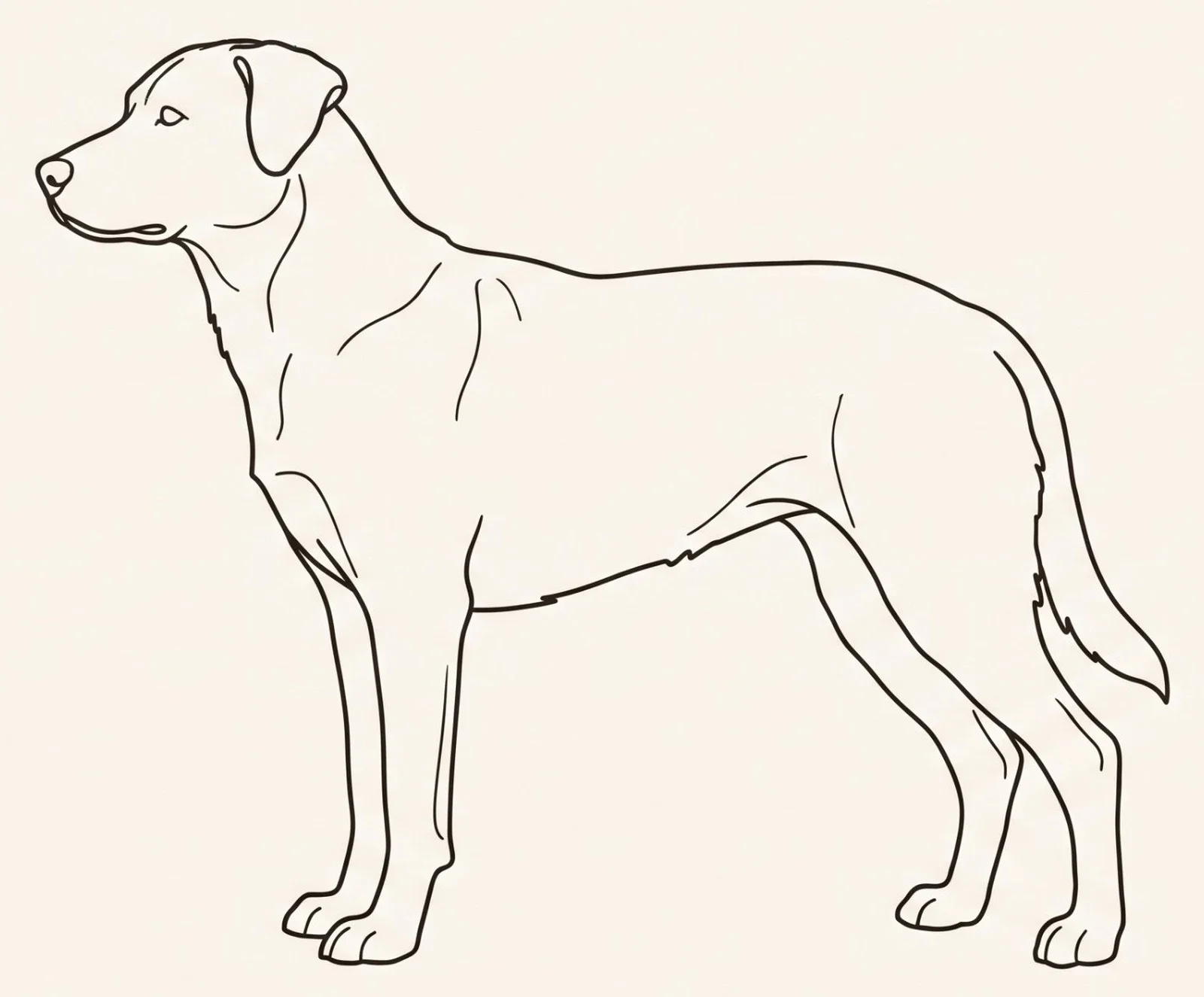
| Landmark | Where it is | Why it matters |
|---|---|---|
| Withers | The highest point of the shoulders, where the neck meets the back | Height is measured here. The shoulder blades sit just below. |
| Shoulder (scapula) | The flat blade along the side of the upper chest | Its angle and length help set how far the front leg can reach. |
| Upper arm (humerus) | From the point of the shoulder back to the elbow | With the shoulder, it forms the front angulation. |
| Elbow | Behind the front leg, level with the bottom of the chest | Should sit close to the body. A common site of inherited joint disease. |
| Pastern | The front leg between the wrist and the foot | Works as a shock absorber. Very upright or very sloped pasterns change how the front lands. |
| Topline | The line from withers to tail | Shows how the back carries itself, especially at a trot. |
| Loin | The muscled section between the last rib and the pelvis | Links front and rear. Its length and strength affect how drive is transferred forward. |
| Croup | The top of the pelvis, ahead of the tail | Its slope affects how the rear legs swing under and behind the body. |
| Hip | The ball-and-socket joint of the femur and pelvis | Cannot be judged from the outside. Joint quality is assessed on radiographs. |
| Stifle | The dog's knee | Its bend, with the hock, forms the rear angulation. The kneecap (patella) sits here. |
| Hock | The joint that looks like a backward knee low on the rear leg | Its angle and the length of bone below it shape the rear stride. |
| Feet | Toes, pads, and nails | Tight, well-padded feet that point forward spread load evenly. |
A useful review of how these parts relate to work, written for selecting working dogs, groups them into size and substance, head and spine, chest, and front and rear angulation, and discusses each in terms of what the dog has to do. That is the right frame for a family dog too: structure in service of an active, comfortable life.
Angulation and Balance: Why More Is Not Better
Angulation is the set of angles where bones meet, mostly at the shoulder and upper arm in front and at the stifle and hock behind. Breeders describe it as straight, moderate, or pronounced.
The idea that matters most is balance. A dog whose front and rear are similar to each other in angulation tends to move with a matching stride at both ends. A dog with strong rear angulation and an upright front may push harder from behind than its front can easily absorb, and it can show that in its gait. That is a movement observation. On its own, it does not show that the dog will develop joint disease.
- There is no universal ideal angle. Breeds were developed for different work, and individual dogs within a breed vary. Published ideal angles are expert conventions rather than tested thresholds for health.
- Moderate usually beats extreme. Exaggeration in any direction, whether very heavy bone, very long backs, or very steep angles, tends to trade function for appearance.
- The parts have to fit. A long stride in back helps when the front can match it, and both need a back strong enough to connect them.
What the evidence does and does not say. Much of what is taught about ideal structure comes from experienced judges, handlers, and breeders. It is valuable, but it is not the same as controlled research showing that a particular angle prevents a particular disease. We present angulation as a way to understand movement, not as a health test.
Structure Is Judged in Motion
A dog can be posed to look correct. Movement is harder to fake. That is why judges, breeders, and veterinarians watch a dog walk and trot, from the side and coming toward and going away.
Walk and trot
At a walk, a dog has three feet on the ground much of the time, which can hide small problems. The trot is a two-beat gait in which diagonal legs move together, and it is the gait most often used to assess structure, because unevenness, a head bob, or a shortened step becomes easier to see.
- From the side: length of reach in front, push from behind, and whether the back stays steady.
- Coming toward you: whether the front legs travel straight, and whether the elbows stay in.
- Going away: whether the rear legs track evenly and the hocks stay parallel.
The limits of the eye
Watching a dog move is useful, but it is subjective, and two experienced observers can disagree. Veterinary research uses objective tools for this reason. Kinematic analysis records joint angles and limb motion with cameras and markers. Kinetic analysis uses force plates or pressure walkways to measure how much load each leg carries. A review of kinematic methods in dogs and a set of best-practice guidelines for measuring ground reaction forces both stress that these tools need standardized methods to produce reliable results. A 2024 review of canine mobility adds that validated measures of how well a dog moves through ordinary daily activities are still limited.
Lameness is a veterinary question. A limp, a head bob, stiffness after rest, reluctance to jump or climb, or uneven muscle between the legs can signal pain. If you see any of these, talk with your veterinarian rather than reading it as a structural trait.
Why Good Conformation Is Not the Same as Healthy Joints
A dog can stand and move beautifully and still have hip dysplasia. The hip joint sits deep under muscle, and its fit is assessed on radiographs. Each type of evaluation answers a different question:
| Evaluation | What it tells you | What it cannot tell you |
|---|---|---|
| Visual conformation | Proportions, visible alignment, balance | Joint quality or inherited disease |
| Gait observation | How the body works in motion, signs of discomfort | The cause of an abnormal gait |
| OFA hip and elbow radiographs | A graded assessment of joint conformation on X-ray | Every future change in the joint |
| PennHIP | A measured index of hip joint laxity | Elbows or other joints |
| DNA testing | Results for the specific variants tested | Polygenic traits such as hip and elbow dysplasia |
| Records of relatives and offspring | How a line actually develops over time | The outcome for one individual puppy |
The term "conformation" also shows up inside orthopedic screening, which adds to the confusion. When the Orthopedic Foundation for Animals grades hips, it is grading the conformation of the hip joint on a radiograph: how well the ball fits the socket. That is a different thing from a dog's outward build.
Screening works when breeders use it
A study of the complete OFA database from 1970 to 2015, covering 60 breeds and more than a million hip records, found that hip and elbow conformation improved over time as breeders selected using screening results, though the size of the improvement differed by breed. The authors noted that selection schemes need to be breed-specific. Two of the authors serve on the OFA's leadership, and the database reflects owners who chose to submit. Even so, it is strong evidence that recorded screening, used over generations, moves a population in the right direction. OFA issues final hip and elbow ratings at two years of age; younger dogs can receive preliminary evaluations.
Genes are not the whole story
Hip and elbow dysplasia are influenced by many genes and by environment. The OFA notes that caloric intake and exercise can affect severity. In a Norwegian study of 501 large-breed puppies, those that used stairs before three months of age were at higher risk of radiographic hip dysplasia, while off-leash exercise on soft, uneven ground in the same period was associated with lower risk. In a lifelong study of 48 Labrador Retrievers, dogs fed 25 percent less than their paired littermates stayed leaner, lived longer, and developed signs of chronic disease later.
For families, that means growth matters. Growing puppies need regular movement, play, exploration, and age-appropriate exercise. During growth, favor self-paced, low-impact activity and avoid forced distance running, repeated high-impact jumping, and other strenuous repetitive exercise. Skeletal maturity varies by dog and size, so families should work with their veterinarian before beginning sustained running or other high-impact activities. Keep your puppy lean and feed to body condition rather than the bag chart. See our guide to large-breed puppy nutrition and growing pains in larger doodles.
For the details of hip screening, read OFA Testing in Doodles and Poodles, PennHIP vs. OFA, Understanding OFA Hip Scores, and Hip Dysplasia in Dogs.
Four Breeds, Four Structural Starting Points
Stokeshire's crosses draw on four parent breeds. Each was developed for different work, and each brings a different frame. Breed standards are professional conventions written by each breed's parent club, not peer-reviewed research, and individual dogs vary within every breed.
A large, sturdy frame built for pulling carts and working farms. Substance is part of the breed; more mass is not more durability. Hips and elbows are central screening points for the breed. Bernese guide
A square, athletic frame with a light, springy gait. The groomed coat can hide the real outline, so structure is easier to judge by hand and in motion. Poodle guide
A moderate, agile frame built to turn and change speed quickly. Show and working lines can differ noticeably in build. Australian Mountain Dog guide
A balanced, medium-large frame meant to carry game over long days in the field. Field and show lines can also differ. Golden Retriever guide
Each breed's parent club recommends health screenings, which the OFA records under its Canine Health Information Center (CHIC) program. Those lists are the right starting point for screening any dog with that breed in its background.
What happens when breeds are crossed
Structural traits such as height, bone length, and angulation are shaped by many genes at once. In a first-generation cross, puppies often fall between the parents. In later generations those genes reshuffle, so littermates can differ in frame as well as size. You cannot predict a puppy's adult structure from its breed mix alone.
Crossing distinct breed lines can increase genetic diversity and may reduce the likelihood that some recessive inherited conditions are expressed. It does not eliminate genetic disease or the health considerations present in the parent breeds. That added diversity is what people usually mean by hybrid vigor: a real benefit of thoughtful crossbreeding, not a promise of better health or sounder structure. A pedigree full of titles is not a promise either. In both cases, the screening results of the actual parents matter most.
What Can You Tell About an Eight-Week-Old Puppy?
Some things. An experienced eye can see balance, proportion, and how a puppy carries itself at seven to nine weeks, and many breeders do evaluate structure at this age. But puppies change a great deal as they grow, and visual impressions at eight weeks are not proof of adult structure or future joint health.
The research on early hip assessment shows why. In a small University of Wisconsin study of 32 puppies, subjective X-ray assessment and some hands-on tests were not reliable predictors at six to ten weeks. Measured radiographic indexes, especially hip distraction of the kind PennHIP uses, did predict which hips developed degenerative joint disease by one year. Measurement outperformed impression, and none of it was a look at the puppy standing.
How puppy gait develops into adult gait is still being studied. The University of Minnesota's Canine Sports Medicine and Rehabilitation Service is following puppies from five to nine weeks old through their first year on a gait analysis mat to map those milestones.
At Match Day. Our Match Day page describes a Breeder's Choice puppy with strong conformation. That is a breeder's assessment of a young puppy's structure and promise. It is one input alongside temperament and parent health, and like any early assessment, it is not a guarantee of adult structure. Temperament is assessed separately; see Puppy Testing.
How to Watch Your Own Dog Move
This is for learning to see structure, not for diagnosing joint disease. Use an adult dog on firm, level, non-slip ground, on a loose lead, and let the dog stand naturally rather than placing its legs. Video helps: slow-motion playback on a phone shows a great deal.
- Side profile, standingLook at overall proportion, the line of the back, depth of chest, and whether front and rear angles look similar.
- Front, standingLook for straight front legs, elbows close to the body, and feet that point forward.
- Rear, standingLook for even hips, hocks that are parallel, and feet that point forward.
- Side, at a trotWatch for an even stride front and back and a steady back. Have someone else handle the dog so you can watch.
- Coming and going, at a trotWatch whether the legs move evenly on both sides and whether the head bobs.
- Compare with the vet recordLine up what you see with your dog's exam notes, any screening results, and any history of soreness.
When to call your veterinarian. A limp, a head bob, stiffness, uneven muscle, or reluctance to move deserves an exam. Pain changes movement, and it is far more important to find than any structural fault.
Champion Lines, Screened Joints, and a Functional Goal
Our Australian Shepherd lines began in champion show lines. Olive, one of our earliest Australian Shepherds, is by Int. Ch. Fullerton Legend of Hercules, an international champion as recorded on her American Stock Dog Registry certificate. Valli's sire, CH Indian Dream Labakan Slovakia, is an AKC Champion, and 22 of the 30 dogs in her four-generation AKC pedigree hold championship titles.
That pedigree is also a good illustration of this page. Of those 30 dogs, 23 carry OFA hip numbers, 18 carry OFA elbow numbers, and 12 hold CHIC numbers, most of them alongside their titles. The titles tell you judges valued their structure and type. The OFA numbers tell you their joints were screened. Neither replaces the other, and that is how we read the pedigrees we consider.
Every Stokeshire breeding dog is genetically tested through Embark before a pairing is planned, and families can review the results on the parents' public Embark profiles. Hip and elbow evaluations are recorded with OFA where completed. Completed OFA records, and any PennHIP, cardiac, or ophthalmologic records a dog has, are provided to approved applicants alongside the applicable agreement and health guarantee. No health-testing program can eliminate every genetic or developmental risk. These screenings are used to inform pairing decisions and reduce avoidable inherited risk wherever current testing and pedigree information allow.
Where we are going
Our goal is a written Stokeshire functional structure standard for our adult breeding dogs: the adult frame we breed toward, the range of variation we accept, how a dog should move, and how veterinary findings bear on breeding decisions. It is a goal, not a current practice, and we will describe it here as it takes shape. Moderate structure, sound movement, screened joints, and a lean, well-muscled body are the direction. We do not breed for maximum size or exaggerated features.
See our parent dogs on the breeding collection, how we raise puppies in The Stokeshire Method, and coverage terms on our health guarantee. Cosmetic traits, conformation, size, and adult appearance are not guaranteed.
Dog Conformation FAQs
Is conformation just about looks?
Can a good-looking dog have hip dysplasia?
Can a mixed-breed dog have good conformation?
What is angulation in dogs?
When is a dog structurally mature?
Can a puppy's conformation predict its adult health?
Is DNA testing enough to know a dog is sound?
What do show titles tell you about a dog?
Structure, Joints, and Breeding: Related Guides
Hips, elbows, and growth
- OFA Testing in Doodles and PoodlesHow hip and elbow screening works.
- PennHIP vs. OFATwo ways to evaluate hips.
- Understanding OFA Hip ScoresWhat each grade means across breeds.
- Hip Dysplasia in DogsCauses, signs, and care.
- Growing Pains in Larger DoodlesPanosteitis explained.
- Can a Puppy Grow Too Fast?Large-breed puppy nutrition.
- What Is IVDD?Disc disease and the genes behind short legs.
Breeding and evaluation
- What Health Testing Should a Breeder Do?The screening checklist.
- Inbreeding vs. LinebreedingUnderstanding COI.
- Puppy TestingHow we assess temperament.
- Match DayHow families are matched with puppies.
- The Stokeshire MethodOur approach from pairing to placement.
- Doodle Size StandardToy through Standard, defined.
Sources (14)
- Zink, M. C., & Schlehr, M. R. (2020). Working dog structure: Evaluation and relationship to function. Frontiers in Veterinary Science, 7, 559055. https://doi.org/10.3389/fvets.2020.559055
- Wells, G. M., Young, K., Haskell, M. J., Carter, A. J., & Clements, D. N. (2024). Mobility, functionality and functional mobility: A review and application for canine veterinary patients. The Veterinary Journal, 305, 106123. https://doi.org/10.1016/j.tvjl.2024.106123
- Sandberg, G. S., Torres, B. T., & Budsberg, S. C. (2020). Review of kinematic analysis in dogs. Veterinary Surgery, 49(6), 1088–1098. https://doi.org/10.1111/vsu.13477
- Conzemius, M. G., Torres, B. T., Muir, P., Evans, R., Krotscheck, U., & Budsberg, S. (2022). Best practices for measuring and reporting ground reaction forces in dogs. Veterinary Surgery, 51(3), 385–396. https://doi.org/10.1111/vsu.13772
- Oberbauer, A. M., Keller, G. G., & Famula, T. R. (2017). Long-term genetic selection reduced prevalence of hip and elbow dysplasia in 60 dog breeds. PLOS ONE, 12(2), e0172918. https://doi.org/10.1371/journal.pone.0172918
- Adams, W. M., Dueland, R. T., Meinen, J., O'Brien, R. T., Giuliano, E., & Nordheim, E. V. (1998). Early detection of canine hip dysplasia: Comparison of two palpation and five radiographic methods. Journal of the American Animal Hospital Association, 34(4), 339–347. https://doi.org/10.5326/15473317-34-4-339
- Krontveit, R. I., Nødtvedt, A., Sævik, B. K., Ropstad, E., & Trangerud, C. (2012). Housing- and exercise-related risk factors associated with the development of hip dysplasia as determined by radiographic evaluation in a prospective cohort of Newfoundlands, Labrador Retrievers, Leonbergers, and Irish Wolfhounds in Norway. American Journal of Veterinary Research, 73(6), 838–846. https://doi.org/10.2460/ajvr.73.6.838
- Kealy, R. D., Lawler, D. F., Ballam, J. M., Mantz, S. L., Biery, D. N., Greeley, E. H., Lust, G., Segre, M., Smith, G. K., & Stowe, H. D. (2002). Effects of diet restriction on life span and age-related changes in dogs. Journal of the American Veterinary Medical Association, 220(9), 1315–1320. https://doi.org/10.2460/javma.2002.220.1315
- Orthopedic Foundation for Animals. (n.d.). Hip dysplasia. Clinical guidance, not peer-reviewed research. https://ofa.org/diseases/hip-dysplasia/
- Orthopedic Foundation for Animals. (n.d.). Elbow dysplasia. Clinical guidance. https://ofa.org/diseases/elbow-dysplasia/
- Orthopedic Foundation for Animals. (n.d.). CHIC programs. Breed screening recommendations. https://ofa.org/chic-programs/
- American Kennel Club. (n.d.). Conformation. Professional standard, not research. https://www.akc.org/sports/conformation/
- University of Minnesota College of Veterinary Medicine. (n.d.). Puppy gait analysis study. Ongoing research; no published results. Link
- American Kennel Club. (n.d.). Breed standards: Australian Shepherd, Bernese Mountain Dog, Poodle (Standard), Golden Retriever. Professional standards. Australian Shepherd · Bernese · Poodle · Golden