What Is a Mini Golden Retriever?
Also called: Miniature Golden Retriever · Petite Golden Retriever · Mini Goldie
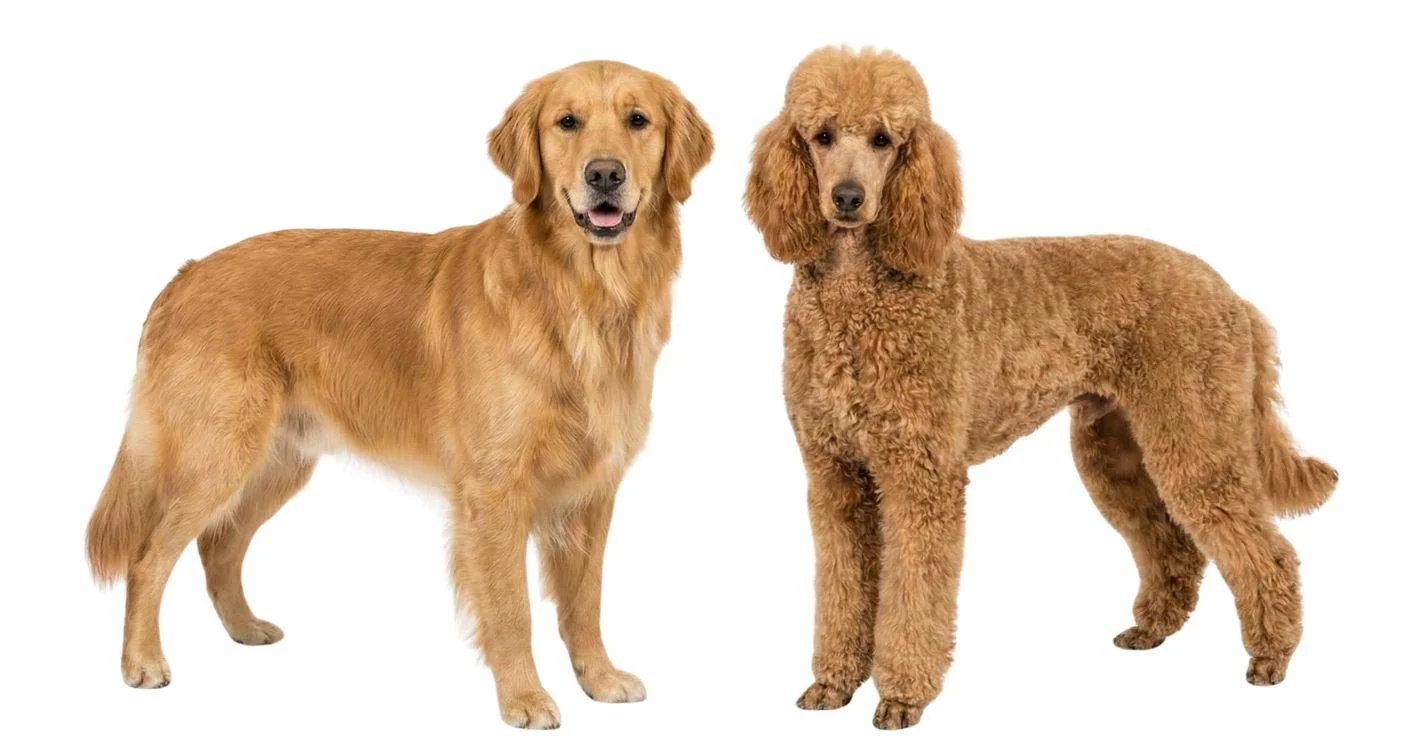
A Mini Golden Retriever is not a breed. It is a name for a smaller dog bred to look like a Golden Retriever, usually a Golden Retriever crossed with a Miniature Poodle, Cocker Spaniel, or Cavalier King Charles Spaniel. Some are unfurnished Mini Goldendoodles; others have no Poodle at all. The name alone cannot tell you which.
By James Stokes, Stokeshire Designer Doodles · Updated October 2026
Mini Golden Retriever: Quick Facts
| What it is | A marketing name for smaller, Golden-look crosses. Not a recognized breed or variety. |
| Usual ancestry | Golden Retriever with Miniature Poodle, Cocker Spaniel, or Cavalier King Charles Spaniel, in one or several generations. |
| Face | Unfurnished (no beard or eyebrows) when the dog carries no furnishings gene. |
| Coat | Usually long, straight to wavy, feathered. Length, curl, and furnishings are separate genes. |
| Shedding | Most shed. No dog is hypoallergenic. |
| Adult size | Varies by parents and generation. Quoted as a range, never a promise. |
| Health | Inherits the considerations of every parent breed. Depends on screening, not on the name. |
Is a Mini Golden Retriever Just an Unfurnished Mini Goldendoodle?
Sometimes yes, often no. It depends entirely on the parents.
Golden Retriever and Poodle lines
A first-generation Golden Retriever × Poodle puppy almost always has furnishings, because most Poodles carry two copies of the dominant furnishings gene. To get the smooth retriever face, breeders go to later generations, where some puppies inherit no furnishings gene from either parent. Those puppies are, genetically, unfurnished Goldendoodles: Poodle in the pedigree, retriever on the outside.
Golden Retriever and spaniel lines
Other programs cross Golden Retrievers with Cocker Spaniels (sometimes sold as Golden Cocker Retrievers) or Cavalier King Charles Spaniels. All three breeds are naturally unfurnished, so these puppies have smooth faces without any Poodle involved. Calling them Goldendoodles would be wrong. Some lines combine all three breed types.
The takeaway: "Mini Golden Retriever" tells you how a dog is meant to look. Only the parents' breeds and DNA results tell you what it is.
Where the Name Came From
One of the earliest documented programs is GoldenQuest in Kentucky. By the breeder's own account, founder Kathy Burgess produced the first "Mini Golden" in 2003 from Golden Retriever and Poodle crosses and trademarked the name Comfort Retriever®, a name that belongs to that one program. GoldenQuest reports that its adult weights vary widely. Other breeders adopted Mini Golden, Miniature Golden, Petite Golden, and similar names for their own lines, often using Cocker Spaniels or Cavaliers.
No major kennel club recognizes a Mini Golden Retriever. The American Kennel Club's Golden Retriever standard describes one size range: about 23 to 24 inches at the shoulder for males and 21.5 to 22.5 inches for females. Some designer-dog registries record names such as Golden Cocker Retriever, but they record parentage; they do not keep a breed standard or a closed stud book. We found no published breed standard and no peer-reviewed genetic study of any Mini Golden Retriever population.
The three common approaches
| Approach | Face | What it brings |
|---|---|---|
| Golden Retriever × Miniature Poodle, then later generations | First generation furnished; later generations can be unfurnished | Widest range of coat outcomes. Poodle health considerations, including eye disease and kneecaps. |
| Golden Retriever × Cocker Spaniel | Unfurnished | Long feathered coat; spaniel size and features. Cocker eye and ear considerations. |
| Golden Retriever × Cavalier King Charles Spaniel | Unfurnished | Long coat; Cavalier size and features. Cavalier heart and neurological considerations. |
Generation labels matter. An F1 has one purebred parent of each breed and tends to be more uniform. A backcross (F1B) is an F1 bred back to one parent breed, which shifts the ancestry toward that breed. An F2 is two F1s bred together and produces the most varied litters. A multigenerational line becomes more consistent only with sustained testing, selection, and records. Our generations guide walks through each label.
The Genetics of the Golden Look
A Golden Retriever's coat is long, straight to gently wavy, and feathered on the legs, chest, and tail, with a short-haired, clean face. A 2009 study led by researchers at the National Institutes of Health showed that most coat differences between dog breeds come from three genes. A fourth adds to shedding. The point that matters most for families: each trait is inherited separately.
Dominant. One copy gives a beard and eyebrows; no copies gives the smooth retriever face. Says nothing about ancestry.
Recessive. Two long copies give a long, feathered coat, with or without furnishings.
One copy usually wavy, two copies curly, when the coat is long enough. Other curl variants likely exist.
Works alongside RSPO2 and is associated with less shedding. A relative effect, not an absolute level.
Furnishings, and why an unfurnished face is not a fault
Furnishings come from a variant near the RSPO2 gene. In Goldendoodle and Labradoodle circles, a dog without it is said to have an "improper coat." That is a breed-standard term, not a health problem. The same result is simply normal in a Golden Retriever. See What Is an Unfurnished Doodle? for the full explanation.
| Parents | Furnished | Unfurnished |
|---|---|---|
| F/N × N/N | About half | About half |
| F/N × F/N | About three in four | About one in four |
| N/N × N/N | None | All |
F means a furnishings copy and N means none. These are odds for each puppy, not a count for each litter: a litter of six from two F/N parents can hold no unfurnished puppies or four of them.
A labeling trap. UC Davis reports one DNA result two ways. On its Furnishings report, N/N means unfurnished. On its Improper Coat report, N/N means fully furnished, and IC/IC means unfurnished. Embark reports the same gene in its own letters. Always check which report a result comes from.
Every Stokeshire breeding dog's coat genetics are tested through Embark before a pairing is planned, and families can review the results on the parents' public Embark profiles. Our coat calculator shows how parent results combine.
Can one dog be small, long-coated, straight, unfurnished, and golden?
Yes, and the combination is genetically ordinary once each trait is treated as its own gene. Furnishings, length, curl, and color can be tested and selected for in the parents. Size cannot be fixed by a single test, which is why size is the slow part of any Golden-look program.
Do Mini Golden Retrievers Shed?
Most unfurnished Golden-look dogs shed, some heavily and seasonally. According to the UC Davis Veterinary Genetics Laboratory, furnishings and the MC5R variant each reduce shedding and their effects add up: dogs with both shed least, dogs with neither shed most. An unfurnished dog has lost one of those two effects. An MC5R result can shift it toward less shedding, but "unfurnished and low-shedding" should be read as relative, never absolute.
Shedding is also different from grooming. Curly, furnished coats tend to shed less into the house but need more brushing and professional grooming, because loose hair stays trapped and mats. Unfurnished coats are easier to keep but leave more hair behind.
No dog is hypoallergenic. Dog allergens come mainly from skin, saliva, and oil glands, not from hair. In a 2012 study, dogs marketed as hypoallergenic, including Labradoodles and Poodles, carried more of the main dog allergen, Can f 1, in their coats than other dogs, and airborne allergen levels in homes did not differ by breed. If anyone in your home has allergies, spend time with the specific dog, ideally with your physician's guidance, before you commit.
Golden color
A Golden Retriever's color is "recessive red." Golden dogs generally carry two copies of a non-working MC1R gene, written e/e, so their hair makes only red and yellow pigment. How pale or deep the gold looks depends on other genes, including MFSD12 and a region near KITLG.
This matters in crosses. If a Golden is bred to a Poodle or Cocker Spaniel that is not e/e, puppies can be black, brown, sable, or parti. Two golden-looking dogs can carry different hidden color genes that reappear later. And because the same coat and color genes occur in other breeds, a dog can look like a Golden Retriever without carrying much Golden Retriever ancestry. Appearance is weak evidence of ancestry.
How Small, and How Proportionate?
Dog size is controlled by a relatively small group of powerful genes, including IGF1, IGF1R, GHR, HMGA2, SMAD2, STC2, and LCORL, plus many smaller influences. Across purebred breeds they explain much of the difference between a Toy Poodle and a Golden Retriever. Within a single mixed litter they explain far less.
When a Golden Retriever is crossed with a Miniature Poodle, first-generation puppies usually land between the parents, because they inherit large versions of size genes from one side and small versions from the other. In later generations those versions reshuffle, so littermates can differ substantially. A breeder can narrow the range over many generations of selection and records. Nobody can promise a puppy's adult weight.
| Class | Adult weight |
|---|---|
| Toy | Up to 15 lb |
| Petite | 16 to 25 lb |
| Mini | 26 to 35 lb |
| Medium | 36 to 50 lb |
| Standard | 51 lb and up |
Adult weight is an estimate rather than a guarantee and may vary based on parentage, sex, generation, and individual development. The full standard is on Doodle Sizes.
Small is not the same as dwarf
A dog that is small because of normal size genes is built like a scaled-down version of a larger dog. Dwarfism is different. Two DNA insertions involving the FGF4 gene shorten the legs. One of them, on chromosome 12 and often called CDDY, also causes early disc degeneration and greatly raises the risk of intervertebral disc disease, a painful spinal condition. One copy is enough to raise that risk, and both insertions can be found with a DNA test. A breeder aiming for a small dog with retriever proportions should test for them and avoid selecting for short legs. Labs test for these insertions in different ways, so ask which lab ran the test. Stokeshire weighs the result in every pairing. More on IVDD.
What the Health Evidence Shows
Crossing distinct breed lines can increase genetic diversity and may reduce the likelihood that some recessive inherited conditions are expressed. It does not eliminate genetic disease or the health considerations present in the parent breeds. That added diversity is what people usually mean by hybrid vigor: a real benefit of thoughtful crossbreeding, not a promise of better health or longer life.
Diversity is still worth protecting. Closed stud books tend to accumulate inbreeding over generations, and research across 227 breeds found that smaller, less inbred breeds tended to be healthier. A well-planned cross generally starts with low inbreeding; a careless multigenerational line can lose that advantage quickly. That is why we check the genomic inbreeding coefficient (COI) of every pairing before it is planned. Read more in Inbreeding vs. Linebreeding.
- Golden Retriever considerations include hip and elbow dysplasia, the heart condition subvalvular aortic stenosis, inherited eye disease, ichthyosis, and cancer. The Golden Retriever Club of America asks breeders to screen hips and elbows, eyes, and hearts, and to use DNA tests.
- Smaller parent breeds bring their own: kneecap problems and eye disease in Poodles and Cocker Spaniels, and heart-valve disease in Cavaliers.
- Cancer is an important health consideration in Golden Retriever lineages. Breed-specific cancer incidence has not been established for Mini Golden Retriever-type dogs, so no one should claim a reduced cancer risk for them simply because they are crosses. See Golden Retriever Lifespan and Cancer.
- The large studies: a UC Davis study of more than 27,000 affected dogs found no difference between purebred and mixed-breed dogs for 13 of 24 inherited conditions. A 2024 study of Cockapoos, Labradoodles, and Cavapoos found no significant difference from their parent breeds in 86.6 percent of health comparisons.
Lifespan. No published study has yet measured Mini Golden Retriever lifespan. In a U.S. study of veterinary records for more than 13 million dogs, average life expectancy fell as size rose: about 13.5 years for small dogs, 12.7 for medium dogs, and 11.5 for large dogs. No lifespan is guaranteed.
Will It Have a Golden Retriever's Personality?
Golden Retrievers are known for being friendly and cooperative, and many Golden-look programs select for that. But in a 2022 genetic study of more than 2,000 dogs, breed explained only about 9 percent of the behavioral differences between individual dogs. A 2026 study of three popular Poodle crosses found the crosses showed more unwanted behaviors than at least one parent breed in 44.4 percent of comparisons. Neither study looked at Golden-based crosses, but both caution against assuming a cross inherits the most wanted traits of each parent. We cover the 2026 study in What the Doodle Behavior Study Found.
The parents' own temperaments, early rearing, socialization, and training shape much of who a dog becomes. A smaller Golden-type dog is still a sporting-breed dog. Expect daily exercise, retrieving or sniffing games, training, and companionship. Smaller size changes the logistics, not the needs.
Can Mixed-Breed Breeding Be Ethical?
We believe it can, when it is done with the same discipline a good purebred breeder brings, and sometimes more. A cross has no breed club watching over it, so the breeder carries that responsibility alone. In our view, responsible mixed-breed breeding means:
- Choosing a clear goal, such as a smaller, unfurnished, retriever-look family dog, and saying honestly what genetics can and cannot deliver.
- Screening every parent for the considerations of every breed in its background, not only the breed it most resembles.
- Testing for the FGF4 insertions and refusing to buy small size with short legs.
- Checking COI on every pairing so a new line does not quietly become an inbred one.
- Publishing results, describing coats and shedding plainly, and never promising size, temperament, or allergy outcomes.
- Moving one generation at a time, and waiting when a dog is not ready.
Before a pairing is planned, every Stokeshire breeding dog is genetically tested through Embark, and families can review the results on the parents' public Embark profiles. Hip and elbow evaluations are recorded with OFA where completed. Completed OFA records, and any PennHIP, cardiac, or ophthalmologic records a dog has, are provided to approved applicants alongside the applicable agreement and health guarantee. No health-testing program can eliminate every genetic or developmental risk. These screenings are used to inform pairing decisions and reduce avoidable inherited risk wherever current testing and pedigree information allow. Parent profiles are on our breeding collection, and coverage terms are on our health guarantee.
Questions to ask any Mini Golden Retriever breeder
- What breeds are in this puppy's background, and can I see both parents' DNA ancestry results?
- What are both parents' furnishings, length, curl, and shedding results, and which lab's letters do they use?
- Have both parents been tested for the FGF4 insertions linked to short legs and disc disease, and by which lab?
- Which hip, elbow, eye, and heart evaluations do the parents have, for every breed in the background?
- What did the parents and earlier litters weigh as adults, and what range do you expect?
- What is the genomic COI of this pairing?
- How are the puppies raised and socialized before they go home?
For the longer argument, read Are Well-Bred Mixed Breeds Ethical? and What Health Testing Should a Breeder Do?
Where Stokeshire Is Going
Families ask us for a smaller dog with a Golden Retriever's face and coat. We are working toward that carefully, through an unfurnished, retriever-look Golden Mountain Doodle, one health-screened generation at a time. The unfurnished face can be settled in a single pairing: a Golden Retriever paired with a parent that carries no furnishings gene produces only unfurnished puppies. Size is the slower work, and we will not rush it at the cost of structure or diversity. A Mini Goldendoodle line is also in development.
We name a pairing only after both parents clear screening, and we do not take deposits on litters that are not yet planned. Read about the unfurnished Golden Mountain Doodle line or join the Mini Goldendoodle notify list.
Mini Golden Retriever FAQs
What is a Mini Golden Retriever?
Is a Mini Golden Retriever a purebred Golden Retriever?
Is a Mini Golden Retriever the same as an unfurnished Mini Goldendoodle?
Do Mini Golden Retrievers shed? Are they hypoallergenic?
How big does a Mini Golden Retriever get?
Are Mini Golden Retrievers healthier than Golden Retrievers?
Will a Mini Golden Retriever have a Golden Retriever's temperament?
Does Stokeshire breed Mini Golden Retrievers?
Every Stokeshire Golden Guide
Everything we have written on Golden Retrievers, Goldendoodles, Golden Mountain Doodles, and the coat and health genetics behind them.
Golden breed and coat guides
- Golden RetrieverThe breed behind every Golden-look cross.
- Golden Retriever Lifespan and CancerWhat the research shows for the parent breed.
- Goldendoodle Breed GuideGolden Retriever and Poodle, every generation.
- Mini GoldendoodleOur Mini Goldendoodle line in development.
- Unfurnished GoldendoodleThe retriever face in a Goldendoodle.
- F2 Flat Coat GoldendoodleWhere most unfurnished Goldendoodles come from.
- Straight Coat DoodlesFurnished straight coats, and how they differ.
- Parti GoldendoodlesWhite spotting in Golden lines.
- Golden Mountain DoodleGoldendoodle and Bernedoodle, our Golden cross.
- The StokeshireOur four-breed cross with Golden ancestry.
- Bernedoodle vs. GoldendoodleSide by side on size, coat, and temperament.
- Aussiedoodle vs. GoldendoodleTwo Poodle crosses compared.
Coat, size, and genetics
- What Is an Unfurnished Doodle?Furnishings across every Stokeshire cross.
- Hypoallergenic Doodles ExplainedWhat the word does and does not mean.
- Doodle Coat CalculatorEstimate coat outcomes from parent genotypes.
- Coat Genetics in PoodlesThe Poodle side of the coat story.
- Stokeshire Doodle Size StandardToy through Standard, defined.
- What Is IVDD?Disc disease and the FGF4 genes behind it.
From the Stokeshire blog
- Goldendoodles That Look Like Retrievers
- English Cream Goldendoodles
- Goldendoodles and Bernedoodles
- Brown and Red Merle Goldendoodles and Bernedoodles
- Golden Retrievers vs. Australian Shepherds
- Lifespan of Golden and Australian Mountain Doodles
- A Golden Mountain Doodle and Life's Big Steps
- Golden Mountain Doodles in Therapy Work
- Unfurnished Doodles and the Improper Coat
- Flat Coat vs. Straight Coat Doodles
- The Unfurnished Doodle and Your Family
- The Unfurnished Doodle: A Natural Look
- The Science of Shedding
- The Genetics Behind Shedding in Doodles
- The Science Behind Canine Coat Genetics
- Coat Types and Allergies: Curly, Wavy, Unfurnished
- IVDD, CDPA, and CDDY Genetics
- What the Doodle Behavior Study Found
- Genetic Diversity in Dog Breeding
- Inbreeding vs. Linebreeding: Understanding COI
- Closed Stud Books and Purebred Lifespan
- Are Well-Bred Mixed Breeds Ethical?
- In Defense of Doodles
- What Health Testing Should a Breeder Do?
- Ethical GMD and AMD Breeders
- Meet the Stokes
Sources (17)
- Cadieu E. et al. Coat variation in the domestic dog is governed by variants in three genes. Science, 2009. Link
- UC Davis Veterinary Genetics Laboratory. Furnishings and Improper Coat. Link
- UC Davis Veterinary Genetics Laboratory. Shedding (MC5R and RSPO2). Link
- UC Davis Veterinary Genetics Laboratory. Curl (KRT71). Link
- Rimbault M. et al. Derived variants at six genes explain nearly half of size reduction in dog breeds. Genome Research, 2013. Link
- NHGRI Dog Genome Project. Canine Body Size Study. Link
- Brown E.A. et al. FGF4 retrogene on CFA12 is responsible for chondrodystrophy and intervertebral disc disease in dogs. PNAS, 2017. Link
- Vredegoor D.W. et al. Can f 1 levels in hair and homes of different dog breeds. Journal of Allergy and Clinical Immunology, 2012. Link
- Bellumori T.P. et al. Prevalence of inherited disorders among mixed-breed and purebred dogs. JAVMA, 2013. Link
- Bryson G.T. et al. Health of designer crossbreeds compared with their progenitor breeds. PLOS ONE, 2024. Link
- Bannasch D. et al. The effect of inbreeding, body size and morphology on health in dog breeds. Canine Medicine and Genetics, 2021. Link
- Montoya M. et al. Life expectancy tables for dogs and cats derived from clinical data. Frontiers in Veterinary Science, 2023. Link
- Morrill K. et al. Ancestry-inclusive dog genomics challenges popular breed stereotypes. Science, 2022. Link
- Comparing undesirable behaviours between designer Poodle-cross dogs and their purebred progenitor breeds. PLOS ONE, 2026. Link
- Golden Retriever Club of America. Health Screenings for the Parents of a Litter. Link
- American Kennel Club. Golden Retriever breed standard. Link
- GoldenQuest Comfort Retrievers. About (breeder history, not scientific evidence). Link